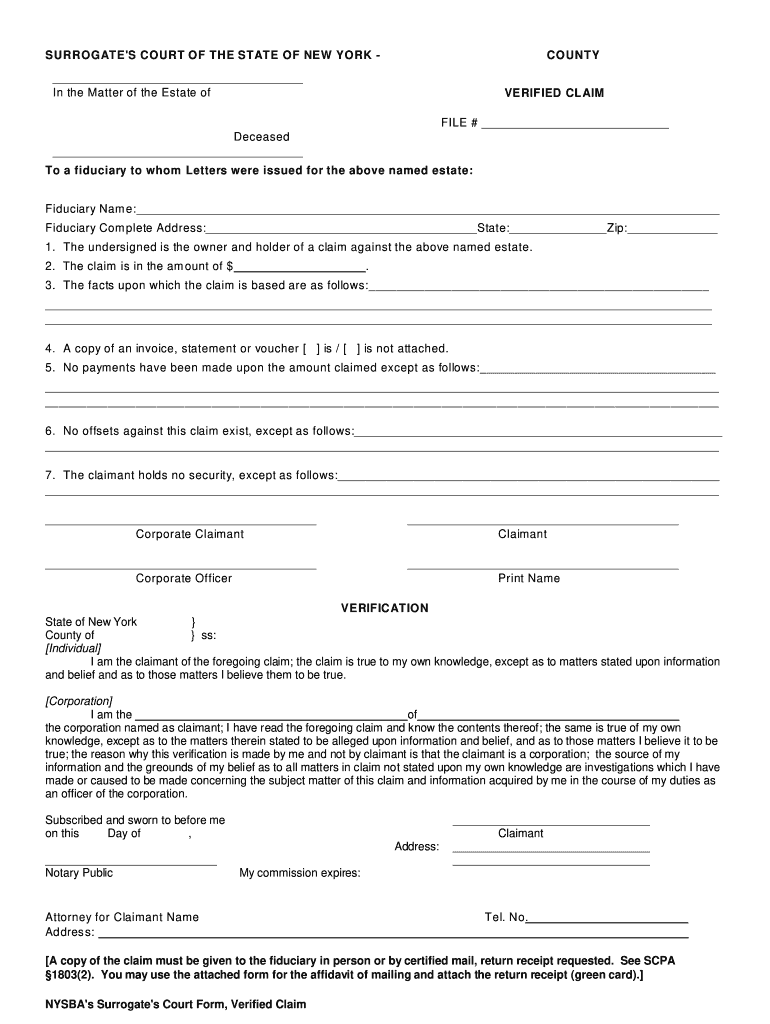
Verified Claim Form


What is the Verified Claim Form
The verified claim form is a legal document used primarily in probate and estate matters within the United States. This form allows individuals to submit claims against an estate, ensuring that creditors can seek payment for debts owed by the deceased. The form must be completed accurately and submitted to the appropriate surrogate court, where it undergoes review and processing. It is essential for establishing the legitimacy of the claim and for the court to assess the validity of the debts being claimed.
How to Use the Verified Claim Form
Using the verified claim form involves several steps to ensure compliance with legal requirements. First, gather all necessary information about the deceased, including their full name, date of death, and details of the estate. Next, clearly outline the nature of your claim, including the amount owed and any supporting documentation. Once the form is completed, it should be signed and dated. Finally, submit the form to the surrogate court in the jurisdiction where the estate is being probated. It is advisable to keep a copy of the submitted form for your records.
Steps to Complete the Verified Claim Form
Completing the verified claim form requires careful attention to detail. Follow these steps to ensure accuracy:
- Begin by entering the decedent's information, including their name and date of death.
- Provide your personal information as the claimant, including your name, address, and relationship to the decedent.
- Clearly state the basis of your claim, including the type of debt and the total amount owed.
- Attach any relevant documentation that supports your claim, such as invoices or contracts.
- Sign and date the form, ensuring that all information is accurate and complete before submission.
Key Elements of the Verified Claim Form
The verified claim form includes several critical elements that must be addressed for it to be considered valid. These elements typically include:
- The decedent's full name and date of death.
- The claimant's name, address, and contact information.
- A detailed description of the claim, including the amount owed and the basis for the claim.
- Signature and date from the claimant, affirming the accuracy of the information provided.
Legal Use of the Verified Claim Form
The verified claim form serves a vital role in legal proceedings related to an estate. It is used to formally notify the surrogate court of a creditor's claim against the estate, ensuring that all debts are settled appropriately. Legal use of this form requires adherence to state-specific regulations, as each jurisdiction may have its own rules regarding the submission and processing of claims. Understanding these regulations is crucial for ensuring that the claim is accepted and processed in a timely manner.
Required Documents
When submitting a verified claim form, certain documents may be required to support your claim. These typically include:
- Proof of debt, such as contracts, invoices, or statements.
- Identification documents to verify your identity as the claimant.
- Any correspondence with the deceased regarding the debt.
Ensuring that all required documents accompany your claim can help facilitate a smoother review process by the surrogate court.
Quick guide on how to complete verified claim form
Finalize and submit your Verified Claim Form swiftly
Effective tools for digital document sharing and endorsement are now crucial for enhancing processes and the ongoing improvement of your forms. When managing legal documents and signing a Verified Claim Form, the correct signing solution can conserve considerable time and resources with each submission.
Locate, fill out, modify, endorse, and distribute your legal documents with airSlate SignNow. This platform provides all you require to create efficient document submission workflows. Its vast library of legal forms and user-friendly interface will assist you in locating your Verified Claim Form promptly, and the editor equipped with our signing feature will enable you to complete and validate it instantly.
Sign your Verified Claim Form in a few easy steps
- Locate the Verified Claim Form you need in our library using search or catalog pages.
- Review the form details and preview it to ensure it meets your requirements and state regulations.
- Click Get form to open it for modification.
- Fill out the form using the comprehensive toolbar.
- Verify the information you entered and click the Sign tool to endorse your document.
- Select one of three options to insert your signature.
- Complete editing and save the document in your storage, then download it to your device or share it right away.
Enhance every phase of your document preparation and endorsement with airSlate SignNow. Experience a more effective online solution that comprehensively addresses your paperwork process.
Create this form in 5 minutes or less
FAQs
-
What's the best contemporary designed sign-up form, in terms of UX, on the internet?
Our in-house UX designer holds the Airbnb sign-up form up as an example of excellent UX design.These are his main reasons, which are all aspects that are easily transferrable (and that we always use on our forms!):Social media access - giving people the option to sign up with Google or Facebook allows them to choose an option that suits them (people love to feel in control - it’s the autonomy bias). They are also aware that signing up through social media may be a much speedier process which is always an attraction and, even better for you, it often allows you access to certain parts of their profile and details so can be an excellent source of invaluable data.Progressive disclosure - Instead of displaying the whole form on the first page, Airbnb uses progressive disclosure, only opening up the full form once the user clicks on “Sign up with Email” which keeps things clean, simple and doesn’t intimidate the user as they are being slowly introduced into the sign-up process.Column layout - There is just one column with each field listed one underneath the other. Again, this keeps it really clean and simple with ample space to fill out the fields.Icons used inside the fields - The icons bring a nice design element to it and also just add that extra ease of comprehension - you see the mail icon and you know that’s where your email address goes. The easier to understand quickly, the more likely it is that people will convert (this is because of Cognitive Ease).Password strength validation - This is always a reassuring tool to provide your customers. Security online (or lack thereof) can be a big factor in putting people off following through with a sign-up or purchase and so lending them this helping hand to show them how strong their password is will give a sense of safety and satisfaction.Overall field validation - When a field has been successfully completed, it is highlighted with a green outline to validate this clearly. It’s a nice way of giving the customer a sense of completion and closure for each step and letting them see their progress - this type of positive reinforcement can be useful in encouraging people to see through the sign-up process until the end.Clear indication of errors - Equally, it’s important to clearly notify customers when there is an issue with one of their completed fields. There’s nothing more frustrating than spending time filling out a form only for it to refuse to submit but with no clear identification of where the error is. Make it quick, obvious and easy for them to see and rectify any errors to ensure frustration doesn’t lead to a swift exit.At Convertize, we’ve compiled our neuromarketing and optimisation expertise into a list of 250 tactics - you can check them out here!
-
What is the craziest lie a customer has come up with when calling your work to complain about you?
I was working as a Census taker for Statistics Canada during the national census of 1996 when one member of the public made a false complaint against me.To give the necessary background: Each census taker was assigned a different territory. We were each provided a detailed map of our own territory, clearly marking out its boundaries. Every residence within that territory was depicted on the map as a little square or rectangle. And for each street within our territory, it listed the relevant range of house numbers for each side of that street (e.g. one territory might end at numbers 49 and 50 Random Street, the next territory started across the intersection at numbers 51 and 52 Random Street.) If everyone got together in a huge field, they could potentially piece together a cool, giant detailed map of Canada.A big part of our job was physically delivering a census form to every separate lot within our territory with a residence on it. If the map showed a lot with a newly built home as empty, a form still needed to be delivered to that residence, and then we needed to mark the missing residence on the map of our territory. The maps were extremely accurate, and I had to mark maybe one new home on mine.The census was meant to be a snapshot of Canada on a particular day. If someone owned multiple residences, they needed to fill out the form for each property with information for that residence as of census day. So if the entire family stayed in one house on that date, the information for their second house would be that it didn’t have any residents as of census day — there was no need to fill out any of the additional data on that form. If someone’s son spent that date in the spare house? Then the form would reflect that the second home had one resident as of that date, and that son’s data would need to be entered on that form.People didn’t have to fill out the forms on the spot, but could mail it in (at no cost) by the deadline, some date following the “census date”. If they had any questions about filling out the form, I could try to answer their questions while I was at their door, or they could call the help line provided on the form itself.There was a different, and longer, census form for farms. It collected some agricultural data as well as data about the residence and its inhabitants. If someone groaned about having to fill out the longer form, I’d point out that they only needed to provide estimates for most of the extra questions (statistically, if someone slightly overestimated one figure, someone else would balance that out by underestimating). I’d also point out they could probably get all the information they required from their last income tax form. If someone hadn’t kept their income tax form and was concerned about providing any inconsistent data? I told them not to worry, because Revenue Canada is not allowed to see their census form, Stats Can is not allowed to see their income tax form (which is why they don’t just take the data from that), the data is all aggregated and, again, Estimates Are OK.This groaning was far from universal — strangely enough, I had to talk some people who had a hobby garden in their backyards out of trying to claim the longer agricultural form to fill out — but I quickly became used to having some people act reluctant about accepting the longer agricultural form.So, on with the story at hand: During one of my trips I came to one farm with clearly only one entrance to the residence, from a road well within my territory, to a home well within my territory. With agricultural form in hand, I knocked on the door and it was answered by a woman. I explained I was here to drop off a form for the census. She looked at the form then told me she will not fill it out. No explanation. She just said she would not fill it out.This wasn’t entirely unusual or unexpected (although up to that point I faced zero resistance — only, in a couple of cases, some antsy migrant workers hurriedly running off to hide in barns.Some people think they aren’t required to respond to the census and consider it to be the government being too “big brother”. So I politely explained to the woman that all the information she provides will be kept private, and won’t be shared with any other government authorities. I was about to explain there are benefits to the census, e.g., ensuring that the appropriate level of health services, police services, etc, are provided to different areas. But before I could, she again said “There is no requirement for me to fill out the form.”So I read to her from a paper we were provided politely explaining that a census form is required to be filled out by every residence in Canada.Then she says she was already given a form. I asked if someone came up to this property? (Because that would mean another census taker erroneously came into my territory). No.Finally, she explained that she had received special permission from someone in the government to not fill out the agricultural form. Taken aback, I asked her where she got that advice from, and she said she had spoken to someone from the census office, and she was told that she wouldn’t be required to fill out a form for this address because they already had a form for another part of their farm operating out of the neighbouring territory.So, I thought to myself “why the hell didn’t you tell me this to begin with instead of wasting everyone’s time?”, but instead I said to her something like “Okay, I was completely unaware of that. How about I leave a form with you, and you give my supervisor a call at this number. Then if you don’t need to complete the form, just throw it out. He can also let me know if I don’t need to get a form back from you.” She seemed very agreeable to this. So I apologized for taking up her time, and headed off.This was in the days before everyone had mobile phones. So instead of driving home, calling my supervisor, finding my way back to where I had left off (which wasn’t at a convenient intersection), and getting back to the job at hand, I decided to continue going door-to-door and following up the next morning.The next day, before I could call my supervisor, he called me.He was a former highschool principal whom I had the pleasure of working with on other contract jobs with the government (Elections Canada, specifically), so he knew me fairly well. He said to me “Hey, I got a complaint from a woman. Don’t worry about it. I know you, and I think this is completely out of character, but she complained that you were very rude and aggressive. She said you threatened to call in the police and get her fined if she didn’t take a form from you, and other things that strike me as very unlikely.” So I told him my side of the story. He said, “You did the right thing. We verified that part of her farm operation is in the next territory, she’s already received a form for it there, and Stats Can doesn’t need her to fill out a second form. The other operation doesn’t have a separate residence, so she can fill that data in on the one form. I told her she can dispose of the form you left with her, and we’ll follow up on her complaint. As far as I’m concerned, that’s the end of that. Keep up the good work.”
-
How can I claim the VAT amount for items purchased in the UK? Do I need to fill out any online forms or formalities to claim?
Easy to follow instructions can be found here Tax on shopping and servicesThe process works like this.Get a VAT 407 form from the retailer - they might ask for proof that you’re eligible, for example your passport.Show the goods, the completed form and your receipts to customs at the point when you leave the EU (this might not be in the UK).Customs will approve your form if everything is in order. You then take the approved form to get paid.The best place to get the form is from a retailer on the airport when leaving.
-
How do companies verify warranty claims?
At my company we have to have proof of defect / failure of product to perform. Depending on the claim, we verify this differently. Sometimes it is confirmed by asking them to send back for testing or simply send a picture. When product is sent to us for testing, we verify against internal specifications and test methods for the failure described by the customer. We also ask them to fill out a claim form to understand context of the situation. Proof of purchase has to be supplied as well.If we can’t verify proof of defect, we either turn down the claim or accommodate it depending on whether or not there are potential negative financial impacts of turning the claim down (critical customer base, small dollar value not worth disputing, etc.)
-
In what cases do you have to fill out an insurance claim form?
Ah well let's see. An insurance claim form is used to make a claim against your insurance for financial, repair or replacement of something depending on your insurance. Not everything will qualify so you actually have to read the small print.
-
How do I fill out the disability forms so well that my claim is approved?
Contact Barbara Case, the founder of USA: Providing Free Advocacy & Support She's incredible!
Create this form in 5 minutes!
How to create an eSignature for the verified claim form
How to create an electronic signature for the Verified Claim Form online
How to make an eSignature for your Verified Claim Form in Chrome
How to create an eSignature for putting it on the Verified Claim Form in Gmail
How to generate an electronic signature for the Verified Claim Form from your smartphone
How to generate an eSignature for the Verified Claim Form on iOS devices
How to make an eSignature for the Verified Claim Form on Android OS
People also ask
-
What is a Verified Claim Form and how does it work with airSlate SignNow?
A Verified Claim Form is a document used to validate claims in various business processes. With airSlate SignNow, you can easily create, send, and eSign your Verified Claim Form, ensuring that all parties involved can review and authenticate the document securely. This streamlines your workflow and enhances the efficiency of claims processing.
-
How much does it cost to use airSlate SignNow for Verified Claim Forms?
Pricing for using airSlate SignNow to handle Verified Claim Forms varies based on the plan you choose. Our cost-effective solutions are designed to fit businesses of all sizes, with options that offer unlimited eSigning capabilities for a flat monthly fee. Check our pricing page for details and find the best option for your needs.
-
What features does airSlate SignNow offer for managing Verified Claim Forms?
airSlate SignNow provides several features for managing Verified Claim Forms, including customizable templates, advanced security options, and real-time tracking of document status. Additionally, our platform allows you to automate workflows, making it easier to manage multiple claims efficiently.
-
Can I integrate airSlate SignNow with other tools to manage Verified Claim Forms?
Yes, airSlate SignNow seamlessly integrates with a variety of applications, including CRM systems, cloud storage services, and project management tools. This allows you to streamline the process of managing your Verified Claim Forms and enhances your overall productivity by connecting your favorite tools.
-
What are the benefits of using airSlate SignNow for Verified Claim Forms?
Using airSlate SignNow for your Verified Claim Forms offers numerous benefits, such as increased speed in processing claims, enhanced security for sensitive information, and improved collaboration among teams. Additionally, our user-friendly interface ensures that anyone can create and manage forms without extensive training.
-
Is airSlate SignNow secure for handling Verified Claim Forms?
Absolutely! airSlate SignNow employs industry-leading security measures, including encryption and secure access controls, to protect your Verified Claim Forms. Our commitment to data security ensures that your sensitive information remains safe throughout the signing process.
-
Can I track the status of my Verified Claim Forms with airSlate SignNow?
Yes, airSlate SignNow allows you to track the status of your Verified Claim Forms in real time. You will receive notifications when documents are viewed, signed, or completed, providing you with peace of mind and ensuring that you are always up to date on your claims.
Get more for Verified Claim Form
- Montana special or limited power of attorney for real estate sales transaction by seller form
- Montana durable power of attorney for health care and medical treatment form
- North carolina limited power of attorney where you specify powers with sample powers included form
- Affidavit collection property form
- North dakota heirship affidavit descent form
- North dakota commercial building or space lease form
- Nebraska declaration form
- New hampshire durable power of attorney for health care and living will statutory form
Find out other Verified Claim Form
- Sign Oklahoma Mutual non-disclosure agreement Simple
- Sign Utah Mutual non-disclosure agreement Free
- Sign Michigan Non disclosure agreement sample Later
- Sign Michigan Non-disclosure agreement PDF Safe
- Can I Sign Ohio Non-disclosure agreement PDF
- Help Me With Sign Oklahoma Non-disclosure agreement PDF
- How Do I Sign Oregon Non-disclosure agreement PDF
- Sign Oregon Non disclosure agreement sample Mobile
- How Do I Sign Montana Rental agreement contract
- Sign Alaska Rental lease agreement Mobile
- Sign Connecticut Rental lease agreement Easy
- Sign Hawaii Rental lease agreement Mobile
- Sign Hawaii Rental lease agreement Simple
- Sign Kansas Rental lease agreement Later
- How Can I Sign California Rental house lease agreement
- How To Sign Nebraska Rental house lease agreement
- How To Sign North Dakota Rental house lease agreement
- Sign Vermont Rental house lease agreement Now
- How Can I Sign Colorado Rental lease agreement forms
- Can I Sign Connecticut Rental lease agreement forms