

An eviction notice is a written notice a landlord serves on a tenant before filing an eviction case, stating the ground, what the tenant must do, and by when. A downloaded eviction notice template gets the layout right and nothing else: the notice period, the grounds, and the delivery method are set by the law of the state where the property sits, and for some properties by federal rules above it. One point is worth settling first. The notice is served on the tenant; it is not a contract the tenant signs. What follows is general information, not legal advice on a specific tenancy.
TL;DR
- An eviction notice is a pre-filing demand, dated and signed by the landlord or an agent. The tenant receives it and does not sign it.
- Notice periods are state law: three days to vacate in Texas, three days excluding weekends and court holidays in California and Florida, and fourteen days in New York.
- Service method is prescribed by statute, and email or text usually does not qualify on its own.
- Covered and federally assisted properties carry an extra federal notice layer, and two of those rules moved in 2026.
- Keep a dated record of what the notice said and when it was issued.
What an eviction notice is, and what it is not
An eviction notice starts the process; it does not end it. It tells the tenant what they have done, what happens if they do not fix it, and how much time they have. If the tenant neither cures nor leaves, the landlord files a case, and possession comes only from a judgment and a writ executed by a sheriff or constable.
The landlord, or the property manager acting for the landlord, signs and dates the notice. The tenant is the recipient, not a party executing an agreement, and the only other signature is on the declaration made by whoever delivered it.
In the areas the Eviction Lab tracking system monitors, 38 city areas and 10 states holding roughly a third of US renter households, landlords filed 1.23 million eviction cases in 2025, down from 1.25 million in 2024, at an average filing rate of 7.9%. The direction of travel varies by metro.
2025 eviction filings against the typical annual volume
| Site | Change against the 2023-2024 average |
| Travis County, TX (Austin) | +30% |
| Atlanta, GA | -4% |
| Houston, TX | -4% |
| Bridgeport, CT | -20% |
Source: Eviction Lab, Eviction Filing Patterns in 2025 (April 2026)
The four notice types and when each applies
Most state codes recognize four notice categories, and picking the wrong one is a common reason filings fail.
- A pay-or-quit notice covers unpaid rent and is curable: the tenant pays within the statutory window, and the tenancy continues.
- A cure-or-quit notice covers a fixable lease breach, such as an unauthorized pet or subtenant, and has to identify the clause breached.
- An unconditional quit notice covers grounds a state treats as non-curable, usually serious damage, repeated violations, or illegal activity.
- A termination notice ends a periodic tenancy without a breach, and its term is normally longer.
Whichever applies, the amount owed and the period it covers have to be stated exactly, because an overstated demand can invalidate the notice. Landlords running several buildings, the pattern behind SignNow real estate solutions, keep a prepared version of each type.
What to include in the template
Whatever the state, the same items carry the weight.
- Parties: Every tenant named on the lease, and the landlord or agent issuing the notice.
- Property: The full address, including unit number, as it appears on the lease.
- Ground: The reason, and the lease clause or statutory ground relied on.
- Amount and period: For unpaid rent, the exact sum and the months it covers, excluding late fees where state law keeps them out of the demand.
- What the tenant must do: Pay, cure, or vacate, stated in the alternative where required.
- Deadline: The date by which the tenant must act, counted under the state’s rule.
- Consequence: A statement that an eviction case may follow.
- Date and signature: The date of issue and the signature of the landlord or authorized agent.
- Proof of service: A block recording of who delivered the notice, when, and how.
Why it matters: the amount and the deadline are the fields a court looks at first, and both are arithmetic; no template can do that for you. Mapping them to fillable fields removes the commonest source of error.
How many days’ notice does your state require?
There is no national notice period, and a template that prints one without naming a state is wrong somewhere. The five states below were verified against their own code text for unpaid rent; the other 45 differ.
| State | Notice before filing (nonpayment) | Statute |
| Texas | At least 3 days to vacate, unless the written lease sets a different period | Tex. Prop. Code 24.005 |
| California | 3 days, excluding Saturdays, Sundays, and other judicial holidays | Cal. Civ. Proc. Code 1161(2) |
| Florida | 3 days, excluding Saturday, Sunday, and court-observed legal holidays | Fla. Stat. 83.56(3) |
| New York | 14 days’ written rent demand | N.Y. RPAPL 711(2) |
| Washington | 14 days for residential tenancies under the ch. 59.18 RCW | RCW 59.12.030(3) |
Texas lets a written lease contract for a shorter or longer period, so the lease is the first document to read. California and Florida exclude weekends and court holidays, so a three-day notice served on a Thursday before a holiday Monday runs into the next week.
Written notice required before a non-payment filing
| State | Notice required | Statute |
| Texas | 3 days | Prop. Code 24.005 |
| California | 3 court days | CCP 1161(2) |
| Florida | 3 court days | Fla. Stat. 83.56(3) |
| New York | 14 days | RPAPL 711(2) |
| Washington | 14 days | RCW 59.12.030(3) |
Source: State statutes as published, verified September 2026. The Washington figure applies to residential tenancies under ch. 59.18 RCW. The other 45 states differ.
The federal layer most templates ignore
State law sets the floor, and for some properties, a federal rule sits above it. A 30-day notice to vacate is required where the property is covered by the CARES Act. The California Courts self-help guide lists the CARES Act covered categories as participation in a covered housing program as defined by the Violence Against Women Act, participation in the rural housing voucher program under section 542 of the Housing Act of 1949, or a federally backed mortgage loan or federally backed multifamily mortgage loan. A landlord with agency financing on the building can fall inside that definition without thinking of the property as subsidized housing.
Subsidized housing moved twice in early 2026. A USDA rural housing rule effective 25 February 2026 removed the minimum 30-day nonpayment notice at Rural Housing Service Section 514 and 515 multi-family properties. HUD published a parallel revocation for public housing agencies and project-based rental assistance owners on 26 February 2026, then postponed it indefinitely on 13 March 2026 after litigation, and that Federal Register delay notice leaves the 30-day requirement operative for those programs.
How to serve the notice and prove you served it
Service is prescribed, not chosen. Texas requires the notice to be given in person or by mail at the premises: by personal delivery to the tenant or any resident aged 16 or older; by affixing the notice to the inside of the main entry door; or by regular, registered, or certified mail with return receipt requested. California’s courts describe three routes: hand delivery, giving the notice to another adult at the tenant’s home or work, and mailing a copy, or posting it on the home and mailing a copy. The server must be 18 or older, and California requires a written proof of service declaration made under penalty of perjury.
Email and text generally do not qualify on their own; some states and leases permit electronic delivery as a supplement, never as a substitute.
What the landlord has to prove later is narrow: what the notice said, and when it was issued. A signed, dated file kept with a timestamped document history answers that, because the history records each action with full names, email and IP addresses, and time stamps.
Preparing and recording the notice in SignNow
SignNow helps you prepare and sign the landlord’s copy of the notice online. It does not serve the notice, and it does not file anything with a court; service happens by the method the governing state prescribes.
The notice itself can start from a ready-made file. SignNow’s eviction notice templates cover the common ones, including a 30-day notice of termination and a notice to quit for nonpayment of rent.
- Click +Create and upload the completed notice, choosing Document for a one-off or Template if you will reuse it. Accepted formats include PDF, DOC, and DOCX, up to 50 MB.
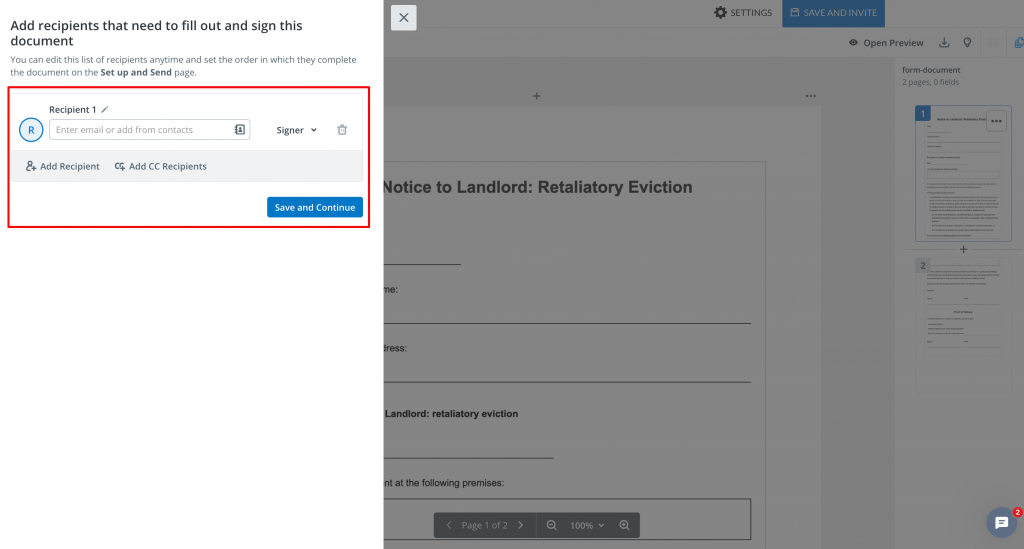
- Use Manage Recipients to add whoever signs or receives a copy: the landlord or agent as Signer, a bookkeeper or attorney as a CC recipient. Do not add the tenant as a signer on the notice.
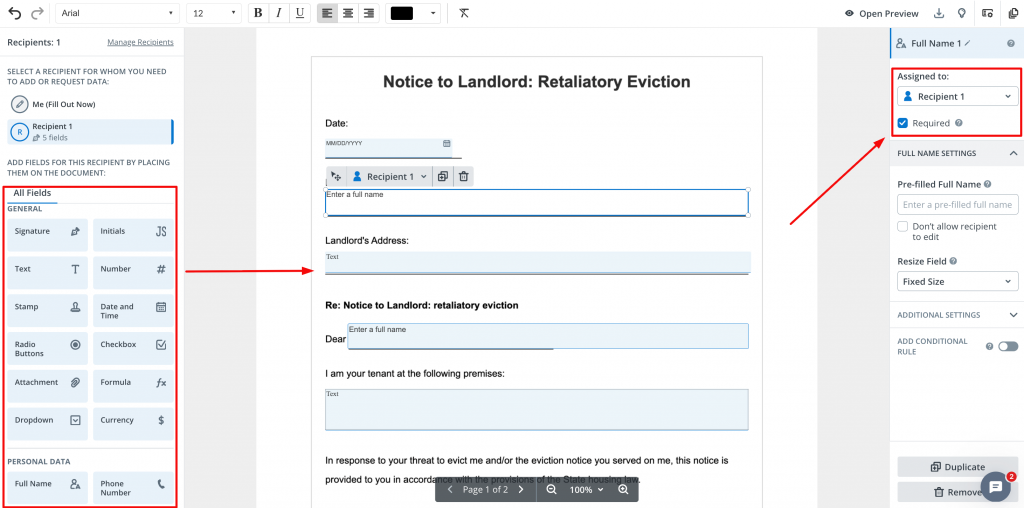
- Place Signature, Date and Time, and Text fields from the left-side panel on the signature block, and on the proof of service block if the person delivering the notice signs the same file. The right-side panel sets each field’s name and whether it is required.
- Click Open Preview to check the document as the signer sees it, then Back to Editing.
- Click Continue to reach the invite page, where Customize Message sets the email subject and body, and Manage Additional Settings adds authentication and reminders.
Make Template turns the finished file into a reusable version in the Templates folder. Reusable templates are on all paid plans: Business at $8 per user per month billed annually, Business Premium at $15 with bulk send for portfolios issuing many notices at once, and Enterprise at $30, all listed on the SignNow pricing plans page.
“SignNow has changed our workflows to be more streamlined and efficient. We saved more than 1500 pieces of paper converting to an electronic format,” says Nicholas Tovar, SHRM-CP.
What happens after the notice period ends
If the tenant cures within the window, record that the matter is closed, because a later filing on the same facts will be tested against it. If not, the landlord files in the court with jurisdiction over the property, and possession follows from a judgment and a writ. A cured notice usually produces further paperwork: a payment plan, an amended lease, or a renewal, which belongs with the original lease agreement template.
Final thoughts
An eviction notice fails on procedure more often than on substance: the wrong notice period, the wrong service method, or no proof of either. Get the state rule right, serve it the way the statute prescribes, and keep a record of when it was issued and by whom. SignNow’s eviction notice templates give you the right form to start from, and signing it there leaves the landlord a dated copy with a timestamped audit trail behind it. The current plans are listed on the SignNow pricing page.
Sign up for a free trial with SignNow today to create and sign your eviction notes and other paperwork efficiently.
Key terms
- Covered property: A rental property inside a federal program or financing definition, which triggers extra notice requirements.
- Proof of service: The signed statement recording who delivered the notice, when, and how.
- Unlawful detainer: The name used in California, Washington, and other states for an eviction action; Texas calls it forcible detainer.
- Writ of possession: The order authorizing a sheriff or constable to remove a tenant after judgment.
FAQ
How many days’ notice does a landlord have to give?
It depends on the state and the ground. For unpaid rent, Texas requires at least three days to vacate unless the lease says otherwise, California and Florida three days excluding weekends and court holidays, and New York fourteen days.
Does the tenant have to sign the eviction notice?
No. The landlord or an authorized agent signs and dates it, and the tenant receives it. The only other signature is the declaration by whoever delivered it.
Can an eviction notice be sent by email or text?
Usually not as the sole method. Statutes name the permitted routes: personal delivery, delivery to another adult at the premises, posting with a mailed copy, or mail. Electronic delivery can supplement those where the state and lease allow it.
Does the CARES Act 30-day notice still apply?
The California Courts self-help guide continues to list a 30-day notice to vacate for CARES Act-covered properties, including those with a federally backed mortgage loan. The point has been litigated, so verify the position in your jurisdiction.
Can a landlord evict a tenant without going to court?
No. Changing locks, removing belongings, or shutting off utilities is unlawful in most states, regardless of how much rent is owed.
Sources
- Preliminary Analysis: Eviction Filing Patterns in 2025 — Eviction Lab, 2026
- Texas Property Code 24.005, Notice to Vacate Prior to Filing Eviction Suit
- California Code of Civil Procedure 1161
- New York Real Property Actions and Proceedings Law 711
- Washington RCW 59.12.030, Unlawful detainer defined
- Florida Statutes 83.56, Termination of rental agreement
- Types of eviction notices for landlords — California Courts Self Help Guide
- Revocation of the 30-Day Notification Requirement, Indefinite Delay of Effective Date — Federal Register, 2026
- TL;DR
- What an eviction notice is, and what it is not
- The four notice types and when each applies
- What to include in the template
- How many days’ notice does your state require?
- The federal layer most templates ignore
- How to serve the notice and prove you served it
- Preparing and recording the notice in SignNow
- What happens after the notice period ends
- Final thoughts
- Key terms
- FAQ
- Sources