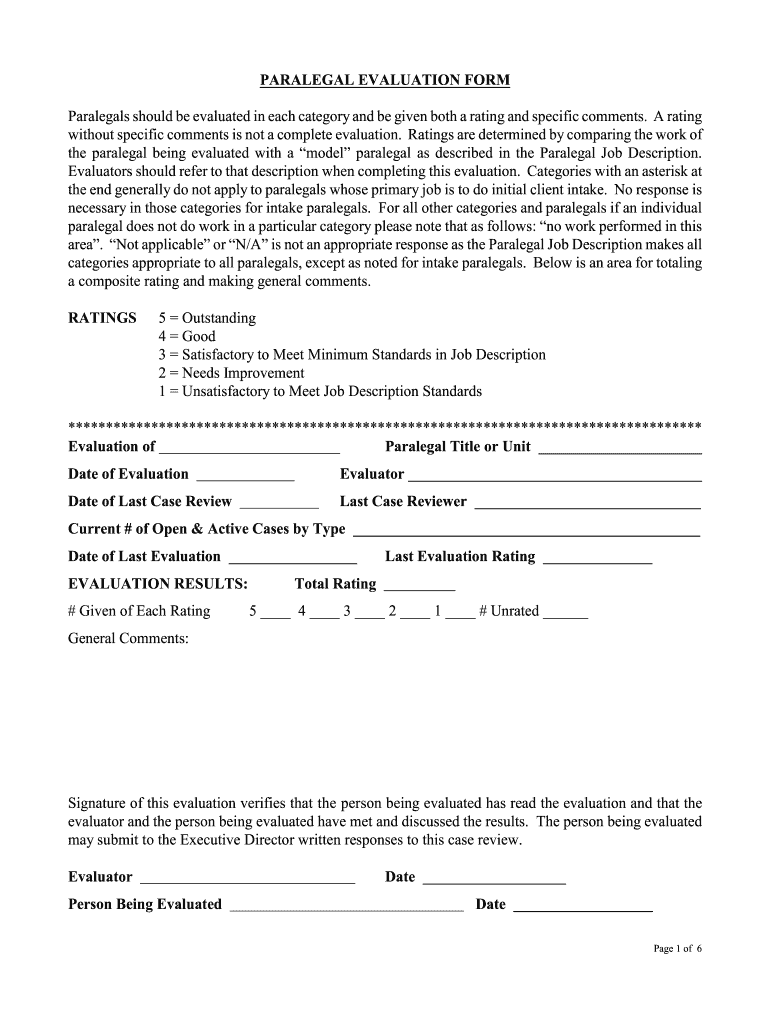
Paralegal Evaluation Form


What is the Paralegal Evaluation Form
The paralegal evaluation form is a crucial document used to assess the performance and competencies of paralegals within a legal setting. This form typically includes sections that evaluate various skills, such as legal research, client communication, and case management. It serves as a structured method for supervisors to provide feedback and identify areas for improvement, ensuring that paralegals meet the necessary standards of their profession.
How to Use the Paralegal Evaluation Form
Using the paralegal evaluation form involves several steps to ensure a comprehensive assessment. First, the evaluator should review the criteria outlined in the form, which may include both quantitative and qualitative measures. Next, the evaluator should gather relevant data, such as performance metrics and feedback from colleagues. After filling out the form, it is beneficial to schedule a meeting with the paralegal to discuss the evaluation, providing an opportunity for dialogue and clarification on any points raised.
Steps to Complete the Paralegal Evaluation Form
Completing the paralegal evaluation form requires careful attention to detail. Follow these steps:
- Review the evaluation criteria to understand the expectations.
- Collect necessary documentation and feedback from relevant sources.
- Fill out the form, ensuring each section is addressed thoroughly.
- Provide specific examples to support your evaluations.
- Discuss the completed evaluation with the paralegal for transparency.
Key Elements of the Paralegal Evaluation Form
Key elements of the paralegal evaluation form typically include:
- Competency areas, such as legal knowledge and research skills.
- Performance metrics, including case outcomes and client satisfaction.
- Feedback sections for both the evaluator and the paralegal.
- Goals for future performance and professional development.
Legal Use of the Paralegal Evaluation Form
The legal use of the paralegal evaluation form is significant in maintaining standards within the legal profession. It can be used as a formal record of performance, which may be referenced in cases of disputes or when considering promotions. Additionally, proper documentation through evaluations can help ensure compliance with regulatory requirements and support the continuous professional development of paralegals.
Examples of Using the Paralegal Evaluation Form
Examples of how the paralegal evaluation form can be utilized include:
- Annual performance reviews to assess overall contributions to the firm.
- Mid-year check-ins to discuss progress on specific goals.
- Feedback sessions following the completion of significant cases.
Digital vs. Paper Version
Choosing between a digital or paper version of the paralegal evaluation form depends on the needs of the firm. Digital forms offer advantages such as easier storage, accessibility, and the ability to integrate with eSignature solutions, making the process more efficient. Conversely, paper forms may be preferred in settings where traditional methods are still in practice. Regardless of the format, ensuring the form is completed accurately is essential.
Quick guide on how to complete paralegal evaluation form paralegals should be lri lri lsc
Easily Prepare Paralegal Evaluation Form on Any Device
Digital document management has become widely embraced by businesses and individuals alike. It offers an ideal environmentally friendly substitute to conventional printed and signed papers, allowing you to access the appropriate form and securely store it online. airSlate SignNow provides you with all the tools necessary to create, edit, and eSign your documents quickly without delays. Handle Paralegal Evaluation Form on any platform using airSlate SignNow's Android or iOS applications and simplify your document-related tasks today.
Effortlessly Modify and eSign Paralegal Evaluation Form
- Locate Paralegal Evaluation Form and click on Get Form to begin.
- Utilize the tools we provide to fill out your document.
- Identify important sections of the documents or obscure sensitive information using tools specifically designed for that purpose by airSlate SignNow.
- Create your eSignature using the Sign feature, which takes only seconds and carries the same legal validity as a conventional ink signature.
- Review all the details and click on the Done button to save your updates.
- Select how you wish to send your form, whether by email, SMS, or invitation link, or download it to your computer.
Eliminate the worry of lost or misplaced documents, tedious form searching, or errors that necessitate printing new document copies. airSlate SignNow meets all your document management requirements within just a few clicks from any device you prefer. Modify and eSign Paralegal Evaluation Form and guarantee effective communication at every stage of the form preparation process with airSlate SignNow.
Create this form in 5 minutes or less
FAQs
-
How a Non-US residence company owner (has EIN) should fill the W-7 ITIN form out? Which option is needed to be chosen in the first part?
Depends on the nature of your business and how it is structured.If you own an LLC taxed as a passthrough entity, then you probably will check option b and submit the W7 along with your US non-resident tax return. If your LLC’s income is not subject to US tax, then you will check option a.If the business is a C Corp, then you probably don’t need an ITIN, unless you are receiving taxable compensation from the corporation and then we are back to option b.
-
Why should it be so complicated just figuring out how much tax to pay? (record keeping, software, filling out forms . . . many times cost much more than the amount of taxes due) The cost of compliance makes the U.S. uncompetitive and costs jobs and lowers our standard of living.
Taxes can be viewed as having 4 uses (or purposes) in our (and most) governments:Revenue generation (to pay for public services).Fiscal policy control (e.g., If the government wishes to reduce the money supply in order to reduce the risk of inflation, they can raise interest rates, sell fewer bonds, burn money, or raise taxes. In the last case, this represents excess tax revenue over the actual spending needs of the government).Wealth re-distribution. One argument for this is that the earnings of a country can be perceived as belonging to all of its citizens since the we all have a stake in the resources of the country (natural resources, and intangibles such as culture, good citizenship, civic duties). Without some tax policy complexity, the free market alone does not re-distribute wealth according to this "shared" resources concept. However, this steps into the boundary of Purpose # 4...A way to implement Social Policy (and similar government mandated policies, such as environmental policy, health policy, savings and debt policy, etc.). As Government spending can be use to implement policies (e.g., spending money on public health care, environmental cleanup, education, etc.), it is equivalent to provide tax breaks (income deductions or tax credits) for the private sector to act in certain ways -- e.g., spend money on R&D, pay for their own education or health care, avoid spending money on polluting cars by having a higher sales tax on these cars or offering a credit for trade-ins [ref: Cash for Clunkers]).Uses # 1 & 2 are rather straight-forward, and do not require a complex tax code to implement. Flat income and/or consumption (sales) taxes can easily be manipulated up or down overall for these top 2 uses. Furthermore, there is clarity when these uses are invoked. For spending, we publish a budget. For fiscal policy manipulation, the official economic agency (The Fed) publishes their outlook and agenda.Use # 3 is controversial because there is no Constitutional definition for the appropriate level of wealth re-distribution, and the very concept of wealth re-distribution is considered by some to be inappropriate and unconstitutional. Thus, the goal of wealth re-distribution is pretty much hidden in with the actions and policies of Use #4 (social policy manipulation).Use # 4, however, is where the complexity enters the Taxation system. Policy implementation through taxation (or through spending) occurs via legislation. Legislation (law making) is inherently complex and subject to gross manipulation by special interests during formation and amendments. Legislation is subject to interpretation, is prone to errors (leading to loopholes) and both unintentional or intentional (criminal / fraudulent) avoidance.The record keeping and forms referred to in the question are partially due to the basic formula for calculating taxes (i.e., percentage of income, cost of property, amount of purchase for a sales tax, ...). However, it is the complexity (and associated opportunities for exploitation) of taxation legislation for Use # 4 (Social Policy implementation) that naturally leads to complexity in the reporting requirements for the tax system.
Create this form in 5 minutes!
How to create an eSignature for the paralegal evaluation form paralegals should be lri lri lsc
How to make an eSignature for your Paralegal Evaluation Form Paralegals Should Be Lri Lri Lsc online
How to create an eSignature for the Paralegal Evaluation Form Paralegals Should Be Lri Lri Lsc in Google Chrome
How to generate an eSignature for signing the Paralegal Evaluation Form Paralegals Should Be Lri Lri Lsc in Gmail
How to generate an electronic signature for the Paralegal Evaluation Form Paralegals Should Be Lri Lri Lsc straight from your mobile device
How to generate an electronic signature for the Paralegal Evaluation Form Paralegals Should Be Lri Lri Lsc on iOS
How to generate an eSignature for the Paralegal Evaluation Form Paralegals Should Be Lri Lri Lsc on Android devices
People also ask
-
What is a Paralegal Evaluation Form?
A Paralegal Evaluation Form is a document designed to assess the skills and qualifications of paralegals in a structured manner. This form typically includes sections for evaluating legal knowledge, communication skills, and practical experience. Utilizing a Paralegal Evaluation Form can streamline the hiring process and ensure that you select the most qualified candidates.
-
How can I create a Paralegal Evaluation Form using airSlate SignNow?
Creating a Paralegal Evaluation Form with airSlate SignNow is simple. You can use our intuitive template editor to customize your form according to your specific needs. Once your Paralegal Evaluation Form is set up, you can easily send it for electronic signatures or share it with your team for collaboration.
-
Is there a cost associated with using the Paralegal Evaluation Form feature?
airSlate SignNow offers various pricing plans that include the ability to create and manage Paralegal Evaluation Forms. Our pricing is designed to be cost-effective, ensuring that you can access all necessary features without breaking the bank. You can choose a plan that fits your business needs and budget.
-
What features does the airSlate SignNow Paralegal Evaluation Form offer?
The Paralegal Evaluation Form feature in airSlate SignNow includes customizable templates, electronic signatures, and real-time collaboration tools. Additionally, it allows you to track the status of your forms and receive notifications when they are completed. These features help streamline the evaluation process and enhance efficiency.
-
Can I integrate the Paralegal Evaluation Form with other software?
Yes, airSlate SignNow offers seamless integrations with various software platforms, allowing you to connect your Paralegal Evaluation Form with tools you already use. This includes CRM systems, document management software, and more, ensuring a smooth workflow and data synchronization.
-
What are the benefits of using a Paralegal Evaluation Form?
Using a Paralegal Evaluation Form can signNowly enhance your recruitment process by providing a standardized method to assess candidates. It helps you gather consistent data on each applicant, making it easier to compare their qualifications. Additionally, it can improve communication and collaboration among hiring team members.
-
Is the Paralegal Evaluation Form compliant with legal standards?
Yes, airSlate SignNow ensures that all forms, including the Paralegal Evaluation Form, comply with legal standards for electronic signatures and data protection. We prioritize security and privacy, so you can trust that your documents are handled in accordance with relevant regulations.
Get more for Paralegal Evaluation Form
- Indiana drainage form
- Foundation contract for contractor indiana form
- Plumbing contract for contractor indiana form
- Brick mason contract for contractor indiana form
- Roofing contract for contractor indiana form
- Electrical contract for contractor indiana form
- Sheetrock drywall contract for contractor indiana form
- Flooring contract for contractor indiana form
Find out other Paralegal Evaluation Form
- How Can I Electronic signature Oklahoma Doctors Document
- How Can I Electronic signature Alabama Finance & Tax Accounting Document
- How To Electronic signature Delaware Government Document
- Help Me With Electronic signature Indiana Education PDF
- How To Electronic signature Connecticut Government Document
- How To Electronic signature Georgia Government PDF
- Can I Electronic signature Iowa Education Form
- How To Electronic signature Idaho Government Presentation
- Help Me With Electronic signature Hawaii Finance & Tax Accounting Document
- How Can I Electronic signature Indiana Government PDF
- How Can I Electronic signature Illinois Finance & Tax Accounting PPT
- How To Electronic signature Maine Government Document
- How To Electronic signature Louisiana Education Presentation
- How Can I Electronic signature Massachusetts Government PDF
- How Do I Electronic signature Montana Government Document
- Help Me With Electronic signature Louisiana Finance & Tax Accounting Word
- How To Electronic signature Pennsylvania Government Document
- Can I Electronic signature Texas Government PPT
- How To Electronic signature Utah Government Document
- How To Electronic signature Washington Government PDF