What Information is Contained in the Medical Record 2004-2026


What information is contained in the medical record
The medical record is a comprehensive document that includes various types of information crucial for patient care and legal purposes. It typically contains:
- Patient demographics, including name, address, and date of birth.
- Medical history, detailing past illnesses, surgeries, and treatments.
- Current medications and allergies that the patient may have.
- Clinical notes from healthcare providers, documenting visits and assessments.
- Diagnostic test results, such as lab work and imaging studies.
- Consent forms for treatments and procedures.
- Billing information related to services rendered.
This information is vital for ensuring continuity of care and meeting legal requirements regarding patient information management.
Steps to complete the authorization release for information contained
Completing the authorization release for information contained in a medical record involves several key steps:
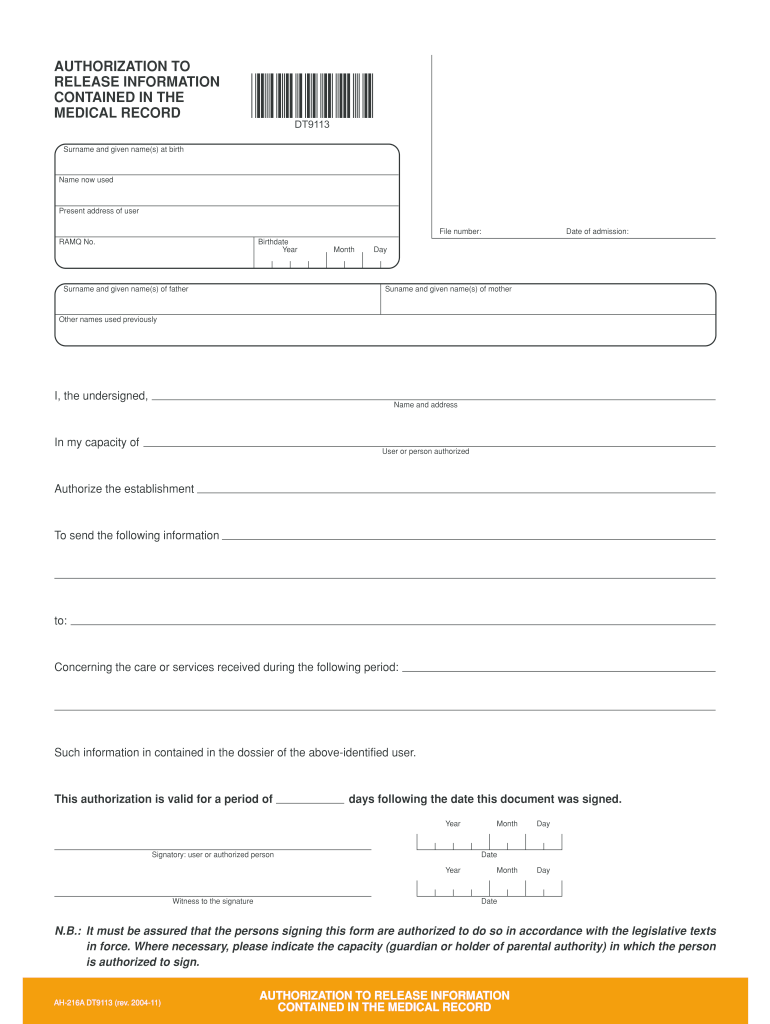
- Obtain the appropriate form, such as the AH 216A, which is specifically designed for this purpose.
- Fill in the required patient information, including full name, address, and date of birth.
- Specify the information to be released, ensuring clarity on what records are needed.
- Indicate the purpose of the release, such as for personal use or legal matters.
- Sign and date the form to validate the authorization.
- Submit the completed form to the relevant healthcare provider or facility.
Following these steps ensures that the release is processed efficiently and complies with legal standards.
Legal use of the authorization release
The legal use of an authorization release for medical records is governed by laws such as HIPAA, which protects patient privacy. When using the AH 216A form, it is essential to:
- Ensure the patient has provided informed consent before any information is shared.
- Limit the release to the specific information requested to avoid over-disclosure.
- Keep a copy of the authorization for your records, as it may be needed for future reference.
- Understand state-specific regulations that may impose additional requirements on the release process.
Adhering to these legal guidelines helps protect patient rights and maintains the integrity of the healthcare system.
Who issues the AH 216A form
The AH 216A form is typically issued by healthcare providers or organizations that manage patient records. This includes:
- Hospitals and medical clinics that maintain comprehensive medical records.
- Specialty care providers who may require specific authorizations for their services.
- Health information management departments responsible for processing requests for medical records.
Patients can request this form directly from their healthcare provider or download it from the provider's website, ensuring they have the correct version for their needs.
Examples of using the AH 216A form
The AH 216A form can be utilized in various scenarios, including:
- When a patient needs to share their medical history with a new healthcare provider for continuity of care.
- For legal purposes, such as when a patient is involved in a lawsuit and needs to provide medical evidence.
- When applying for disability benefits, where medical records are required to support the claim.
These examples illustrate the importance of having a clear and legally compliant authorization release process to facilitate the sharing of medical information.
Disclosure requirements for the AH 216A form
Disclosure requirements for the AH 216A form are essential to ensure compliance with privacy laws. Key points include:
- The form must clearly state what information is being disclosed and to whom.
- Patients should be informed of their rights regarding the information being shared.
- Any disclosures made must be documented to maintain an accurate record of what information was released.
Understanding these requirements helps protect patient privacy and ensures that disclosures are made in accordance with legal standards.
Quick guide on how to complete authorization to release information contained in the medical record csss sudlanaudiere
The optimal method to locate and sign What Information Is Contained In The Medical Record
On the scale of an entire organization, ineffective procedures concerning paper approvals can exhaust a signNow amount of work hours. Signing documents such as What Information Is Contained In The Medical Record is an inherent aspect of operations in any enterprise, which is why the effectiveness of every agreement’s lifecycle heavily impacts the company’s overall performance. With airSlate SignNow, signing your What Information Is Contained In The Medical Record can be as simple and swift as possible. This platform provides you with the latest version of virtually any form. Even better, you can sign it right away without the need to install third-party software on your computer or print hard copies.
How to obtain and sign your What Information Is Contained In The Medical Record
- Browse through our library by category or use the search box to locate the form you require.
- Examine the form preview by clicking on Learn more to ensure it’s the correct one.
- Click Get form to start editing immediately.
- Fill out your form and add any relevant information using the toolbar.
- When finished, click the Sign tool to sign your What Information Is Contained In The Medical Record.
- Select the signature method that suits you best: Draw, Create initials, or upload a photograph of your handwritten signature.
- Click Done to complete editing and move to document-sharing options if necessary.
With airSlate SignNow, you possess everything you need to handle your documents efficiently. You can find, fill out, edit, and even send your What Information Is Contained In The Medical Record in a single tab without any trouble. Enhance your procedures with a unified, intelligent eSignature solution.
Create this form in 5 minutes or less
FAQs
-
Why, after all that time and money was spent computerizing medical records, do we all have to fill out these forms that already have the information requested?
Because the office doesn’t know all of your info is up to date. Have you moved? Did you see another doctor who changed a medication? Did you go to the naturopath and you’re now taking an herbal supplement? Has your knee been hurting and you’ve been taking tylenol every day for the last month? Did you go to the ED 6 months ago while you were visiting relatives out of town because you had an allergic reaction to something? All of those things may impact your treatment plan and we don’t always remember to tell the doctor because it’s “old” news to us
-
Is there a medical app that contains my information, and when I'm at the hospital and need to fill out the basic forms, I can alternatively scan my phone, lets say on a NFC or Bluetooth pad for example, to transfer the information to the computer?
No. The portability act makes things a bit more cumbersome. An app that all health systems can use interchangeably is where things may be going but have not signNowed that level of access yet… you're asking for a web site to store all of your data and all hospitals to subscribe.
-
How can the information contained in the general ledger be utilised to carry out cost analysis within an organisation?
The information in the general ledger is usually too de-aggregated to perform useful analysis. Remember, a general ledger contains every entry in the accounting system. It's better to use a trial balance where information is aggregated at the account level. If you have your chart of accounts setup in a meaning way, then costs analysis should be fairly straight forward.
-
How did analysts get Apple's Q2 so wrong? Given the massive drop in the stock price, are there any consequences to analysts that release information that turn out to be completely wrong?
I’ll just open this, in the interests of full disclosure, with this: I fucking hate analysts.They’re like the color commentators at sporting events that never played the game themselves, times a thousand. And yet, market price depends on what they think - because they’ll make their best guesses as to what is going to happen, and then if it doesn’t, the stock goes down. Even if it’s good news.Leading cause of me saying you’ll not catch me running a public company.Anyway, to be in the right frame of mind, close your eyes, hold a copy of the Wall Street Journal in one hand, and The Economist in the other hand. Lean back, relax, breath deeply. You’re going back… back… back.Your nine years old and in the fourth grade. You’re wondering what’s for lunch since the menu is already wrong. Does that new kid kinda have a crush on you? Oh my god is there going to be a pop quiz?Bobby, over in the corner? He’s got answers. It’s not pizza because it’s never pizza on a Thursday after it’s been chicken on Tuesday. No, the new kid is just shy with everyone. And Bobby didn’t have a pop quiz, so you’re safe.You just met your first analyst.Now, some of these folks are really bright. (trust me, just ask them, they’ll tell you all about it). And some of them have unimpeded access to parts of the ecosystem that frankly should be off-limits. And all of them are convinced that they understood what Tim Cook really meant, no matter what he said.In reality, they are positing interpretations of the future from data which may or may not be relevant, and using that to guess whether or not the company is going to be more, or less, valuable over the next 90 days.If you know anything about anything, you know that value can never be created in 90 days. You can blow yourself up in 90 days, but anything that looked like it created an insane amount of value in 90 days had been cooking for at least another year, probably two.As an officer of a public company you have a fiducial obligation to make available relevant information in a timely manner. But you also have a fiducial obligation to not engage in behavior that is seen as manipulating the market, or that would allow competitors to undermine your position. It’s super tricky. I used to spend piles of time on that, you have to say enough to keep people excited but not enough for them to go away explaining how there’s no possible way you can pull off the thing that you’re actually doing.On a really regular basis, analysts get everything completely wrong. They’re living in a world were things happen at the speed of Twitter, not at the actual speed of work.Do yourself, and everyone else, a favor: don’t listen to them. Don’t buy into the hype cycle they create, don’t anticipate what a company is going to do based on “leading indicators” and “trusted industry source”. When you do, you’re back in the fourth grade again, talking to Bobby.And you’re way smarter than that.
-
A web page I need to fill out states (in their privacy policy) they will track the site I came from and go to afterwards, as well as my location, browser and OS identity, and much more information. How can I safely fill it out but block all this?
There’s a few separate things here:OS and browser: they already have this as soon as you open the form. All web servers get this to ensure they can provide a page you can load. You can send a fake one using something like the Google headers editor for Chrome, but it’s fairly pointless - you are just one of millions running near identical hardware. It’s mostly useful for their site tester to check it works on the common platforms,Location: They will get a rough location from your IP address. You could use a VPN - they will still get a location, but it will not be very accurate. Locations from IP are often not very useful - often they are only accurate to the country level. The site might ask your browser for accurate location information - just click on ‘no’.Source site: Just open the URL manually in a new tab. Then there is no source site information to pass.Forwarded to site: They can only see this if it’s by clicking a link on the page. don’t click the links.Other sites you may have visited. Normally done with a cross-site advertising tracking cookie. Open the site in a Private / Incognito / Porn mode session to block them all. Close it as soon as you have finished.To be honest, they will get far, far more information from the form you complete than anything else.
-
How can I securely manage docs between physicians and patients containing PHI and medical billing information in the cloud (including a way to facilitate digital signatures)?
There are several sub-questions nested in your query. Thrust of your question makes me assume that this is pointed at US operations. TL; dr: Not easy; lots of moving parts and entrenched, rigid players; Learn by attending events or reviewing web content at HIMSS, AHIMA, vmware, signNow,.. Here are my suggestions:1. Get to understand healthcare info tech data flows: You don't need to be PHI expert. It is however important to understand the dynamics between the stakeholders; There are several players here besides the physician and the patient and these include (but not limited to ) the hospital facility AHA Home Page, the pharmacist, other associated physicians - such as referring or Emergency Dept, insurance companies, America's Health Insurance Plans governmental agencies -federal the official site for Health IT information and state. 2. If you have technology/software inclincation, learn the basics of the language used for health data interfaces - it is called HL7 and you can find out more about it thru search engines and also at Health Level Seven International 3. Learn about cloud based solutions and associated architecture: You can read about it at sites such as VMware Virtualization Software for Desktops, Servers & Virtual Machines for Public and Private Cloud Solutions or Compute, Storage, Database (AWS). Storing sensitive documents in a cloud-based environment is not simple and there are multiple factors like cost, access controls,scalability, risk have tobe balanced; you may also need to understand the concepts of single/multi-tenant architecture. 4. In terms of billing, there are many subsystems that are important - there's the International Classification of Diseases (ICD); The current versions of this in the US are at level 9 , also referred to as ICD-9 and these are being replaced/revamped with a more complex/comprehensive version ICD-10. Then there are the CPT - Current Procedural Terminology codes. It may not be necessary for you to know about HCS-PCS codes. In US, the payments/reimbursements are managed by Centers for Medicare & Medicaid Services . Many private insurance companies follow the same templates. 5. Digital signatures are getting more traction in healthcare and associated insurance industries (https://www.echosign.signNow.com/e... ) I still run into physicians who prefer to handsign a printed document that can then get scanned. As you can see, this ecosystem is not particularly easy to grasp. In my case, I took a junior level job to get a solid/real ground-level experience. This has a cost and may or may not not work for you. For me, the insights and the learning has been very powerful in many dimensions.
Create this form in 5 minutes!
How to create an eSignature for the authorization to release information contained in the medical record csss sudlanaudiere
How to make an electronic signature for your Authorization To Release Information Contained In The Medical Record Csss Sudlanaudiere in the online mode
How to generate an eSignature for your Authorization To Release Information Contained In The Medical Record Csss Sudlanaudiere in Chrome
How to make an electronic signature for putting it on the Authorization To Release Information Contained In The Medical Record Csss Sudlanaudiere in Gmail
How to create an eSignature for the Authorization To Release Information Contained In The Medical Record Csss Sudlanaudiere from your mobile device
How to create an electronic signature for the Authorization To Release Information Contained In The Medical Record Csss Sudlanaudiere on iOS
How to create an eSignature for the Authorization To Release Information Contained In The Medical Record Csss Sudlanaudiere on Android devices
People also ask
-
What information is contained in the medical record?
The medical record contains essential information such as a patient's medical history, treatment plans, medications, and test results. Understanding 'What Information Is Contained In The Medical Record' is critical for healthcare providers to ensure continuity of care and accurate diagnosis. This documentation is vital for both patient safety and effective communication among medical professionals.
-
How can airSlate SignNow help with medical record management?
airSlate SignNow provides an efficient way to manage medical records by allowing healthcare professionals to securely send and eSign documents. By streamlining the process, users can easily access 'What Information Is Contained In The Medical Record' without delays. This enhances patient care and reduces administrative burdens.
-
What are the pricing options for airSlate SignNow?
airSlate SignNow offers flexible pricing plans to suit various business needs, including healthcare providers looking to manage medical records. Each plan includes features that help answer 'What Information Is Contained In The Medical Record' efficiently. You can choose a plan based on your volume of usage and required features.
-
Is airSlate SignNow compliant with HIPAA for medical records?
Yes, airSlate SignNow is designed to comply with HIPAA regulations, ensuring that all information, including 'What Information Is Contained In The Medical Record,' is handled securely. This compliance protects patient privacy and confidentiality, making it a trusted solution for healthcare organizations.
-
Can I integrate airSlate SignNow with existing healthcare systems?
Absolutely, airSlate SignNow can be integrated with various healthcare management systems, enhancing the workflow related to 'What Information Is Contained In The Medical Record.' This integration ensures that your existing systems work seamlessly with our solution, making document management more efficient.
-
What features does airSlate SignNow offer for healthcare providers?
airSlate SignNow offers features tailored for healthcare providers, including easy document creation, eSigning, and secure storage. These features help address 'What Information Is Contained In The Medical Record' and facilitate quick access to essential patient data. This streamlining improves operational efficiency and patient satisfaction.
-
How does airSlate SignNow enhance patient communication regarding medical records?
airSlate SignNow enhances patient communication by providing a secure platform for sharing medical records. Patients can easily receive and review 'What Information Is Contained In The Medical Record,' which encourages transparency and trust between healthcare providers and patients. This feature promotes better health outcomes and patient engagement.
Get more for What Information Is Contained In The Medical Record
Find out other What Information Is Contained In The Medical Record
- How Do I Electronic signature Arkansas Real Estate Word
- How Do I Electronic signature Colorado Real Estate Document
- Help Me With Electronic signature Wisconsin Legal Presentation
- Can I Electronic signature Hawaii Real Estate PPT
- How Can I Electronic signature Illinois Real Estate Document
- How Do I Electronic signature Indiana Real Estate Presentation
- How Can I Electronic signature Ohio Plumbing PPT
- Can I Electronic signature Texas Plumbing Document
- How To Electronic signature Michigan Real Estate Form
- How To Electronic signature Arizona Police PDF
- Help Me With Electronic signature New Hampshire Real Estate PDF
- Can I Electronic signature New Hampshire Real Estate Form
- Can I Electronic signature New Mexico Real Estate Form
- How Can I Electronic signature Ohio Real Estate Document
- How To Electronic signature Hawaii Sports Presentation
- How To Electronic signature Massachusetts Police Form
- Can I Electronic signature South Carolina Real Estate Document
- Help Me With Electronic signature Montana Police Word
- How To Electronic signature Tennessee Real Estate Document
- How Do I Electronic signature Utah Real Estate Form