
Are electronic signatures legally binding? Understanding eSignature validity

- Electronic signatures are legally binding in most countries, provided they meet specific requirements for authenticity, intent, and consent.
- Under laws such as the U.S. ESIGN Act and UETA, as well as the European eIDAS Regulation, eSignatures have the same legal status as handwritten ones.
- Electronic and digital signatures are fundamentally distinct, even though people often use them interchangeably.
- Certain documents require a wet-ink instead of an electronic signature: wills/trusts, adoption/divorce, and most court filings.
- SignNow complies with all major eSignature regulations worldwide, offering audit trails, encryption, and authentication to ensure every signature is valid and enforceable in court.
- Need to notarize documents? Use Remote Online Notarization (RON) where permitted. SignNow offers an online notarization service, making the process simple and efficient.
Contracts are the foundation of business. Traditionally, this involved printing, signing, and mailing documents—a slow and inefficient process. Today, electronic signatures streamline workflows and close deals faster. But one question remains: are electronic signatures legal?
The short answer is yes. Key legislation in the U.S. and the EU makes electronic signatures legally valid and enforceable, provided they meet specific requirements. This article will guide you through the laws, validity criteria, and proper usage under both U.S. and international law.
What is an electronic signature?
An electronic signature, or eSignature, is a legal way to approve electronic documents or forms. It refers to any electronic process that signifies agreement, such as typing your name, drawing it with a mouse, or uploading its image via platforms like SignNow. eSignatures are used for everything from permission slips to contracts, offering a secure way to verify identity and intent, effectively replacing traditional pen-and-paper signatures.
The key is that an eSignature represents a person’s agreement to the terms of a document. According to the Electronic Signatures in Global and National Commerce (ESIGN) Act
The main laws governing the legality of electronic signatures
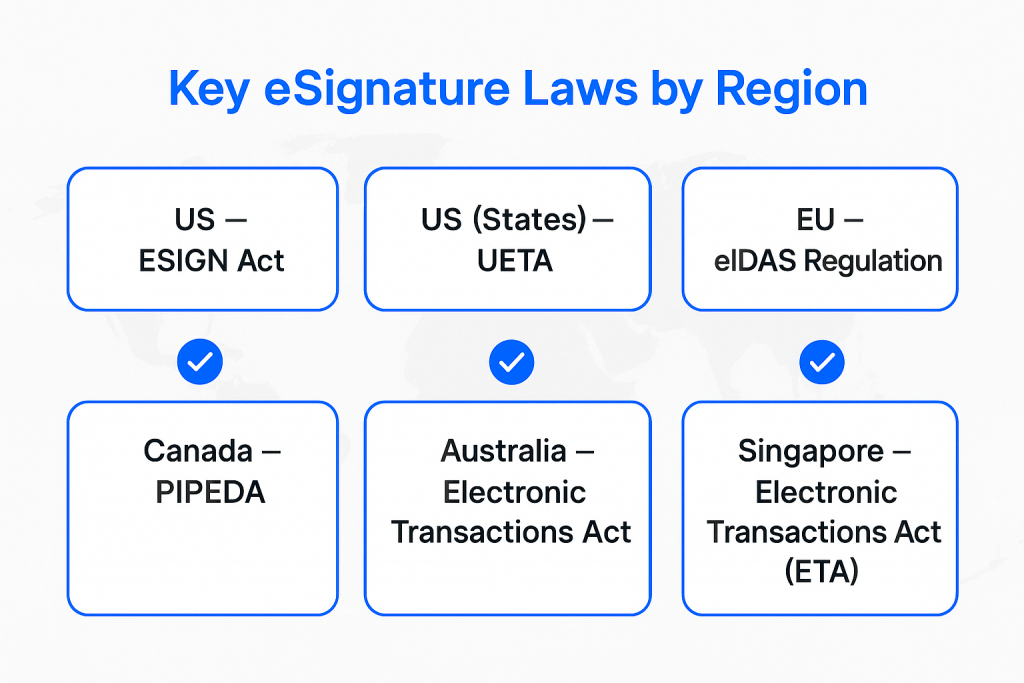
eSignature regulations vary significantly across countries, shaped by local requirements and technological standards. Understanding regional rules is crucial before implementing any eSignature solution. Let’s look into the key US and EU regulations, exploring how these frameworks ensure the legal validity and security of electronic signatures.
ESIGN Act
Passed in 2000, the ESIGN Act is a federal law that legally recognizes electronic signatures and records nationwide. It ensures that a contract or signature cannot be denied legal effect solely because it is in an electronic format, facilitating interstate and foreign commerce.
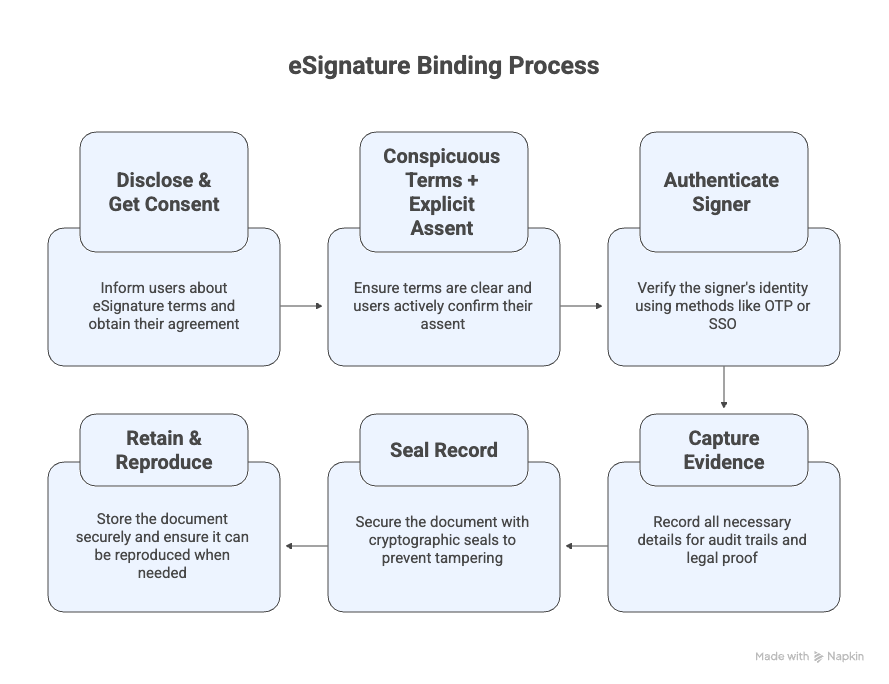
ESIGN Act compliance entails meeting key requirements for the integrity and legality of electronic signatures:
- Intent to sign: The signer must demonstrate a clear intention to sign the document, which can be achieved by clicking an “I agree” button or by drawing their signature.
- Consent to do business electronically: All parties must consent to using electronic records and signatures, usually during the initial agreement or user acceptance process.
- Clear signature attribution: The system must link the signature to the signer, typically via an email address, IP address, or other digital identifiers.
- Record retention: The signed document must be stored in a way that allows it to be accurately reproduced for all parties involved, ensuring the record’s availability for future reference.
Platforms like SignNow are built to meet these standards, providing a seamless and legally sound signing experience.
UETA
The Uniform Electronic Transactions Act (UETA) was introduced in 1999 to harmonize state laws regarding electronic transactions. As of today, 49 states, the District of Columbia, Puerto Rico, and the U.S. Virgin Islands have adopted it. The only state that has not adopted UETA is New York, but it has its own similar law, the Electronic Signatures and Records Act (ESRA).
UETA provides a legal framework for the use of electronic signatures and records in state commerce. It confirms that if a law requires a signature, an electronic one will suffice. Like the ESIGN Act, it ensures that electronic records and signatures carry the same legal weight as their paper counterparts.
eIDAS regulation
For businesses operating in the European Union, the governing regulation is eIDAS (Electronic Identification, Authentication, and Trust Services, 2016). eIDAS unifies electronic identification and trust services across all EU member states, simplifying cross-border transactions. It outlines three tiers of electronic signatures:
- Simple Electronic Signature (SES): The most basic form, such as a scanned signature, offering a minimal level of security.
- Advanced Electronic Signature (AES): A digital signature uniquely linked to the signer that requires extra identity verification, such as a government ID or biometric checks, before signing.
- Qualified Electronic Signature (QES): An advanced electronic signature that offers the highest security, requiring a certified digital certificate from a government-approved provider to ensure maximum legal validity.
While all three types are legally valid, they provide different levels of assurance. A key eIDAS principle is non-discrimination, ensuring that an electronic signature cannot be dismissed simply because of its digital format. This establishes the clear legality of electronic signatures across the EU.
Current eSignature state & trends (2024–2025)
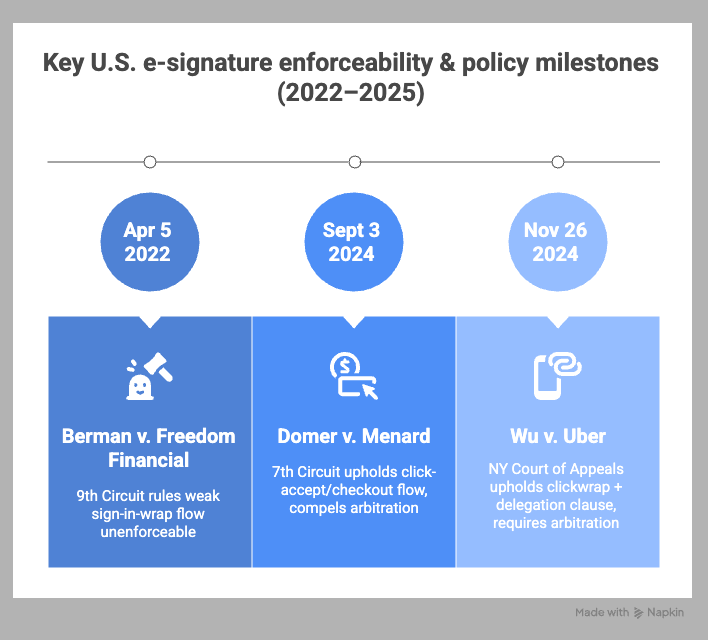
- Courts continue to enforce eSign and online-assent flows that conspicuously notify and require an unambiguous action. In Domer v. Menard (7th Cir., Sept. 3, 2024), the court compelled arbitration based on terms accepted during the online checkout process.
- Conversely, the Ninth Circuit’s Berman v. Freedom Financial (2022) illustrates what fails: “sign-in wrap” flows without clear disclosure that clicking a button signifies assent. That standard continues to guide product teams in 2024–2025.
- New York’s highest court upheld the enforceability of Uber’s clickwrap with a valid delegation clause to arbitration in Wu v. Uber Technologies (Nov. 2024), underscoring that properly designed flows bind users (like clicking “Confirm” to agree to the terms and conditions).
- Federal acceptance is widening. The IRS updated its Internal Revenue Manual in October 2023 to permanently permit eSignatures on a broad range of forms, extending beyond the temporary pandemic-era relief.
- Technical baselines keep maturing. NIST’s FIPS 186-5 (2023) codifies approved digital signature algorithms (RSA, ECDSA, EdDSA) widely used to implement cryptographic seals and signer certificates.
Electronic vs. digital signatures: What’s the difference?
While “electronic signature” and “digital signature” are often used interchangeably, they are not the same. An electronic signature is a broad term for any electronic process indicating agreement. A digital signature is a specific, highly secure type of electronic signature.
The key difference is the technology that ensures security and validity. Digital signatures utilize Public Key Infrastructure (PKI) to associate the signer with the document, providing greater assurance of the signer’s identity and the document’s integrity. While all digital signatures are eSignatures, not all eSignatures are digital signatures.
A quick note: SignNow does not include built-in digital signature features and offers only legally binding electronic signatures.
So, are digital signatures legally binding?
Yes, digital signatures are legally binding. They are a more secure and technologically advanced type of electronic signature. They meet and often exceed the legal requirements set forth in laws such as the ESIGN Act, UETA, and eIDAS.
The enhanced security of digital signatures comes from their use of PKI. This system uses a pair of keys—a private key, known only to the signer, and a public key, available to anyone. When a document is signed, a unique digital “fingerprint” or hash is created. This hash is then encrypted with the signer’s private key, creating the digital signature.
What documents can’t be signed electronically?
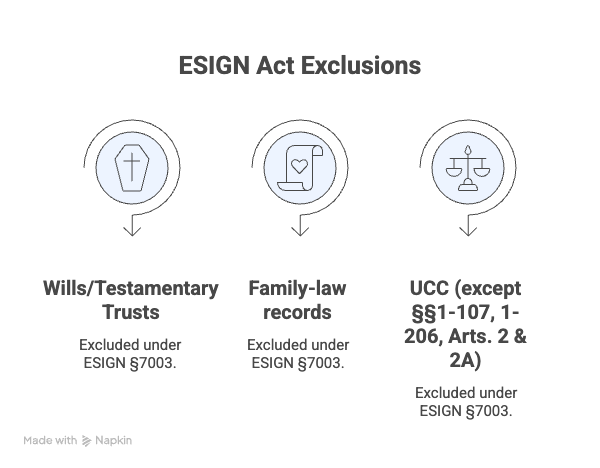
Most documents can be signed electronically, but some exceptions require greater formality or specific legal provisions. Under 15 U.S.C. § 7003, ESIGN’s protections don’t apply to:
- wills/codicils/testamentary trusts
- adoption and divorce papers
- court orders, notices, and other official court documents (including briefs and pleadings).
States frequently mirror these exclusions in UETA enactments. Your policy should route these cases to wet-ink signature or to specialized electronic workflows expressly authorized by specific state laws (e.g., electronic wills statutes) or notarization regimes.
Online notarization
Some transactions require notarization (e.g., certain real-estate filings or affidavits). Most states now enable Remote Online Notarization (RON), which allows a notary public to notarize documents using audio/visual technology, even when the signer is in a different physical location. The technical requirements vary across states; national groups like the MBA track these frameworks and resources for compliance. If your document requires notarization, use a RON-compliant workflow rather than a plain eSignature.
SignNow offers a seamless remote notarization service, making it easy to get documents notarized remotely with certified notaries. Learn more about SignNow online notarization service.
How do you prove the validity of an electronic signature?
Proving the validity of an electronic signature comes down to the quality of the evidence trail created during the signing process. While eSignatures are legally binding, their enforceability in a dispute depends on demonstrating that the signature is authentic and that the document has not been altered. A comprehensive audit trail is the key.
A robust eSignature solution like SignNow automatically generates a detailed history for every document. This log, called an Audit Trail, captures every action taken. It includes the signer’s name, their IP address, the date and time of each event (like viewing and signing), and a unique document ID. This digital evidence is crucial for verifying the signature’s validity long after the signing is complete.
This audit trail provides a step-by-step record that can be presented in court to prove who signed the document, when they signed it, and that the document has remained unchanged since then. It addresses the core legal requirements for intent, consent, and attribution, making the eSignature highly defensible.
Stay compliant and secure with SignNow
SignNow offers a user-friendly, legally binding eSignature solution that enables businesses of all sizes to streamline their document workflows. The platform is designed to meet the legal standards set by the ESIGN Act, UETA, and other global regulations. It provides enterprise-grade security and a comprehensive audit trail for every document.
With features like two-factor authentication, SignNow adds an extra layer of security to verify the signer’s identity. The platform’s intuitive interface makes it simple for anyone to sign documents from any device, while its powerful automation and integration capabilities help businesses work more efficiently.
SignNow is committed to ensuring the legality of electronic signatures for all its users. By providing a secure environment and detailed documentation, SignNow gives you the confidence to conduct business digitally, knowing your agreements are secure and legally enforceable.
Conclusion
Electronic signatures have revolutionized business agreements, saving time, reducing paperwork, and streamlining workflows while maintaining their legal enforceability. With regulatory frameworks like ESIGN, UETA, and eIDAS, eSignatures offer a reliable and secure alternative to traditional methods. By meeting requirements such as intent, consent, and clear attribution, they ensure contracts are binding and legally compliant.
Choosing the right eSignature platform is critical for ensuring compliance and security. SignNow is a trustworthy eSignature solution that not only meets legal standards but also provides advanced features such as audit trails, two-factor authentication, and seamless integrations to enhance trust and usability. Try SignNow today to experience a smart and legally binding way to sign and manage your documents.
FAQ
1. Can I use an electronic signature for real estate or employment contracts?
Yes, you can use electronic signatures for real estate and employment contracts. Most types of contracts, including those for employment, sales, and real estate, are legally valid when signed electronically. However, always check local laws and regulations, as some jurisdictions might have specific requirements for certain document types.
2. Do electronic signatures hold up in court?
Yes, electronic signatures are legally binding and admissible in court. Laws like the ESIGN Act in the U.S. give eSignatures the same legal weight as traditional wet-ink signatures. For evidence to hold up, robust audit trails and authentication data are crucial to prove the signature’s validity.
3. Is an email signature legally binding?
Yes, an email signature can be legally binding. Courts have consistently ruled that an email, including the sender’s name typed at the end, can constitute a signed writing if it meets the fundamental requirements of a legal signature, like an intent to sign. If an email exchange clearly indicates an intention to form an agreement, the names at the end can serve as legally binding signatures. For example, if parties negotiate terms via email and conclude with “I agree” or “Confirmed” along with their names, a court may consider the contract formed.
4. How long should I keep electronically signed documents?
The retention period for electronically signed documents varies by location and industry. Generally, you should keep them for the duration of the contract plus any additional time required by law. Ensure they are stored securely to remain safe and accessible when needed.
Sources
- FDIC, The Electronic Signatures in Global and National Commerce Act (E-Sign Act) compliance guide (June 2024). FDIC
- Uniform Law Commission, Uniform Electronic Transactions Act (UETA) (official materials). Uniform Law Commission
- European Commission, The eIDAS Regulation, (EU) No 910/2014. European Commission
- JUSTIA US Law, Domer v. Menard, Inc., No. 23-2672 (7th Cir. 2024), Justia Law
- JUSTIA US Law, DANIEL BERMAN V. FREEDOM FINANCIAL NETWORK LLC, No. 20-16900 (9th Cir. 2022), Justia Law
- JUSTIA US Law, Wu v. Uber Tech., Inc., Justia Law
- PWC, IRS permanently extends ability to electronically sign certain tax forms, returns, and documents, PWC
- Federal Register, Announcing Issuance of Federal Information Processing Standard (FIPS) 186-5, Digital Signature Standard, Federal Register
- Cornell Law School Legal Information Institute, 15 U.S. Code § 7003 – Specific exceptions, LII
- What is an electronic signature?
- The main laws governing the legality of electronic signatures
- Current eSignature state & trends (2024–2025)
- Electronic vs. digital signatures: What’s the difference?
- What documents can’t be signed electronically?
- Online notarization
- How do you prove the validity of an electronic signature?
- Stay compliant and secure with SignNow
- Conclusion
- FAQ
- Sources