
Best electronic signature software for law firms in 2026

Electronic signature software for law firms has evolved from a back-office utility to a client-facing infrastructure. As law firms modernize workflows, choosing the right eSignature platform has become a more important business and compliance decision.
- eSignature software is now a strategic choice for U.S. law firms, not just a convenience tool.
- The market is split between enterprise platforms and SMB/mid-market tools focused on speed, usability, and cost efficiency.
- For many firms, the best option is the one with strong audit trails, authentication, templates, integrations, and predictable pricing.
- SignNow stands out for affordability, scalability, security, and unlimited-user pricing.
- Docusign, Adobe, and Dropbox Sign remain solid options for enterprise or lighter-use cases.
For many U.S. law firms, the ideal platform combines legal defensibility with operational efficiency. SignNow offers a compelling solution for small to mid-sized firms, while Docusign, Adobe, and Dropbox Sign are well-suited for firms with enterprise-level needs.
The new standard for law firm document workflows
For law firms, the shift is significant because signature workflows intersect with risk, revenue, and service quality. Engagement letters, fee agreements, NDAs, settlement documents, HR paperwork, vendor contracts, and internal approvals all depend on fast, verifiable execution.
The legal framework is stable but nuanced. ESIGN applies federally to transactions affecting interstate commerce, while state-level rules are governed by UETA variants. However, ESIGN and UETA

The 2026 buyer problem is clear: law firms don’t just need “an eSign tool.” They need a signing system that is easy for clients, operationally efficient, and rigorous enough for legal scrutiny.
Why this category matters more to law firms in 2026
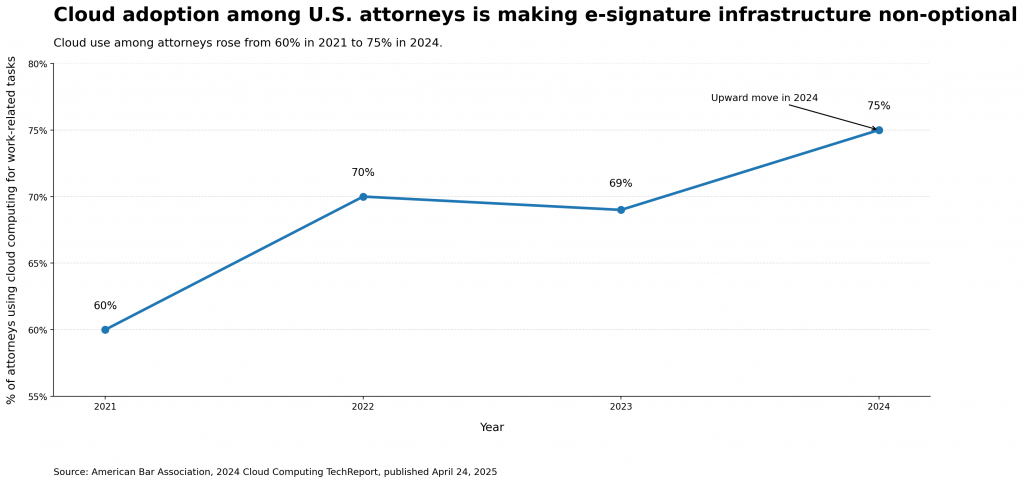
Law firms are adopting eSignature software in a rapidly digitizing market. The ABA’s 2024 Legal Technology Survey found that 75% of attorneys use cloud computing for work-related tasks, up from 60% in 2021. Among firms with 50–99 lawyers, cloud adoption exceeds 94%, reflecting how mid-sized practices have normalized browser-based legal operations.
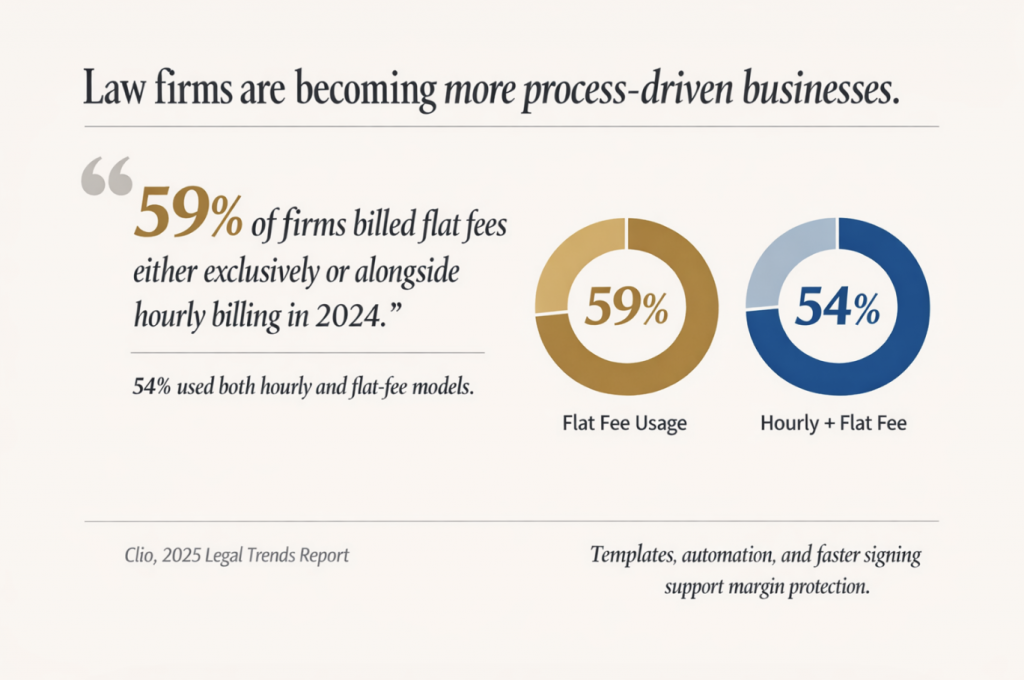
Simultaneously, law-firm business models are shifting toward standardized, repeatable service delivery. Clio’s 2025 Legal Trends Report revealed that 59% of firms billed flat fees in 2024, rewarding speed, template discipline, and lower administrative overhead: areas where eSignature tools excel.
Client expectations are also evolving. Consumers increasingly use AI for legal questions before engaging counsel, raising the bar for responsiveness and digital experience. A clunky print-scan-email process no longer aligns with modern client expectations.
What changed in the U.S. market
Looking ahead to 2026, the eSignature landscape is poised for significant transformation, shaped by three key developments that will redefine how we execute agreements digitally:
- Legal validity is settled, but workflow nuances remain: While the ESIGN Act and UETA have established the legality of electronic signatures across the U.S., challenges persist with document-type exceptions and procedural constraints. The debate has shifted from whether eSignatures are legal to how businesses can effectively prove intent, consent, integrity, and auditability within specific workflows.
- Mid-sized firms embrace operational maturity: With over 90% of mid-sized firms adopting AI and 64% offering flat-fee billing, operational efficiency has become a key strategic priority. Features once seen as mere administrative conveniences, such as reusable templates, bulk sending, and real-time tracking, are now recognized as significant competitive advantages.
- Product positioning has diverged: The eSignature market has split into distinct niches. Docusign is building a comprehensive agreement stack with AI-driven analysis and centralized workflows. Adobe continues to dominate PDF-centric processes with deep integrations. Meanwhile, SignNow differentiates itself with transparent pricing and unlimited users, while Dropbox Sign serves as a lightweight, legally binding solution for simpler use cases.
How law firms should evaluate eSignature software
When choosing eSignature software, law firms should evaluate five dimensions:
- Compliance and evidentiary posture
Platforms must support durable audit trails, encryption, and compliance with standards like SOC 2 Type II and HIPAA. SignNow excels here with role-based access controls and tamper-evident records. - Client experience
Clients prioritize ease of use, mobile access, and automated reminders. SignNow, Adobe, and Dropbox Sign all emphasize intuitive, client-friendly workflows. - Administrative efficiency
Templates, bulk send, and field reuse are critical for recurring documents. SignNow supports these features, making it ideal for engagement letters and intake packets. - Integration fit
A good eSign tool integrates seamlessly with existing systems. SignNow offers over 20 integrations, including Salesforce, NetSuite, and Microsoft 365. - Scaling economics
Unlimited-user pricing, as offered by SignNow, reduces adoption friction and supports broader rollout across HR, finance, and operations.
Why SignNow deserves a serious look
SignNow is uniquely positioned for SMB and mid-market law firms. Its unlimited-user pricing, transparent costs, and robust security features make it a practical choice for firms looking to scale without hidden expenses. With integrations across popular business tools and 24/7 support, SignNow simplifies deployment and ensures compliance.
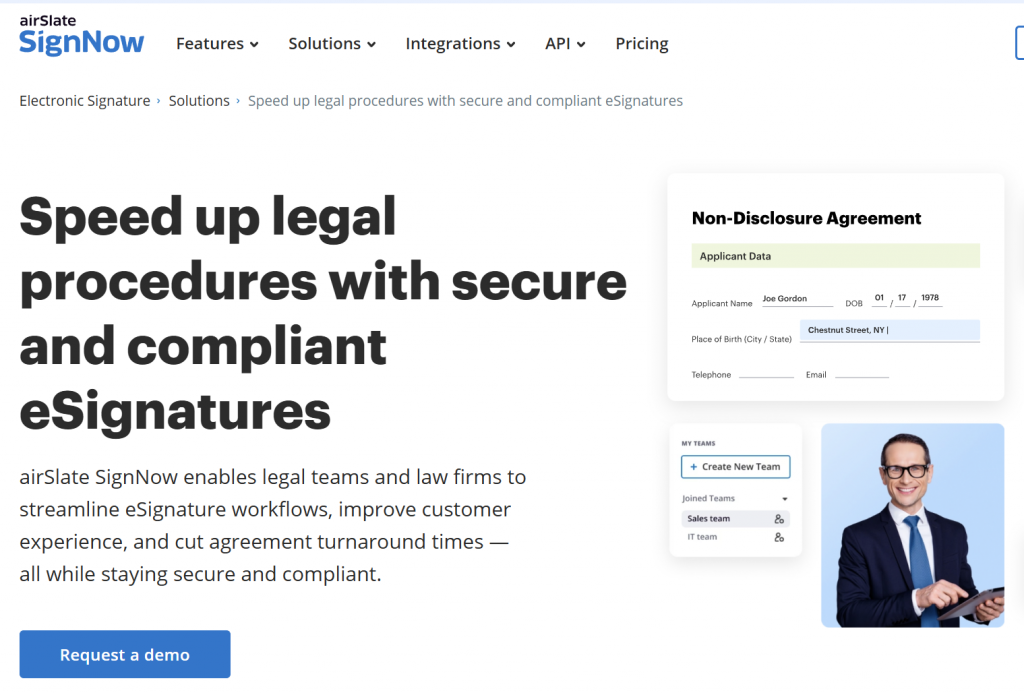
For law firms, the value lies in SignNow’s ability to support broader participation across teams: intake coordinators, paralegals, HR, and finance staff without licensing friction. This aligns directly with the needs of operationally growing firms.
Case studies and transferable lessons
- Bryant & Stratton College expanded its use of SignNow across multiple departments, citing the platform’s ease of use and significant cost savings. This successful rollout demonstrates how seamlessly non-technical users can adopt the software.
- Funjoin transformed its paper-heavy registration process into a streamlined digital workflow, mirroring the client intake and onboarding procedures common in law firms.
- Solar Energy World’s success highlights the critical role of speed in finalizing documents: a principle that directly applies to legal contexts, such as accelerating engagement acceptance and securing timely settlement approvals.
Conclusion
When choosing the best eSignature software for law firms in 2026, the key is to find a solution that balances speed, compliance, and cost-effectiveness. While Docusign and Adobe are well-suited for enterprise clients and those with PDF-heavy workflows, SignNow emerges as the superior choice for small to mid-sized firms that prioritize scalability and a strong return on investment.
Ready to streamline your legal workflows? Start with SignNow today and experience the perfect blend of simplicity, security, and affordability.
FAQ
What features should law firms prioritize in eSignature software?
Law firms should focus on features like robust audit trails, signer authentication, reusable templates, and seamless integrations with tools like Salesforce or Microsoft 365. These capabilities ensure compliance, streamline workflows, and improve client experience. Scalability and transparent pricing, like SignNow’s unlimited-user model, are also critical for long-term value.
How does eSignature software improve client satisfaction?
eSignature software simplifies the signing process, making it faster and more convenient for clients to complete documents on any device. Automated reminders and mobile-friendly workflows reduce delays and frustration. A smooth digital experience reflects professionalism and builds trust with clients.
Can eSignature software help with compliance audits?
Yes, platforms like SignNow provide detailed audit trails, encryption, and role-based access controls to meet compliance standards like SOC 2 Type II and HIPAA. These features ensure that every step of the signing process is documented and secure, making it easier to demonstrate compliance during audits or legal disputes.
Why might law firms consider SignNow as an eSignature option?
SignNow may be a good fit for law firms that want an easy-to-use eSignature platform with core features such as audit trails, signer authentication, templates, real-time tracking, and integrations. Its pricing model can also appeal to SMB and mid-market firms that need to grant access to multiple teams without adding excessive licensing complexity.