
Here is a high-level summary of the key differences between electronic and digital signatures.
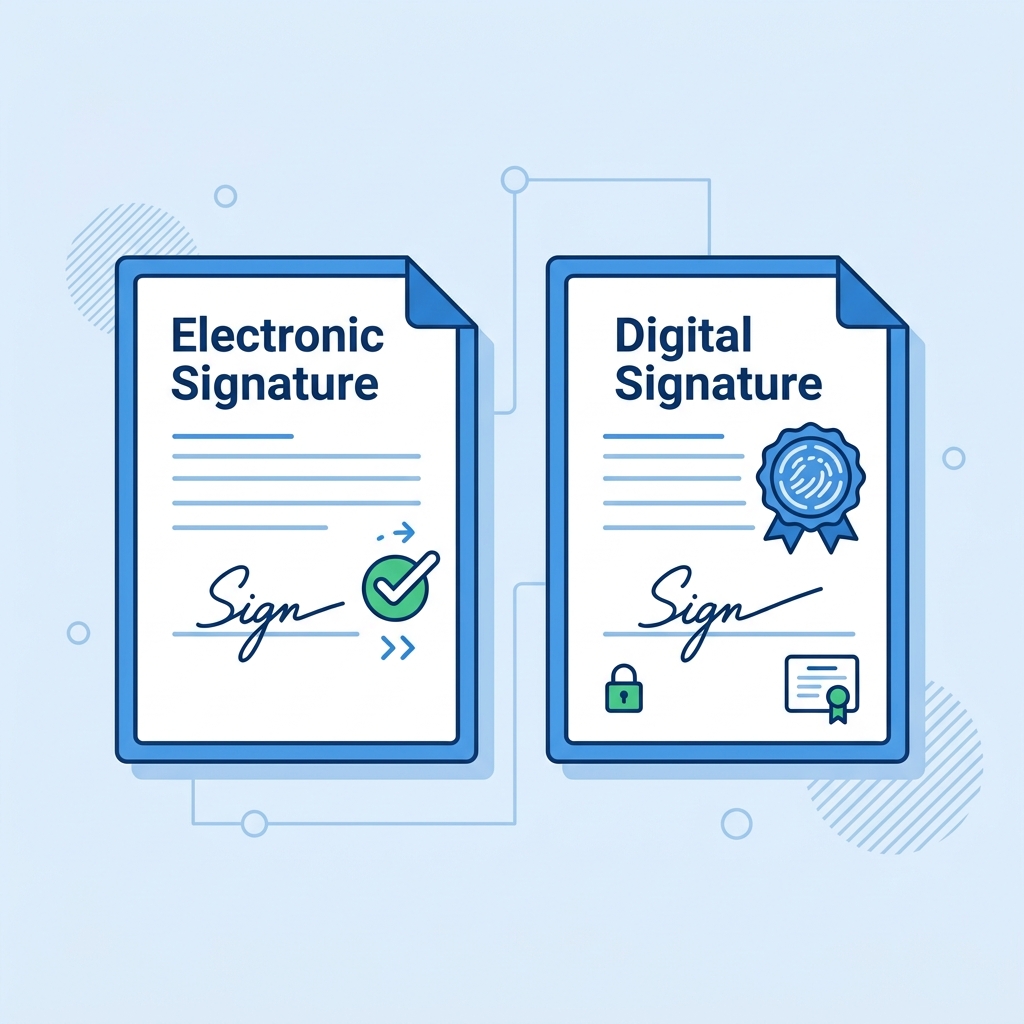
- Electronic signatures are best for everyday business agreements where capturing signer intent is the main goal.
- Digital signatures are a highly secure type of electronic signature that use cryptography to verify identity and protect document integrity.
Think of it this way:
- An electronic signature is like replying “I agree” to an email — simple, legally binding, and sufficient for most workflows.
- A digital signature is like placing that agreement in a tamper-proof, cryptographically sealed envelope that proves who signed it and whether anything changed afterward.
What is an electronic signature? The legal concept of intent
An electronic signature, or eSignature, is a broad legal term for any electronic symbol or process attached to a record or contract, executed by a person with the intent to sign. Its primary function is to capture and prove the signer’s intent to be bound by the terms of the document.
The keyword is intent. An electronic signature is not defined; electronic signatures are legally valid and enforceable under the Electronic Signatures in Global and National Commerce Act in the United States. At the state level, the Uniform Electronic Transactions Act (UETA) harmonizes state laws with these federal principles, ensuring consistency across jurisdictions.
Common forms of electronic signatures include:
- A typed name at the bottom of an email agreement
- Clicking “I Accept” on a terms-of-service screen
- Drawing a signature on a touchscreen
- Uploading a scanned image of a handwritten signature
That last example is a frequent source of confusion: a scanned image of your handwritten signature is a simple electronic signature, not a digital signature. It carries no cryptographic verification of identity or document integrity.
SignNow is compliant with both the ESIGN Act and UETA, and provides a court-admissible audit trail for every document — recording full names, email addresses, IP addresses, and timestamps of all signing actions. This audit trail serves as the evidentiary record that the signing process occurred as intended.
What is a digital signature? The technology of trust
A digital signature is a specific, highly secure type of electronic signature that uses a cryptographic method called Public Key Infrastructure (PKI) to validate the signer’s identity and ensure the document has not been altered after signing.
Where an electronic signature answers the legal question “Did this person intend to sign?”, a digital signature answers the technical question “Can we cryptographically prove who signed, and that nothing has changed since?”
“The fundamental distinction lies in the ‘what’ versus the ‘how.’ An electronic signature is a legal concept — it’s about the intent to sign. A digital signature is a technical implementation — it’s the cryptographic mechanism used to secure the document and prove that intent.” — Dr. Aruna Seneviratne, IEEE Fellow, 2025.
How PKI works in plain terms: When you apply a digital signature, the system generates a unique mathematical fingerprint of the document — called a cryptographic hash — and encrypts it with your private key. This encrypted fingerprint is your digital signature. Anyone with access to your public key (which is widely distributed via your digital certificate) can decrypt the fingerprint and compare it to the document. If even a single character was changed after signing, the fingerprint will not match, proving tampering occurred. Your private key is issued and verified by a trusted third-party Certificate Authority (CA), which acts as the identity validator in this system.
SignNow’s platform is built using PKI technology to ensure the security of all electronic signatures processed through the platform.
Difference 1: Security and document integrity
The core security difference lies in how each signature type protects a document from tampering. Electronic signatures typically rely on a secure process and a detailed audit log, while digital signatures use cryptography to create a tamper-evident seal directly on the document.
Electronic signature security — the audit trail approach:
- Captures IP address, email address, device information, and timestamps for every signing action
- Creates a chronological document history that can be presented as evidence in a dispute
- Relies on the security of the platform and the integrity of the process, not the document itself
- SignNow uses AES-256-bit encryption for data at rest and TLS 1.2/1.3 for data in transit
Digital signature security — the cryptographic seal approach:
- Embeds a cryptographic hash directly into the document file
- Any post-signing modification — including whitespace changes — invalidates the signature
- Provides mathematical proof of document integrity that is independent of any platform
- Required for workflows where HIPAA’s Security Rule mandates entities to “ensure the integrity of all electronic protected health information”
What “tamper-evident” means in practice: If a document with a digital signature is altered after signing — even a single character changed — the cryptographic verification will fail when the document is next opened or reviewed. The signature will show as invalid, alerting any reviewer that the document is not in its original signed state. An electronic signature’s audit trail, by contrast, records what happened during the signing process but does not detect post-signing alterations to the document file itself.
For most commercial agreements, an audit trail provides sufficient evidentiary protection. For regulated healthcare records, pharmaceutical documentation, or government contracts, the cryptographic guarantee of a digital signature is the appropriate standard.
Difference 2: Signer authentication and identity verification
Electronic signatures authenticate signers using common methods such as email verification, SMS codes, or account logins. Digital signatures require a higher level of assurance, verifying identity through a digital certificate issued by a trusted third-party Certificate Authority (CA).
Standard eSignature authentication methods include:
- Email-based verification (clicking a link sent to the signer’s address)
- SMS one-time passcode (OTP) sent to a registered phone number
- Account-based authentication (signer logs into a known account)
- Knowledge-based authentication (answering identity questions)
These methods confirm that the person who received the invitation completed the signing. They do not independently verify the signer’s real-world identity against a government-issued document.
Digital signature authentication works differently. A CA — such as a government-accredited trust service provider — issues a digital certificate only after verifying the signer’s identity through a formal process, which may include document verification, biometric checks, or in-person validation. The certificate is then cryptographically linked to every signature the holder produces.
Gartner (2025) notes that demand for identity verification (IDV) integrated with signature workflows is a key differentiator as organizations move toward higher-assurance signing processes. Looking ahead, AI-powered IDV tools — capable of scanning a government-issued ID and matching it to a live selfie in seconds — are increasingly being embedded into eSignature workflows to bridge the gap between standard email-based authentication and full certificate-based digital signatures. This approach provides substantially higher identity assurance without the complexity of a traditional CA-issued certificate.
Mention the trend of using AI-powered IDV (like scanning a driver’s license) to bridge the gap between standard eSignature authentication and certificate-based digital signatures.
SignNow enhances security with advanced recipient authentication options on Enterprise plans and above, including two-factor authentication via password, text message, or phone call — providing a verified chain of custody for every signing session. Visit SignNow Help Center to learn more about how a SignNow Digital Certificate ensures your documents are authentic and legally valid.
Difference 3: Legal weight and global acceptance
In the US, both signature types are legally binding under the ESIGN Act. However, in the European Union, the eIDAS regulation creates a tiered framework that gives specific types of digital signatures — Qualified Electronic Signatures (QES) — the same legal standing as a handwritten signature.
The US approach — technology neutral: The ESIGN Act and UETA do not prescribe a specific technology. Any electronic signature that captures intent and can be authenticated is legally enforceable. This flexibility supports broad adoption but places the burden of proof on the party relying on the signature in a dispute.
The EU approach — tiered by assurance level: The eIDAS regulation defines three levels:
| Level | Abbreviation | Description | Technology required |
|---|---|---|---|
| Simple Electronic Signature | SES | Basic eSignature; any electronic indication of intent | None specified |
| Advanced Electronic Signature | AES | Uniquely linked to the signer; capable of detecting post-signing changes | PKI-based |
| Qualified Electronic Signature | QES | Equivalent in law to a handwritten signature; created with a qualified device | PKI + CA-issued qualified certificate |
AES and QES are specific types of digital signatures. QES carries the highest legal weight in the EU — it shifts the burden of proof in a dispute and is required for certain government and notarial acts.
“For high-risk, regulated transactions, the cryptographic assurance and non-repudiation provided by a standards-based digital signature isn’t just a best practice; it’s often a compliance mandate.” — Sheila FitzPatrick, IAPP, 2025
SignNow complies with eIDAS, providing Simple Electronic Signatures (SES) on all plans. Qualified Electronic Signatures (QES) are available as an add-on for the Site License plan for businesses operating in the EU that require the highest level of legal assurance for cross-border transactions.
Difference 4: Industry compliance and common use cases
Electronic signatures are suitable for the vast majority of business documents — sales contracts, HR onboarding, NDAs, and internal approvals. Digital signatures are often mandated for industries with strict regulatory oversight, such as life sciences, government contracting, and high-value financial transactions.
Scenario A — HR onboarding (electronic signature)
Nicholas Tovar, SHRM-CP at LEARN, describes the shift from paper: “SignNow has changed our workflows to be more streamlined and efficient. We saved more than 1,500 pieces of paper converting to an electronic format.” SHRM (2024) reports that HR departments see an average reduction of 1.5 hours per new hire in administrative time by using electronic signatures for onboarding documents. For employment contracts, offer letters, and policy acknowledgments, a legally-binding eSignature with a court-admissible audit trail is the appropriate and sufficient standard.
Scenario B — Life sciences and FDA compliance (digital signature)
FDA 21 CFR Part 11 governs electronic records for pharmaceutical manufacturers, clinical research organizations, and medical device companies. This regulation typically requires digital signatures — specifically, signatures that include electronic authentication, audit trails, and controls that meet the FDA’s definition of a closed or open system. SignNow is 21 CFR Part 11 compliant (available as an add-on for the Site License plan), providing two-factor authentication, session controls, and document history retention that the regulation requires.
Scenario C — Healthcare patient intake (electronic signature with HIPAA compliance)
For patient consent forms and intake documents, SignNow’s HIPAA-compliant configuration (available via Business Associate Agreement on the Site License plan) provides the required safeguards for protected health information.
Forrester (2024) notes that adoption of digital signatures is accelerating in financial services, healthcare, and government sectors — driven by increasing regulatory scrutiny and the need for non-repudiation in high-value transactions. For the majority of commercial use cases outside these regulated sectors, a compliant electronic signature platform remains the practical and legally sufficient choice.
Difference 5: Cost and user experience
Generally, electronic signature solutions are more accessible, affordable, and have a simpler user experience, making them suitable for broad organizational adoption. Digital signatures, especially those requiring certificates from a CA, can be more complex and costly to implement—which is why they are reserved for specific high-stakes use cases.
The cost and friction trade-off:
Standard eSignature platforms charge per user per month or per document. The process for a signer is typically: receive an email, click a link, sign in a browser or mobile app, and done. No software installation, no hardware tokens, no certificate management.
Digital signatures — particularly QES in the EU — may require signers to obtain a digital certificate from an accredited CA, authenticate via a hardware security key or a mobile ID app, and complete an identity verification process before they can sign a single document. This is appropriate for a high-value contract requiring the legal equivalent of a notarized handwritten signature. It is friction-intensive for routine business documents.
The global eSignature market was valued at USD 6.18 billion in 2023 and is projected to grow at a CAGR of 26.9% from 2024 to 2030. The global digital signature market is projected to reach USD 43.1 billion by 2030, growing at a CAGR of 30.1%.
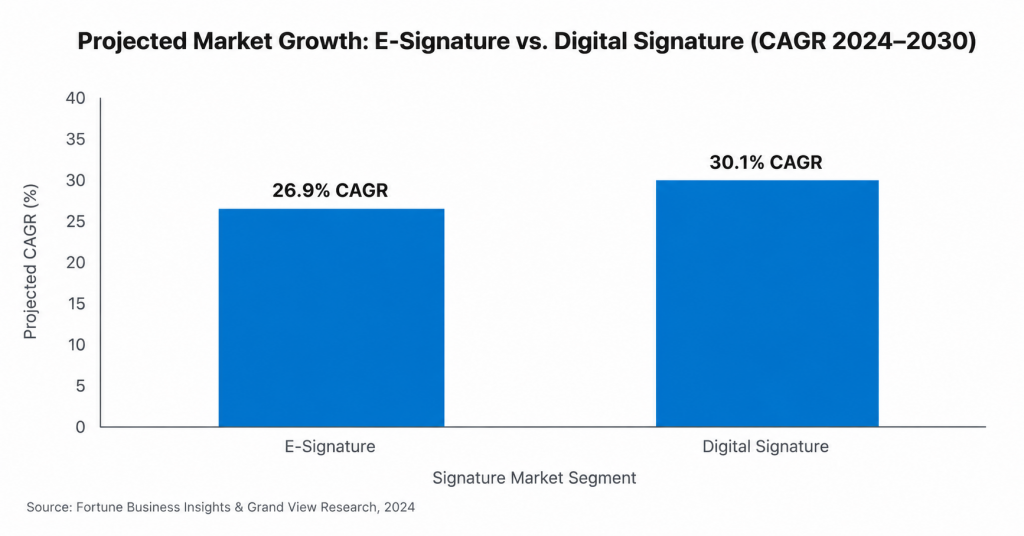
Both markets are growing rapidly, reflecting rising demand across the spectrum. Modern platforms are working to reduce the friction of digital signatures — for example, cloud-based qualified certificate issuance and mobile-first CA authentication are making QES workflows less dependent on hardware tokens. But for most organizations, the cost-to-value calculation still favors starting with a compliant eSignature platform and adding digital signature capabilities only where regulation specifically requires it.
SignNow’s Business plan starts at $8/user/month (billed annually), with no cap on documents sent. G2 reviewers rate SignNow’s ease of use at 9.0/10, reflecting a signing experience that works for both technical and non-technical users.
Side-by-side comparison: Electronic vs. digital signature
This table provides a detailed, side-by-side breakdown of the differences between standard electronic signatures and technology-driven digital signatures across all five key dimensions.
| Dimension | Electronic Signature | Digital Signature |
|---|---|---|
| Core definition | Legal concept: any electronic indication of intent to sign | Technical implementation: PKI-based cryptographic signing |
| Underlying technology | Platform-managed process; no specific technology mandated | Public Key Infrastructure (PKI), cryptographic hash, digital certificate |
| Document integrity | Audit trail records signing events; does not detect post-signing file changes | Cryptographic hash detects any post-signing alteration to the document |
| Signer authentication | Email verification, SMS OTP, account login, 2FA | Digital certificate issued by a Certificate Authority (CA) |
| Legal basis (US) | ESIGN Act, UETA — legally binding in all US states | ESIGN Act, UETA — same legal basis, higher evidentiary strength |
| Legal basis (EU) | eIDAS SES — basic legal recognition | General commercial contracts, HR, real estate, insurance, and education |
| Compliance use cases | General commercial contracts, HR, real estate, insurance, education | FDA 21 CFR Part 11, eIDAS QES, government, high-value financial |
| Typical cost | Site License plan; QES available as an add-on; 21 CFR Part 11 and HIPAA available as add-ons | Higher; CA certificate fees, potential hardware or identity verification costs |
| User experience | Low friction; sign from any browser or mobile device | Can require certificate installation, hardware tokens, or formal ID verification |
| Non-repudiation | Supported by audit trail and process evidence | Cryptographically enforced; signer cannot deny signing without invalidating the certificate |
| SignNow support | All plans; SOC 2 Type II, GDPR, ESIGN/UETA, eIDAS SES | Site License plan; QES available as add-on; 21 CFR Part 11 and HIPAA available as add-ons |
Which should you choose? A guide for your business
The right choice depends entirely on your specific use case, industry regulations, and risk tolerance. Here are four common business scenarios to help you decide.
Scenario 1: HR manager — Employee onboarding documents
- Who: HR managers and operations teams at companies of any size
- What: Employment contracts, offer letters, policy acknowledgments, NDAs, and benefits enrollment forms
- Where: Distributed teams across multiple locations or states
- When: At hire, during annual reviews, or whenever policy updates require acknowledgment
- Why: These documents require legal enforceability and a clear record of consent, but do not require cryptographic identity verification. An audit trail with timestamps, IP addresses, and email confirmation is sufficient for employment law purposes in the US.
- How: Use SignNow’s Business plan ($8/user/month). Upload a template, assign signing fields, send to new hires, and receive a completed, court-admissible document within minutes. Laura H., who manages HR across seven terminals in three states, notes: “We’ve centralized our process and our documents are fully complete before an employee ever starts their first day.”
Recommendation: Standard electronic signature. SignNow Business plan.
Scenario 2: Sales director — High-volume contract execution
- Who: Sales teams sending proposals, service agreements, and order forms at scale
- What: Sales contracts requiring signatures from multiple parties, sometimes across hundreds of accounts simultaneously
- Why: Speed of execution directly affects revenue. Bulk sending and payment collection in a single workflow eliminates back-and-forth.
- How: Use SignNow’s Business Premium plan ($15/user/month), which includes bulk signature invites and the ability to request payments alongside signatures.
Recommendation: Standard electronic signature with bulk send. SignNow Business Premium plan.
Scenario 3: Healthcare administrator — Patient consent and intake forms
- Who: Healthcare providers, clinics, and telehealth practices handling protected health information
- What: Patient intake forms, consent to treatment, HIPAA authorization forms
- Why: HIPAA requires specific safeguards for electronic records containing protected health information. A Business Associate Agreement (BAA) with the eSignature provider is required.
- How: Use SignNow’s Site License plan with the HIPAA compliance add-on. The BAA activates the required security controls, and SignNow’s audit trail meets the documentation requirements for electronic health records.
Recommendation: Electronic signature with HIPAA compliance. SignNow Site License + HIPAA add-on.
Scenario 4: Legal Counsel — EU cross-border high-value agreements
- Who: Legal and compliance teams at companies executing contracts under EU law where QES is required or preferred
- What: High-value commercial agreements, notarial acts, or contracts where eIDAS QES equivalence to a handwritten signature is a compliance requirement
- Why: eIDAS QES carries the highest legal standing in the EU. For certain regulated transactions, QES is not optional — it is the mandated standard.
- How: Use SignNow’s Site License plan with the QES add-on, which provides access to eIDAS SES, AES, and QES signing levels for EU-based workflows.
Recommendation: Digital signature (QES). SignNow Site License + QES add-on.
Disclaimer: The information contained in this blog post is provided for general informational purposes only and does not constitute formal legal advice.
Final thoughts
Understanding the difference between electronic signature vs. digital signature is not an academic exercise — it directly affects your organization’s legal risk, compliance posture, and operational efficiency. The right choice is determined by your use case, the regulatory environment you operate in, and the level of identity assurance your documents require.
For the vast majority of business workflows — HR onboarding, sales contracts, real estate, insurance, legal services, and education — a compliant electronic signature with a court-admissible audit trail is the legally sufficient and operationally practical choice. For regulated industries requiring cryptographic proof of identity and document integrity, digital signature capabilities are available when the workflow demands them.
SignNow is trusted by 28 million users, including 352 Fortune 500 companies, and is rated 9.0/10 for ease of use on G2. Customers report an average 7x ROI within the first six months of deployment.
Start your free trial with SignNow!
Glossary
- Certificate Authority (CA): A trusted third-party organization that issues digital certificates verifying a signer’s identity. CAs are the foundation of the PKI system. Examples include government-accredited trust service providers in the EU that issue certificates required for Qualified Electronic Signatures.
- Cryptography: The mathematical science of securing information through encoding. In the context of digital signatures, cryptography is used to create a unique fingerprint of a document (a hash) and encrypt it with the signer’s private key, enabling anyone with the corresponding public key to verify authenticity and detect tampering.
- eIDAS: The EU regulation on electronic identification and trust services (Regulation No 910/2014). It defines three levels of electronic signatures — SES, AES, and QES — and establishes the legal framework for their cross-border recognition within the European Union.
- ESIGN Act: The Electronic Signatures in Global and National Commerce Act, enacted in the United States in 2000. It establishes that electronic signatures and electronic records carry the same legal weight as their paper-based equivalents in interstate and foreign commerce.
- Public Key Infrastructure (PKI): A framework of policies, hardware, software, and procedures used to create, manage, distribute, and verify digital certificates. PKI underpins digital signatures by providing each signer with a mathematically linked pair of keys — a private key (held only by the signer) and a public key (distributed via a certificate) — that together enable cryptographic signing and verification.
FAQ
1. Is an electronic signature legally binding?
Yes. In the United States, electronic signatures are legally valid and enforceable under the Electronic Signatures in Global and National Commerce Act (ESIGN) and the Uniform Electronic Transactions Act (UETA). These laws apply in all 50 states and cover the vast majority of commercial and personal agreements. Certain document types — including wills, court orders, and some real estate transactions — may have jurisdiction-specific requirements. SignNow is compliant with both ESIGN and UETA, and provides a court-admissible audit trail for every signed document.
2. Which is more secure — an electronic signature or a digital signature?
Digital signatures provide a higher level of cryptographic security because they embed a tamper-evident seal directly into the document file using PKI. If the document is altered after signing, the digital signature becomes invalid. Electronic signatures rely on a secure signing process and a detailed audit trail — which is legally sufficient for most business use cases — but do not provide cryptographic document-level integrity verification. For regulated industries where document integrity must be mathematically provable, a digital signature is the appropriate choice. For general commercial agreements, a compliant electronic signature with a robust audit trail provides sufficient security and legal enforceability.
3. How can you tell if a signature is a digital signature?
When you open a PDF with a valid digital signature in a reader like Adobe Acrobat, a panel will display the signature’s validity status, the name of the Certificate Authority that issued the signer’s certificate, and whether the document has been modified since signing. A simple electronic signature will not display this certificate panel — it may show a signature image but no cryptographic verification data. The presence of a valid certificate chain from a recognized CA is the definitive indicator of a true digital signature.
4. Is a scanned image of my handwritten signature a digital signature?
No. This is a common misconception. A scanned image of a handwritten signature is a simple electronic signature — it shows an image of your signature but carries no cryptographic verification of your identity and no tamper-evident protection for the document. Anyone could copy and paste the image into another document. A digital signature, by contrast, is mathematically bound to both the signer’s verified identity and the specific document content at the moment of signing.
5. Is a SignNow signature legally binding?
Yes. A SignNow signature is a legally-binding electronic signature that uses digital signature technology — including PKI and AES-256 bit encryption — to ensure security and compliance. SignNow is compliant with the ESIGN Act, UETA, GDPR, and eIDAS SES on all plans. HIPAA compliance and 21 CFR Part 11 compliance are available as add-ons on the Site License plan. Every SignNow document includes a court-admissible audit trail recording the full names, email addresses, IP addresses, and timestamps of all signing actions.
Sources
- eIDAS Regulation — European Commission Digital Strategy:
https://digital-strategy.ec.europa.eu/en/policies/eidas-regulation - Global E-Signature Market Size Report — Fortune Business Insights (2024):
https://www.fortunebusinessinsights.com/e-signature-market-110030 - Gartner (2025 search landing): https://www.gartner.com
- HIPAA Security Rule — Electronic Records Integrity — HHS:
https://www.hhs.gov/hipaa/for-professionals/security/laws-regulations/index.html - FDA 21 CFR Part 11 — Electronic Records and Signatures:
https://www.ecfr.gov/current/title-21/chapter-I/subchapter-A/part-11 - SHRM — Electronic Signatures in HR / Onboarding: https://www.shrm.org
- Forrester — Digital Signature Adoption: https://www.forrester.com
- What is an electronic signature? The legal concept of intent
- What is a digital signature? The technology of trust
- Difference 1: Security and document integrity
- Difference 2: Signer authentication and identity verification
- Difference 3: Legal weight and global acceptance
- Difference 4: Industry compliance and common use cases
- Difference 5: Cost and user experience
- Side-by-side comparison: Electronic vs. digital signature
- Which should you choose? A guide for your business
- Final thoughts
- Glossary
- FAQ