

A promissory note is a written, unconditional promise to pay a fixed sum of money, either on demand or by a set date. A template becomes enforceable the moment it carries the elements a court looks for and both parties sign it, which is why filling one in correctly matters more than where you downloaded it. Two things decide whether the finished note holds up: the interest rate you write into it, and how the signatures are collected.
TL;DR
- A note is a negotiable instrument only if it is an unconditional promise to pay a fixed amount, payable to bearer or to order, on demand or at a definite time, with no other obligations attached.
- Load-bearing clauses: parties, principal, interest rate and method, payment schedule, maturity, late fee, default and acceleration, prepayment, governing law, and signatures.
- A private loan priced below the IRS applicable federal rate can generate imputed interest for the lender. The September 2026 short-term rate is 4.18%.
- Enforcement is generally limited to six years after the due date.
- Ordinary notes can be signed electronically; a note secured by real property needs a system that controls a single authoritative copy.
- Keep the audit trail. It is the record that shows who signed, when, and from what device.
What a promissory note is, and what makes it binding
A promissory note binds the borrower because it records a promise supported by consideration, the money actually lent. Notarization is not what creates that obligation, although some states and county recorders require it for notes tied to recorded property interests.
The formal test is narrow. Under UCC 3-104 requirements, the document is a negotiable instrument only when it is an unconditional promise to pay a fixed amount of money, payable to bearer or to order, on demand or at a definite time, and free of any other undertaking beyond paying money. Add a clause requiring the borrower to perform a service, and the note stops being negotiable, so it can no longer be transferred with the protections a lender expects.
A note is also not a loan agreement. The note is the borrower’s one-way promise; a loan agreement template is a mutual contract with covenants and remedies on both sides, and it suits commercial lending above a modest size.
Informal lending is where undocumented promises fail. In LendingTree’s 2025 friends and money survey of 2,000 US consumers, 77% said they had loaned money to a friend, 32% were not repaid on their most recent loan, and 36% said they had lost a friendship over money.
Lending between friends: what actually happens
| Measure | Share of US consumers |
| Have loaned money to a friend | 77% |
| Not repaid on most recent loan | 32% |
| Lost a friendship over money | 36% |
What to include in the template
Ten clauses carry the weight. Everything else in a typical template is refinement.
- Parties. Full legal names and addresses of borrower and lender, with entity names where a business is involved.
- Principal. The exact amount advanced.
- Interest rate and method. The annual rate, whether it is simple or compounding, and the compounding period.
- Payment schedule. Amount, frequency, first payment date, and where payment is sent.
- Maturity or demand terms. A fixed final date, or the notice period, the lender must give on a demand note.
- Late fee. A flat amount or percentage, plus the grace period that triggers it.
- Default and acceleration. What counts as default and the lender’s right to call the full balance due.
- Prepayment. Whether the borrower can pay early, and whether a penalty applies.
- Governing law. The state whose law applies, which sets the usury ceiling and enforcement procedure.
- Signatures and date. Both are parties dated, with a co-signer line if one is involved.
Why acceleration matters: without it, a lender facing a borrower who has missed three payments can usually sue only for the missed installments, not the outstanding balance.
Security is a separate decision layered on top. A secured note names collateral and the lender’s right to take it; an unsecured note relies on the borrower’s promise and a court judgment. If the note will be reused, map each item to fillable fields so the next loan takes minutes instead of a redraft.
Choosing the repayment structure
Pick the structure from how the borrower will actually generate the money. An installment note spreads equal payments across a term and suits a steady income. A demand note has no maturity date and is payable when the lender asks, which suits an open-ended advance between related businesses. A balloon note keeps early payments small and lands one large payment at the end, for a borrower expecting a specific future inflow.
A small contracting business buying a used truck from a supplier is a typical balloon case: the owner wants low payments through the slow season and clears the balance after the spring contracts settle. That structure only works if the note states the balloon amount and its due date explicitly, because the six-year enforcement window runs from that date.
Setting the interest rate without creating a tax problem
Below-market interest on a private loan is a tax question, not just a generosity question. The IRS publishes applicable federal rates monthly, and the September 2026 applicable federal rates on annual compounding are 4.18% short-term, 4.49% mid-term, and 5.12% long-term.
IRS applicable federal rates, September 2026 (annual compounding)
| Term | Rate |
| Short-term (3 years or less) | 4.18% |
| Mid-term (over 3 to 9 years) | 4.49% |
| Long-term (over 9 years) | 5.12% |
Under the below-market loan rules, forgone interest on a gift loan is treated as transferred from the lender to the borrower and retransferred as interest, which the lender may have to report. Two thresholds soften this. A gift loan between individuals is exempt on any day the aggregate outstanding balance between them does not exceed $10,000, unless the loan is attributable to purchasing income-producing assets. For gift loans at or under $100,000, the imputed amount is capped at the borrower’s net investment income for the year.
State usury law sets the other boundary, the ceiling. Caps vary by state and by whether the lender is a licensed institution, so check the rate against the governing law state before the note is signed, rather than after.
How to fill out and send the note in SignNow
If you would rather not build the file from scratch, SignNow keeps a gallery of ready-made promissory note templates you can open and adapt before running the steps below.
Prepare the note once as a template, then reuse it for every subsequent loan. On a paid plan, the Business tier starts at $8 per user per month, billed annually, the workflow is:
- Click +Create and upload the completed note as a PDF, DOC, or DOCX file, up to 50 MB.
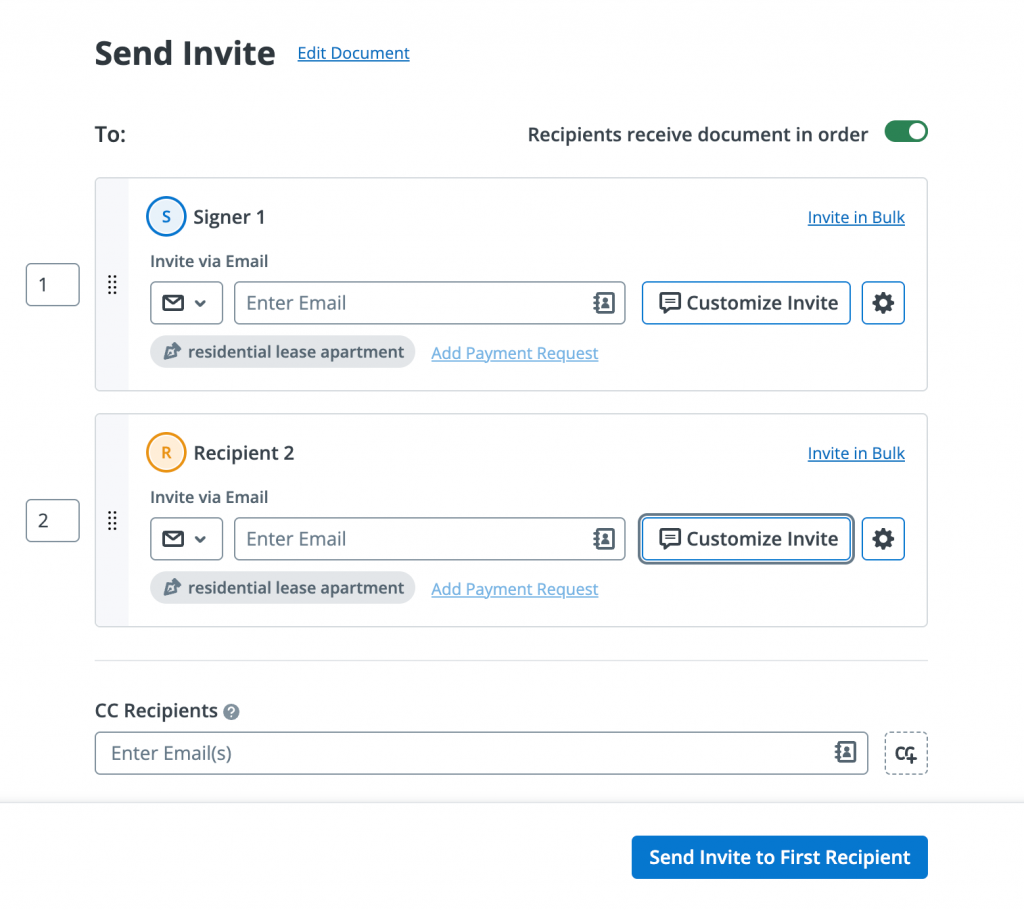
- Add the borrower and lender as recipients by email and assign each a role. A CC recipient, such as a bookkeeper, receives the completed document without signing.
- If the file already carries native fillable fields, accept Add Fields; otherwise, choose Skip and place them yourself.
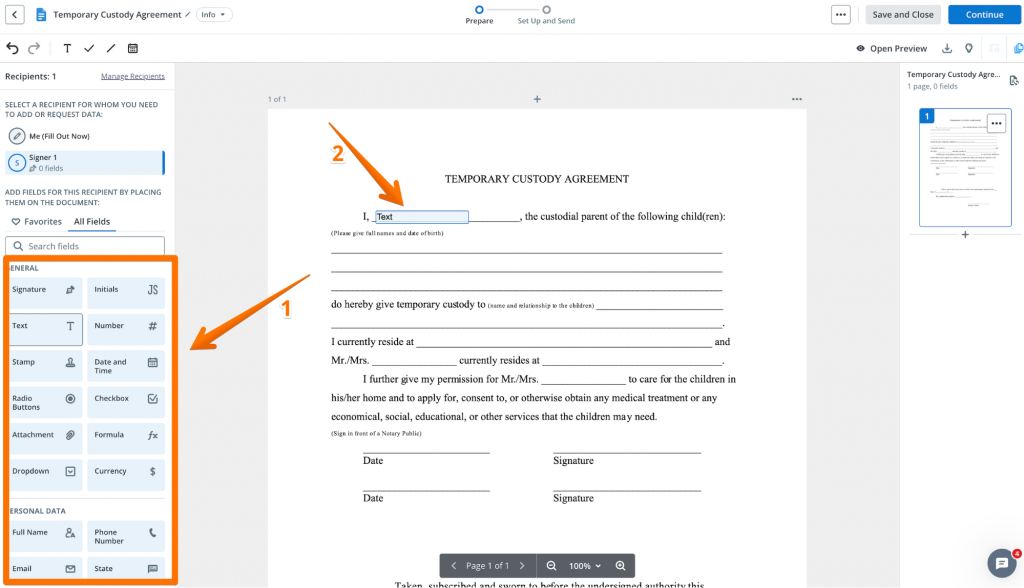
- Select a signing role, then drag Signature, Text Field, Date, and Checkbox fields onto the note. Assign the principal and interest fields to the lender’s role and the acknowledgment fields to the borrower’s, so neither party can edit the other’s entries.
- Click Open Preview to check the note as the signer will see it, then Back to Editing.
- Click Continue to reach the Invite page. Set the Signing Order if the lender signs first, use Customize Message for the email subject and body, and open Manage Additional Settings to add recipient authentication and automatic reminders.
Turn the finished file into a template with Make Template, and it appears in the Templates folder for reuse. Teams issuing many notes at once can send in bulk on Business Premium at $15 per user per month; the current tiers are listed on the SignNow pricing plans page, and reusable templates are available on all paid plans.
The paper savings are the part that customers notice first. “SignNow has changed our workflows to be more streamlined and efficient. We saved more than 1500 pieces of paper converting to an electronic format,” says Nicholas Tovar, SHRM-CP.
When an e-signature is enough, and when it is not
For an ordinary promissory note between two individuals or two businesses, an electronic signature carries the same legal weight as ink under the federal ESIGN Act and state enactments of UETA, and SignNow maintains electronic signature legality guidance by country.
A note secured by real property is the exception, and it is a technical one. Under the transferable record rules, an electronic note only replaces the paper original when a system reliably establishes control through a single authoritative copy that is unique, identifiable, and unalterable except by authorized revision. A signed PDF sitting in shared storage does not meet that test, no matter how valid the signature on it is. Mortgage lenders solve this with eNote vaults registered on the MERS eRegistry, which passed 3 million registered eNotes in March 2026, with leading adopters registering between 30% and 80% of their originations electronically.
“Surpassing 3 million eNotes reflects the steady progress the industry has made in modernizing how loans are produced, transferred, and managed,” said Bob Hart, President of ICE Mortgage Technology.
The practical rule: Use e-signature for personal, family, and ordinary business notes. If the note is secured by a home and will be sold or pledged into the secondary market, it needs a registered eNote system, which is a separate category of product from a general-purpose e-signature platform.
If the borrower stops paying
Start with a written demand that states the missed amounts and the cure period, because acceleration clauses usually require notice before the full balance comes due. If that fails, the remedies are small claims court below the state’s dollar threshold, a civil suit above it, and repossession or foreclosure of named collateral on a secured note.
Timing is the trap. Enforcement of a note payable at a definite time must begin within six years after the due date, and a demand note left untouched for ten continuous years without a payment of principal or interest becomes unenforceable.
Evidence is the other half. The audit trail records each signing action with timestamps and signer details, which is what answers a borrower who claims they never signed. That record sits inside a platform audited against SOC 2 Type II, 21 CFR Part 11, GDPR, and PCI DSS standards, described on the security and compliance page.
Final thoughts
A promissory note protects the lender only if it carries the elements a court looks for, prices interest at or above the applicable federal rate, and is signed in a way you can prove afterwards. Build it once as a reusable template, assign each field to the borrower or the lender, and every loan after the first takes minutes instead of a redraft. Build your own or start from one of the ready-made promissory note templates and adapt it.
Start your journey with SignNow today—enjoy a 7-day free trial with no credit card required! Check out our current plans on the SignNow pricing page.
Key terms
Acceleration clause: A provision letting the lender declare the entire unpaid balance due after a default.
Authoritative copy: The single controlled electronic version that stands in for a paper original under the transferable-record rules.
Holder in due course: A party who takes a negotiable instrument in good faith and for value, with stronger rights than an ordinary assignee.
Imputed interest: Interest the tax code treats as paid on a below-market loan even though no money changed hands.
Negotiable instrument: A document meeting the UCC 3-104 conditions, which can be transferred to another holder.
Principal: The original amount lent, before interest.
FAQ
Does a promissory note need to be notarized?
No. A note is binding on signature and consideration. Notarization adds evidentiary weight by confirming identity, and some states or recorders require it for notes connected to recorded property interests, so check the rule in the governing-law state.
Can a promissory note be signed electronically?
Yes, for ordinary notes, under ESIGN and state UETA enactments. A note secured by real property additionally needs a system that controls a single authoritative copy to qualify as a transferable record under 15 U.S.C. 7021.
What is the difference between a promissory note and a loan agreement?
The note is the borrower’s unilateral promise to repay. A loan agreement is a two-sided contract with covenants and obligations for both parties, and it is normally used for larger or commercial lending.
How long do I have to enforce a promissory note?
Six years after the due date for a note payable at a definite time, and six years after demand for a demand note, with a ten-year outer limit where no demand is made and no payment is received.
What interest rate can I charge a family member?
Anything up to the state usury cap, but pricing below the IRS applicable federal rate can cause forgone interest to be imputed to the lender unless the loan stays inside the $10,000 de minimis threshold.
What happens if the borrower stops paying?
Send a written demand, then accelerate if the note allows it, then sue in small claims or civil court. On a secured note, the lender can also move against the named collateral.
Sources
- Uniform Commercial Code 3-104 — Cornell Law School LII
- Uniform Commercial Code 3-118 — Cornell Law School LII
- 15 U.S.C. 7021, Transferable records — Cornell Law School LII
- 26 U.S.C. 7872, Below-market loans — Cornell Law School LII
- Internal Revenue Bulletin 2026-37, applicable federal rates — IRS, 2026
- MERS eRegistry Surpasses 3 Million eNotes — Intercontinental Exchange, 2026
- 2025 Friends and Money Report — LendingTree, 2025
- TL;DR
- What a promissory note is, and what makes it binding
- What to include in the template
- Choosing the repayment structure
- Setting the interest rate without creating a tax problem
- How to fill out and send the note in SignNow
- When an e-signature is enough, and when it is not
- If the borrower stops paying
- Final thoughts
- Key terms
- FAQ
- Sources