
Electronic signature GDPR compliance: How EU businesses can avoid costly fines

Electronic signature GDPR compliance means ensuring that the collection, processing, and storage of personal data within an eSignature workflow meet the requirements of the EU’s General Data Protection Regulation (GDPR). It doesn’t govern the signature itself, but all the personal data handling and personal data involved in the signing workflow. According to the GDPR, personal data encompasses any information that can identify an individual, including data processed through electronic signature workflows.
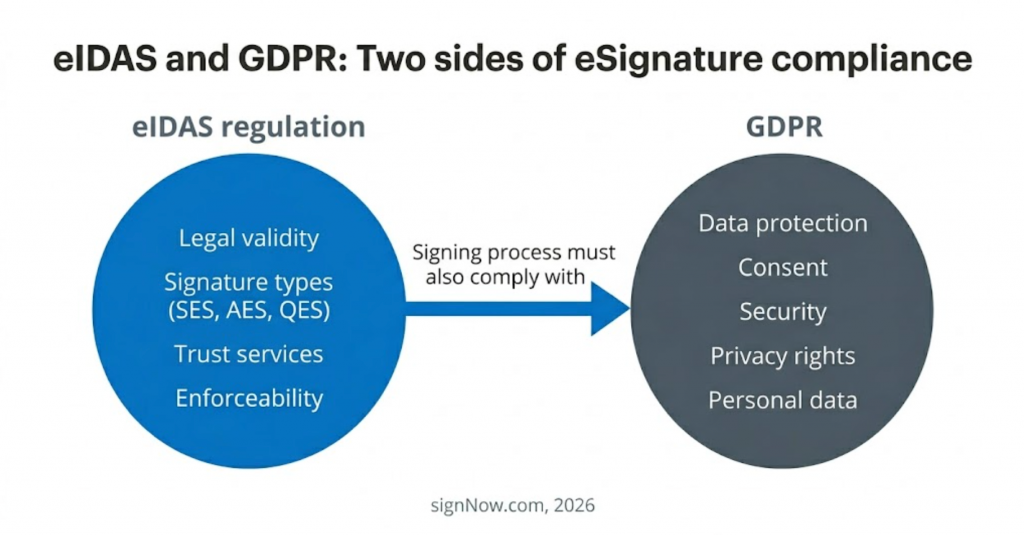
Think of it this way: the eIDAS regulation is like a car’s registration — it proves the vehicle is legally a car. GDPR is the driver’s license and insurance — it proves you’re handling that car responsibly and protecting everyone on the road. You need both to operate legally.
TL;DR: Key facts on eSignature compliance in the EU
- According to the DLA Piper 2026 survey, total GDPR fines issued since 2018 have surpassed €7.1 billion across the European Economic Area and the UK, making non-compliance a serious financial risk for any business handling EU personal data.
- The global digital signature market is projected to reach $70.2 billion by 2030, with Europe as a key driver due to regulations like eIDAS and GDPR. (MarketsandMarkets, 2025)
- An ABA Tech Report 2024 found 68% of organizations increased their use of eSignatures, with 85% citing compliance and security as top selection criteria for their provider.
- A signature can be legally valid under eIDAS while still violating GDPR — for example, if the signer’s consent to data processing was not properly obtained before the signing event. (International Journal of Law and Information Technology, 2024)
- Compliance under GDPR covers five distinct obligations: lawful basis, data minimization, security of processing, data residency, and upholding data subject rights.
- SignNow is SOC 2 Type II certified, GDPR-compliant, and offers EU data residency on all paid plans starting at $8/user/month.
This guide is for EU businesses, their partners, and legal professionals seeking to ensure their electronic signature workflows meet GDPR requirements.
Why GDPR compliance for eSignatures matters
It’s critical for electronic signatures to comply with GDPR because non-compliance exposes businesses to substantial financial penalties, undermines customer trust, and can render digital agreements unenforceable under EU law — even when the signature itself is technically valid under eIDAS.
Real financial risks
Since enforcement began in May 2018, total GDPR fines have surpassed €7.1 billion, with regulators now targeting data processors more frequently, not just controllers. An eSignature platform that stores signer IP addresses, email addresses, and timestamps without a lawful basis or a proper Data Processing Agreement is a liability, not an asset.
Customer trust as a competitive factor
According to the ABA TechReport 2024, 85% of legal professionals say compliance and security are their top priorities when choosing an eSignature provider. In regulated industries like healthcare, finance, and legal services, businesses that can’t prove their workflows are GDPR-compliant often lose contracts to those that can.
Misunderstanding the legal distinction
The crucial point businesses miss is that eIDAS and GDPR are not interchangeable

A signature that meets eIDAS standards can still be challenged or create regulatory risk if the underlying data processing is unlawful. This dual-compliance requirement is the most common gap in eSignature deployments across the EU.
How a GDPR-compliant eSignature process works
A GDPR-compliant electronic signature process involves five sequential obligations: establishing a lawful basis for data collection, minimizing the data captured during signing, securing the processing event, storing data in accordance with residency requirements, and maintaining mechanisms for data subjects to exercise their rights.
Here is how each step maps to specific GDPR articles:
1. Establish a lawful basis and obtain consent (Art. 6). Before sending a document for signature, an organization must have a lawful basis for processing the signer’s personal data. For most commercial contracts, this basis is contractual necessity (Art. 6(1)(b)). For other documents, like consent forms or marketing agreements, explicit consent is required (Art. 6(1)(a)). Using the correct basis is critical, as choosing the wrong one is a GDPR violation.
2. Minimize data collection during the signing event (Art. 5). GDPR’s data minimization principle requires collecting only what is strictly necessary.
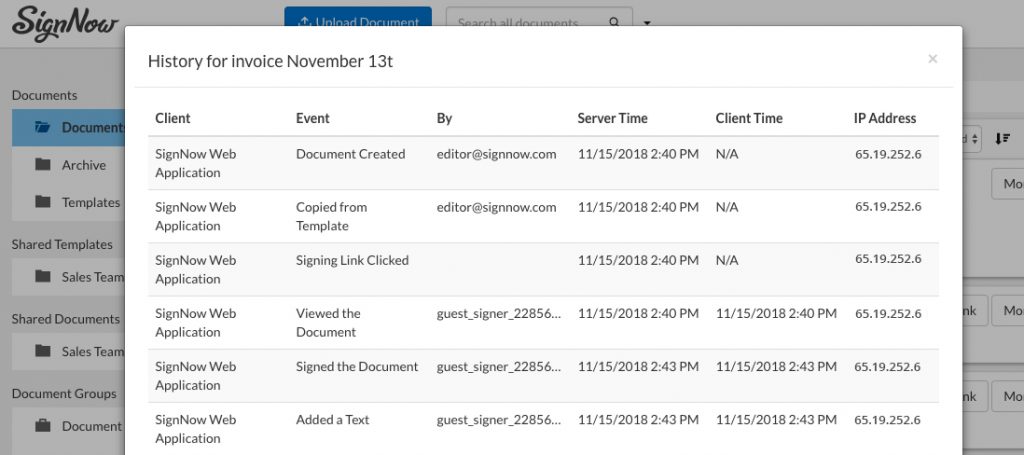
3. Secure the processing event and generate an audit trail (Art. 32). The platform must use appropriate technical measures to secure data, including encryption, access controls, and a tamper-proof record of every signing action. SignNow captures IP addresses, device information, timestamps, and all field interactions to create a court-admissible audit trail. This record logs who opened the document, when they viewed it, when they signed, and from what device, providing a clear chain of evidence that proves the integrity of the signing process.
4. Store data according to residency and retention requirements. While GDPR doesn’t set specific data residency rules, EU authorities require that personal data from EU activities is not transferred to other countries without proper safeguards. Organizations processing data for EU residents should select a provider offering EU data center options. SignNow offers EU data residency on all paid plans.
5. Manage data subject rights (Arts. 15–22). GDPR gives individuals the right to access, correct, and — in some cases — erase their personal data. This “right to erasure” creates a practical challenge for eSignature workflows. While a signer can request to have their personal data deleted, maintaining signed documents may still be necessary for legal, regulatory, or contractual reasons. Organizations should clearly document their data retention policies and the legal grounds for keeping data after an erasure request. This is one of the most frequently litigated areas of GDPR enforcement for eSignatures.
Key features of a GDPR-compliant eSignature platform
A GDPR-compliant eSignature platform must offer EU data residency, detailed audit trails, advanced signer authentication, strong encryption, and certified security standards — and these features should be available without requiring custom configuration or additional vendor engagement.
According to Forrester’s 2024 report, leading platforms are differentiated by their ability to offer EU data residency, comprehensive audit trails, and support for all three eIDAS signature levels. Here is what to look for:
- EU data residency. It’s the ability to store all document data and personal data in EU-based data centers. SignNow offers data residency in the US or EU on all paid plans, satisfying the cross-border transfer requirements that GDPR imposes on data controllers operating in the EU.
- Court-admissible audit trail. A tamper-evident log that captures the full name, email address, IP address, and timestamp for every action in a signing session. The SignNow audit trail is included in the Certificate of Completion, meets the evidentiary requirements of GDPR’s Article 32, and is admissible in legal proceedings.
- Advanced recipient authentication. Multi-factor verification before a signer can access a document, including password protection, SMS one-time codes, or phone call verification. SignNow’s two-factor authentication is available on the Enterprise and Site License plans and supports GDPR’s requirement to verify that personal data is accessed only by authorized individuals.
- AES-256 encryption and TLS 1.2/1.3. Data is encrypted at rest using AES-256-bit encryption and in transit using TLS 1.2/1.3. This ensures personal data captured during signing cannot be intercepted or accessed without authorization, directly supporting the requirement for appropriate technical security measures under GDPR Article 32.
- SOC 2 Type II certification and GDPR compliance. Third-party-audited security controls demonstrate that the platform’s data-handling practices meet recognized standards. SignNow is SOC 2 Type II certified and GDPR compliant, with a security and compliance overview available for enterprise due diligence.
In addition to these features, SignNow’s comprehensive security and compliance measures provide a strong foundation for meeting GDPR requirements.
eIDAS vs. GDPR: Understanding the two pillars of EU eSignature law
While both are EU regulations affecting electronic signatures, they serve different functions. eIDAS defines the legal validity and types of eSignatures, while GDPR governs how personal data collected during the signing process is protected.
The table below clarifies the most common points of confusion between the two frameworks.
| Aspect | eIDAS regulation (910/2014) | GDPR (2016/679 |
| Primary goal | Establish a legal framework for electronic signatures and trust services across the EU | Protect the personal data and privacy of individuals within the EU |
| Scope | Electronic signatures, seals, timestamps, and authentication services | Any processing of personal data, including data collected during a signing event |
| Key focus | Signature validity, legal equivalence to handwritten signatures, cross-border recognition | Lawful basis, consent, data minimization, security, and data subject rights |
| Example of compliance | A Qualified Electronic Signature (QES) is legally equivalent to a handwritten signature in all EU member states | A signer’s email address and IP address are processed only under a documented lawful basis, with a DPA in place with the eSignature provider |
| Example of non-compliance | Using a Simple Electronic Signature (SES) for a document that legally requires a QES | Collecting signer data without a lawful basis, or transferring that data outside the EU without adequate safeguards |
For example, a contract signed with an Advanced Electronic Signature (AES) is fully valid under eIDAS. However, if the eSignature platform transfers signer data to servers outside the EU without proper safeguards like the EU-U.S. Data Privacy Framework or Standard Contractual Clauses, the signature remains valid, but the data transfer violates GDPR. The eIDAS Regulation establishes a predictable regulatory environment for electronic transactions, but it does not substitute for GDPR data protection obligations.
Who needs GDPR-compliant eSignatures?
Any organization that collects personal data from EU residents during a signing workflow needs to use GDPR-compliant eSignatures. This rule applies even if the organization is based outside the EU.
Who needs to be compliant? Legal, HR, finance, and operations teams at any company operating in the EU or serving EU residents. This includes non-EU companies with EU-based customers or employees.
What documents are affected? Any document that contains sensitive personal data and requires a signature, including employment contracts, patient intake forms, loan applications, and consent forms.
Where does this apply? The rule applies to any signing workflow that includes the personal data of an EU resident, regardless of where the signing occurs.
When does GDPR apply? GDPR applies from the moment you collect personal data. In a signing workflow, that’s when a signer’s email is entered into the platform, not when they sign the document.
Why is this important? GDPR compliance helps you avoid significant fines, ensure agreements are legally enforceable, and meet the standards of customers and partners.
How can you stay compliant? Choose an eSignature platform with EU data residency, a clear Data Processing Agreement, strong multi-factor authentication features, and a detailed audit trail. Also, make sure your internal processes establish a lawful basis for data collection before sending any document.
Industry-specific scenarios illustrating GDPR practical stakes
Healthcare — patient intake forms. A clinic using SignNow to send patient intake forms is processing sensitive health and personal data. SignNow’s HIPAA and GDPR compliance ensures that data is encrypted, stored in the selected residency region, and protected by access controls — all critical for a data category that carries a high GDPR enforcement risk.
Financial services — loan applications. A bank processing loan applications needs advanced signer authentication to verify identities before granting document access. It also needs a detailed audit trail to show regulators that the signing process was controlled and documented. SignNow’s advanced recipient authentication, available on the Enterprise plan, directly supports these requirements.
Legal services — settlement agreements. A law firm sending settlement agreements across EU jurisdictions needs to know that client data is stored in an EU data center and that the platform uses recognized data transfer frameworks. SignNow addresses this by participating in the EU-U.S. Data Privacy Framework and offering EU data residency as a standard feature.
Benefits of adopting a compliant eSignature solution
Adopting a GDPR-compliant eSignature solution produces several measurable business outcomes, including reduced legal and financial exposure, stronger customer trust, simpler cross-border EU operations, stronger global compliance readiness, and preparedness for upcoming regulatory changes.
- Reduced risk of regulatory fines. With cumulative GDPR penalties exceeding €5 billion since 2018, the cost of a compliant platform is a fraction of a single enforcement action. Organizations that document their lawful basis for processing, maintain clear audit trails, and use a certified eSignature provider are in a stronger position during regulatory investigations.
- Higher win rate in enterprise procurement. 85% of legal and compliance professionals cite compliance and security as their primary vendor selection criteria. A GDPR-compliant workflow is no longer a differentiator — it is a baseline requirement for selling into regulated industries. Lucija Hrvat, Course Coordinator at Instituto Italiano di Fotografia, put it directly: “We can recommend SignNow not only because of compliance, but also because it is easy in use for us and for all the applicants.”
- Simpler cross-border EU transactions. eIDAS ensures that electronic signatures are mutually recognized across all EU member states. By combining eIDAS-valid signatures with GDPR-compliant data handling, you can remove legal uncertainties in cross-border digital transactions. This prevents issues when parties in different countries question whether a signing process meets their national data protection laws.
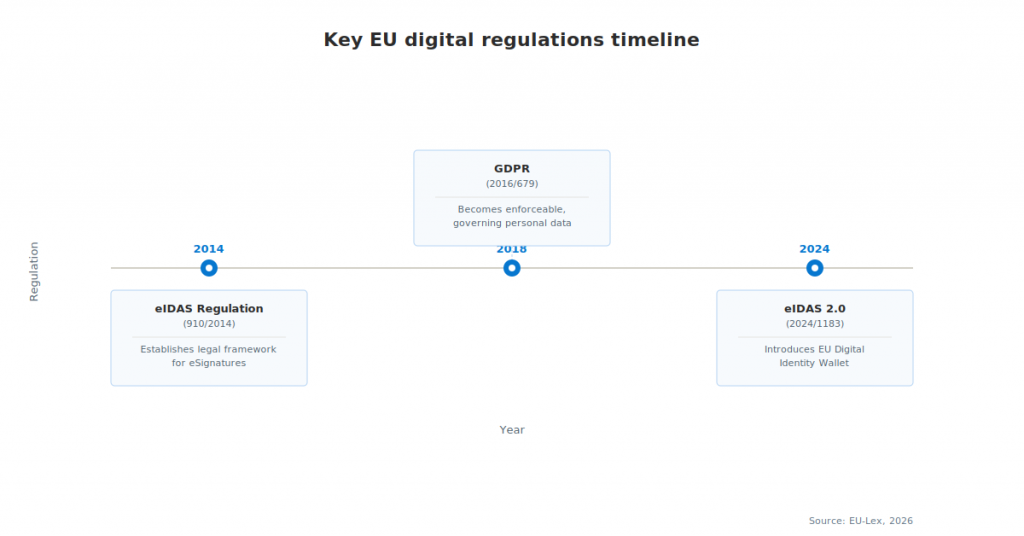
- Preparedness for eIDAS 2.0. The upcoming EU Digital Identity Wallet, part of eIDAS 2.0 (Regulation 2024/1183), will streamline identity verification for Qualified Electronic Signatures. It also strengthens the connection between identity proofing and data handling. Organizations with existing GDPR-compliant workflows will find it much easier to adapt to these new requirements than those starting from scratch.
- Operational efficiency alongside compliance. SignNow customers report saving up to 6 hours per employee per week after switching from paper-based signing processes — demonstrating that compliance and efficiency are not in tension when the platform is designed for both.
Stay compliant with SignNow’s eSignature solution
Navigating eIDAS and GDPR is simpler when your platform is built for both. SignNow is GDPR-compliant and SOC 2 Type II-certified, offering EU data residency, court-admissible audit trails, AES-256 encryption, and advanced signer authentication. Plans start at just $8 per user per month, with unlimited users included at no extra cost.
With features designed for compliance, you can streamline your workflows while upholding the highest standards of data protection. Secure your digital agreements and ensure GDPR compliance with SignNow. Start your 7-day free trial today — no credit card required.
Glossary
- Advanced Electronic Signature (AES): An electronic signature that meets eIDAS Article 26 requirements. It is uniquely linked to the signatory, created using data under their sole control, and linked to the signed data so that any subsequent changes are detectable.
- Data Processing Agreement (DPA): A legally binding contract between a data controller and a data processor, required under GDPR Article 28, that specifies the scope, purpose, and security requirements for processing personal data on behalf of the controller.
- eIDAS: Regulation (EU) No 910/2014 on electronic identification and trust services for electronic transactions in the internal market, which establishes the legal framework for electronic signatures, seals, and timestamps across EU member states.
- GDPR: The General Data Protection Regulation (EU) 2016/679, which governs the collection, processing, and storage of personal data belonging to individuals within the EU, came into force on 25 May 2018.
- Qualified Electronic Signature (QES): The highest level of electronic signature under eIDAS, created using a Qualified Electronic Signature Creation Device and based on a qualified certificate, legally equivalent to a handwritten signature in all EU member states.
- Simple Electronic Signature (SES): The most basic level of electronic signature under eIDAS. It can be any electronic data used by a signatory to sign, such as a typed name or scanned signature image.
FAQ
1. Are electronic signatures compliant with GDPR?
Whether an electronic signature is GDPR-compliant depends entirely on how the signing platform handles personal data. A signature might be legally binding under eIDAS but still violate GDPR. This can happen if the platform collects a signer’s data without a lawful basis, lacks a Data Processing Agreement, or fails to offer an EU data residency option. Therefore, compliance requires not just a valid signature, but a lawful data processing framework to support it.
2. What is the difference between eIDAS and GDPR?
The eIDAS regulation (910/2014) provides the legal foundation for electronic signatures within the EU. It outlines three distinct types—Simple (SES), Advanced (AES), and Qualified (QES)—and establishes their legal standing relative to handwritten signatures. Separately, the GDPR (Regulation 2016/679) regulates how personal data, including information collected during the signing process like email and IP addresses, is handled. It’s crucial to understand that these two regulations are independent; compliance with one does not guarantee compliance with the other.
3. Does an electronic signature count as personal data under GDPR?
Yes. An electronic signature typically contains or is linked to personal data — at minimum, the signer’s name, email address, and IP address. Under GDPR Article 4(1), any information relating to an identified or identifiable natural person constitutes personal data. This means that the entire signing workflow, including invitation emails, audit trail records, and the signed documents themselves, is subject to GDPR regulations. Therefore, all data must be processed according to a documented and lawful basis.
4. Do I need a Data Processing Agreement with my eSignature provider?
Yes. Under GDPR Article 28, any organization that engages a third-party service provider to process personal data on its behalf must have a written Data Processing Agreement (DPA) in place. An eSignature platform processes signer data, such as names, emails, IP addresses, and timestamps, on behalf of the document sender. Without a DPA, the document sender is in violation of GDPR regardless of the platform’s own compliance status. Most compliant signature providers, including SignNow, offer a standard DPA as part of their enterprise agreements. The full text of the General Data Protection Regulation outlines the specific rights and legal obligations for data controllers and processors.
5. What personal data is collected during an electronic signature process?
A typical signing workflow collects: the signer’s full name, email address, IP address, device type and browser information, geolocation data (in some configurations), and timestamps for every action taken — including document open, field completion, and signature placement. Some workflows also collect phone numbers for SMS authentication. Each of these data points falls under GDPR’s definition of personal data and must be processed under a lawful basis documented before the signing invitation is sent.
Sources
- GDPR Fines and Data Breach Survey — DLA Piper, 2026
- Digital Signature Market Size & Forecast — MarketsandMarkets, 2025
- ABA TechReport: E-Signature Adoption and Compliance — ABA, 2024
- eIDAS and GDPR Dual Compliance Requirements — International Journal of Law and Information Technology, 2024
- “The European Commission proposal amending the eIDAS regulation (EU) No 910/2014: A personal data protection perspective” by Alessandro Ortalda, Niko Tsakalakis, Lina Jasmontaite – Brussels Privacy Hub
- The Digital Signature And Trust Solutions Landscape, Q1 2024 — Forrester, 2024
- eIDAS Regulation (910/2014) — EU-Lex
- General Data Protection Regulation (2016/679) — EU-Lex
- SignNow Security and Compliance Overview — SignNow
- Why GDPR compliance for eSignatures matters
- How a GDPR-compliant eSignature process works
- Key features of a GDPR-compliant eSignature platform
- eIDAS vs. GDPR: Understanding the two pillars of EU eSignature law
- Who needs GDPR-compliant eSignatures?
- Benefits of adopting a compliant eSignature solution
- Stay compliant with SignNow’s eSignature solution
- Glossary
- FAQ
- Sources