
How to sign as power of attorney: The correct format for every document type


Signing as power of attorney (POA) requires three elements: the principal’s name, your name, and a word or phrase that identifies your role as agent. Think of it like a permission slip — it needs to show whose permission is being granted and who is actually signing. Leave any one of these out, and you risk having the document rejected — or worse, being held personally liable for the transaction.
The exact wording varies depending on the document type. Bank signature cards, checks, real estate transactions, and healthcare forms each have their own requirements in addition to the standard format, and getting one wrong is enough to have a teller or title company send an otherwise valid power of attorney back for correction.
This guide covers the mechanics of the signature itself: the format, worked examples, document-type rules, the role of notarization and eSignatures, and how agents sign documents correctly under a POA. For a broader overview of how power of attorney works, visit SignNow’s blog post: “What is power of attorney, and how does it work for signing documents?”
Disclaimer: The information contained in this blog post is provided for general informational purposes only and does not constitute formal legal advice.
TL;DR
- The correct format discloses both names and the agency relationship, for example: “[Principal’s name], by [Agent’s name], as attorney-in-fact.” Never sign your own name alone or the principal’s name alone.
- The core format stays the same across document types, but banks, county recorders, and healthcare providers each add their own extra requirements.
- eSigning a document under a POA is generally valid under the ESIGN Act and UETA, though this is a separate question from whether the POA itself still requires notarization.
- About 31 states and Washington, D.C., have adopted the Uniform Power of Attorney Act, which gives a properly executed POA a statutory right to acceptance within defined timelines.
- Keep a dated record of every transaction: amount, purpose, and the parties involved.
- Signing authority ends at revocation, an expiration date, incapacity (for a non-durable POA), or the principal’s death, whichever comes first.
Disclaimer: The information contained in this blog post is provided for general informational purposes only and does not constitute formal legal advice.
Before you sign anything
Here’s what to check and have in order before you sign anything:
- Have three things ready: the power of attorney document, your government-issued photo ID, and confirmation that the transaction falls within the legal authority the document grants.
- Bring the original POA, or a certified or notarized copy. A photocopy of a photocopy is often refused outright.
- Use your own photo ID, not the principal’s.
- Re-read the granted-powers clause before signing. A financial POA does not automatically cover health-related decisions, and a limited POA may not cover the specific account or property involved.
- Check with the institution in advance. If a bank, title company, or other institution has its own signature-card format, confirm what’s expected before your appointment — it can save you a second trip.
That authority is a fiduciary duty, not a formality. An agent, or attorney-in-fact, who signs outside the document’s scope or can’t produce the underlying paperwork upon request risks having the transaction unwound and being held personally liable for any resulting loss.
Consider an adult child acting as agent for an aging parent, a common real-world use case. Before signing a home-equity paperwork package, the agent calls the lender’s POA department, learns the lender wants the principal’s name listed first on every signature line, and brings both the original POA and a certified copy to the closing. The extra call adds a day to the timeline; skipping it risks a rejected closing package and a second appointment.
Any agent preparing to sign on behalf of the principal should run through this checklist, regardless of the relationship. The goal is to confirm scope and format directly with the institution involved, whether that’s a bank, a title company, or a hospital admissions office. Do this before the appointment, not during. An institution that hasn’t reviewed the agent’s paperwork in advance has no obligation to accept an unfamiliar format on the spot.
The correct way to sign a power of attorney document
Two formats are both correct. In the first, the principal’s name comes first:
“[Principal’s name], by [Agent’s name], as attorney-in-fact.”
In the second, the agent’s name comes first:
“[Agent’s name], as attorney-in-fact for [Principal’s name].”
Either order works as long as both names and the agency relationship are visible on the page.
The Consumer Financial Protection Bureau’s own guide for agents gives this model:
“Juan Doe, as agent for Martina Roe.”
Two more worked examples, using a placeholder agent and principal:
- “Maria Alvarez, by Daniel Alvarez, as attorney-in-fact” (principal-first)
- “Daniel Alvarez, as attorney-in-fact for Maria Alvarez” (agent-first)
Which signing format is preferred?
Most institutions accept either ordering, as long as the principal’s name, the agent’s name, and an agency phrase (“by,” “as attorney-in-fact for,” or “as POA for”) are all present. To avoid a second visit, confirm the receiving party’s preferred order ahead of time, as outlined in the previous section.
The same logic applies when the principal is a business owner rather than an individual. If a small-business owner grants a POA to a partner or an office manager, the agent’s signature line should still name the principal by their own legal name (not just the business name), followed by the agent’s name and the attorney-in-fact notation, since the authority flows from the individual who signed the POA, not from the business entity itself.
One SignNow customer’s experience captures why this level of precision matters, even outside a legal setting:
“SignNow provides us with the flexibility needed to get the right signatures on the right documents, in the right formats, based on our integration with NetSuite.” —SignNow customer
When preparing a document for signature, place the signature field and the attorney-in-fact notation on the same line. This makes the signer’s authority clear to anyone who reviews the document later.
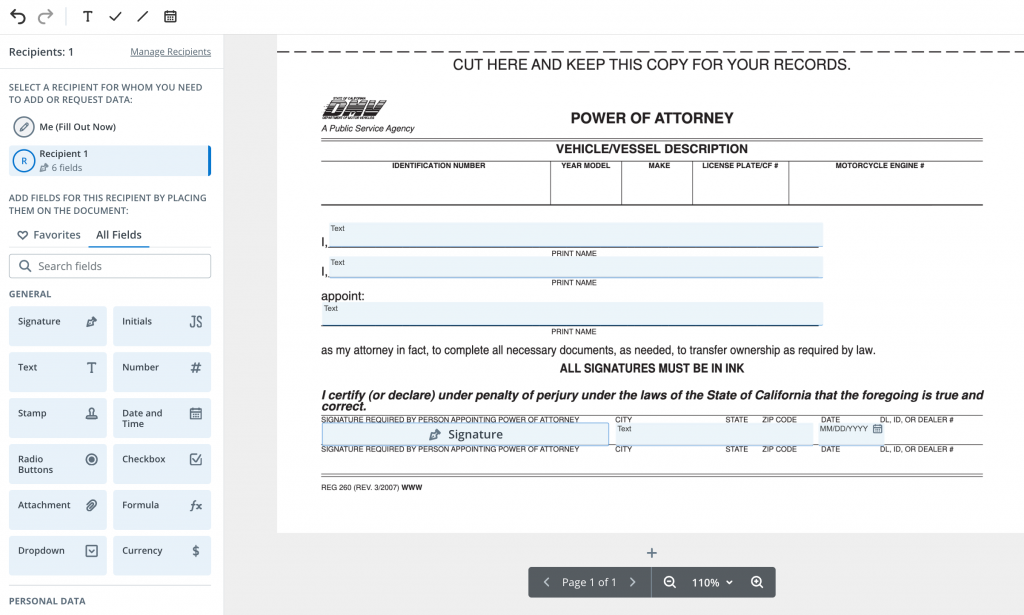
Signature format by document type
The core format stays the same across document types, but banks, county recorders, and healthcare providers each layer on their own extra requirements.
Document type | Signature format note | Extra requirement | Risk if skipped |
Bank and financial documents | Use the standard two-name format; confirm the bank’s preferred name order before the appointment | Some banks require the POA on file with their POA department in advance | Document rejected at the teller window, requiring a second visit |
Checks | Endorse using the same attorney-in-fact format on the back of the check | The bank typically needs the POA on file before the check will clear | Check held or returned unpaid |
Real estate deeds and mortgages | Use the standard format on the deed itself | The deed usually requires notarization, and many counties require the POA document to be recorded with the county recorder | Deed rejected by the title company or county recorder, delaying closing |
Healthcare forms | Confirm the POA explicitly grants healthcare authority before signing | A financial power of attorney does not automatically cover medical decisions; a separate healthcare POA is often required | Provider refuses the signature, treating it as unauthorized |
A real estate closing illustrates why the extra layer matters. A buyer’s agent signing a deed on the principal’s behalf typically needs the deed notarized in the agent’s presence, and the title company or county recorder may separately require the power of attorney document itself to be recorded before the sale closes. Skipping either step doesn’t just delay the paperwork: it can leave the transfer of title open to challenge later, which is a far more expensive problem than a second notary appointment.
Why it matters: A signature that satisfies the general format rule can still fail a document-specific requirement, so confirming both layers before the appointment is what actually prevents a rejection.
How to sign as power of attorney: A General guide for agents
When acting as an agent under a power of attorney, following proper signing protocol ensures that transactions are legally binding on the principal while protecting you from personal legal liability.
1. Verify your authority and validity: Confirm that the POA explicitly grants authority for the specific transaction (e.g., real estate, banking, or business decisions). Verify it hasn’t been revoked or expired, and that the principal is still living — POA authority automatically terminates upon the principal’s death.
2. Check institutional requirements: Contact the receiving party, such as a bank, title company, or court, to ask if they have a mandatory signature layout or require pre-approval of your POA document before the signing date.
3. Match names exactly: Write or print the principal’s name precisely as it appears on the relevant account, property record, or underlying POA document without variations or nicknames.
4. Use an explicit representative signature format: Sign your own name next to or beneath the principal’s name, accompanied by a title that clearly indicates your legal capacity. Standard accepted formats include:
- [Principal’s Name], by [Your Signature], Attorney-in-Fact
- [Your Signature], Agent for [Principal’s Name]
5. Confirm eSignature acceptance: If completing the transaction digitally, verify in advance that all receiving parties accept legally binding electronic signatures for POA transactions. Use a trusted eSignature solution, like SignNow, to ensure your electronic signatures are secure and legally valid under key industry regulations.
6. Review for intent: Carefully read the entire agreement before signing to confirm all terms accurately reflect the principal’s financial or personal interests and fall within your authorized duties.
7. Maintain thorough records: Keep copies of all signed documents, accompanying proof of authority, and written receipts to maintain a clear record of your actions as an agent.
8. Provide proof of authority: Bring the original notarized POA or a certified copy, plus a valid government-issued photo ID. Most institutions won’t accept a representative signature without verifying the underlying legal authorization.
Common mistakes that create personal liability
The most common error agents make when signing under a power of attorney is using only their own name or only the principal’s name without an agency notation. Either approach can leave the agent personally liable for the transaction.
Pitfalls to watch out for
Agents using only their own name is not the only mistake that can result in personal liability. There are other pitfalls to be aware of when acting as an agent under a power of attorney:
- Omitting the agency notation entirely, so the document reads as if you signed for yourself. A signature that looks personal is treated as personal, agency intent aside.
- Signing after the POA has been revoked or the principal has died. A POA is only valid during the principal’s lifetime and automatically expires at the moment of their death. However, banks and title companies have no way of verifying whether the timing was honored unless the agent discloses it themselves.
- Signing for something outside the specific powers granted, even when it seems like a reasonable extension of the agent’s role. A POA that grants banking authority doesn’t automatically extend to selling real estate, for example.
- Mixing the principal’s funds or property with your own, even temporarily or with good intentions. The CFPB’s fiduciary-duty guidance is explicit that an agent must keep the principal’s assets entirely separate, in a distinct bank account whenever practical.
- Failing to keep a contemporaneous record of the transaction, so there’s nothing to point to if the signature or the underlying decision is later questioned by another family member, a court, or the institution itself.
Banks and financial institutions scrutinize agent signatures closely — and for good reason. According to the FBI’s 2024 Internet Crime Report, the average reported loss in an internet-crime complaint filed by someone aged 60 or older was $83,000. Elder financial exploitation remains a recognized enforcement priority. That’s why a caregiving agent managing a parent’s finances should expect and prepare for more scrutiny than an agent handling a routine business transaction. Thorough record-keeping isn’t just paperwork; it’s protection.
What a power of attorney agent can never sign
Some acts are personal by law and can’t be delegated to an agent, no matter how broadly the power of attorney is written. These include:
- Voting in an election.
- Executing or changing a will or codicil.
- Marrying or divorcing on the principal’s behalf.
- Taking an oath that must legally be the principal’s own.
A power of attorney ends the moment the principal dies. An agent’s authority under a POA is not the same as an executor’s authority under a will: signing as an agent after death carries no legal authority. This is a common stumbling block in HR and benefits contexts. An agent who has spent years signing a parent’s insurance paperwork cannot continue doing so after death, even for routine account cleanup. At that point, signing authority transfers to the estate’s executor, not the former agent.
Electronic signatures and notarization: Two separate steps to a valid POA
An electronic signature on a document you’ve been asked to sign carries the same legal weight as a wet-ink signature. That’s a separate question from whether the power of attorney document itself needs to be notarized under your state’s rules.
The federal ESIGN Act and UETA give electronic signatures the same legal standing as wet-ink signatures for most contracts. Wills are the most notable exclusion, along with a short list of other document types, such as adoption paperwork and court orders, not powers of attorney themselves. An agent should still confirm a specific institution’s policy before relying on an eSignature for a high-stakes transaction.
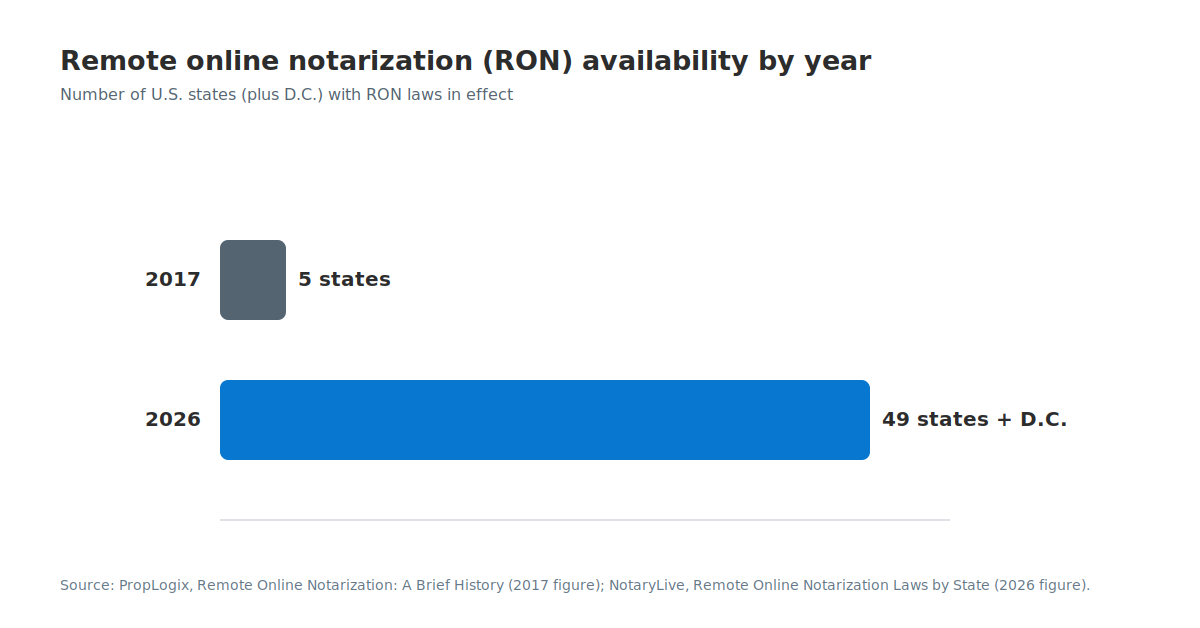
Most states still require a power of attorney to be notarized, and sometimes witnessed, even when the underlying transaction is e-signed. These are two separate requirements. Remote online notarization (RON) is now available in 49 states and Washington, D.C., as of 2026, meaning agents can complete notarization online without visiting a notary in person.
Why it matters
Confusing “eSigned” with “notarized” is the most common mistake agents make with electronic signing — and it’s the one most likely to surface after a transaction has already closed, when both steps were assumed to be complete.
Take a real estate closing involving an out-of-state principal: the purchase agreement and disclosures can be eSigned by the agent from anywhere, but the deed still requires notarization — either in person or via a remote online session where available. That’s a common scenario where the distinction between eSigning and notarization becomes impossible to ignore.
How it works
In practice, routing a POA-backed document for signature typically involves three steps:
- Start with a reusable template instead of a blank upload.
- Set a signing order for the principal, agent, and receiving institution.
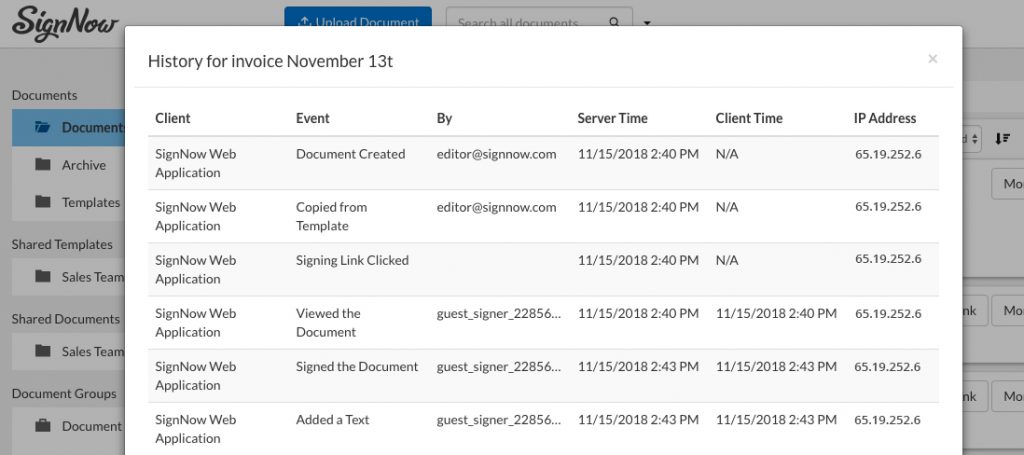
- Rely on a timestamped audit trail once all parties have signed.
Automatic field detection can also place signature and date fields on a scanned POA-backed document without manual setup, reducing the exact placement errors described earlier in this guide. These SignNow eSign Power of Attorney capabilities, along with 24/7 online notarization, are included on Business Premium, Enterprise, and Site License subscription plans; advanced signer authentication for verifying a signer’s identity is available with Enterprise and Site License plans.
Where remote online notarization isn’t available for a specific document type or state, in-person notarization remains a valid alternative; it just requires scheduling a visit rather than completing the step from wherever the agent is. For documents where RON is supported, SignNow’s 24/7 online notarization handles the notarization step directly within the platform.
When a bank or institution refuses a valid power of attorney
In roughly 31 states plus the District of Columbia, the Uniform Power of Attorney Act gives a validly executed POA a statutory right to acceptance, with fixed response windows for the institution.
Under the model act, an institution generally has about seven business days to accept the document, refuse it on a legally recognized ground, or request supporting materials, then five more business days after receiving satisfactory materials to make a final decision. An institution that refuses without a legally recognized ground can face a court order compelling acceptance, along with liability for the agent’s reasonable attorney’s fees.
This protection isn’t universal. Not every state has adopted the Uniform Power of Attorney Act. Agents in states that haven’t should follow the earlier guidance: confirm format and documentation requirements directly with the institution before the appointment, rather than assuming a statutory backstop is in place. It’s essential to thoroughly review your state laws before appointing an agent or drafting your power of attorney document.
In practice, a refusal is rarely the institution ignoring the law outright. It’s more often a front-line employee who hasn’t seen that specific POA format before, or a policy that requires manager sign-off on any agent-signed transaction over a certain dollar amount. Asking to speak with a supervisor or the bank’s dedicated POA or estates department resolves most refusals faster than a legal threat, and the UPOAA’s timelines are most useful as a backstop when that escalation doesn’t work.
Final thoughts
Every document signed as an agent should leave a paper trail, because fiduciary duty and legal protection both depend on being able to show what was signed and why.
Record the date, amount, purpose, and parties involved for each transaction, and avoid cash payments where a traceable alternative exists. A simple dated log, even a spreadsheet with one row per transaction, is enough to satisfy this duty; what matters is that it exists and is contemporaneous rather than reconstructed later from memory.
Signing authority ends when the principal dies, revokes the POA in writing, when an expiration date in the document is reached, or, for non-durable POAs only, when the principal becomes incapacitated. Signing after any of these events carries the same legal exposure as signing without authority, regardless of how routine the transaction seems. An agent who keeps signing after a parent’s death, assuming small transactions will go unnoticed, takes on personal liability for actions that legally require an executor’s signature.
SignNow makes it straightforward to prepare a power of attorney. Use ready-made templates, drag-and-drop fields for names and signatures, and secure online notarization — all without leaving your desk.
Try SignNow for free today and experience the convenience of modern document management.
Key terms
- Agent (attorney-in-fact): The person authorized by a power of attorney to act on the principal’s behalf. The agent’s authority is limited to what the POA document specifically grants — not a blanket license to act in every context.
- Durable power of attorney: A POA that stays in effect if the principal becomes incapacitated. This distinction determines whether an agent’s authority survives a medical event that leaves the principal unable to communicate.
- Notarization: A notary public verifies the signer’s identity and witnesses the signature — typically required for the POA instrument itself. This is separate from whether the signature on a given document is electronic or wet-ink.
- Principal: The person who grants authority to an agent through a power of attorney. Only the principal, while competent, can create, modify, or revoke that authority.
- Remote online notarization (RON): Notarization completed over live video instead of in person, available in 49 states plus Washington, D.C. as of 2026. RON laws are based on where the notary is commissioned, not where the signer is located.
- Uniform Power of Attorney Act (UPOAA): A model law adopted in roughly 31 states plus D.C. that standardizes agent authority and sets timelines for third-party acceptance of a valid POA. States that haven’t adopted it may still recognize POAs, but without the same statutory acceptance timelines.
FAQ
What is the correct way to sign as power of attorney?
Write the principal’s name, your own name, and an agency phrase such as “as attorney-in-fact,” in either order, so both names and the relationship are visible. The Consumer Financial Protection Bureau’s model example is “Juan Doe, as agent for Martina Roe.” Signing your own name alone is the most common way this goes wrong.
How do I sign checks as power of attorney?
Endorse the check using the same two-name, attorney-in-fact format on the back, and confirm beforehand that the bank already has the power of attorney on file, since most banks require that before a check will clear. Some banks also ask the agent to sign a separate signature card in person before the first check is processed.
Can a power of attorney be signed electronically?
In most cases, yes. The ESIGN Act and UETA allow you to sign documents electronically with the same legal weight as a handwritten signature, making them legally valid in most transactions. That said, the power of attorney document itself may still require notarization depending on your state, regardless of how the underlying transaction is signed. Think of these as two separate requirements, not one.
What happens if you sign incorrectly as power of attorney?
Signing without an agency notation may be read as signing personally, exposing the agent to liability for the transaction and potentially invalidating the document in the eyes of the receiving institution. In practice, this usually surfaces first as a rejected transaction, and as a liability question only if a dispute follows later.
Does a power of attorney need to be notarized to be valid?
Most states require the power of attorney document itself to be notarized, and in some cases witnessed, separately from whether any transaction document it’s used to sign is paper or electronic. Requirements vary enough by state that confirming with the specific institution or county recorder is worth doing before relying on a document as final.
What can’t a power of attorney do or sign?
An agent can’t vote, execute, or change a will or codicil; marry or divorce on the principal’s behalf; or take an oath that must legally be the principal’s own, no matter how broadly the document is written. These limits exist because the acts are considered too personal to delegate, regardless of how much authority the principal intended to grant.
Authority ends at the principal’s death, written revocation, an expiration date in the document, or, for a non-durable POA, the principal’s incapacity, whichever happens first. After any of those points, a former agent who continues signing is acting without authority, even for routine matters.
Sources
- Help for agents under a power of attorney
- Uniform Power of Attorney Act: rules and state adoption
- 2025 Elder Exploitation Infographic
- Remote online notarization laws by state
- Remote online notarization: a brief history and current state laws
- Electronic signature law: ESIGN Act and UETA
- eSign Power of Attorney
- TL;DR
- Before you sign anything
- The correct way to sign a power of attorney document
- Signature format by document type
- How to sign as power of attorney: A General guide for agents
- Common mistakes that create personal liability
- What a power of attorney agent can never sign
- Electronic signatures and notarization: Two separate steps to a valid POA
- When a bank or institution refuses a valid power of attorney
- Final thoughts
- Key terms
- FAQ
- What is the correct way to sign as power of attorney?
- How do I sign checks as power of attorney?
- Can a power of attorney be signed electronically?
- What happens if you sign incorrectly as power of attorney?
- Does a power of attorney need to be notarized to be valid?
- What can’t a power of attorney do or sign?
- When does signing authority under a power of attorney end?
- Sources