What is a power of attorney, and how does it work for signing documents?

Power of attorney (POA) is a legal document that lets one person, the principal, authorize another person, the agent or attorney-in-fact, to act on their behalf. It can cover a single transaction, like closing on a house, or a broad financial and personal authority that lasts for years. This article covers what a POA is, the main types, what makes one legally binding, and how the actual signing process works, on paper and electronically, so a reader who needs one soon can act with confidence.
TL;DR
- A power of attorney authorizes an agent (attorney-in-fact) to act for a principal; it ends at the principal’s death and never replaces a will.
- The main types are durable, general, limited or special, springing, and medical or healthcare POA, each granting a different scope of authority.
- Validity generally requires the principal’s capacity at signing, a written signature, and, in most states, notarization and sometimes witnesses.
- As of 2019, 26 states had adopted the Uniform Power of Attorney Act, which standardizes the rules for creating and agent duties (Uniform Law Commission, via Wikipedia, 2019).
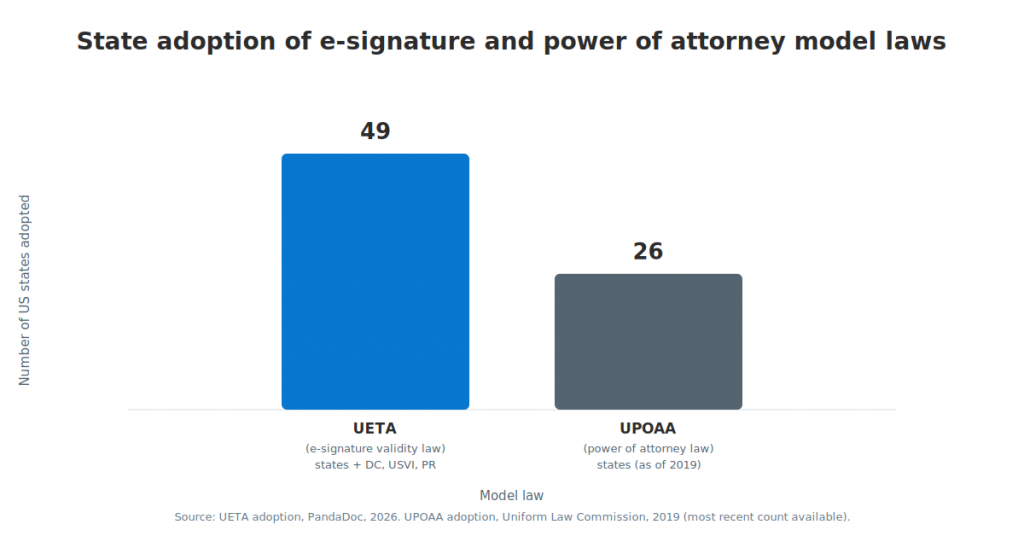
- Electronic signatures on a POA carry the same legal weight as handwritten ones under the federal ESIGN Act and the state-level UETA, adopted by 49 states plus DC, provided state notarization and witness rules are still met (PandaDoc, 2026).
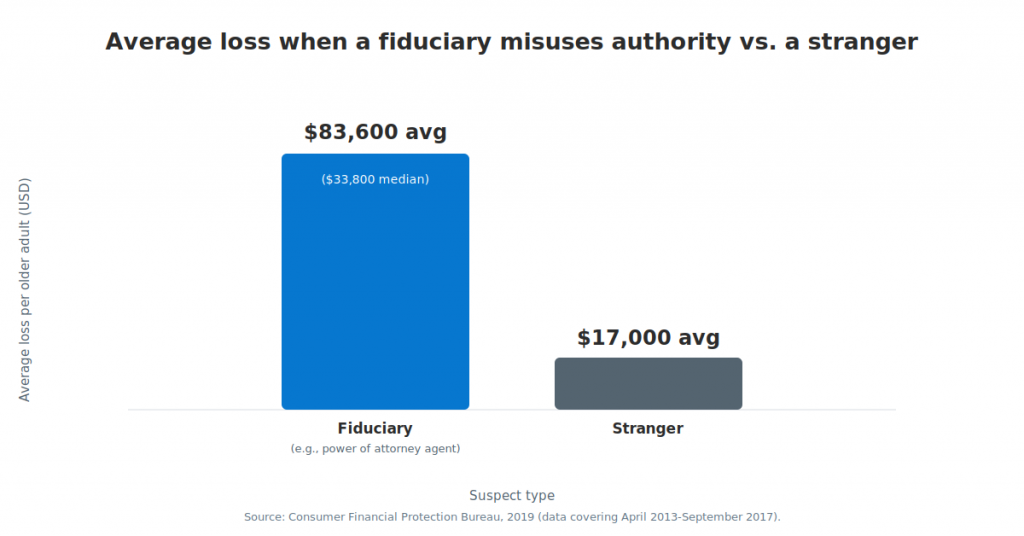
- Agents owe fiduciary duties to the principal; misuse by a fiduciary, including a POA agent, produced an average loss of $83,600 per older adult in documented cases (Consumer Financial Protection Bureau, 2019).
What is power of attorney?
A power of attorney is a signed legal document giving one person, the agent, the authority to make decisions or sign documents for another person, the principal. The scope of that authority is defined entirely by the document itself: a POA can be narrow, such as signing a single real estate closing document, or broad, covering banking, contracts, taxes, and property management.
Why it matters
Without a POA in place before a person loses capacity, family members typically cannot act on that person’s behalf without going to court for a guardianship or conservatorship, a slower and more expensive process. A POA is not the same as a will; a will only takes effect after death, while a POA is only valid while the principal is alive and stops the moment they die.
Every POA involves three core components:
- The principal — the person granting authority
- The agent or attorney-in-fact — the person receiving it
- The document itself, which defines the scope and limits of that authority
Many principals draft a POA using a state-specific legal form rather than writing one from scratch, since notarization and witness requirements vary by state, and a generic template can miss a required clause.
What are the types of power of attorney?
There are five common types of power of attorney, and picking the wrong one is one of the most frequent mistakes people make. Each type defines a different scope and duration of authority.
- General power of attorney: grants broad authority over financial and legal matters, but only while the principal remains mentally competent. It ends if the principal becomes incapacitated.
- Durable power of attorney: covers the same broad authority as a general POA, but remains in effect if the principal becomes incapacitated. Most estate planning attorneys recommend including durable language as a default.
- Limited or special power of attorney: restricts authority to a single transaction or task, such as selling a specific property or managing one bank account.
- Springing power of attorney: only takes effect after a specific triggering event — most commonly a physician’s determination that the principal is incapacitated.
- Medical power or healthcare power of attorney: gives the agent authority to make healthcare decisions on the principal’s behalf only. To do this effectively, the healthcare agent may need access to protected health information to make informed medical decisions. This is a separate document from a financial power of attorney and is governed by different state statutes.
The table below outlines the key differences between various types of powers of attorney for easy reference.
| Type | Takes effect | Survives incapacity |
General | Immediately | No |
| Durable | Immediately | Yes |
| Limited/special | Immediately, for one task | Depends on wording |
| Springing | On a triggering event | Yes, by design |
| Medical/healthcare | Immediately or on incapacity | Yes |
What are the legal requirements for a power of attorney to be binding?
A power of attorney becomes legally binding when the principal signs it while of sound mind (with the mental capacity to understand what they’re authorizing) and when it meets their state’s execution requirements.
Most states require three things for a POA to be legally binding:
- The principal’s signature
- Proof of legal capacity at the time of signing
- Notarization
Some states also require witnesses in addition to notarization, and a few mandate both a notary and two witnesses. That’s why you should always check your state’s specific requirements before finalizing a POA.
As of 2019, 26 states had adopted the Uniform Power of Attorney Act, a model law that standardizes how a POA is created, what duties an agent owes, and when third parties, like banks, must accept a properly executed document. States that haven’t adopted the Uniform Act still recognize powers of attorney — they simply follow their own statutes. Because state laws governing powers of attorney vary, a document that’s valid in one state may need to be re-notarized or reissued after a move.
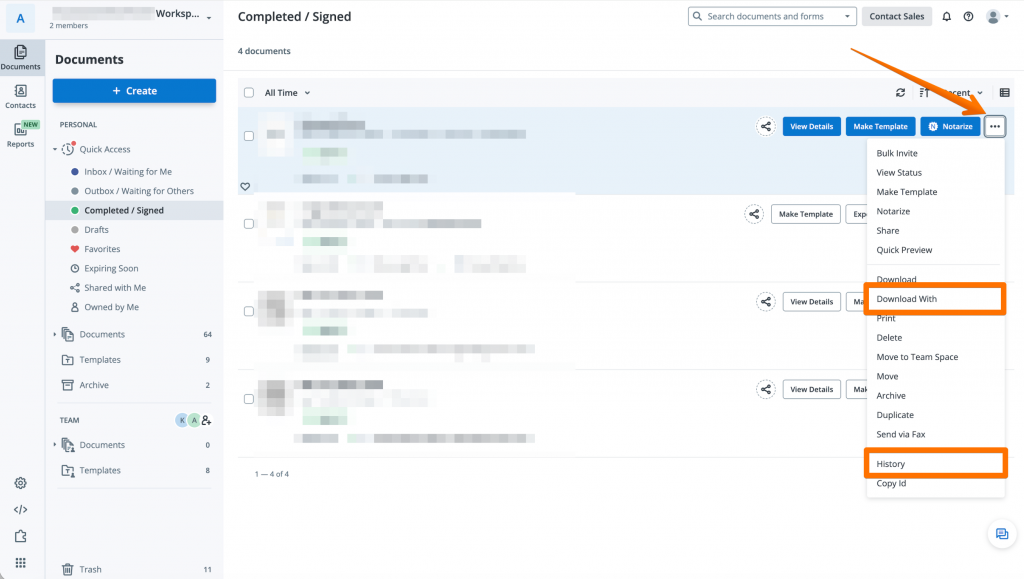
Once signed, the document becomes the agent’s proof of authority. Financial institutions (like banks), hospitals, and title companies will typically ask for the original or a certified copy before acting on it, which is why storing signed documents in a searchable, cloud-based library is just as important as getting the signature right.
How does the power of attorney form work for signing documents?
Power of attorney works in four practical stages: preparing the document, the principal signing it with capacity, satisfying the state’s notarization or witness rule, and the agent later using the document to sign on the principal’s behalf when authority is actually needed.
- Choose the right form and scope. Start from a state-specific power of attorney template rather than a generic one-size-fits-all document, since the required clauses (durability language, hot-powers grants, notary blocks) differ by state.
- Confirm the principal has capacity. The principal must understand what they are signing and its consequences at the moment of signing; a POA signed after capacity is already lost can be challenged and invalidated.
- Sign in front of a notary (and witnesses, if required). Most states require notarization for the document to be presumptively valid; some add one or two witnesses on top of that.
- Distribute copies to the people who will rely on it. Banks, healthcare providers, and title companies each need to see the executed document before honoring the agent’s authority, so keeping a signed copy accessible and shareable avoids delays later.
- The agent signs only when authority is actually exercised. Having a POA does not require the chosen agent to sign anything immediately; the document simply grants the standing authority to act when the need arises.
A real estate transaction is one of the most common situations where a POA comes into play. If a seller can’t attend closing in person, they can grant a limited POA to a trusted representative. That trusted person then signs the closing documents on the seller’s behalf, with the notarized POA attached as proof of authority for the title company’s records.
How do you sign as someone’s power of attorney (agent signature format)?
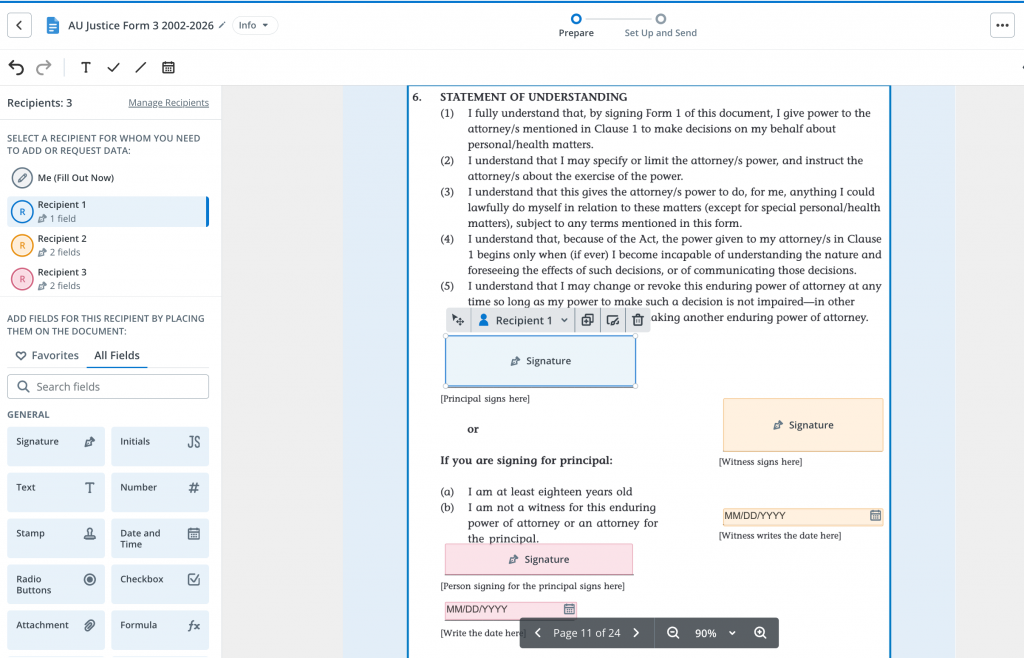
To sign as an agent, write the principal’s full legal name first, then your own name, followed by a designation that makes clear you’re signing on their behalf. Accepted formats include “[Principal’s Full Name], by [Agent’s Full Name], as Power of Attorney” or “as Attorney-in-Fact.”
- Confirm the exact wording your bank, title company, or counterparty expects. Formats accepted for a mortgage closing can differ from those accepted for a simple bank withdrawal.
- Write or type the principal’s name exactly as it appears on the underlying account or property record.
- Add your own name and the POA designation immediately after, on the same signature line.
- Bring or attach a copy of the notarized POA document itself. Most institutions will not accept the signature format alone without seeing the underlying authority.
Can you sign and notarize a power of attorney electronically?
Yes, in most states, an electronically signed power of attorney is legally valid, provided the same notarization and witness rules that apply to a paper POA are still satisfied. The federal ESIGN Act and the state-level Uniform Electronic Transactions Act give an electronic signature the same legal weight as a handwritten one; 49 states plus DC, the US Virgin Islands, and Puerto Rico have adopted UETA, while New York uses its own Electronic Signatures and Records Act to the same effect.
Notarization is one area that still requires attention. Many states now allow remote online notarization, which lets the principal sign and be notarized over live video instead of appearing in person, closing most of the gap between paper and electronic execution. SignNow’s Business Premium, Enterprise, and Site License plans include 24/7 online notarization built into the same workflow as the signature itself, along with a court-admissible audit trail that timestamps every action for later verification.
Two-factor signer authentication and a customizable signing order add another layer of assurance for a document as consequential as a POA, since advanced recipient authentication confirms the person signing is actually the principal named in the document, not just anyone with access to the link.
What can and can’t a power of attorney agent do?
Understanding the limits of an agent’s authority is essential to safeguarding the principal — and avoiding costly mistakes.
An agent can only do what the document explicitly authorizes, and they owe the principal a fiduciary duty to act in the principal’s best interest, not their own. That duty includes:
- Acting with reasonable care
- Keeping accurate records of transactions made on the principal’s behalf
- Avoiding conflicts of interest
Certain actions, sometimes called hot powers, require the document to grant them expressly and are never assumed by default: making gifts of the principal’s property, changing beneficiary designations, or creating or amending a trust. An agent who exceeds the document’s actual scope, whether through a hot power or simple overreach, can be held personally liable for the resulting harm.
This is not a theoretical risk. Fiduciary abuse, including misuse by a POA agent, appeared in about 7% of elder financial exploitation cases reported to regulators, but produced far larger losses than other kinds of exploitation when it did occur: an average of $83,600 per older adult, compared with $17,000 when a stranger was responsible (Consumer Financial Protection Bureau, 2019). Keeping every signed transaction in a single, auditable document library gives both the agent and the principal’s family a clear record if a transaction is ever questioned.
When does a power of attorney expire?
A power of attorney doesn’t last forever. Here are the most common ways it comes to an end:
- The principal passes away. The POA becomes void immediately upon death.
- The principal revokes it. As long as the principal remains mentally competent, they can revoke the POA at any time.
- It reaches its expiration date or fulfills its purpose. Some POAs are written with a set end date or a specific goal in mind.
- The principal becomes mentally incapacitated (non-durable POA only). Unlike a durable POA, a non-durable POA stops the moment the principal loses mental capacity — which is exactly the gap a durable POA is designed to fill.
To revoke a POA, the principal typically needs to provide a written revocation notice to the agent and any institution relying on the document. A bank or title company that has already seen the POA has no way of knowing it’s been revoked unless notified directly. If you’re changing agents, correcting an error, or simply ending the arrangement, execute a written revocation and replace it with an updated, properly notarized document — don’t assume the old one will lapse on its own.
Common power of attorney signing mistakes to avoid
Small errors in how a POA is signed, witnessed, or formatted can render the entire document invalid — here’s what to watch out for:
- Using the wrong signature format. Signing only your own name, without the principal’s name and a POA designation, is one of the most common reasons a document is rejected.
- Assuming one state’s notarization rule applies everywhere. Notarization and witness requirements differ by state; a document valid in one state can need re-execution after a move.
- Skipping a required witness. Some states require a notary and one or two witnesses. Omitting the witness’s signature can invalidate an otherwise correctly signed document.
- Relying on an outdated or wrong-state template. A generic form found online may be missing a clause a specific state requires, such as durability language or a hot-powers grant; a current, state-specific legal form library helps avoid this.
Final thoughts
Power of attorney forms can help simplify important legal decisions by letting someone you trust act on your behalf when needed. Whether you’re planning for future medical care, financial matters, or temporary assistance, understanding how a power of attorney works can help you make informed choices and avoid unnecessary complications.
If you’re ready to create and manage your power of attorney documents with confidence, SignNow makes it straightforward — from drafting to signing, notarizing, and storing. Start your free trial today and see how easy it is to keep your important documents organized and legally sound.
Key terms
- Principal: The person who grants authority to another person by signing a power of attorney.
- Agent (attorney-in-fact): The person authorized to act on the principal’s behalf under the document’s terms.
- Durable power of attorney: A POA that explicitly remains valid after the principal becomes incapacitated.
- Springing power of attorney: A POA that only takes effect after a defined future event, typically incapacity.
- Fiduciary duty: The legal obligation to act in the principal’s best interest, with reasonable care and without self-dealing.
- UETA (Uniform Electronic Transactions Act): The state-level law giving electronic signatures the same legal weight as handwritten ones.
- ESIGN Act: The federal law establishing that electronic signatures and records are valid for transactions in interstate commerce.
Frequently asked questions
A power of attorney is a signed legal document that authorizes a designated agent — also referred to as an attorney-in-fact — to act on behalf of the principal. Depending on how the document is written, the agent’s authority can be narrow, covering just a single transaction or decision, or broad enough to encompass a wide range of financial and personal matters on the principal’s behalf.
The principal signs the document while they have legal capacity — meaning they fully understand what they’re authorizing. From there, the document is typically notarized, and in some states, one or more witnesses must also sign. Once complete, the agent presents the document as proof of their authority whenever they need to act on the principal’s behalf, whether that’s signing a contract, managing bank accounts, or making another permitted decision.
The main types of power of attorney are general, durable, limited or special, springing, and medical or healthcare. Each type differs in the scope of authority it grants — for example, whether it covers financial decisions, healthcare choices, or a specific transaction — as well as how long that authority lasts and under what conditions it takes effect or expires.
Yes. A POA does not require an attorney to draft it, as long as it meets the principal’s state’s signing, capacity, and notarization requirements. Many principals use a state-specific template rather than drafting one from scratch.
In most states, notarization is required for a POA to be considered presumptively valid — meaning it will be accepted without additional proof of authenticity. Some states go a step further and also require one or two witnesses to be present at signing. Because these legal requirements vary from state to state, it’s important to check the specific rules that apply in the principal’s state before finalizing the document.
Yes. Under the federal ESIGN Act and UETA — adopted by 49 states and DC — an electronically signed POA holds the same legal weight as a handwritten one, as long as your state’s notarization and witness requirements are still met.
A POA becomes invalid under several circumstances: It ends automatically when the principal passes away; It can also be terminated earlier through a written revocation by the principal, or on a specific expiration date if one was included in the document; A non-durable POA also ends if the principal becomes incapacitated — unlike a durable POA, which is designed to remain in effect even then.
Sources
- UETA state adoption and electronic signature validity: PandaDoc, 2026
- Uniform Power of Attorney Act adoption: Wikipedia summary of Uniform Law Commission data
- Suspicious Activity Reports on Elder Financial Exploitation: Consumer Financial Protection Bureau, 2019
- 2025 Wills and Estate Planning Study: Caring.com
- What is a power of attorney: Forbes Advisor, reviewed by Karen C. Davakis
- Power of attorney resources: American Bar Association, Real Property, Trust and Estate Law Section
- Federal Deposit Insurance Corporation: The Electronic Signatures in Global and National Commerce Act (E-Sign Act)
- TL;DR
- What is power of attorney?
- What are the types of power of attorney?
- What are the legal requirements for a power of attorney to be binding?
- How does the power of attorney form work for signing documents?
- How do you sign as someone’s power of attorney (agent signature format)?
- Can you sign and notarize a power of attorney electronically?
- What can and can’t a power of attorney agent do?
- When does a power of attorney expire?
- Common power of attorney signing mistakes to avoid
- Final thoughts
- Key terms
- Frequently asked questions
- Sources