

Signatory authority is a critical concept in business and legal operations, granting individuals the power to sign documents on behalf of an organization. Understanding how to assign this authority properly ensures compliance, efficiency, and accountability within your organization.
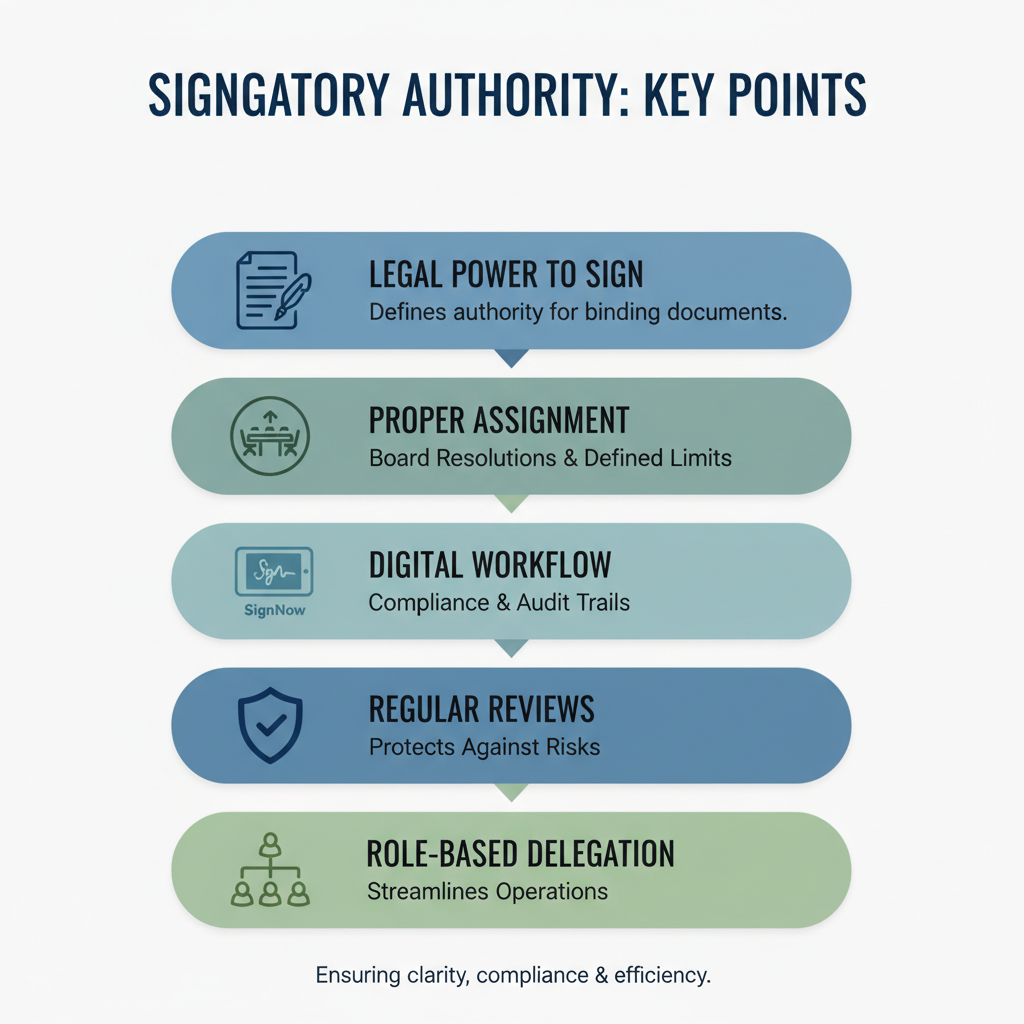
- Signatory authority is the legal power granted to an individual to sign documents and bind an organization to contracts.
- Proper assignment involves clear board resolutions, defined scope limits, and secure digital tools to prevent fraud or unauthorized commitments.
- Digital workflows using platforms like SignNow ensure audit trails and compliance with regulations like the ESIGN Act.
- Regular reviews of authorized signatories protect your business from risks associated with outdated permissions or former employees.
- Role-based delegation is the most scalable way to manage authority across departments like Finance, HR, and Legal.
When a manager signs a contract, they aren’t just writing their name. They are exercising a specific legal power known as signatory authority. This authority determines who can legally bind an organization to an agreement. If the person signing doesn’t have the proper authority, the contract might be unenforceable. This can lead to financial losses, compliance failures, or even personal liability.
Understanding signatory authority meaning is critical for any growing business. As companies expand, founders can no longer sign every document. They must delegate this power to trusted team members. This process requires careful planning to ensure compliance and reduce risk.
In this guide, we will explore what a signatory authority is and how to assign it effectively in 2026. We will cover the legal implications, practical steps for delegation, and how digital tools like SignNow make the process secure. Whether you are a procurement officer or a business owner, getting this right is essential for smooth operations.
Signatory authority is the official permission given to an individual to execute contracts or other legal documents on behalf of an organization. In the U.S., this concept is rooted in agency law and the Uniform Commercial Code (UCC). When an authorized representative signs a document, their signature has the same legal weight as if the company itself signed it.
This authority is not automatic for most employees. It must be formally granted through corporate bylaws, board resolutions, or specific policy documents. Without this grant, an employee generally cannot legally bind the company to financial agreements or strategic partnerships.
There are different types of authority to consider. Actual authority is explicitly given to an agent, while apparent authority occurs when a company acts in a way that leads others to believe an agent has authority. To avoid confusion and legal disputes, organizations should rely on explicit, written assignments of authority.
Getting signatory authority right protects your business. Unauthorized signatures can void contracts or commit the company to bad deals. Conversely, strict controls ensure that only the right people approve payments and execute contracts.
A clear signatory authority policy helps in several ways:
- Fraud prevention: Limits who can access funds or transfer assets.
- Operational efficiency: Prevents bottlenecks by distributing signing tasks.
- Compliance: Ensures regulatory filings (like tax forms or I-9s) are signed by an employer official with signatory authority.
Assigning authority is a structured process. It involves more than just telling a manager they can sign contracts. You need a repeatable workflow that creates a clear paper trail.
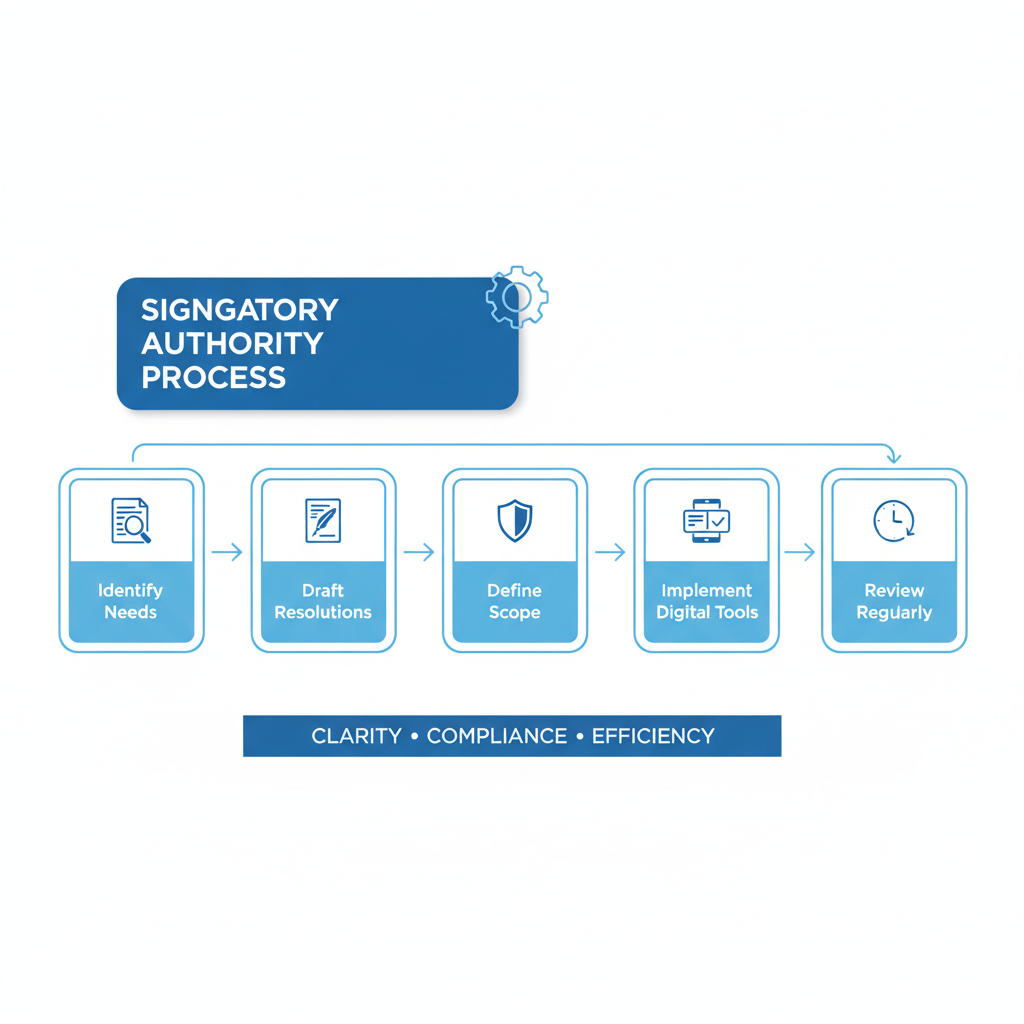
Step 1: Map your needs and risks
Start by identifying which documents need signatures. Look at your sales contracts, vendor agreements, and HR forms. Classify these by risk level. A non-disclosure agreement (NDA) carries different risks than a multi-million dollar merger.
Determine which roles need authority to sign. Do not assign authority to specific people; assign it to roles (e.g., “Senior VP of Sales” rather than “John Smith”). This makes handling turnover much easier.
Step 2: Draft board resolutions
For significant authority, use board resolutions. These are formal documents where the company’s board votes to grant specific powers to officers. A resolution should clearly state the scope of authority. For example, it might grant the Chief Financial Officer the power to sign documents related to banking but not real estate.
Step 3: Define scope and limits
Never grant “blank check” authority unless necessary. Set clear limits based on dollar amounts or document types.
- Department heads might sign expenses up to $10,000.
- Senior executives might sign contracts up to $100,000.
- Board members might be required for anything above that.
This tiered approach ensures that financial risks are managed appropriately. It also prevents any single person from committing the company to excessive financial transactions.
Sometimes, external parties need proof that a person can sign. A signatory authority letter (or letter of authorization) serves this purpose. This document, often signed by a corporate secretary or CEO, confirms that an individual is an authorized manager with the power to bind the company.
Once you have defined who can sign what, you need a way to enforce it. Paper processes are slow and hard to track. Digital solutions provide control and visibility. airSlate SignNow helps organizations operationalize their authority matrix effectively.
Role-based routing
With SignNow, you can create templates that enforce your approval hierarchy. If a document requires approval from a procurement manager before the CFO signs, you can set that signing order. This ensures that necessary approvals happen in the correct sequence every time.
Audit trails and security
Every transaction in SignNow generates a detailed audit trail. This log records who signed, when they signed, and from which IP address. This evidence is crucial if you ever need to prove proper authority in court. It turns digital signatures into verifiable proof of intent and consent.
Bulk sending for efficiency
When you need multiple signatories for standard forms—like updated HR policies—SignNow’s bulk send feature is invaluable. You can send thousands of documents at once, ensuring that every employee acknowledges the new signatory rules or policies instantly.
Different departments encounter unique needs for authorized signatures. Understanding these contexts helps you assign the right powers to the right teams.
Human resources and I-9 compliance
HR teams handle sensitive employment contracts and government forms. The Form I-9, for example, requires an employer official with signatory authority or an authorized representative to verify documents.
- Challenge: Remote hiring makes physical review difficult.
- Solution: Designate specific HR representatives with limited authority strictly for onboarding. Use SignNow to manage the document flow securely.
Finance and banking
The finance team manages closing accounts, opening lines of credit, and approving wires. Banks often require a specific signatory authority letter or resolution to process these requests.
- Risk: Unauthorized signatures on checks or wire transfers can drain accounts.
- Control: Implement dual-signature requirements for high-value transactions. Ensure your Chief Financial Officer and another executive must both sign.
Legal and procurement
Legal teams draft legal agreements, while procurement buys goods. Both need clear authority to execute contracts.
- Best practice: The procurement officer should have the authority to sign purchase orders up to a specific budget cap. Anything larger should escalate to senior executives.
- Legal weight: Ensure that non-disclosure agreements and vendor contracts are signed by someone with actual authority to avoid enforceability issues later.
It is important to distinguish between having the legal right to sign and the operational permission to do so.
- Legal authority: Derived from bylaws or board resolutions. It gives the person the legal power to bind the entity.
- Operational authority: Derived from internal policy. It dictates what a person should do.
If an employee with legal authority signs a contract that violates internal policy (e.g., signing a $50k deal when their limit is $10k), the company is likely still bound by the contract due to apparent authority. However, the employee may face internal disciplinary action. This distinction highlights why signatory authority matters so much—you need to align legal power with internal controls.
Maintaining a clean list of signatories requires ongoing effort. Here are actionable tips to keep your process tight.
1. Regular audits
Review your list of authorized signatories quarterly. Remove anyone who has left the company or changed roles. Old permissions are a major security gap.
2. Dual control
For significant financial agreements or strategic partnerships, two signatures are required. This “four-eyes principle” reduces the risk of error or internal fraud.
3. Use digital tools
Stop using wet ink for routine business. Platforms like airSlate SignNow allow you to manage signatory rights centrally. You can revoke access instantly if an employee leaves, which is impossible with a paper document.
4. Explicit delegation
Avoid vague language. Use specific titles and dollar amounts in your delegation documents. State clearly that this authority helps ensure compliance with the company bylaws.
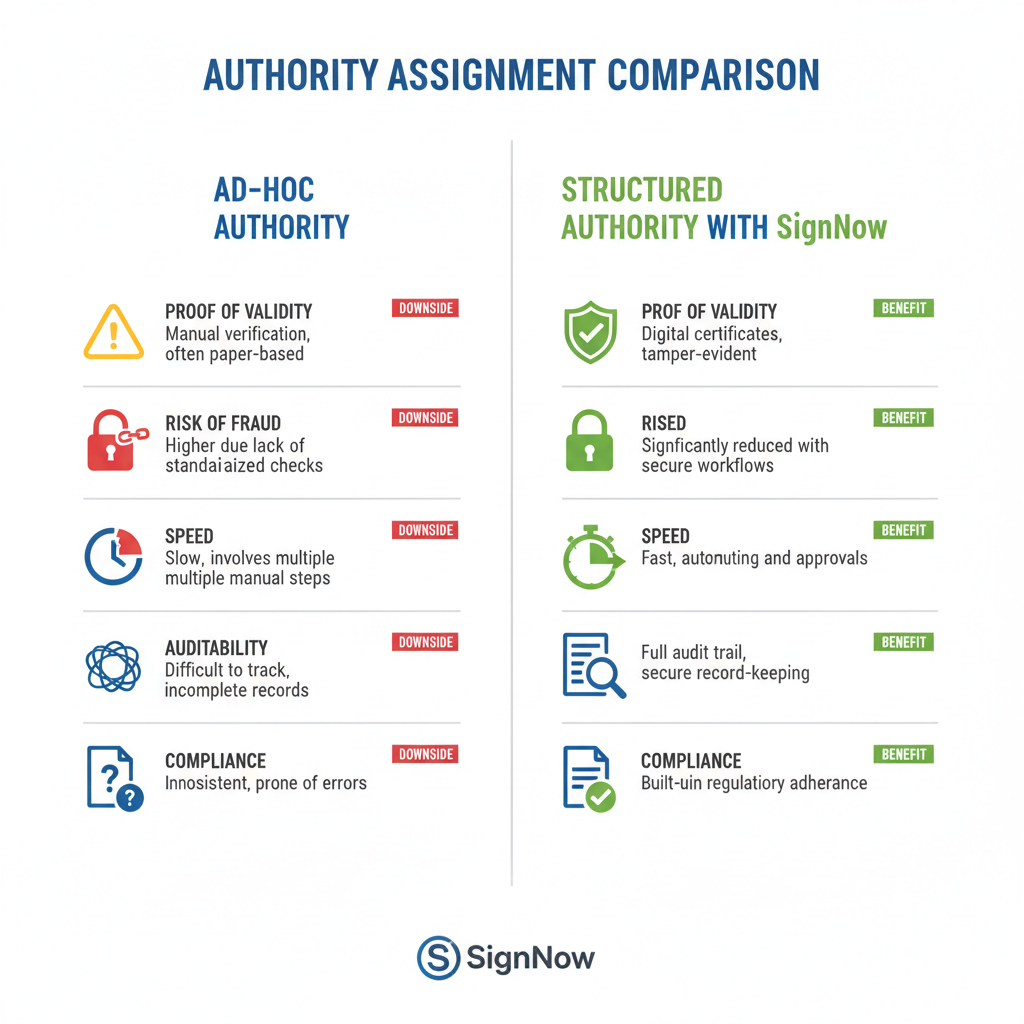
| Feature | Ad-Hoc / Verbal Authority | Structured / Digital Authority (airSlate SignNow) |
| Proof of Validity | Low. relies on “he said, she said.” | High. Backed by board resolutions and audit trails. |
| Risk of Fraud | High. Unauthorized person can sign easily. | Low. Access controls and ID verification prevent fraud. |
| Speed | Slow. Physical routing of paper documents. | Fast. Automated routing to relevant parties. |
| Auditability | Poor. Papers get lost or filed incorrectly. | Excellent. Digital logs track the entire process. |
| Compliance | Difficult. Hard to prove who signed what/when. | Built-in. Complies with ESIGN, UETA, and eIDAS. |
What happens if someone signs without authority? The consequences depend on the context, but are rarely good.
- Unenforceable contracts: The counterparty might refuse to honor the deal if they discover the signer lacked proper authority.
- Personal liability: The individual who signed might be held personally responsible for the performance of the contract.
- Reputational damage: Legal action over invalid contracts makes your organization look unprofessional and risky to future partners.
To mitigate these legal risks, always verify the authority of the person signing on behalf of the company. When in doubt, request a signatory authority letter or a copy of the corporate resolution.
Disclaimer: The information contained in this blog post is provided for general informational purposes only and does not constitute formal legal advice.
Final thoughts
Managing signatory authority effectively is a cornerstone of corporate governance. It protects your assets, ensures legally binding decisions are valid, and streamlines operations. As we move through 2026, the reliance on digital tools to manage this authority will only grow.
By formalizing your signatory authority policy, defining clear authority levels, and utilizing secure platforms like SignNow, you empower your team to move fast without breaking things. Don’t let outdated paper processes slow you down or expose you to risk. Take control of your signing workflows today.
Ready to secure your signing process?
Start your free trial of SignNow today and experience the easiest way to manage signatory authority and secure digital workflows.
Glossary
- Apparent authority: A situation where an individual appears to have the authority to act on behalf of an organization, leading a third party to reasonably believe they can bind the company, even if they lack actual authority.
- Board resolution: A formal document that records the decisions or votes of a company’s board of directors, often used to grant signatory rights to specific officers.
- Fiduciary duty: The legal obligation of an agent (like a Chief Financial Officer) to act in the best interest of the principal (the company) when exercising their authority.
- Ratification: The process by which a company accepts and validates a contract signed by an unauthorized person, effectively giving it retroactive validity.
- Uniform Commercial Code (UCC): A comprehensive set of laws governing all commercial transactions in the United States, which provides the legal framework for authorized signatories and contract enforcement.
FAQ
1. Who typically has signatory authority in a company?
In most organizations, senior executives like the CEO, President, and Chief Financial Officer are granted full signatory authority by the bylaws. However, specific powers are often delegated to department heads, project managers, or a procurement officer for operational needs. The scope of this authority is usually limited by the type of document or financial threshold.
2. Can the signatory authority be delegated to anyone?
Yes, a company can generally grant delegated authority to any competent employee or third-party agent. However, this should always be done formally through a written policy or a power of attorney to define the limits. Randomly assigning authority without documentation increases financial risks and confusion.
3. What is the difference between signature authority and approval authority?
Approval authority allows an employee to authorize a transaction internally, such as saying “yes” to a budget spend. Signature authority is the legal power to execute a document that binds the company to a transaction. For example, a manager might approve a particular expense, but an authorized officer must sign the legal documents to finalize the deal.
4. Does electronic signature authority carry the same legal weight as wet ink?
Yes, under laws like the ESIGN Act and UETA in the U.S., digital signatures have the same significant legal weight as traditional handwritten signatures. As long as the platform (like airSlate SignNow) provides identity verification and an audit trail, the electronic record is legally binding.
5. How do I prove someone has signatory authority?
To prove authority, you typically provide a certified copy of the board resolutions or a signatory authority letter signed by a corporate officer. For routine matters, the title of the individual (e.g., VP of Sales) often implies authority, but high-value transactions usually require explicit proof.
6. What happens if an unauthorized person signs a contract?
If an unauthorized person signs, the contract may be voidable by the company, meaning they are not legally bound to it. However, if the company acts as if the contract is valid (e.g., by making payments), it may unintentionally ratify the agreement. This creates legal matters that can be complex to resolve in court.
7. Do I need to update the signatory authority when an employee leaves?
Absolutely. You must immediately revoke the signatory rights of any employee who leaves to prevent them from acting on behalf of the company. This involves updating internal lists, notifying banks, and disabling their access to eSignature platforms like SignNow to ensure they cannot sign documents.