Architectural Change Request Form 2011-2026


What is the Architectural Change Request Form
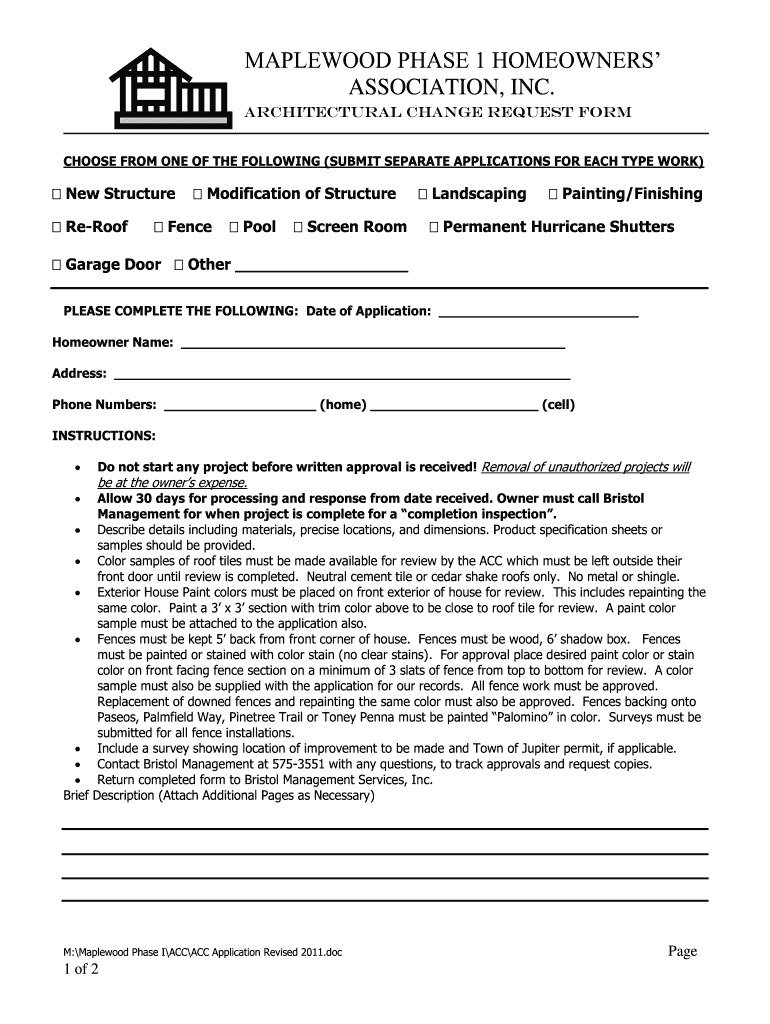
The Architectural Change Request Form is a crucial document used by homeowners associations (HOAs) to manage and regulate modifications to properties within their jurisdiction. This form allows residents to formally request permission for changes such as renovations, additions, or alterations to their homes or yards. It helps ensure that all changes comply with the community’s architectural guidelines and standards, maintaining the aesthetic and structural integrity of the neighborhood.
How to use the Architectural Change Request Form
To effectively use the Architectural Change Request Form, homeowners should first review their HOA’s architectural guidelines to understand what changes are permissible. Once familiar with these guidelines, residents can fill out the form by providing necessary details such as the type of change requested, a description of the project, and any supporting documents like plans or drawings. After completing the form, it should be submitted to the HOA for review and approval.
Key elements of the Architectural Change Request Form
Several key elements must be included in the Architectural Change Request Form to ensure it is complete and compliant. These elements typically include:
- Homeowner Information: Name, address, and contact details of the homeowner submitting the request.
- Project Description: A detailed description of the proposed changes, including materials and colors.
- Site Plans or Drawings: Visual representations of the proposed changes, if applicable.
- Compliance Statement: A statement confirming that the proposed changes adhere to the HOA’s guidelines.
- Signatures: Required signatures from the homeowner and possibly from neighbors, depending on the HOA’s requirements.
Steps to complete the Architectural Change Request Form
Completing the Architectural Change Request Form involves several steps:
- Review the HOA’s architectural guidelines to understand requirements.
- Gather necessary documents, such as site plans or photographs.
- Fill out the form with accurate and detailed information.
- Attach any required supporting documents.
- Submit the form to the appropriate HOA committee or board for review.
Legal use of the Architectural Change Request Form
The Architectural Change Request Form must be used in accordance with local laws and the governing documents of the HOA. It is essential for homeowners to ensure that their requests comply with both the HOA’s regulations and any applicable state or local building codes. Proper use of the form helps protect homeowners from potential disputes and ensures that all modifications are legally sanctioned.
Examples of using the Architectural Change Request Form
Common examples of when a homeowner might use the Architectural Change Request Form include:
- Requesting permission to build a fence or wall around the property.
- Proposing changes to landscaping, such as planting new trees or installing a garden.
- Seeking approval for exterior renovations, like painting the house or replacing windows.
- Requesting modifications to driveways or walkways.
Quick guide on how to complete architectural change request form association and property
Ensure your t's are crossed and your i's are dotted on the Architectural Change Request Form
Negotiating contracts, managing listings, arranging meetings, and conducting viewings—real estate agents and professionals navigate a diverse array of tasks on a daily basis. Numerous responsibilities involve substantial documentation, such as Architectural Change Request Form, that must be finalized promptly and with the utmost accuracy.
airSlate SignNow is a comprehensive solution that assists individuals in the real estate field in alleviating the challenges of paperwork, allowing them to focus more on their clients' goals throughout the entire negotiation phase and enabling them to secure the most favorable terms in the transaction.
Steps to complete Architectural Change Request Form using airSlate SignNow:
- Access the Architectural Change Request Form page or utilize our library’s search features to locate the required form.
- Click on Obtain form—you’ll be immediately directed to the editor.
- Begin completing the document by selecting fillable areas and entering your text into them.
- Add new information and adjust its settings if needed.
- Select the Sign option in the upper toolbar to create your electronic signature.
- Explore additional tools available to annotate and enhance your document, such as drawing, highlighting, adding shapes, etc.
- Click on the notes tab to include notes regarding your document.
- Conclude the process by downloading, sharing, or dispatching your document to your specified recipients.
Eliminate paper forever and simplify the home purchasing process with our user-friendly and powerful platform. Experience enhanced convenience when filling out Architectural Change Request Form and other real estate documents online. Try our tool today!
Create this form in 5 minutes or less
FAQs
-
How do I respond to a request for a restraining order? Do I need to fill out a form?
As asked of me specifically;The others are right, you will likely need a lawyer. But to answer your question, there is a response form to respond to a restraining order or order of protection. Worst case the form is available at the courthouse where your hearing is set to be heard in, typically at the appropriate clerk's window, which may vary, so ask any of the clerk's when you get there.You only have so many days to respond, and it will specify in the paperwork.You will also have to appear in court on the date your hearing is scheduled.Most courts have a department that will help you respond to forms at no cost. I figure you are asking because you can't afford an attorney which is completely understandable.The problem is that if you aren't represented and the other person is successful in getting a temporary restraining order made permanent in the hearing you will not be allowed at any of the places the petitioner goes, without risking arrest.I hope this helps.Not given as legal advice-
-
Has New Zealand changed from happy go lucky, let's go bungy jumping, mate, to 'fill out this form in triplicate and think the right thoughts'?
Seems like you may have already made up your mind on this one! You can't judge a place based on one experience, of course - and you know that there are jerks everywhere. Does the potential position involve working with/for lawyers? OK..kidding. But are your expectations of New Zealanders too high? I've lived in NZ and the US for equal periods of time, and I've noticed that Americans tend to idealize NZ a bit, ie. Everybody is nice, its very safe, you can hitchhike everywhere...Hobbiton it ain't.My mother grew up in NZ in the fifties, and she found it crushingly conformist, backward, and old-fashioned at the time. She (and many others) couldn't wait to leave the country to move to...London, Australia, the US...anywhere. NZ was about thirty years behind the rest of the world, and that wasn't necessarily a good thing. Over the years I think NZ that reserved, self-conscious atmosphere has lessened, NZ becoming more open minded, more sophisticated, and more secure in its identity. I would say it's definitely more "PC" and conservative than Australia (but what country isn't?).Australia is becoming more like the United States, and NZ is becoming less like Australia.The thing that strikes me as the biggest difference between NZ and the US is that in the US you are encouraged to be as confident and self-promoting as possible, whereas here it's kind of frowned upon. There's a phenomena known as "Tall Poppy Syndrome" in NZ where you must cut down the "tall poppies", ie. those who are more successful than you, to make yourself feel better. I do miss the utter (blind) self-confidence of Americans.I would say that the American "niceness" you speak of, that fake smiley shit, doesn't exist here and I don't think it will start any time soon. I do like how straightforward people are here. NZers are far more likely to invite you to their homes than Americans are (again, this depends on what part of the states you are from. I'm from the passive-aggressive Northwest).One final point: Auckland is so thoroughly different from the rest of the country, and if your job will be based in Auckland this might be the heart of the problem. Auckland was voted the Least Friendliest City in NZ recently (not that there's a lot of competition, but still). You might fare better in Wellington.Don't worry, this is still a really great country, on the whole I find people a lot more trustworthy - and has not been taken over by the PC Police. But do be aware that while America is very much the "Wild West" of free speech, I find NZ to be a bit more stringent on that one. I was shocked to find when I moved back here that there is an Official Censor, which would never exist in the United States (we librarians wouldn't let that happen).
-
Why don't schools teach children about taxes and bills and things that they will definitely need to know as adults to get by in life?
Departments of education and school districts always have to make decisions about what to include in their curriculum. There are a lot of life skills that people need that aren't taught in school. The question is should those skills be taught in schools?I teach high school, so I'll talk about that. The typical high school curriculum is supposed to give students a broad-based education that prepares them to be citizens in a democracy and to be able to think critically. For a democracy to work, we need educated, discerning citizens with the ability to make good decisions based on evidence and objective thought. In theory, people who are well informed about history, culture, science, mathematics, etc., and are capable of critical, unbiased thinking, will have the tools to participate in a democracy and make good decisions for themselves and for society at large. In addition to that, they should be learning how to be learners, how to do effective, basic research, and collaborate with other people. If that happens, figuring out how to do procedural tasks in real life should not provide much of a challenge. We can't possibly teach every necessary life skill people need, but we can help students become better at knowing how to acquire the skills they need. Should we teach them how to change a tire when they can easily consult a book or search the internet to find step by step instructions for that? Should we teach them how to balance a check book or teach them how to think mathematically and make sense of problems so that the simple task of balancing a check book (which requires simple arithmetic and the ability to enter numbers and words in columns and rows in obvious ways) is easy for them to figure out. If we teach them to be good at critical thinking and have some problem solving skills they will be able to apply those overarching skills to all sorts of every day tasks that shouldn't be difficult for someone with decent cognitive ability to figure out. It's analogous to asking why a culinary school didn't teach its students the steps and ingredients to a specific recipe. The school taught them about more general food preparation and food science skills so that they can figure out how to make a lot of specific recipes without much trouble. They're also able to create their own recipes.So, do we want citizens with very specific skill sets that they need to get through day to day life or do we want citizens with critical thinking, problem solving, and other overarching cognitive skills that will allow them to easily acquire ANY simple, procedural skill they may come to need at any point in their lives?
-
How can I create an auto-fill JavaScript file to fill out a Google form which has dynamic IDs that change every session?
Is it possible to assign IDs on the radio buttons as soon as the page loads ?
Create this form in 5 minutes!
How to create an eSignature for the architectural change request form association and property
How to generate an electronic signature for the Architectural Change Request Form Association And Property online
How to create an eSignature for your Architectural Change Request Form Association And Property in Chrome
How to generate an eSignature for putting it on the Architectural Change Request Form Association And Property in Gmail
How to create an eSignature for the Architectural Change Request Form Association And Property straight from your mobile device
How to create an eSignature for the Architectural Change Request Form Association And Property on iOS devices
How to generate an electronic signature for the Architectural Change Request Form Association And Property on Android OS
People also ask
-
What is an Architectural Change Request Form?
An Architectural Change Request Form is a document used by organizations to formally request changes to architectural designs or plans. This form helps streamline the process of evaluating and approving changes, ensuring all stakeholders are informed. By utilizing an effective Architectural Change Request Form, businesses can enhance communication and maintain project integrity.
-
How can airSlate SignNow help with Architectural Change Request Forms?
airSlate SignNow simplifies the process of managing Architectural Change Request Forms by allowing users to create, send, and eSign documents electronically. This platform ensures that all changes are documented securely and can be tracked throughout the approval process. With airSlate SignNow, you can enhance efficiency while reducing delays associated with traditional paper-based methods.
-
Is there a cost associated with using airSlate SignNow for Architectural Change Request Forms?
Yes, airSlate SignNow offers various pricing plans tailored to meet the needs of businesses of all sizes. These plans provide access to features that facilitate the creation and management of Architectural Change Request Forms. You can visit our pricing page to find the best option for your organization.
-
What features does airSlate SignNow offer for Architectural Change Request Forms?
airSlate SignNow provides a range of features designed for Architectural Change Request Forms, including customizable templates, secure eSignature capabilities, and real-time tracking of document status. Additionally, the platform allows for seamless collaboration among team members, ensuring everyone is on the same page during the change request process.
-
Can I integrate airSlate SignNow with other software for Architectural Change Request Forms?
Absolutely! airSlate SignNow offers integrations with various software applications, including project management tools and CRM systems. This flexibility allows you to incorporate Architectural Change Request Forms into your existing workflow, enhancing productivity and ensuring that all team members can access the necessary documents easily.
-
What are the benefits of using an electronic Architectural Change Request Form?
Using an electronic Architectural Change Request Form streamlines the request process, reduces paperwork, and minimizes the risk of lost documents. It also speeds up approvals, as stakeholders can review and sign the form from anywhere, anytime. With airSlate SignNow, you can track the status of your requests, making it easier to manage changes effectively.
-
How secure is airSlate SignNow for handling Architectural Change Request Forms?
airSlate SignNow prioritizes security, utilizing encryption and secure access controls to protect your Architectural Change Request Forms and sensitive information. The platform is compliant with various industry standards, ensuring that your documents remain confidential and secure throughout the signing process. You can trust airSlate SignNow for secure document management.
Get more for Architectural Change Request Form
- Temporary event notice form
- Marketing rubric form
- Job stress questionnaire pdf form
- Cadham requisition form
- Sarah baartman district municipality application form
- Certificate of appropriateness app doc form 1950 rev 0812 monroela
- Marketing agency service level agreement template form
- Marketing agency service agreement template form
Find out other Architectural Change Request Form
- Electronic signature South Dakota Non-Profit Business Plan Template Now
- Electronic signature South Dakota Non-Profit Lease Agreement Template Online
- Electronic signature Legal Document Missouri Online
- Electronic signature Missouri Legal Claim Online
- Can I Electronic signature Texas Non-Profit Permission Slip
- Electronic signature Missouri Legal Rental Lease Agreement Simple
- Electronic signature Utah Non-Profit Cease And Desist Letter Fast
- Electronic signature Missouri Legal Lease Agreement Template Free
- Electronic signature Non-Profit PDF Vermont Online
- Electronic signature Non-Profit PDF Vermont Computer
- Electronic signature Missouri Legal Medical History Mobile
- Help Me With Electronic signature West Virginia Non-Profit Business Plan Template
- Electronic signature Nebraska Legal Living Will Simple
- Electronic signature Nevada Legal Contract Safe
- How Can I Electronic signature Nevada Legal Operating Agreement
- How Do I Electronic signature New Hampshire Legal LLC Operating Agreement
- How Can I Electronic signature New Mexico Legal Forbearance Agreement
- Electronic signature New Jersey Legal Residential Lease Agreement Fast
- How To Electronic signature New York Legal Lease Agreement
- How Can I Electronic signature New York Legal Stock Certificate