

UETA is a state-level model law that most states have adopted to standardize when electronic records and signatures are legally valid within that state’s transactions. ESIGN is the federal backstop that ensures eSignatures have nationwide legal effect and adds specific requirements around consumer consent and record retention; together, ESIGN sets the baseline while UETA handles state-law implementation details (with exceptions like New York using ESRA instead of UETA).
Disclaimer: This article is for informational purposes only and should not be considered legal advice. Since compliance requirements vary by location and industry, we recommend consulting a legal professional to ensure your eSignature practices align with your specific regulatory requirements.
Summary (executive overview)
- ESIGN (federal, 2000) gives electronic signatures and records nationwide legal effect for transactions “in or affecting interstate or foreign commerce” and adds consumer-consent and record-retention rules.
- UETA (state model law, 1999) harmonizes e-transactions at the state level; as of June 25, 2021 Illinois adopted UETA, leaving New York as the only non-UETA state (it uses ESRA).
- Both laws exclude key categories (e.g., wills, some family-law matters, much of the UCC), so some documents still require “wet” signatures.
- Recent U.S. policy shifts (e.g., IRS making many eSign accommodations permanent; NIST SP 800-63-4 digital identity update) strengthen digital workflows but raise assurance and authentication expectations.
- For SMB and mid-market teams, practical compliance means getting affirmative consumer consent, keeping auditable records, matching authentication to risk, and observing state carve-outs (notably New York ESRA in public-sector contexts).
The difference between UETA and ESIGN (practical view)
What they have in common
Both validate the legal effect of eSignatures and e-records and recognize electronic agents (e.g., automated systems) as part of contract formation.
Key differences that affect your implementation
- Jurisdiction & preemption: ESIGN is federal; states may modify/supersede it by enacting UETA (or a similar law consistent with ESIGN). Practically, most states follow UETA; New York uses ESRA.
- Consumer disclosures: ESIGN has explicit consumer-consent mechanics—affirmative consent, hardware/software disclosures, demonstrable access, and easy withdrawal. UETA lacks this federal consumer-notice regime; many teams implement ESIGN-style consent everywhere to be safe.
- Carve-outs: Both exclude similar categories, but state adoptions of UETA may add local twists. Always review the state’s version and any agency rules.
Statistics & dynamics (what changed lately)
- IRS permanence: The IRS’s 2023 move to make many eSignature allowances permanent lowered friction for tax-advisory and finance teams (e.g., during exams or Appeals). Expect wider adoption of digital signatures in back-office processes.
- Identity assurance bar rising: Adoption of NIST SP 800-63-4 by agencies and vendors nudges the market toward risk-based authentication—for higher-risk agreements, use stronger factors and maintain immutable audit trails.
- State modernizations: Illinois now references UETA in courts and is refining agency rules, signaling maturing state-level practice.
Comparisons of key factors
This table compares the three main U.S. frameworks that govern the validity of electronic signatures and records: ESIGN (federal), UETA (state law as enacted), and New York’s ESRA. Use it to sanity-check consent, retention, exclusions, and NY-specific requirements at a glance.
U.S. eSignature frameworks: ESIGN vs UETA vs New York ESRA (2026)
| Factor | ESIGN (federal) | UETA (state) | NY ESRA |
| Legal effect | 15 U.S.C. §7001(a): records/signatures not denied effect due to electronic form | Legal recognition; use varies by state enactment | State Tech Law/ESRA guidance, ITS G04-001 (May 2024)”: equal effect for eSignatures/e-records |
| Consumer consent | §7001(c)(1)(A)–(D): affirmative consent + H/W disclosure + demonstrable access + withdrawal rights | No federal-style consumer disclosure; rely on party agreement | “Policies set by NY ITS; not mandated for private parties; gov’t entities ensure authenticity/integrity/security.” |
| Record retention | §7001(d)(1)(A)–(B): accurate reflection; accessible/reproducible | Comparable state provisions (e.g., 815 ILCS 333/12) | Agencies maintain authenticity, integrity, security per ITS guidance. |
| Exclusions | §7003(a)(1)–(3)” (wills, family-law matters, much of UCC) | Similar exclusions in state enactments | Follows state policy; check specific statutes/regulations. |
| Notarization | §7001(g): e-notary accepted if attached/associated | State provisions; e-notary/remote notary governed elsewhere | State-defined implementations. |
| Status/adoption | Public Law 106-229 (June 30, 2000) | Adopted nationwide incl. Illinois (815 ILCS 333, 2021) and Washington (RCW 1.80). New York has not adopted | New York’s statewide framework. |
In practice, many teams follow ESIGN’s consumer-consent and retention approach across all states because it’s the most explicit baseline. When New York is involved (especially public-sector workflows), treat NY ITS ESRA guidance (ITS G04-001) as the key operational reference for authenticity, integrity, and security expectations.
Impact on stakeholders
Legal and compliance
Risk of unenforceability comes less from “is an eSignature legal?” and more from process: did you obtain ESIGN-compliant consumer consent where it applies? Can you reproduce the record accurately? Is the audit trail intact?
IT & security
Authentication choices (password/SMS/phone/IdP, etc.) should follow a risk-based rubric aligned to NIST SP 800-63-4. High-risk transactions → higher AAL; lower risk → streamlined sign-in.
Operations & finance
IRS permanence makes it easier for tax teams to complete certain workflows digitally; for federal/vendor dealings, FAR 4.502 signals acceptance of e-commerce artifacts (digital records, signatures) where practicable.
Expert forecasts (6–24 months)
- Identity & fraud controls: Agencies and regulated industries will increasingly map signer authentication to assurance levels; expect more MFA and identity-proofing for higher-risk agreements.
- Sector-specific rules: More agency-level codifications (e.g., tax, housing, finance) will clarify acceptable eSignature methods and record formats, yielding less ambiguity and more digital-by-default processes.
- State refinements: States will continue to tweak UETA implementations (e.g., Illinois adjustments to agency rules under 815 ILCS 333 proposals), improving clarity for public-sector workflows.
How to operationalize ESIGN + UETA (step-by-step)
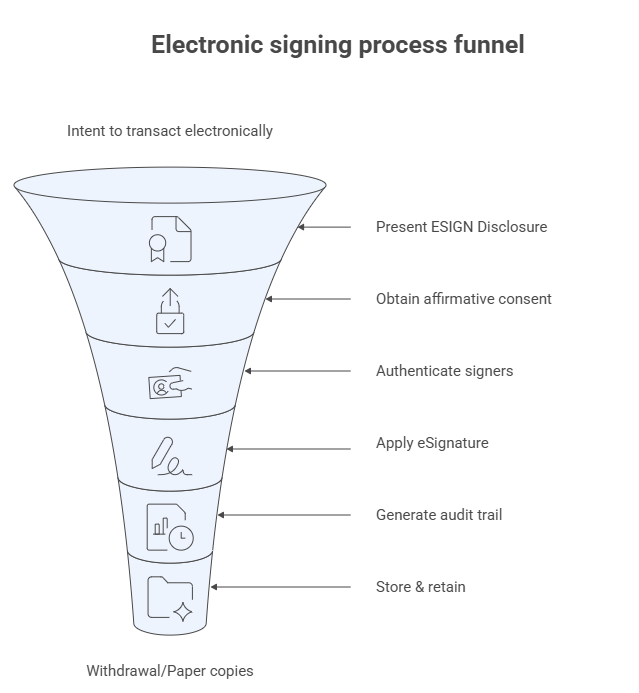
This workflow turns ESIGN and UETA concepts into a practical, step-by-step signing process for U.S. agreements. It reduces enforceability risk by ensuring clear consent, proper authentication, and strong recordkeeping from start to finish.
How airSlate SignNow fits: easy and scalable
airSlate SignNow combines user-friendly design with enterprise-level scalability to meet the needs of growing businesses. Whether you’re managing a small team or a global operation, SignNow ensures seamless workflows, compliance, and efficiency at every level.
Templates, invite links, team sharing, and more
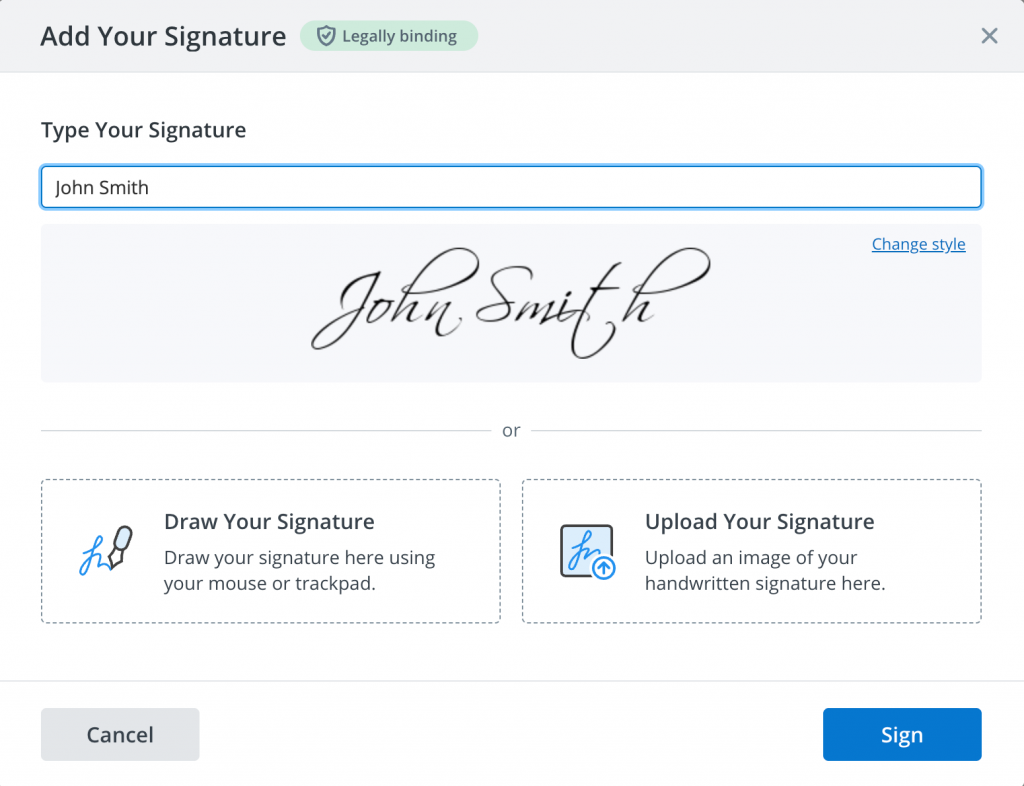
SignNow’s features like templates, bulk send, invite links, and team sharing are designed to seamlessly align with UETA and ESIGN workflows. These tools simplify processes for HR onboarding, vendor and customer agreements, as well as admissions or membership flows. By streamlining the secure eSignature process, SignNow helps teams save time, reduce errors, and ensure compliance with eSignature laws, making it an ideal solution for businesses of all sizes.
Cost control
SignNow offers transparent, pay-as-you-go pricing options with unlimited users across all paid plans, helping organizations avoid the inefficiencies of per-seat licensing. This approach aligns with IT and Operations goals to reduce software sprawl and control costs without sacrificing functionality. With SignNow, you can scale your eSignature solution as your business grows, while keeping expenses predictable and manageable.
Compliance support
SignNow simplifies compliance with robust features like detailed audit trails, signer authentication via password, SMS, or phone, and customizable branding and compliance settings. These tools make it easy to capture ESIGN-compliant consent and meet record-retention obligations with confidence. Paired with 24/7 support, SignNow ensures your team is equipped to handle change management and stay ahead of evolving regulatory requirements.
Case studies (USA focus)
Higher education IT (long-term adoption)
Bryant & Stratton College (8-year customer) expanded to additional departments, citing ease of use and cost advantage over alternatives—consistent with SMB/mid-market priorities for rapid scale and budget control (brand data provided).
Operations: SMB registrations
Funjoin digitized a complex registration process; eSign simplified intake and cut manual handling—illustrating how templates, invite links, and bulk send reduce cycle times at scale (brand data provided).
Financial/tax workflows
Tax advisory firms leveraged the IRS permanent eSignature policy for certain forms to speed reviews and reduce in-person steps while retaining admissible, reproducible records. Pair eSign with demonstrable access records to satisfy ESIGN.
Looking to implement a powerful eSignature solution in your organization? Explore SignNow’s tailored solutions for industries like financial services, healthcare, and more.
Recommendations for compliant eSignature implementation
To achieve major compliance victories in the next 12–36 months, businesses should treat eSignatures as a repeatable system, rather than a one-time feature. This approach ensures that consent, identity, and retention policies are consistently upheld across all channels and states. The following recommendations aim to reduce enforcement risks while maintaining fast, efficient workflows for SMB and mid-market teams.
- Standardize on ESIGN-grade consent everywhere (even where UETA alone would suffice). It’s safer and consistent for consumers.
- Adopt risk-based authentication: map documents to AAL targets (NIST SP 800-63-4). Use SMS/phone factors or IdP for higher-risk agreements; log everything.
- Harden auditability: store complete, immutable audit trails (timestamps, IPs, signer auth) and ensure accurate reproduction for the full retention window.
- Maintain a state matrix: track any special state carve-outs (e.g., ESRA in NY; agency-specific requirements). Update quarterly.
- Leverage platform features for scale: templates, bulk send, invite links, team sharing, and 24/7 support (per your brand context), reduce cycle times, and support consistent compliance across HR, Sales, and Ops.
By implementing these steps, you’ll be able to adapt to state-by-state regulatory changes, such as the nuances of New York’s ESRA, without overhauling your entire process. More importantly, you will create a defensible evidence trail that supports faster cycles across HR, Sales, and Operations, all while maintaining compliance.
Start a SignNow free trial to send and eSign documents faster with ESIGN-ready consent, audit trails, and scalable workflows.
Sources
- 15 U.S.C. §7001 (ESIGN: legal effect, consumer consent, retention) — Legal Information Institute (Cornell).
- Public Law 106-229 (ESIGN original text) — Congress.gov.
- Illinois UETA (815 ILCS 333; enacted June 25, 2021) — Justia / LegiScan / DLA Piper.
- IRS e-signature permanence for certain forms (Oct 2023) — PwC / Grant Thornton summaries referencing IRM updates.
FAQ
Are eSignatures valid in every U.S. state?
Yes, eSignatures are valid under the federal ESIGN Act, and UETA fills in state law gaps. New York uses its own law, ESRA, which recognizes eSignatures for most purposes. Always check for specific exclusions in your state.
What makes a consumer eSignature compliant under ESIGN?
To comply with ESIGN, consumers must give affirmative consent and receive clear disclosures, including the option for paper records and system requirements. They must also demonstrate access to the eSignature process. Additionally, records must be retained in a way that’s accessible and accurate.
Do I need “digital signatures” (PKI) or are “electronic signatures” enough?
Electronic signatures are broadly accepted under ESIGN and UETA for most transactions. However, for higher-risk agreements, stronger authentication methods, like those outlined in NIST SP 800-63-4, may be advisable. Choose the level of security that matches the sensitivity of your document.
Which documents usually cannot be eSigned?
Certain documents, like wills, codicils, testamentary trusts, and adoption or divorce matters, are commonly excluded from eSignature laws. Large portions of the UCC also have exceptions. Always review local laws to confirm what’s allowed.
How does New York ESRA differ?
New York’s ESRA aligns with ESIGN’s definition of eSignatures but adds state-specific standards for authenticity, integrity, and security. These standards are especially important for government-related transactions. It ensures compliance while maintaining robust security measures.
- Summary (executive overview)
- The difference between UETA and ESIGN (practical view)
- Statistics & dynamics (what changed lately)
- Comparisons of key factors
- Impact on stakeholders
- Expert forecasts (6–24 months)
- How to operationalize ESIGN + UETA (step-by-step)
- How airSlate SignNow fits: easy and scalable
- Case studies (USA focus)
- Recommendations for compliant eSignature implementation
- Sources
- FAQ