
What is contract management? Process, stages, and key concepts explained

Contract management is the process of creating, executing, and overseeing an agreement from the first request through signature, performance, and eventual renewal or closeout, so that both parties meet their contractual obligations and the organization captures the value it negotiated. Think of it as the difference between filing a contract away and actually driving it: managing contracts means someone keeps checking the map, watching the clock, and making sure each one ends properly. This article walks through the standard, structured contract management process, addresses why sources disagree on how many “stages” that process has, looks at the four areas practitioners commonly group the work into, and shows what the process looks like inside a working eSignature platform.
Key takeaways: contract management at a glance.
- Contract management is the ongoing oversight of an agreement, from request and drafting through negotiation, execution, performance, and renewal or closeout.
- The process consists of 5 steps, or key stages, though some frameworks split it into 4 broader stages or expand it to 7 more granular ones.
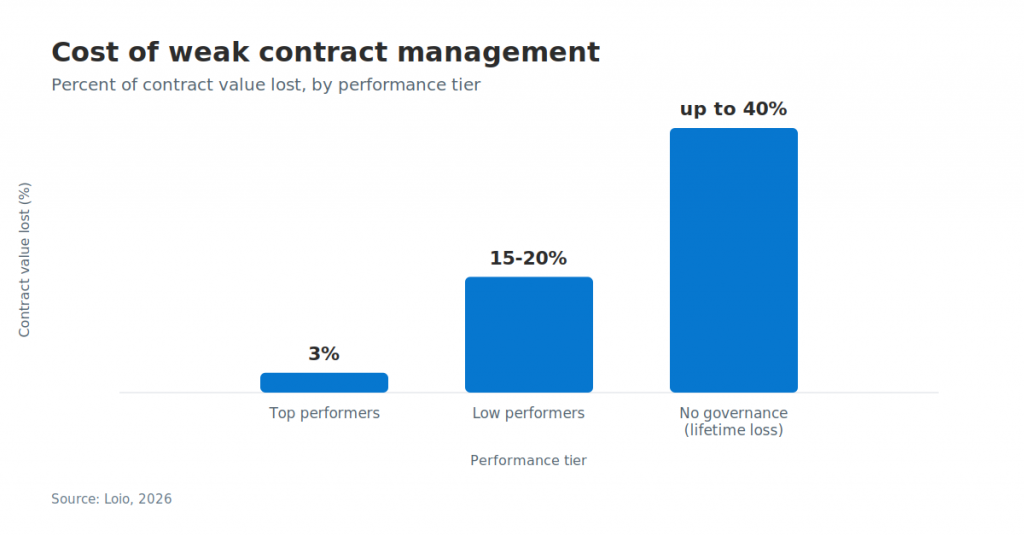
- Weak contract management is measurable: top-performing organizations hold contract value leakage to about 3%, while low performers lose 15-20%, according to Loio.
- Contract management has four practical areas: people, process, technology, and risk/compliance, though no single standards body defines this grouping.
- Legal, procurement, sales, and finance teams are typical executors of different stages of the same contract.
- A contract management system like SignNow supports the process end to end with templates, routing, e-signature, audit trails, and renewal reminders.
- The benefits of contract management show up as fewer missed deadlines, less value leakage, and a searchable record of every active contract.
What contract management means
Contract management means overseeing an agreement so both sides do what they said they would do, from the moment someone requests a contract until it’s renewed, amended, or closed out. The National Contract Management Association defines it as “the process of managing contracts, deliverables, deadlines, contract terms and conditions while ensuring customer satisfaction.” That definition covers the full span of the work: drafting and negotiating terms, routing a document for approval and signature, then tracking whether each side holds up its end once the ink is dry. The contractual relationship doesn’t end at signature; it starts there. Some teams describe this broader view as contract and commercial management, treating the paperwork and the underlying commercial relationship as one function rather than two.
The context of the term
The term is often used interchangeably with contract lifecycle management (CLM), but they aren’t quite the same thing. Contract management describes the discipline itself: the tasks, roles, and decisions involved in handling an agreement. CLM usually refers to the software-supported version of that discipline: templates, routing, and tracking handled inside a dedicated platform instead of manual contract management over email threads and shared drives. In practice, most organizations doing serious contract management are doing some version of CLM, whether or not they use that term.
Why contract management matters
Effective contract management prevents most of this; weak contract management shows up directly on the balance sheet instead. Poor post-signature oversight, missed obligations, and unused terms let low-performing organizations lose 15-20% of negotiated contract value, while top performers hold that figure closer to 3%, and weak governance on its own can wipe out up to 40% of a contract’s value over its lifetime, according to data from Loio.
Visibility is a separate problem from leakage. An estimated 71% of organizations cannot locate at least 10% of their active contracts when they need them, which makes it difficult to answer basic questions like which vendor terms are still active or when a lease expires, and it’s a common root cause of contract disputes when neither side can produce the version they agreed to. Ineffective contract management is estimated to drain roughly 9.2% of annual revenue at organizations that don’t manage the process deliberately.
The stakes are rising alongside the market itself. The global contract management market constituted $3.68 billion in 2026, projected to reach $10.50 billion by 2034 at a 14.01% compound annual growth rate. The narrower CLM software segment has the opportunity to grow from $3.39 billion in 2026 to $6.26 billion by 2031, a 13.06% CAGR, as more organizations move from spreadsheets and shared drives to dedicated platforms.
The contract management process: 5 steps
The contract management process has 5 steps: request and initiation, authoring and negotiation, approval and execution, performance and obligation management, and renewal, amendment, or closeout. Together, these steps make up what’s usually called the contract lifecycle: the full span of a single agreement’s existence, from the first request for it to the moment it ends or renews.
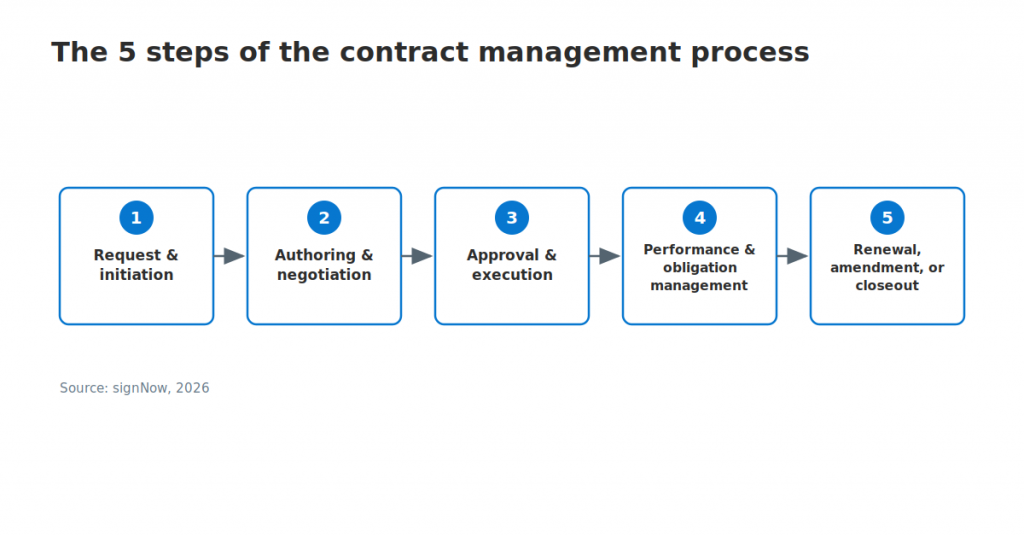
- Request and initiation. Someone identifies the need for an agreement, whether that’s a new vendor purchase, a customer deal, or an employment contract, and routes the contract request, with the parties identified, to whoever owns drafting.
- Authoring and negotiation. Contract creation happens here: the contract gets drafted, usually from a reusable template rather than from scratch, and both sides go back and forth on terms until they land on language everyone can accept. This is the step non-specialists picture when they hear “negotiating a contract”: in plain terms, it’s just two sides trading edits on the same document until neither one has anything left to change.
- Approval and execution. Internal reviewers sign off through an approval process, then contract execution happens once all parties formally sign.
- Performance and obligation management. Both sides carry out what the contract requires: deliverables ship, payments and services are in place and someone tracks whether that successful execution is actually happening.
- Renewal, amendment, or closeout. The contract reaches its natural end point: it renews (automatically or by negotiation), gets formally amended against the previous contract’s terms, or is closed out and archived.
Five or seven steps?
Not every source counts it this way. One widely used five-stage framework groups the work as generation, negotiation, routing, approval, and signature, and storage, while a seven-stage lifecycle framework common in enterprise CLM guides splits the same work into seven key stages by separating authoring, negotiation, and renewal into their own steps for more granularity. The underlying work is the same in every version. What differs is how finely each source slices it, and a reader comparing “the 5 steps” against “the 7 stages of contract management” on two different websites isn’t looking at two different processes, just two different ways of grouping the same activities. A team choosing which framework to follow internally should pick whichever level of detail matches how closely it needs to track each handoff, not assume one count is more correct than another.
The 4 pillars of contract management
Contract management has informal groups for four practical areas: people, process, technology, and risk and compliance. No single standards body publishes this exact framework, so it’s worth treating it as a common way practitioners organize the discipline rather than an official classification.
People, Process, Technology, Risk and compliance
People covers who owns a contract and whether they have the skills to manage it: a contract with no assigned owner is a contract nobody is watching.
Process covers whether contracts follow a standardized path from request to signature, using consistent templates and approval steps instead of ad hoc emails.
Technology covers whether agreements live in a centralized, searchable system rather than scattered across inboxes and local drives, which directly affects how easily a team can find any one of the organization’s contracts when it needs to.
Risk and compliance covers whether the organization can demonstrate that contracts meet regulatory requirements and other compliance obligations under applicable contract law: ESIGN Act and UETA standards for signature validity in the US, GDPR for handling personal data inside a contract, or industry-specific rules depending on the sector. Compliance gaps here tend to surface later as regulatory exposure and operational risk, which is why most frameworks treat this pillar as the place to minimize risk before it becomes a problem rather than after.
Weakness in any one of these four areas tends to show up as the leakage and visibility problems from the list above. Teams looking for more contract management consistency across all four typically start with the technology pillar, since centralized storage fixes the visibility problem first.
Who is involved in contract management
The parties in contract management typically include legal teams, procurement, a sales team, and finance, working as separate teams that coordinate on the same agreement, with IT or security added when data handling or system integration is part of it. Together, these people form the contract management team for that agreement, even though they usually sit in different departments. Legal usually owns legal review and final contract language, procurement handles vendor agreements, negotiation, and its own contract review before signature, sales manages customer-facing contracts, and finance tracks payment terms and renewal cost.
A healthcare example: intake contracts moved online
A healthcare provider offers a concrete example of who, what, and why this matters in practice. When a therapy practice needed to move patient intake entirely online, the contract work involved was specific: intake agreements had to be signed remotely, tracked for compliance, and stored securely, all without an in-person visit. That’s why the practice moved that work onto a signing platform in the first place, and when it did, the underlying process didn’t change, only where it happened did.
Mark Dombeck, Ph.D., described the change this way:
“When COVID-19 occurred we converted to 100% teletherapy within a week. Now I am doing that intake contract work via SignNow and it has simplified the workflow.”
Other industries: legal, finance
The same pattern holds outside healthcare. A legal services team routes agreements to outside counsel and clients in a specific signing order before a deal closes, while a financial services team completes and tracks approvals on lending or account documents against a compliance deadline. Internal agreements, like a statement of work between two departments, often fall under project management instead of legal, but they follow the same request-to-close pattern, and a missed obligation there shows up as a project delivery problem instead of a legal one.
A procurement team at a mid-size manufacturer runs a third version of the same task, often after supplier consolidation has narrowed the field to a handful of vendors: a purchasing manager negotiates unit pricing and delivery terms with a supplier, routes the finished agreement through a finance review before signature, and then tracks the delivery schedule and payment milestones the contract created. A missed milestone on that agreement is what shows up later as cost overruns, a vendor dispute, or a late shipment that hurts operational performance and financial performance alike.
Different industries, same underlying task: get the right people to review and sign the right terms, then keep a record of what the negotiators agreed on and check back on it, since that follow-through is what keeps strong business relationships intact after signature.
How contract management works in SignNow
In SignNow, the entire contract lifecycle described above runs on five connected capabilities: templates, routing, e-signature, audit trail, and storage with renewal reminders. None of these require custom development; they’re part of the same contract management and signing workflow available on SignNow’s Business plan.
Here’s how the process runs in practice:
1. Start from a template.
Instead of drafting a contract from a blank page, a team builds pre-approved templates once, with fillable fields for the terms that change deal to deal: names, dates, dollar amounts, custom clauses, while pre-approved language for standard clauses stays in place without change.
2. Add signature and data fields.
Fillable fields turn a static PDF into something recipients can actually fill out and sign, including text fields, checkboxes, and signature blocks placed exactly where they belong.
3. Route it for approval and signature.
Serial or parallel routing controls who reviews and signs first, so an internal approver can sign off before the document ever reaches the counterparty.
4. Execute with a legally valid e-signature.
Signing in SignNow is designed to meet ESIGN Act and UETA requirements in the US, so the signed contract holds up the same way a wet-ink signature would. Learn mote about the difference between ESIGN Act and UETA from one of our previous blogs.
5. Rely on the audit trail.
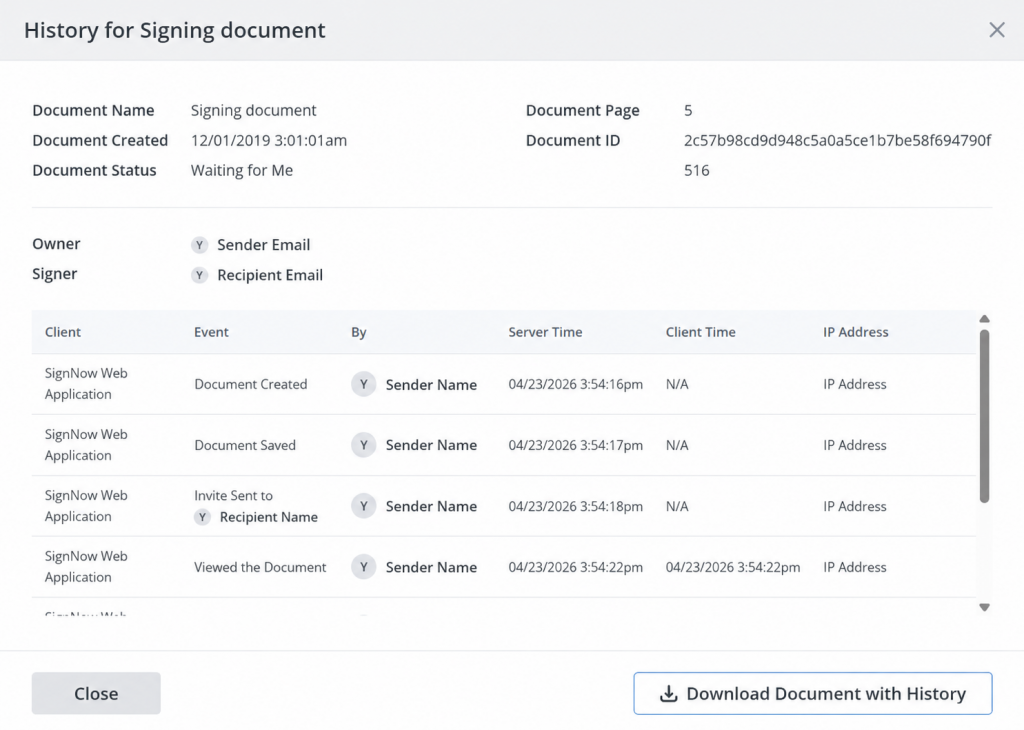
Every view, signature, and authentication step has a timestamp in document History, creating a record that supports compliance reviews or a dispute over what was agreed and when.
Teams that need to send the same agreement to a large group at once, an annual policy update to every vendor, for example, can do that with bulk send, available starting on the Business Premium plan. Organizations that need contract data and related financial data flowing into a CRM or ERP automatically, rather than copy-paste by hand, can connect SignNow through its REST API and integrations with systems like Salesforce or NetSuite, available on the Site License plan.
Common contract management mistakes to avoid
The most common contract management mistakes happen after signature, not before it. Roughly 40% of organizations lack clearly defined contract ownership, meaning no one is explicitly responsible for tracking a given agreement once it’s executed, which is a large part of why obligations get missed.
- No named owner. Without one person or team accountable for a contract, unclear ownership means follow-up on deadlines and contract deliverables falls through.
- Manual version tracking. Redlines and revisions passed back and forth by email create confusion over which version is actually final, since it’s easy to lose track of the original contract once several people have edited separate copies.
- Missed renewal dates. Without automated alerts, a contract carries renewal risk: it can auto-renew on unfavorable terms or lapse when it shouldn’t.
- No centralized storage. Contracts scattered across inboxes and local drives are the direct cause of the “can’t locate 10% of active contracts” problem described earlier.
- Treating signature as the finish line. Performance and obligation tracking, not signing, is where most of the value leakage described above actually happens; skipping it is the single most expensive mistake on this list.
Centralizing templates, renewal reminders, and storage in one system addresses most of these at once, rather than requiring five separate fixes. That is why centralization shows up so often in lists of contract management best practices.
Contract management vs. contract lifecycle management vs. contract administration
These three terms overlap, but they aren’t interchangeable.
Contract management is the broadest term, covering the entire process from request to closeout. Contract lifecycle management (CLM) refers specifically to doing that work with dedicated software rather than manual tools. Contract administration is narrower still: some frameworks use it to describe only the post-award portion of the work, such as tracking deliverables and managing the relationship after signature, rather than the drafting and negotiation that happens before. CIPS’s pre-award and post-award model, for instance, lists contract administration as one part of that post-award phase, alongside service delivery management and supplier relationship management.
Where the confusion comes from
A team can, in practice, do contract management without ever adopting CLM software, and a contract administrator can hold a job title that covers only one slice of the broader discipline; the confusion mostly comes from vendors and job postings using all three terms loosely, not from any real disagreement about what each stage of work involves.
| Term | Scope | Typical tools | Primary focus |
| Contract management | Full process, request through closeout | Templates, email, shared drives, or a CLM platform | The complete discipline |
| Contract lifecycle management (CLM) | Same full process | Dedicated CLM/eSignature software | Software-supported version of contract management |
| Contract administration | Post-award only, in some frameworks | Tracking spreadsheets, CLM platform | Performance, compliance, and relationship management after signing |
Final thoughts
Most contract management problems come down to visibility: nobody can find the current version, or nobody notices a deadline. Templates, routing, e-signature, and an audit trail, the same contract management and signing workflow covered above, fix that without adding a separate tool for every stage.
Get started with SignNow today to streamline your contract management!
Key terms
- Audit trail. A timestamped log of every action taken on a document, including views, signatures, and authentication steps, used to support compliance reviews and resolve disputes over what was agreed.
- Contract administration. In some frameworks, the narrower, post-award portion of contract management: tracking performance, deliverables, and the relationship after a contract is signed.
- Contract lifecycle. The full span of an agreement’s existence, from the initial request through drafting, negotiation, signature, performance, and renewal or closeout.
- Contract lifecycle management (CLM). The software-supported version of contract management, where templates, routing, and tracking are handled inside a dedicated platform.
- ESIGN Act / UETA. US federal and state laws that establish the legal validity of electronic signatures and records for contracts.
- Obligation management. The ongoing tracking of the key obligations each party to a contract must meet after signature, such as deliverables, payments, or service levels.
FAQ
What is contract management in simple words?
Contract management is making sure an agreement gets drafted, signed, and followed through on by both sides, from the initial request to the point the contract ends or renews. It covers the paperwork and the follow-through in equal measure, since a signed contract that no one tracks afterward isn’t really being managed.
What are the 5 steps of contract management?
Request and initiation, authoring and negotiation, approval and execution, performance and obligation management, and renewal, amendment, or closeout. Each step hands off to the next one, so a delay or a skipped step early on, an unclear request or a rushed negotiation, tends to surface as a problem later at the performance or renewal stage.
What are the 4 stages of contract management?
Some frameworks group the same work into 4 broader stages instead of 5 or 7, typically pre-award, award, post-award, and closeout. It’s the same underlying activities, just grouped more coarsely, and the choice of 4 versus 5 versus 7 usually comes down to how much detail a particular framework wants to show rather than any real difference in the work itself.
Is contract management the same as CLM?
Not exactly. Contract management is the discipline itself, while CLM (contract lifecycle management) usually refers to running that discipline through dedicated software rather than manual tools like email and spreadsheets. Most organizations that describe themselves as doing CLM are simply doing contract management with the help of a platform.
What is the contract lifecycle?
The full contract lifecycle spans a single agreement’s entire existence, from the initial request through drafting, negotiation, signature, performance, and renewal or closeout. It’s the same span the 5-step process above describes, just named as a single continuous timeline rather than a set of steps.
Why is contract management important?
Because weak contract management is measurably costly: low-performing organizations lose 15-20% of contract value to poor oversight while top performers hold that figure to about 3%, and a majority of organizations cannot locate a meaningful share of their own active contracts. Both problems compound the longer a contract portfolio goes unmanaged, which is why the cost of fixing it tends to grow over time rather than stay flat, and the same gaps tend to repeat in future agreements if the underlying process never changes.
What skills does a contract manager need?
Attention to detail for tracking obligations and deadlines, negotiation skills for the authoring stage, familiarity with relevant compliance requirements, and comfort using dedicated software to keep the process centralized rather than scattered across email. Clear written communication also matters, since much of the job involves explaining contract terms to people outside legal or procurement who still need to act on them. Many contract managers also pursue certification through a national or international association focused on the profession, and choosing the right contract management software matters just as much, since it’s what makes centralized storage and automated alerts possible in the first place.
How can AI improve contract management?
Mainly by speeding up review: flagging unusual clauses, pulling key dates and obligations out of existing documents, and summarizing long agreements so a reviewer can focus on what actually changed rather than rereading the whole thing. It doesn’t replace legal review or negotiation, but it can meaningfully cut the time spent finding the details that matter across a large contract portfolio.
Sources
- National Contract Management Association: contract management definition
- Fortune Business Insights: Contract Management Market, 2026-2034
- Mordor Intelligence: CLM software market sizing
- Loio: contract management statistics
- Concord: contract management ROI and revenue impact
- Zefort: contract visibility statistics
- CIPS: contract management pre-award and post-award stages
- ESIGN Act overview
- Key takeaways: contract management at a glance.
- What contract management means
- Why contract management matters
- The contract management process: 5 steps
- The 4 pillars of contract management
- Who is involved in contract management
- How contract management works in SignNow
- Common contract management mistakes to avoid
- Contract management vs. contract lifecycle management vs. contract administration
- Final thoughts
- Key terms
- FAQ
- What is contract management in simple words?
- What are the 5 steps of contract management?
- What are the 4 stages of contract management?
- Is contract management the same as CLM?
- What is the contract lifecycle?
- Why is contract management important?
- What skills does a contract manager need?
- How can AI improve contract management?
- Sources