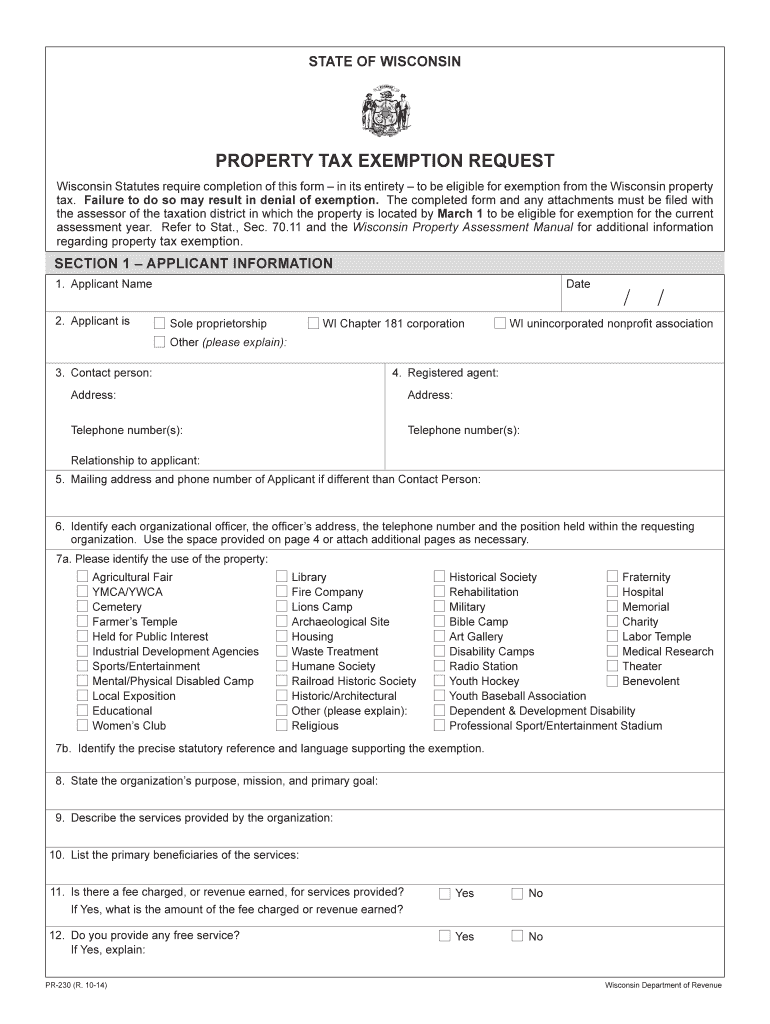
Wisconsin Property Tax Exemption Form 2014


What is the Wisconsin Property Tax Exemption Form
The Wisconsin Property Tax Exemption Form is a document that allows eligible property owners in Wisconsin to apply for exemptions from certain property taxes. This form is designed to reduce the tax burden for qualifying individuals or organizations, such as veterans, disabled persons, and non-profit entities. By completing this form, applicants can potentially lower their property tax obligations, making homeownership more affordable.
Eligibility Criteria
To qualify for the Wisconsin Property Tax Exemption, applicants must meet specific criteria set by state law. Generally, eligible parties include:
- Veterans with a service-connected disability
- Individuals aged sixty-five and older
- Non-profit organizations that provide housing or services
- Disabled individuals who meet certain income limits
Each category has its own set of requirements, so it is essential to review the guidelines carefully to determine eligibility before applying.
Steps to Complete the Wisconsin Property Tax Exemption Form
Completing the Wisconsin Property Tax Exemption Form involves several key steps:
- Obtain the form from the appropriate state or local government office.
- Fill out the form with accurate information, including personal details and property information.
- Attach any required documentation, such as proof of eligibility or income statements.
- Review the completed form for accuracy.
- Submit the form by the specified deadline, either online, by mail, or in person.
Following these steps carefully can help ensure a smooth application process and increase the chances of approval.
Form Submission Methods
Applicants can submit the Wisconsin Property Tax Exemption Form through various methods. These include:
- Online Submission: Many municipalities offer online portals for submitting forms electronically.
- Mail: Completed forms can be sent to the appropriate local tax office via postal service.
- In-Person: Applicants may also choose to deliver the form directly to their local tax office.
Choosing the right submission method can depend on personal preference and the resources available in the applicant's area.
Required Documents
When applying for a property tax exemption, certain documents may be required to support the application. Commonly required documents include:
- Proof of age or disability, such as a birth certificate or medical records
- Military discharge papers for veterans
- Financial statements to verify income levels
- Documentation proving the non-profit status of organizations
Having these documents ready can facilitate the application process and help ensure that the form is processed without delays.
Legal Use of the Wisconsin Property Tax Exemption Form
The Wisconsin Property Tax Exemption Form is legally binding once submitted and approved. It is important for applicants to understand that providing false information can lead to penalties, including denial of the exemption or legal repercussions. Therefore, ensuring the accuracy and honesty of the information provided is crucial for compliance with state laws.
Quick guide on how to complete wisconsin property tax exemption 2014 form
Your assistance manual on how to prepare your Wisconsin Property Tax Exemption Form
If you’re curious about how to create and send your Wisconsin Property Tax Exemption Form, here are a few brief guidelines on simplifying the tax submission process.
To start, you just need to set up your airSlate SignNow account to modify how you manage documents online. airSlate SignNow is an exceptionally intuitive and powerful document platform that enables you to edit, draft, and finalize your income tax documents with ease. With its editing feature, you can toggle between text, checkboxes, and electronic signatures, and revisit your responses as necessary. Enhance your tax management with advanced PDF editing, electronic signing, and easy sharing.
Complete the tasks below to finalize your Wisconsin Property Tax Exemption Form in moments:
- Create your account and begin handling PDFs in no time.
- Utilize our directory to find any IRS tax form; browse through variations and schedules.
- Click Obtain form to access your Wisconsin Property Tax Exemption Form in our editor.
- Enter the necessary fillable fields with your information (text, numbers, check marks).
- Employ the Signature Tool to insert your legally-valid electronic signature (if required).
- Review your document and correct any mistakes.
- Save your revisions, print your version, send it to your recipient, and download it to your device.
Utilize this manual to file your taxes electronically with airSlate SignNow. Be aware that submitting in paper form can lead to return inaccuracies and postpone refunds. Importantly, before electronically filing your taxes, check the IRS website for submission guidelines applicable to your state.
Create this form in 5 minutes or less
Find and fill out the correct wisconsin property tax exemption 2014 form
FAQs
-
How do you fill out tax forms?
I strongly recommend purchasing a tax program, Turbo tax, H&R block etc.These programs will ask you questions and they will fill out the forms for you.You just print it out and mail it in. (with a check, if you owe anything)I used to use an accountant but these programs found more deductions.
-
How do I fill a W-9 Tax Form out?
Download a blank Form W-9To get started, download the latest Form W-9 from the IRS website at https://www.irs.gov/pub/irs-pdf/.... Check the date in the top left corner of the form as it is updated occasionally by the IRS. The current revision should read (Rev. December 2014). Click anywhere on the form and a menu appears at the top that will allow you to either print or save the document. If the browser you are using doesn’t allow you to type directly into the W-9 then save the form to your desktop and reopen using signNow Reader.General purposeThe general purpose of Form W-9 is to provide your correct taxpayer identification number (TIN) to an individual or entity (typically a company) that is required to submit an “information return” to the IRS to report an amount paid to you, or other reportable amount.U.S. personForm W-9 should only be completed by what the IRS calls a “U.S. person”. Some examples of U.S. persons include an individual who is a U.S. citizen or a U.S. resident alien. Partnerships, corporations, companies, or associations created or organized in the United States or under the laws of the United States are also U.S. persons.If you are not a U.S. person you should not use this form. You will likely need to provide Form W-8.Enter your informationLine 1 – Name: This line should match the name on your income tax return.Line 2 – Business name: This line is optional and would include your business name, trade name, DBA name, or disregarded entity name if you have any of these. You only need to complete this line if your name here is different from the name on line 1. See our related blog, What is a disregarded entity?Line 3 – Federal tax classification: Check ONE box for your U.S. federal tax classification. This should be the tax classification of the person or entity name that is entered on line 1. See our related blog, What is the difference between an individual and a sole proprietor?Limited Liability Company (LLC). If the name on line 1 is an LLC treated as a partnership for U.S. federal tax purposes, check the “Limited liability company” box and enter “P” in the space provided. If the LLC has filed Form 8832 or 2553 to be taxed as a corporation, check the “Limited liability company” box and in the space provided enter “C” for C corporation or “S” for S corporation. If it is a single-member LLC that is a disregarded entity, do not check the “Limited liability company” box; instead check the first box in line 3 “Individual/sole proprietor or single-member LLC.” See our related blog, What tax classification should an LLC select?Other (see instructions) – This line should be used for classifications that are not listed such as nonprofits, governmental entities, etc.Line 4 – Exemptions: If you are exempt from backup withholding enter your exempt payee code in the first space. If you are exempt from FATCA reporting enter your exemption from FATCA reporting code in the second space. Generally, individuals (including sole proprietors) are not exempt from backup withholding. See the “Specific Instructions” for line 4 shown with Form W-9 for more detailed information on exemptions.Line 5 – Address: Enter your address (number, street, and apartment or suite number). This is where the requester of the Form W-9 will mail your information returns.Line 6 – City, state and ZIP: Enter your city, state and ZIP code.Line 7 – Account numbers: This is an optional field to list your account number(s) with the company requesting your W-9 such as a bank, brokerage or vendor. We recommend that you do not list any account numbers as you may have to provide additional W-9 forms for accounts you do not include.Requester’s name and address: This is an optional section you can use to record the requester’s name and address you sent your W-9 to.Part I – Taxpayer Identification Number (TIN): Enter in your taxpayer identification number here. This is typically a social security number for an individual or sole proprietor and an employer identification number for a company. See our blog, What is a TIN number?Part II – Certification: Sign and date your form.For additional information visit w9manager.com.
-
How do I fill out an income tax form?
The Indian Income-Tax department has made the process of filing of income tax returns simplified and easy to understand.However, that is applicable only in case where you don’t have incomes under different heads. Let’s say, you are earning salary from a company in India, the company deducts TDS from your salary. In such a scenario, it’s very easy to file the return.Contrary to this is the scenario, where you have income from business and you need to see what all expenses you can claim as deduction while calculating the net taxable income.You can always signNow out to a tax consultant for detailed review of your tax return.
-
How do you fill out a 1040EZ tax form?
The instructions are available here 1040EZ (2014)
-
How do I fill out tax form 4972?
Here are the line by line instructions Page on irs.gov, if you still are having problems, I suggest you contact a US tax professional to complete the form for you.
-
How do I fill out 2013 tax forms?
I hate when people ask a question, then rather than answer, someone jumps in and tells them they don't need to know--but today, I will be that guy, because this is serious.Why oh why do you think you can do this yourself?Two things to consider:People who get a masters degree in Accounting then go get a CPA then start doing taxes--only then do some of them start specializing in international accounting. I've taught Accounting at the college-level, have taken tax classes beyond that, and wouldn't touch your return.Tax professionals generally either charge by the form or by the hour. Meaning you can sit and do this for 12 hours, or you can pay a CPA by the hour to do it, or you can go to an H&R Block that has flat rates and will do everything but hit Send for free. So why spend 12 hours doing it incorrectly, destined to worry about the IRS putting you in jail, bankrupting you, or deporting you for the next decade when you can get it done professionally for $200-$300?No, just go get it done right.
-
Why don't schools teach children about taxes and bills and things that they will definitely need to know as adults to get by in life?
Departments of education and school districts always have to make decisions about what to include in their curriculum. There are a lot of life skills that people need that aren't taught in school. The question is should those skills be taught in schools?I teach high school, so I'll talk about that. The typical high school curriculum is supposed to give students a broad-based education that prepares them to be citizens in a democracy and to be able to think critically. For a democracy to work, we need educated, discerning citizens with the ability to make good decisions based on evidence and objective thought. In theory, people who are well informed about history, culture, science, mathematics, etc., and are capable of critical, unbiased thinking, will have the tools to participate in a democracy and make good decisions for themselves and for society at large. In addition to that, they should be learning how to be learners, how to do effective, basic research, and collaborate with other people. If that happens, figuring out how to do procedural tasks in real life should not provide much of a challenge. We can't possibly teach every necessary life skill people need, but we can help students become better at knowing how to acquire the skills they need. Should we teach them how to change a tire when they can easily consult a book or search the internet to find step by step instructions for that? Should we teach them how to balance a check book or teach them how to think mathematically and make sense of problems so that the simple task of balancing a check book (which requires simple arithmetic and the ability to enter numbers and words in columns and rows in obvious ways) is easy for them to figure out. If we teach them to be good at critical thinking and have some problem solving skills they will be able to apply those overarching skills to all sorts of every day tasks that shouldn't be difficult for someone with decent cognitive ability to figure out. It's analogous to asking why a culinary school didn't teach its students the steps and ingredients to a specific recipe. The school taught them about more general food preparation and food science skills so that they can figure out how to make a lot of specific recipes without much trouble. They're also able to create their own recipes.So, do we want citizens with very specific skill sets that they need to get through day to day life or do we want citizens with critical thinking, problem solving, and other overarching cognitive skills that will allow them to easily acquire ANY simple, procedural skill they may come to need at any point in their lives?
Create this form in 5 minutes!
How to create an eSignature for the wisconsin property tax exemption 2014 form
How to create an eSignature for your Wisconsin Property Tax Exemption 2014 Form online
How to create an electronic signature for your Wisconsin Property Tax Exemption 2014 Form in Google Chrome
How to generate an electronic signature for putting it on the Wisconsin Property Tax Exemption 2014 Form in Gmail
How to generate an electronic signature for the Wisconsin Property Tax Exemption 2014 Form right from your smartphone
How to create an eSignature for the Wisconsin Property Tax Exemption 2014 Form on iOS devices
How to make an electronic signature for the Wisconsin Property Tax Exemption 2014 Form on Android
People also ask
-
What is the Wisconsin Property Tax Exemption Form?
The Wisconsin Property Tax Exemption Form is a document that allows qualifying property owners to apply for exemptions that can reduce their property tax burden. By submitting this form, individuals can benefit from tax savings based on specific eligibility criteria set by the state.
-
How can I obtain the Wisconsin Property Tax Exemption Form?
You can easily obtain the Wisconsin Property Tax Exemption Form from your local county assessor's office or download it from the Wisconsin Department of Revenue website. Additionally, airSlate SignNow offers a streamlined way to access and eSign this form online, ensuring convenience and efficiency.
-
What features does airSlate SignNow offer for the Wisconsin Property Tax Exemption Form?
airSlate SignNow provides features such as electronic signing, document templates, and secure storage for the Wisconsin Property Tax Exemption Form. These tools simplify the process, making it easier to complete and submit your exemption application without any hassle.
-
Is there a cost associated with using airSlate SignNow for the Wisconsin Property Tax Exemption Form?
Yes, airSlate SignNow offers various pricing plans that cater to different needs, starting with a free trial. Depending on your usage, you can choose a plan that allows you to efficiently manage the Wisconsin Property Tax Exemption Form and other documents at a reasonable cost.
-
What are the benefits of using airSlate SignNow for property tax exemption forms?
Using airSlate SignNow for the Wisconsin Property Tax Exemption Form provides numerous benefits, including increased efficiency, reduced paperwork, and enhanced security. The platform allows you to sign documents electronically, track their status, and store them securely, simplifying the entire process.
-
Can I integrate airSlate SignNow with other applications for managing the Wisconsin Property Tax Exemption Form?
Absolutely! airSlate SignNow integrates seamlessly with a variety of applications, such as CRM systems and cloud storage services, which enhances your workflow when managing the Wisconsin Property Tax Exemption Form. This integration helps streamline your processes and improves overall efficiency.
-
What should I do if I encounter issues with the Wisconsin Property Tax Exemption Form on airSlate SignNow?
If you encounter any issues with the Wisconsin Property Tax Exemption Form on airSlate SignNow, you can access our comprehensive help center or contact customer support for assistance. Our team is dedicated to helping you resolve any problems quickly so you can continue with your property tax exemption application.
Get more for Wisconsin Property Tax Exemption Form
- Sf425 form
- Statement of values spreadsheet form
- California 4 h youth development program annual project report ucanr form
- Personal data and emergency contact form
- Life threatening allergy plan fillable form
- Audreturns gtcounty org form
- Form 541 t california allocation of estimated tax payments to
- 580 2039 6 listing of child care staff membershousehold members missouri department of health and senior services form
Find out other Wisconsin Property Tax Exemption Form
- How To Electronic signature Delaware Government Document
- Help Me With Electronic signature Indiana Education PDF
- How To Electronic signature Connecticut Government Document
- How To Electronic signature Georgia Government PDF
- Can I Electronic signature Iowa Education Form
- How To Electronic signature Idaho Government Presentation
- Help Me With Electronic signature Hawaii Finance & Tax Accounting Document
- How Can I Electronic signature Indiana Government PDF
- How Can I Electronic signature Illinois Finance & Tax Accounting PPT
- How To Electronic signature Maine Government Document
- How To Electronic signature Louisiana Education Presentation
- How Can I Electronic signature Massachusetts Government PDF
- How Do I Electronic signature Montana Government Document
- Help Me With Electronic signature Louisiana Finance & Tax Accounting Word
- How To Electronic signature Pennsylvania Government Document
- Can I Electronic signature Texas Government PPT
- How To Electronic signature Utah Government Document
- How To Electronic signature Washington Government PDF
- How Can I Electronic signature New Mexico Finance & Tax Accounting Word
- How Do I Electronic signature New York Education Form