
Adobe Sign pricing vs. SignNow: Which eSignature tool gives you more for less?

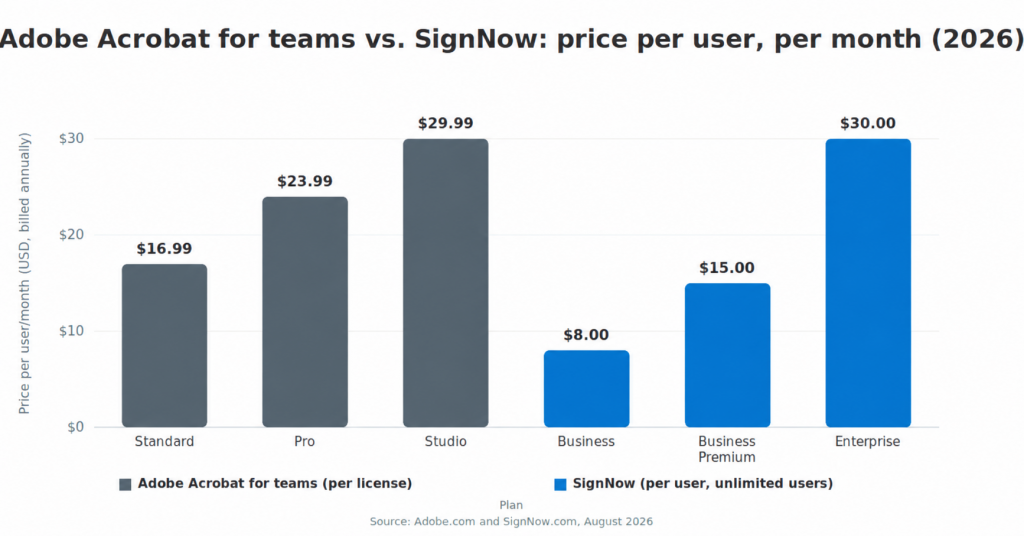
Adobe Acrobat Sign’s team plans run $16.99 to $29.99 per user per month on a required annual contract, with a 150-signature-transaction-per-user-per-year cap on every tier below enterprise. SignNow’s four plans run $8 to $30 per user per month, billed annually, with unlimited users on every paid tier and no published transaction cap. The gap between the two isn’t only the sticker price: it’s how each vendor bills, what each one caps, and what happens if a team needs to cancel early or streamline signing workflows.
That gap matters more as spending in the category grows. The digital signature market was valued at $9.85 billion in 2025, is projected to reach $13.70 billion in 2026, and is projected to reach $154.52 billion by 2034, at a 35.40% compound annual growth rate, according to Fortune Business Insights’ digital signature report. More vendors, more tier names, and more procurement dollars flowing through this category make a plain-language cost comparison worth doing before signing a 12-month contract with either provider.
This article provides a clear, detailed cost comparison between Adobe Acrobat Sign and SignNow for 2026. It is tailored for operations managers, procurement leaders, sales teams, and business owners seeking an objective breakdown of pricing tiers, transaction limits, contract terms, and hidden fees to help them choose the right e-signature solution for their team.
TL;DR
- Adobe Acrobat for teams: Standard $16.99/user/month, Pro $23.99/user/month, Studio $29.99/user/month, all billed on a 12-month commitment.
- SignNow: Business $8/user/month, Business Premium $15/user/month, Enterprise $30/user/month, Site License $1.50/signature invite; all billed annually, all with unlimited users.
- Adobe caps most tiers at 150 signature transactions per user per year; SignNow publishes no equivalent cap on its paid plans.
- Adobe’s early-termination terms were central to a $150 million federal settlement announced in March 2026 over undisclosed cancellation fees.
- SignNow offers a 7-day free trial with no credit card required; Adobe’s free trials automatically convert to a paid subscription unless canceled first.
- For a 10-person team over one year, Adobe Acrobat Pro for Teams totals $2,878.80, versus $1,800 for SignNow Business Premium.
What is the Adobe Acrobat Sign pricing in 2026?
Adobe doesn’t sell eSignature as a standalone product; it’s bundled into Adobe Acrobat’s business pricing tiers within the broader Adobe ecosystem, and the exact pricing depends on whether you buy one of the individual plans or a team license.
Plan | Billing unit | Price (annual commitment) | Includes | Signature cap |
Acrobat Standard (individual) | Per user | $14.99/month | PDF editing, e-signing, Microsoft 365 integration | 150/year |
Acrobat Pro (individual) | Per user | $19.99/month | Standard features plus custom branding, payment collection | Unlimited (Fair Use) |
Acrobat Studio (individual) | Per user | $24.99/month | Pro features plus Acrobat AI Assistant, PDF Spaces | Unlimited (Fair Use) |
Acrobat Standard for teams | Per license | $16.99/month ($203.88/year) | Admin console, user/group management, shared templates | 150/user/year |
Acrobat Pro for teams | Per license | $23.99/month ($287.88/year) | Standard for teams + redaction, web forms, bulk sending, advanced e-signatures | Unlimited (Fair Use) |
Acrobat Studio for teams | Per license | $29.99/month ($359.88/year) | Pro for teams plus Acrobat AI Assistant, PDF Spaces, Adobe Express Premium | Unlimited (Fair Use) |
Acrobat Sign Solutions (enterprise) | Custom | Quote-only | Advanced authentication, HIPAA/FERPA compliance, CRM integrations, API access | Volume-based purchase options |
Every team and enterprise tier requires a 12-month commitment, and Acrobat Sign transaction limits cap individual and team plans at 150 signature transactions per user per year; enterprise customers can request a higher limit. Acrobat Sign Solutions, Adobe’s enterprise eSignature tier, has no published pricing; buyers must contact sales for a quote.
Third-party trackers have listed lower numbers earlier in 2026 (some cited Acrobat Standard for teams at $14.99 rather than $16.99), which lines up with Adobe’s published pricing history of restructuring Acrobat tier pricing more than once during the year. Independent guides, such as Eversign’s Adobe Acrobat Sign coverage, describe the same pattern of tier renaming across 2026. The figures above reflect Adobe’s own live pricing page as of September 2026. Buyers comparing quotes gathered even a few months apart should treat any Adobe number as a snapshot, not a fixed price, and confirm the current tier names and rates directly on Adobe’s pricing page before budgeting.
How much does SignNow cost in 2026?
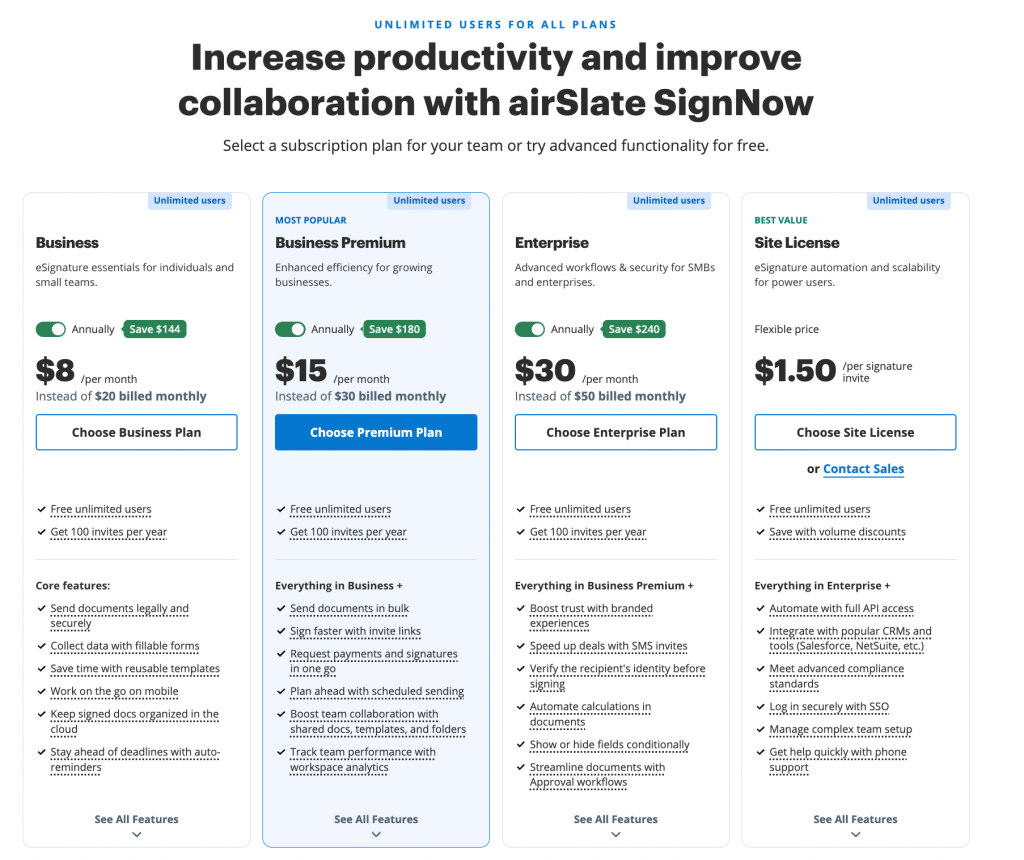
SignNow offers its standalone eSignature product through four distinct tiers, each featuring annual billing and support for unlimited users at no additional charge.
Plan | Price (billed annually) | Price (billed monthly) | Adds |
Business | $8/user/month | $20/user/month | Send for signing, fillable forms, reusable templates, mobile apps |
Business Premium | $15/user/month | $30/user/month | SignNow bulk send, invite links, request payments, kiosk mode |
Enterprise | $30/user/month | $50/user/month | Advanced signer authentication, formula fields, SignNow advanced integrations with Salesforce and NetSuite |
Site License | $1.50/signature invite | $1.50/signature invite | SSO, full API access, phone support, dedicated customer success manager |
Even the entry-level Business tier equips small businesses and teams with essential signing tools, including reusable SignNow templates and access to SignNow mobile apps for iOS and Android, allowing them to get started efficiently without immediately stepping up to a higher plan. Business Premium is the tier where the two vendors’ models start to diverge in practice: at $15 a user, a team already gets bulk sending and payment requests, which Adobe reserves for higher, capped tiers. Each plan listed above features a 7-day SignNow free trial with no credit card required. Additionally, SignNow explicitly indicates on its pricing page that renewal comes with zero hidden fees or overages.
SignNow reports that customers see an average 700% return on investment in their first year, with an average 7x ROI within the first six months, up to 6 hours saved per employee per week, and an average 8% improvement in deal-closing rate. On SignNow G2 reviews, SignNow’s profile lists a 4.6/5 stars overall user rating, 9.0/10 for ease of use, and 9.0/10 for ease of setup, figures the platform cites directly on its own site alongside G2 Leader recognition across recent quarters.
Adobe Sign vs. SignNow: Individual and business plans comparison
Lining up each vendor’s closest tiers shows the structural difference more clearly than either pricing page does on its own.
Attribute | Adobe Acrobat Sign | SignNow |
Entry price | $14.99/user/month (individual) | $8/user/month |
Mid-tier price | $23.99/user/month (Pro for teams) | $15/user/month (Business Premium) |
Top self-serve tier | $29.99/user/month (Studio for teams) | $30/user/month (Enterprise) |
Billing unit | Per license | Per user |
Users included | Priced per seat purchased | Unlimited on every paid plan |
Signature cap | 150 transactions/user/year (non-enterprise) | No published cap |
Contract term | 12-month commitment | Annual billing; monthly option available |
Free trial | Varies by plan; converts to a paid subscription unless canceled | 7 days, no credit card required |
Cancellation terms | Early-termination fee applies after a 14-day window | No overages or hidden fees disclosed |
Bulk sending | Included from Pro for teams up | Included from Business Premium up |
Payment collection | Payment collection options are available with Acrobat Pro plans / Acrobat Pro for teams and up | Payment collection is available from Business Premium up |
Compliance | HIPAA/FERPA (enterprise tier) | SignNow SOC 2 compliance, HIPAA via BAA, GDPR, PCI DSS |
Adobe Acrobat Sign signature solutions are designed for medium and large organizations, while SignNow will be a better choice for the small and mid-sized business segment.
Audit trail logging is enabled by default starting from SignNow’s entry Business plan rather than being locked behind higher-priced tiers. Enforceability for both providers rests on the same legal foundation: the ESIGN Act and UETA compliance give electronic signatures equal legal standing to paper ones across the U.S. Consequently, evaluating these platforms comes down to contract terms and overall cost rather than core legal validity. Since neither company publishes a direct comparative satisfaction rating, this breakdown focuses strictly on public pricing models and plan terms instead of aggregating user reviews from different third-party sites.
Hidden expenses behind Adobe Sign’s pricing
Enrolling in an Acrobat Standard, Pro, or Studio team plan requires a 12-month contract. Canceling past the initial 14-day grace period incurs a fee equal to 50% of the remaining contract balance according to Adobe’s terms. These cancellation policies and how they were presented led to a federal settlement over subscription fees with the U.S. Department of Justice, which alleged violations of the Restore Online Shoppers’ Confidence Act due to obscured fine print. As part of the $150 million agreement ($75 million in penalties and $75 million in customer refunds), Adobe agreed to upfront disclosures of termination fees, advance notices prior to trial conversions, and a simplified cancellation process.
Additionally, the 150-transaction yearly limit operates like a capped data plan. Teams may easily exceed this threshold during peak periods, forcing them to negotiate higher limits or upgrade to expensive enterprise pricing.
By contrast, SignNow’s no-hidden-fees pricing applies the same terms across every plan: unlimited users, no per-signature overage at renewal, and a trial that doesn’t require a card on file to start.
What advanced features does SignNow include at the same price point?
At $15 per month, SignNow Business Premium already includes such advanced e-signature capabilities as Bulk Send, payment requests, and SignNow kiosk mode: features Adobe reserves for higher, capped tiers rather than bundling into a mid-priced plan. Standard plans (Business, Business Premium, Enterprise) offer unlimited seats and provide an allotment of 100 signature invites per user per year, which are shared across the entire account instead of charging per person.
The bigger difference shows up in how each vendor counts users. Adobe bills per license, so a 20-person team pays for 20 seats even in a month where only a handful of people actually send a document. Every SignNow paid plan includes unlimited users at no extra cost, which matters most for teams whose signing volume is uneven rather than steady. That model scales to SignNow’s largest customers too: the platform lists 318 Fortune 500-registered companies and 211 enterprise customers paying over $10,000, alongside 270+ native integrations spanning CRM, ERP, and cloud-storage systems, without changing the per-user pricing structure between a 5-person team and a 500-person one.
Consider a real estate brokerage that closes a handful of contracts most weeks but spikes to dozens during a seasonal rush: SignNow real estate solutions let the brokerage sign, send, and save rental applications and lease agreements from any device without recalculating how many licenses to buy before the busy season starts. A brokerage on a per-license plan has to either overbuy seats year-round or true up before every spike; a brokerage on SignNow’s per-user plan pays the same rate for one signer or fifty.
Real-world cost: one 10-person team for a year
A 10-person team on Adobe Acrobat Pro for teams pays $2,878.80 in year one at list price, versus $1,800 on SignNow Business Premium for the same 10 seats. That’s before counting Adobe’s transaction cap or termination-fee exposure.
The arithmetic:
- Adobe Acrobat Pro for teams costs $23.99 per user per month; at 10 users for 12 months, that’s $23.99 x 12 x 10 = $2,878.80.
- SignNow Business Premium costs $15 per user per month; at the same 10 users for 12 months, that’s $15 x 12 x 10 = $1,800.00.
The Adobe total assumes the team never cancels early and never exceeds 1,500 combined signature transactions across the year (150 per user x 10 users); the SignNow total carries no seat-count condition and no transaction ceiling to plan around.
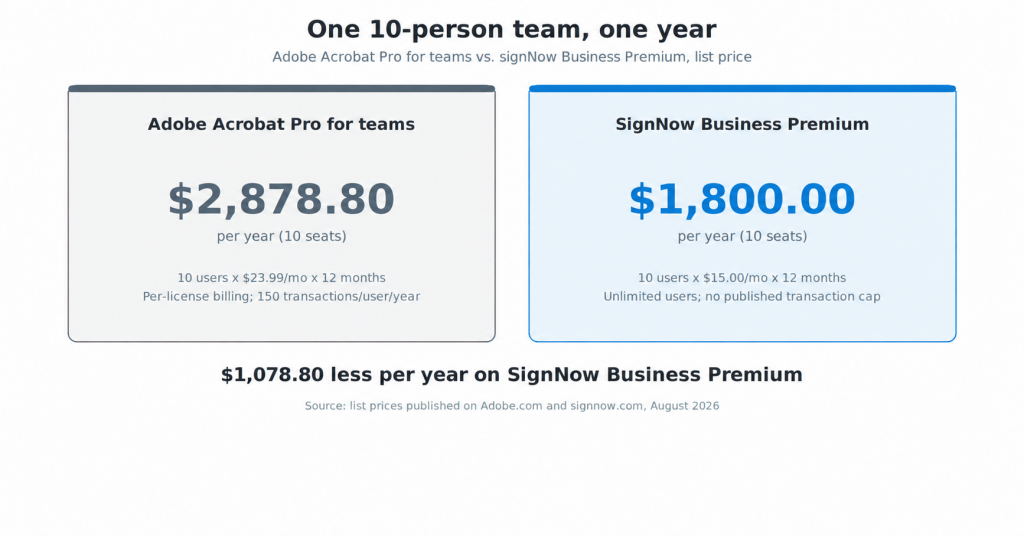
For a 10-person team over a single year, this represents a $1,078.80 cost gap. That discrepancy expands further when taking into account seasonal team members or temporary staff, as every additional seat under Adobe requires an extra full-price license, whereas SignNow provides a consistent per-user rate with no extra setup steps. These calculations rely on standard published rates from both websites. They do not factor in potential enterprise discounts, Adobe’s optional AI Assistant feature, or penalties for terminating an Adobe annual contract early—factors that would only expand the pricing difference. Organizations evaluating options can review SignNow plans and pricing to calculate the numbers for their specific team size.
Which plan fits your team, and when to switch
While organizations with steady, lower-volume needs can operate effectively on the entry tiers of either provider to sign documents, SignNow’s unlimited-user model delivers greater value for businesses facing variable transaction volumes, regular bulk send needs, or a growing count of occasional signers.
Smaller legal practices issuing only a few engagement letters each month can operate comfortably on either provider’s basic tier, as their sending volume remains safely below standard caps. Conversely, real estate firms experiencing seasonal workload surges benefit more from a predictable per-user pricing model that avoids purchasing extra seat licenses in advance. Healthcare organizations processing patient forms require SignNow HIPAA compliance backed by an executed Business Associate Agreement, which is available upon request. While Adobe accommodates HIPAA requirements under its Enterprise tier, it does so exclusively through custom, quote-based plans. Companies seeking centralized contract workflows across HR, finance, and sales—along with single sign-on and more advanced features, like complete API access—can obtain these capabilities through SignNow API access via the Site License option, which charges per signature invite instead of per seat and includes single sign-on on the same tier.
When enterprise-level organizations compare SignNow’s Site License with Adobe Acrobat Sign Solutions, the decision hinges on custom pricing, integration capabilities, and support structures rather than standard monthly subscription fees. Because both offerings rely on custom quotes instead of self-serve tiers, evaluating teams should request written commitments regarding specific terms from each vendor prior to financial comparison. Under SignNow’s Site License model, accounts receive phone support and a dedicated customer success manager alongside the transactional per-invite billing rate.
Cohesity CEO Mohit Aron, in a review featured among SignNow customer stories, described why his team adopted the platform: “SignNow has helped us take the work out of this process and has been a lifesaver! In our business, it’s not uncommon to see documents that require approvals and signatures exchange multiple hands before a transaction can be completed.” That kind of multi-party, unpredictable routing is exactly the scenario where a per-user, uncapped plan avoids the seat-math problem a per-license, capped plan creates.
Who switches, and why: A finance or operations lead managing a growing team, evaluating both vendors before a contract renewal, who needs the total annual cost and the cancellation terms in writing before signing another 12-month commitment.
How: Compare the plan-by-plan tables above against actual monthly signing volume, not just headcount, since volume, not team size, is what triggers Adobe’s cap and what a per-user plan absorbs without a rate change.
Final thoughts
Comparing the list prices of Adobe and SignNow is straightforward; however, understanding the costs after a subscriber signs an annual contract is more complex. Factors like transaction caps, per-license billing, and the early termination fee structure, as outlined in the March 2026 DOJ settlement, can significantly alter the actual expense compared to what’s shown on a pricing page. For a team of 10 people, this discrepancy amounts to an additional $1,078.80 per year. This extra cost either remains in a SignNow account for other tools or helps manage the financial impact of Adobe’s contract terms.
Experience the difference with your own contracts: start SignNow’s 7-day free trial and put this month’s documents through it to compare the offerings of both platforms at their respective prices.
Key terms
- Annual commitment: A contract term requiring a subscriber to pay for a full year of service, whether billed as one upfront payment or as monthly installments across the year.
- Early termination fee: A charge applied when a subscriber cancels an annual contract before its term ends, calculated as a portion of the remaining committed payments.
- Per-license billing: a pricing model that charges for each seat purchased, regardless of how many people actually use it in a given period.
- Per-user billing: A pricing model that charges based on the number of active users, without a separate seat-purchase step.
- SOC 2 Type II: An auditing standard that verifies a service provider’s security controls are both designed correctly and operating effectively over time.
- Transaction cap: A limit on the number of signature requests or envelopes a plan allows within a set period, typically a year.
- Unlimited users: A plan term meaning every paid seat on the account is included in the listed price, with no per-seat add-on cost.
FAQ
How much does Adobe Sign cost per month?
Adobe Acrobat Sign is bundled into Acrobat plans starting at $14.99/month for an individual Standard plan, rising to $29.99/user/month for Studio for teams, with enterprise Acrobat Sign Solutions priced by quote only. Team-licensed tiers run $16.99-$29.99 per user per month on a required 12-month commitment.
Does Adobe Sign have a free plan?
No. Adobe offers free trials on select plans but no permanent free tier for eSignature features. The trial terms and length vary by which Acrobat tier a buyer selects.
Does Adobe Sign charge a fee for canceling early?
On annual-commitment plans, Adobe’s pricing page states that canceling after the first 14 days triggers a fee equal to half the remaining contract balance, a practice that was the subject of a $150 million DOJ settlement announced in March 2026, after which Adobe agreed to disclose termination fees more clearly before signup.
How many signatures can I send per year with Adobe Sign?
Individual and team plans are capped at 150 signature transactions per user per year; enterprise customers can request a higher limit through Acrobat Sign Solutions, which is priced by quote rather than a published rate.
Is SignNow cheaper than Adobe Sign?
At every comparable tier, yes: SignNow’s entry plan is $8/user/month against Adobe’s $14.99, and SignNow’s $15/user/month Business Premium plan already includes bulk send and payment requests that Adobe reserves for pricier tiers. The gap holds at the top self-serve tier too: SignNow Enterprise runs $30/user/month against Adobe Acrobat Studio for teams at $29.99, but SignNow’s tier adds unlimited users while Adobe’s stays per-license.
Does SignNow require a credit card for its free trial?
No. SignNow’s 7-day free trial does not require a credit card to start, and every paid plan afterward carries the same no-overage, no-hidden-fee terms at renewal.
Sources
- TL;DR
- What is the Adobe Acrobat Sign pricing in 2026?
- How much does SignNow cost in 2026?
- Adobe Sign vs. SignNow: Individual and business plans comparison
- Hidden expenses behind Adobe Sign’s pricing
- What advanced features does SignNow include at the same price point?
- Real-world cost: one 10-person team for a year
- Which plan fits your team, and when to switch
- Final thoughts
- Key terms
- FAQ
- Sources