

A loan agreement template is a reusable document that sets the loan amount, interest rate, repayment terms, and default consequences between a lender and a borrower, ready to be filled in and signed for each new loan. This guide covers drafting a compliant template once and routing it for signature each time a new loan closes, rather than rewriting the contract from scratch for each borrower. More than a third of U.S. consumers (38%) held a personal loan in 2025, and that volume is one reason a written, reusable agreement now matters more than an informal handshake or a one-off IOU.
TL;DR
- Check the interest rate against your state’s usury cap, and, for a family loan, against the IRS Applicable Federal Rate, before drafting any terms.
- Include the core clauses every loan agreement needs: parties, principal, interest rate, repayment schedule, default terms, and governing law.
- Replace static details with fillable fields so that a single template works for every new borrower.
- Add every signer, including any guarantor, and set the order in which they sign the document.
- An electronically signed loan agreement is as legally binding as a wet-ink one under the ESIGN Act and UETA, provided each signer’s intent is demonstrable.
Before you begin
Confirm four things before opening a document editor:
- Who is lending and who is borrowing, including any guarantor or co-signer
- Whether the loan is secured by collateral or unsecured
- Which state’s law will govern the agreement
- How the document will be signed: in person, by mail, or electronically
A SignNow account with its document editor and a stable internet connection are all you need to build the agreement, whether the lender is an individual or a financial services team. You can build the contract once as a reusable template and reuse it for every new borrower rather than redrafting it from scratch—a capability available on SignNow’s Business plan and above.
Disclaimer: The information contained in this blog post is provided for general informational purposes only and does not constitute legal advice.
Step 1: Confirm the terms are legal before you draft
Every state caps the interest rate a private lender can charge, and skipping that check is the fastest way to end up with an unenforceable clause. State usury laws set the ceiling, but banks are frequently exempt from the borrower’s state cap and can instead apply the more permissive rules of their home state. Creola Johnson, a law professor at Ohio State University, explains that states have exempted banks from usury restrictions “to entice them to set up shop there,” letting those institutions charge rates based on their home state’s rules rather than the borrower’s.
For a loan between family members or friends, a second check applies. The IRS publishes an Applicable Federal Rate each month, and a loan priced below it can trigger imputed interest income for the lender. As of September 2026, the short-term rate (loans up to three years) is 4.18%, the mid-term rate (three to nine years) is 4.49%, and the long-term rate (over nine years) is 5.12%. Unpaid interest below that floor also counts against the lender’s annual gift-tax exclusion of $19,000 per recipient: price a family loan below the AFR, and the IRS treats the shortfall as a taxable gift rather than as interest that was simply never charged.
Step 2: Draft the core terms of the agreement
A complete loan agreement states the principal amount, interest rate, repayment schedule, default consequences, and governing law, the same core terms a promissory note covers with less detail and fewer mutual obligations. Include:
- The full names and addresses of both parties, the date of the agreement
- The principal sum, the interest rate, and how it compounds
- The repayment method (installments, a lump sum, or on demand)
- What happens if a payment is missed
- Which state’s law applies if a dispute reaches court
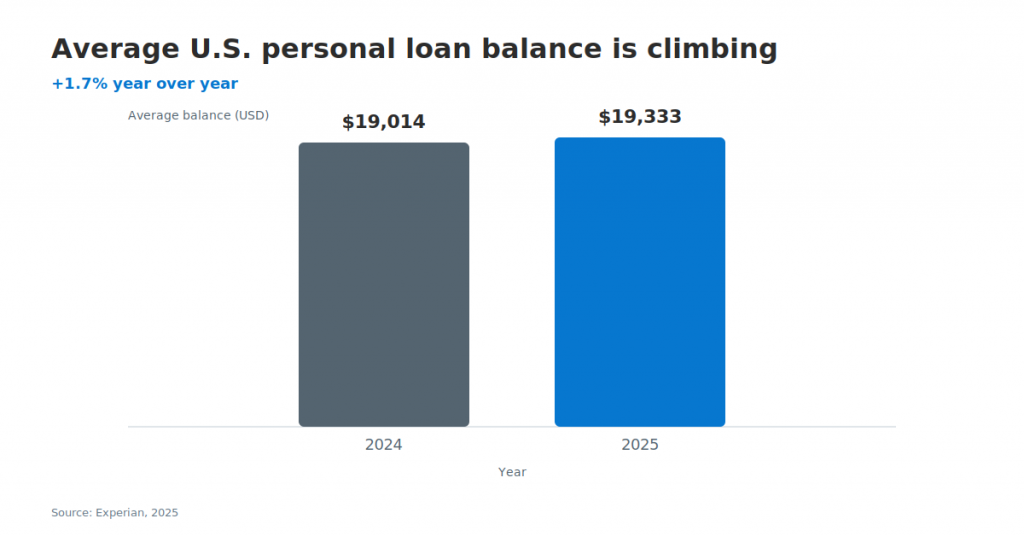
Demand for this kind of documentation has grown alongside personal loan balances, which reached an average of $19,333 in 2025, up from $19,014 the year before. Customizable and reusable templates let a lender set these clauses once and change only the variable details for each new agreement.
Step 3: Add fillable fields for the loan-specific details
Once the clause language is set, the variable loan details (names, principal, interest rate, dates) can be replaced with fields that stay blank until a new borrower fills them in, so the same document works without redrafting. Uploading the draft and adding fillable fields turns the static clauses into a form: a text field for each party’s name and address, a date field for the origination date, and, on plans that support it, a calculated field for the interest total so the payment math updates automatically when the principal or rate changes. For more details, learn how to make your PDF fillable.
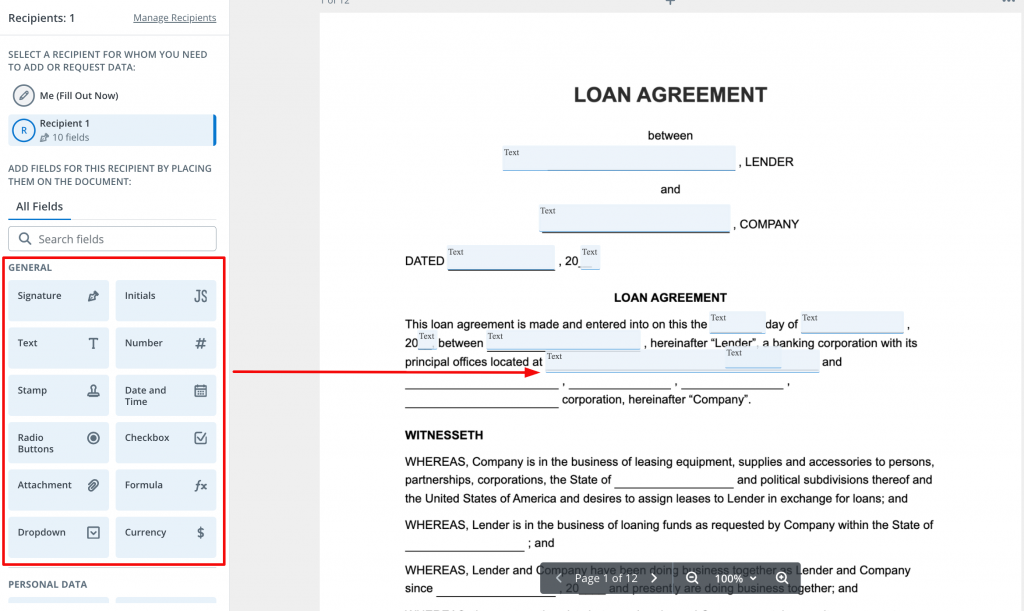
Once you finish creating your own loan agreement sample, use the document preview to check that it looks clean and professional.
Basic fillable fields, including text and date fields, are available on all SignNow’s subscription plans. Automated interest-total calculations (formula fields) and conditional fields, which show or hide a clause depending on an earlier answer, both require the Business or Enterprise plans.
Step 4: Add every party and set the signing order
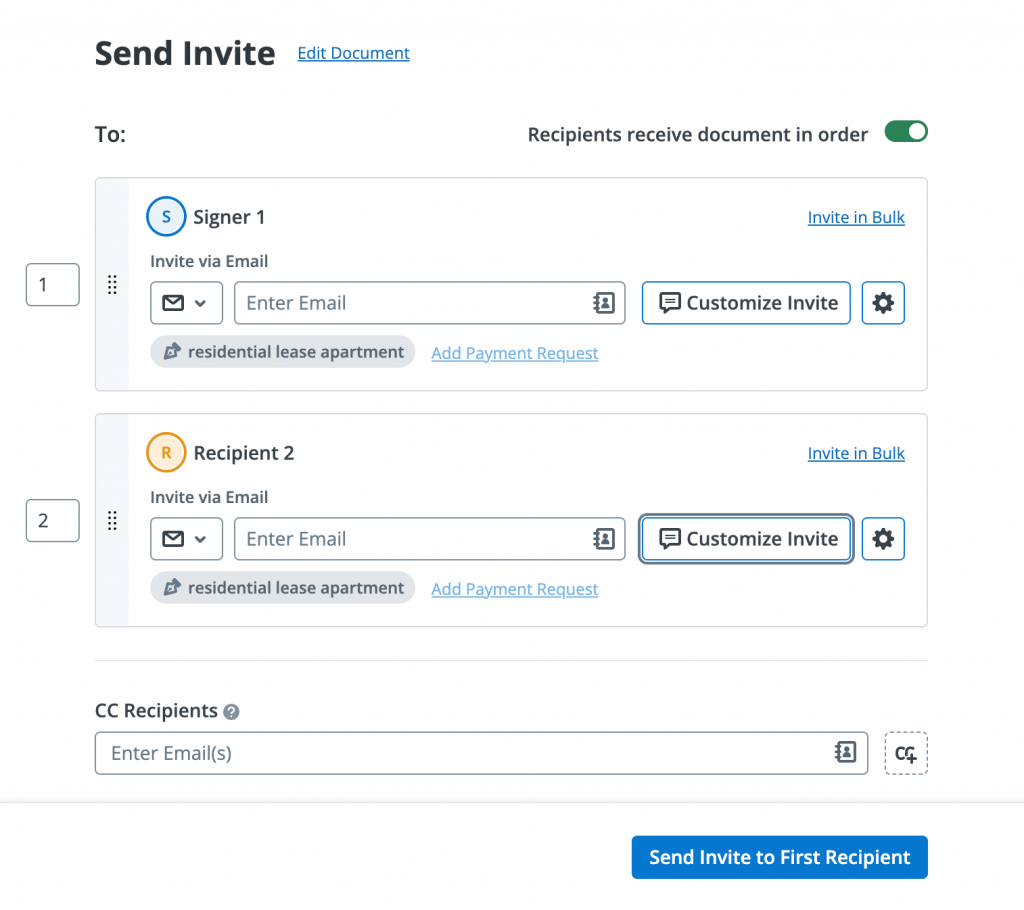
A loan agreement usually requires more than two signatures: the lender, the borrower, and often a guarantor or co-signer, so the signing order has to be set before the document goes out. A private lender financing a rental property purchase, for example, might need the borrower to sign first, a co-signing family member second, and the lender to countersign last, with each party working from a different city.
After adding multiple signers as separate recipients, a custom signing order routes the document to each party in sequence instead of sending it to everyone at once. Each signer receives an email invitation only after the previous signer has finished, which prevents a co-signer from signing a document the lender has not yet approved.
Step 5: Send it for a legally binding eSignature
Under the federal ESIGN Act and state UETA statutes, an electronically signed loan agreement has the same legal validity as a traditional wet-ink signature, as long as it is clear that each signer’s intent to sign is evident and the agreement does not specifically require a handwritten signature. The ESIGN Act and UETA apply to loan agreements the same way they apply to any other business contract: consent to sign electronically can be shown through the parties’ conduct, such as exchanging and returning electronically signed documents.
Dan Rotelli, CEO of BIS, a legal services provider, said: “We felt most comfortable investing with SignNow given their SOC 2 certification and strict focus on ESIGN and UETA act compliance. Deploying SignNow across all functions of our growing organization and within critical Office 365 environments has simplified our entire workflow.”
Every signature carries a detailed audit trail: full names, email addresses, IP addresses, and timestamps for each action taken on the document, which is what a lender points to if a borrower later disputes whether or when they signed. Adoption is accelerating alongside broader digital signature market growth, projected to expand from $13.70 billion in 2026 to $154.52 billion by 2034, with banking and lending among the sectors replacing paper-based signing to speed loan approvals.
Troubleshooting: Common mistakes to avoid
Avoid these common pitfalls when creating and executing a loan agreement to ensure your contract remains legally enforceable and clear for all parties.
- Skipping the usury check. Setting an interest rate without checking the borrower’s state cap can make that clause unenforceable, even if both parties agreed to it in writing.
- Underpricing a family loan. A rate below the IRS Applicable Federal Rate turns the shortfall into imputed income for the lender and can count against the annual gift-tax exclusion.
- Reusing an old template without updating the governing law. A template drafted for one state’s rules does not automatically apply correctly to a borrower in a different state.
- Leaving default terms vague. Loan repayment terms and schedules without a clear late-fee amount or grace period give both sides room to disagree about what happens after a missed payment.
- Forgetting the guarantor’s signature. A co-signer who never formally executes the agreement is not bound by it, no matter what the borrower promised on their behalf.
Final thoughts
A loan agreement template only pays off once it is used more than once: the clauses get vetted against usury limits, and AFR rules a single time, and every borrower after that signs a document that has already been checked. The fields capture the variable details, the signing order prevents a guarantor from committing to terms the lender hasn’t yet approved, and the audit trail gives both sides a record if the loan is ever disputed. None of that depends on the lender being a law firm or a bank; it depends on having a template built correctly once.
Build a reusable loan agreement template in SignNow and send your first one for signature today.
Key terms
- Applicable Federal Rate (AFR): The minimum interest rate the IRS publishes each month for family and other below-market loans, used to determine whether unpaid interest counts as a taxable gift.
- Audit trail: A record of every action taken on a signed document, including names, email addresses, IP addresses, and timestamps.
- Default: A borrower’s failure to meet the loan’s terms, most often a missed or late payment.
- Guarantor: A third party who agrees to repay the loan if the borrower does not.
- Principal: The original amount of money loaned, before interest.
- Promissory note: A simpler, one-sided written promise to repay a debt.
- Usury: Charging interest above the maximum rate a state allows.
Sources
- Personal Loan Study, Experian, 2025
- Digital Signature Market Report, Fortune Business Insights, 2026
- Applicable Federal Rates, IRS
- Usury Laws Guide, NerdWallet
- Electronic Signatures Comment, American Bar Association
- SignNow eSignature Legality, United States
FAQ
What is a loan agreement?
A loan agreement is a legally binding written contract between a lender and a borrower. It defines the principal loan amount, interest rate, repayment terms, and consequences of default.
Is a loan agreement legally binding without a notary?
Yes. Notarization is not required for a loan agreement to be enforceable in most states; what matters is that both parties sign it and the terms are clear. Some lenders still choose notarization for extra evidentiary weight.
What is the difference between a loan agreement and a promissory note?
A promissory note is a simpler, one-sided promise to repay, typically signed only by the borrower. A loan agreement is a fuller contract signed by both parties that spells out mutual obligations, default remedies, and governing law.
How much interest can I legally charge on a personal loan?
The limit depends on the state’s usury law, which sets a maximum rate for private lenders. Banks are frequently exempt and can apply their home state’s rate instead of the borrower’s.
Can a loan agreement be signed electronically?
Yes. Under the federal ESIGN Act and state UETA statutes, an electronic signature on a loan agreement has the same legal effect as a handwritten one, provided the signer’s intent to sign is demonstrable.
What happens if someone does not pay back a loan agreement?
The agreement’s default clause specifies the remedies available when a borrower fails to make payments. These consequences can include late fees, acceleration of the total remaining balance, or collateral repossession for secured loans.
Do you need a witness to sign a loan agreement?
Most states do not require a witness for a private loan agreement to be valid. However, some lenders still choose to use a witness or notary to provide additional evidence if the contract is ever disputed.
- TL;DR
- Before you begin
- Step 1: Confirm the terms are legal before you draft
- Step 2: Draft the core terms of the agreement
- Step 3: Add fillable fields for the loan-specific details
- Step 4: Add every party and set the signing order
- Step 5: Send it for a legally binding eSignature
- Troubleshooting: Common mistakes to avoid
- Final thoughts
- Key terms
- Sources
- FAQ