
How to sign a lease agreement electronically: complete guide for 2026

The ability to sign a lease agreement electronically is a standard part of modern workflows, not just a convenience feature. For property managers, brokers, and SMB operators, the priority in 2026 is building a workflow that is fast for tenants, efficient for staff, and robust enough to withstand scrutiny if questions arise later.
Quick summary
- Electronic signatures are the most popular technology used by realtors, generally valid for U.S. lease agreements when the workflow meets federal and state requirements.
- A legally sound lease signing process requires more than a signature field: it should include consent to do business electronically, the correct lease package, signer authentication where needed, and a durable record of the completed agreement.
- Electronic lease signing helps property managers and SMB operators reduce delays, improve visibility, and standardize leasing operations.
- SignNow fits well into this process because it supports reusable templates, multi-signer routing, tracking, audit trails, and integrations that help teams manage lease workflows at scale.
- The biggest risks in digital lease execution usually come from weak process design, not from the e-signature technology itself.
From a single task to a workflow part
For U.S. property managers and SMB operators, lease signing is no longer just an administrative task. It is part of a larger workflow that affects tenant experience, operational efficiency, and record quality.
A paper-based process or an email-and-attachment workflow can slow execution, create version confusion, and make it harder to maintain complete records. A structured electronic process helps solve those problems by standardizing how lease documents are prepared, routed, signed, and stored.
This guide explains how to sign a lease agreement electronically, what makes the process legally sound, what businesses should look for in an eSignature workflow, and how SignNow supports lease execution at scale. In case you are interested in digital contract signing as a related topic, check out our guide: How to sign a digital contract.
Why electronic lease signing matters in 2026
Electronic lease signing helps leasing teams move faster and work with better control.
Instead of manually sending documents, checking returned pages, and following up on missing signatures, teams can centralize the lease package, assign required fields in advance, track progress, and keep completed records in one place.
For SMB property teams, the benefits are practical:
- faster turnaround from approval to move-in;
- fewer manual follow-ups;
- more consistent lease documentation;
- clearer visibility into signing status; and
- stronger records if a dispute comes up later.
That is why electronic lease signing is best viewed as an operational workflow, not just a digital signature feature.
Is it legal to sign a lease agreement electronically in the U.S.?
In most cases, yes. Electronic signatures can be legally valid for lease agreements in the United States.
At the federal level, the ESIGN Act supports the legal effect of electronic signatures and records in qualifying transactions. In most states, UETA provides the legal framework that gives electronic records and signatures the same basic standing as paper documents and handwritten signatures. For more explanations, we’ve covered What is UETA? The difference between UETA and the Esign act in one of our previous blogs.
Still, legal validity depends on more than using eSignature software. A defensible lease workflow should show that the signer intended to sign, agreed to transact electronically, received the correct lease package, and could retain the completed record.
State and local requirements also matter. Lease forms, disclosures, and related documents may vary by jurisdiction, and some lease-related forms may involve additional formalities such as notarization.
How to sign a lease agreement electronically
A reliable lease signing workflow should reduce both legal risk and operational friction.
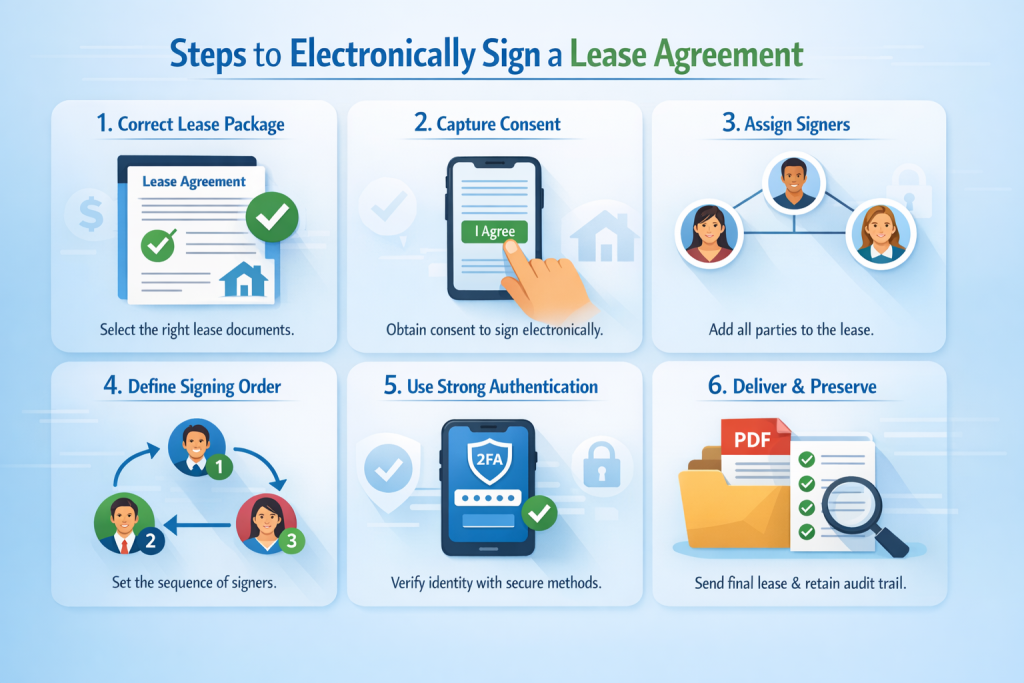
1. Start with the correct lease package
Before sending a document for signature, confirm that the lease form is up to date and appropriate for the property’s jurisdiction.
Attach all required supporting documents from the start. Depending on the transaction, that may include disclosures, pet addenda, guarantor forms, notices, or building rules.
A complete package matters because a valid signature does not fix missing or outdated documents.
2. Capture consent to transact electronically
Electronic consent is a core part of a legally sound workflow.
Before the tenant signs, the process should clearly explain that the records will be delivered and signed electronically and that the signer must be able to access and retain them. This step should be deliberate and well-documented. SignNow makes it easy to capture this consent by including it as a separate Start filling button at the beginning of the signing process
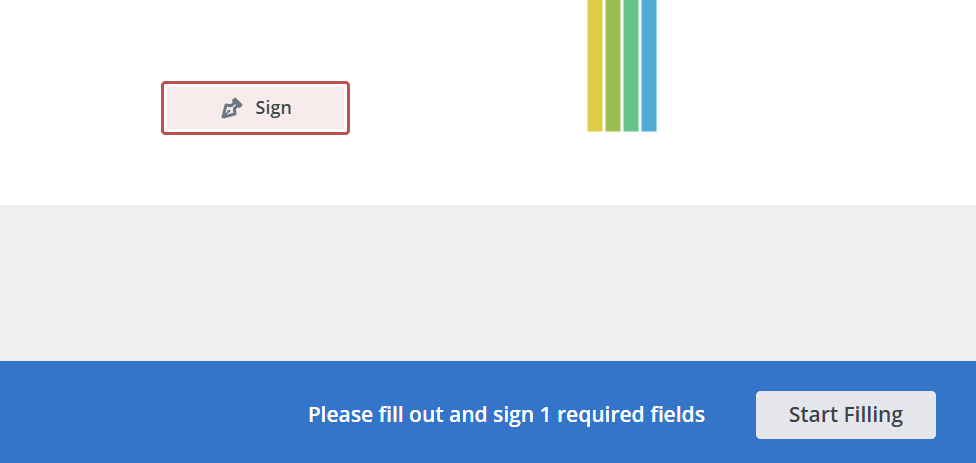
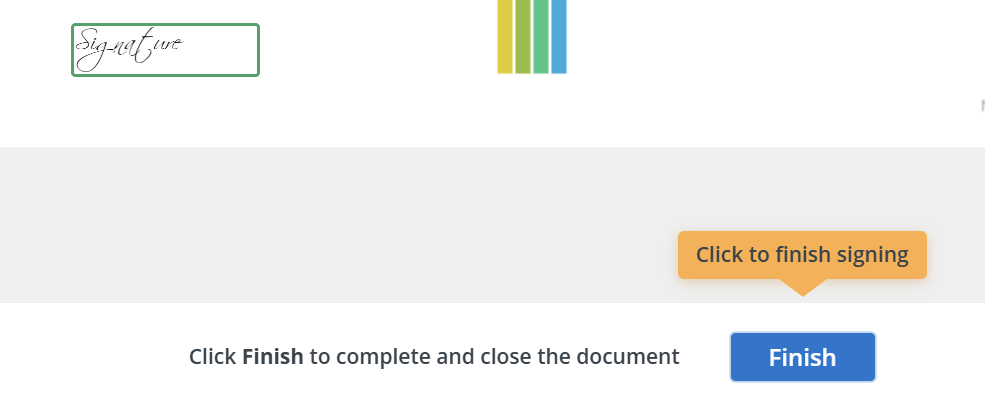
and the Finish button in the end to complete the document.
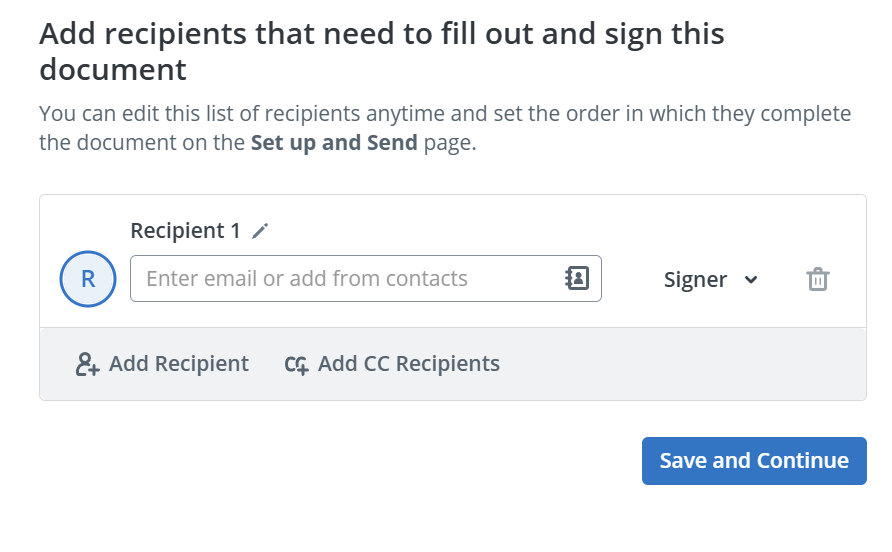
3. Assign signers and define the signing order
Lease agreements often involve multiple participants, including the landlord, tenants, guarantors, or cosigners.
A structured workflow should define who signs, which fields each person completes, and the order in which the document moves. This helps reduce delays, confusion, and incomplete agreements. When using SignNow, the signing order can be easily set, as well as the specific fields each party needs to complete.
4. Use stronger authentication when needed
Not every lease presents the same level of risk.
Routine renewals for known residents may need only baseline controls, while new tenants, guarantors, or higher-risk situations may justify stronger authentication. The goal is to apply the right level of verification for the transaction.
5. Deliver the final executed lease in a retainable format
Once the lease is signed, all parties should receive a complete executed copy.
The final agreement should be easy to download, store, and retrieve later. This supports both tenant experience and record integrity.
6. Preserve the audit trail
A signed PDF alone is not always enough.
If the lease is ever challenged, the supporting record matters: when the document was sent, when it was opened, who completed which fields, and when the signing sequence finished.
A strong audit trail helps support intent, timing, and completion.
What SMB executives should require from an eSign workflow
For SMBs, electronic lease signing should be evaluated as a business workflow, not just a signing feature.
The right platform should help reduce manual work while improving consistency and control. The key capabilities to look for are:
Reusable templates
Templates reduce setup time and make lease packages easier to standardize across renewals, addenda, and new leases.
Multi-party routing
Lease agreements often involve more than one signer. A useful system should support clear routing and signature order without forcing staff to manually manage everything.
Auditability
A platform should preserve the history of the signing process, not just the final file. This is important for both internal control and dispute defense.
Access and retention
Completed documents should be easy to deliver, retrieve, and store in a reliable way.
Integrations
The best signing workflow fits into the systems a business already uses, including cloud storage, productivity tools, CRM platforms, and finance systems.
Where SignNow fits for lease workflows
SignNow is a strong fit for lease workflows when a business wants to digitize execution without complicating adoption.
For SMB and mid-market property teams, its value comes from helping turn lease signing into a repeatable process. SignNow supports core workflow needs such as reusable templates, multi-signer routing, tracking, audit trails, and integrations with broader business systems.
That makes it useful for common leasing scenarios such as:
- new lease execution;
- lease renewals;
- guarantor packets;
- addenda and supplemental forms; and
- multi-party signature workflows.
The main advantage is not just that tenants can sign online. It is that teams can manage lease execution with more consistency, less manual work, and better documentation.
Common mistakes to avoid
Most problems in electronic lease signing come from weak workflow design rather than the technology itself.
Sending incomplete lease packages
Missing disclosures or outdated forms can create risk even when the signature itself is valid.
Treating consent as an afterthought
Electronic consent should be built into the workflow clearly and intentionally.
Using the same controls for every transaction
Some leases require stronger identity checks than others. Higher-risk transactions should be handled accordingly.
Failing to provide a durable final copy
Tenants and internal teams should be able to access and retain the completed lease easily.
Relying on software without standardizing the process
Even a capable platform like SignNow cannot fix a workflow that lacks template governance, document control, or retention discipline.
Practical examples
These potential examples show how electronic lease signing could help landlords, property managers, and brokerages reduce friction in day-to-day operations.
Single-site landlord standardizes renewals
A landlord managing a 60-unit property sends renewals manually as email attachments. Staff spend time rebuilding documents, checking returned pages, and following up with tenants.
By moving renewals into SignNow, the landlord can use templates, required fields, reminders, and centralized tracking to create a more consistent process and reduce manual effort.
Regional property manager improves guarantor workflows
A regional operator works with tenants and guarantors across multiple properties. The challenge is keeping the process orderly and well-documented.
Using SignNow’s routing and authentication features, the business can create a cleaner multi-party workflow and maintain a stronger record if questions arise later.
Brokerage connects lease execution to daily operations
A brokerage wants lease signing to fit into its broader operational stack rather than remain a disconnected task.
With SignNow, the team can connect lease execution more closely to its document workflow, making completed records easier to manage and reducing context switching.
Conclusion
To electronically sign a lease agreement in 2026, businesses need a workflow that captures consent, uses the correct lease package, routes documents accurately, applies stronger controls where needed, and preserves a durable final record.
That is why the best approach combines sound process design with a platform that supports repeatability. SignNow fits well into that model by helping property teams standardize lease workflows, reduce administrative effort, and maintain stronger documentation.
Start your free trial of SignNow today, and see how it can streamline your lease agreement process.
FAQ
Are electronic lease agreements legally binding?
Yes, electronic lease agreements are completely legally binding when executed correctly. SignNow ensures your documents comply with industry-leading security standards like ESIGN and UETA to guarantee global validity. Our platform automatically captures a comprehensive, court-admissible audit trail to preserve a reliable record of consent and execution.
Can a tenant refuse to sign a lease electronically?
Yes, a tenant generally has the right to decline electronic records or signatures and request a physical copy. However, you can easily offer them a secure, mobile-friendly signing experience through SignNow that often removes the friction of traditional paperwork. If they still prefer paper, you can simply upload the manually signed document back into your SignNow account for centralized storage.
What makes an electronically signed lease harder to dispute?
An electronically signed lease is highly defensible because it relies on a strong, automated workflow rather than easily forged manual signatures. SignNow protects your agreements with advanced audit trails that track every document view, signature, IP address, and timestamp. We also offer extra authentication options, like two-factor authentication, to verify the exact identity of the person signing your document.
Why use SignNow for lease agreements?
SignNow streamlines the entire leasing process by letting you create reusable templates and route them to multiple parties in seconds. Property managers can easily track document status in real-time, ensuring leases are completed faster and without missing signatures. Plus, our secure cloud storage keeps all your executed agreements perfectly organized and accessible from any device.
Do lease agreements need notarization?
Standard residential leases typically do not require notarization, but specific addenda or local state laws might dictate otherwise. You should always verify your local legal requirements before finalizing any property agreement. If a notary is required, you can seamlessly use digital notarization tools alongside your SignNow workflows to keep the entire process paperless.
- Quick summary
- From a single task to a workflow part
- Why electronic lease signing matters in 2026
- Is it legal to sign a lease agreement electronically in the U.S.?
- How to sign a lease agreement electronically
- What SMB executives should require from an eSign workflow
- Where SignNow fits for lease workflows
- Common mistakes to avoid
- Practical examples
- Conclusion
- FAQ