
What Is a Notary Public? Role, responsibilities, and when you need one

A notary public is a state-appointed official authorized to witness the signing of important documents and verify the identity and willingness of the people signing them. Think of a notary as a neutral referee for paperwork: they don’t judge whether the deal in front of them is a good one, they just confirm that the right person is signing, on purpose, with eyes open.
Most people meet a notary exactly once and never think about the role again until the next deed, power of attorney, or affidavit lands on their desk. Real estate fraud, much of it built on forged deeds and impersonated signers, drove more than $173 million in reported losses in a single year
TL;DR
- A notary public is appointed by a state government to serve as an impartial witness and deter document fraud, not to judge a document’s legal content.
- Core duties are verifying the signer’s identity, confirming willingness and competence, administering oaths and affirmations, and overseeing the signature itself.
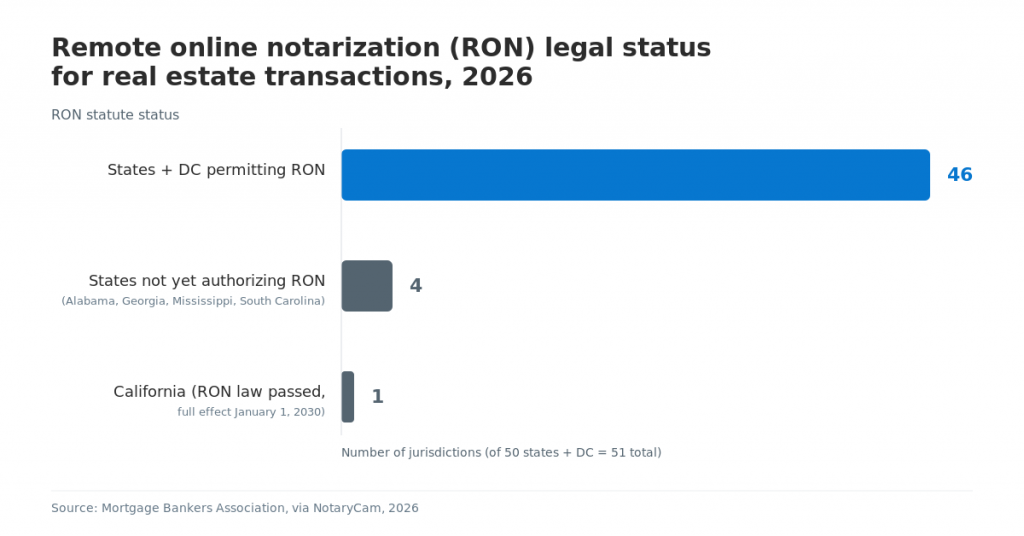
- Notaries now work in four formats: traditional in-person, mobile, in-person electronic notarization (IPEN), and remote online notarization (RON), which 45 states and the District of Columbia now permit for real estate transactions, with Alabama, Georgia, Mississippi, and South Carolina not yet authorizing it and California’s full RON law not effective until 2030.
- Common documents that require notarization include deeds, powers of attorney, affidavits, wills, and certain loan and healthcare paperwork; requirements vary by state.
- Notarization is legally distinct from an electronic signature: the ESIGN Act and UETA make eSignatures enforceable, but a notarial act adds a separate layer of identity verification and record-keeping.
- Fees are capped by state law and typically run $2 to $25 per signature, with mobile and RON appointments adding a convenience charge on top.
What does a notary public do?
A notary public verifies who is signing a document, confirms they are doing so willingly and with a clear mind, and then records that act. Why it matters: Without this check, a forged signature or a coerced signer could go undetected until the document is already relied on in a property sale, a loan, or an estate.
The role breaks down into four consistent duties across states, as the National Notary Association describes the office.
Verifying the signer’s identity
A notary asks for current, government-issued photo identification, typically a driver’s license or passport, and compares the photo, physical description, and signature against the person in front of them. If the notary has any doubt about identity, they can decline to proceed.
Confirming willingness and mental competence
The notary checks that the signer understands what they’re signing and isn’t being pressured into it. This is a judgment call in the moment, not a background investigation, but it’s the step most directly aimed at preventing elder abuse and coercion in estate and power-of-attorney signings.
Administering oaths and affirmations
Some notarial acts require the signer to swear, under penalty of perjury, that a statement is true. An oath invokes a higher power; an affirmation is the secular equivalent, made on personal honor. Both carry the same legal weight.
Witnessing or acknowledging the signature
In most cases, the notary watches the document get signed in real time. Where state law allows a document to be signed beforehand, the notary instead has the signer acknowledge, under oath, that the signature on the page is theirs. Either way, the notary’s central job is confirming that an impostor didn’t sign in the real signer’s place.
Notary public vs. civil-law notary vs. lawyer
A US notary public is not a lawyer and cannot give legal advice, draft contracts, or interpret what a document means for the signer’s situation. That’s the single most common point of confusion for first-time signers.
A US notary public is a person authorized by law to administer oaths and certify documents and signatures, a common-law function performed by a layperson rather than an attorney. This is different from a civil-law notary, a role found in countries such as France, Germany, and much of Latin America, where the notary is a licensed attorney who drafts and certifies legal instruments directly. A US notary who isn’t also a lawyer is prohibited from practicing law, even informally, while performing notarial duties.
Types of notaries: in-person, mobile, IPEN, and RON
Every notary holds the same underlying state commission, but four distinct service models have developed around how and where the notarization happens.
| Notary type | Document format | Where it happens | Typical use case |
| Employee notary | Paper or electronic | Employer’s office | In-house HR, banking, or title paperwork |
| Mobile notary | Paper | Signer’s home, hospital, or workplace | Signers who can’t travel |
| Notary signing agent | Paper or electronic | In-person, often at closing | Mortgage and refinance loan signings |
| Remote online notary (RON) | Electronic | Live video call | Signers in a different city or state from the notary |
Traditional and employee notaries
Many notaries are commissioned as part of an existing job, most often in banking, title, or HR roles, and notarize documents as one duty among several rather than as a standalone business. Employee notaries in banking or HR who handle the same notarized forms repeatedly often keep the surrounding paperwork consistent with reusable document templates, even though the notarial act itself still happens the same way it always has.
Mobile notaries and notary signing agents
A mobile notary travels to the signer instead of the other way around. Notary signing agents are a specialized subset, trained and background-screened specifically to handle mortgage and refinance closing documents. 51.1% of respondents in the National Notary Association’s most recent survey were self-employed mobile notaries or signing agents, reflecting how much of the profession now runs as independent, appointment-based work rather than a fixed office role.
In-person electronic notarization (IPEN)
With IPEN, the signer and notary are in the same room, but the document, signature, and notarial certificate are all electronic. No special notarial training is required beyond learning the specific platform, since the in-person identity check is unchanged from a paper notarization; the same in-person signing capability that lets two people complete a document on one device in an eSignature workflow is what an IPEN session builds on.
Remote online notarization (RON)
RON lets a commissioned electronic notary witness a signing over live video instead of in person, verifying identity through knowledge-based questions or credential analysis before the signer applies their electronic signature on camera. According to the Mortgage Bankers Association, 45 states and the District of Columbia now permit RON for real estate financial transactions; Alabama, Georgia, Mississippi, and South Carolina have not yet enacted their own RON authorization, and California has passed a RON law that isn’t fully in effect until January 1, 2030, though a limited pilot program is available there in the meantime.
When do you need a notary public?
You need a notary whenever a state, court, lender, or receiving institution specifically requires a notarized signature, not simply a signed one. The requirement is set document by document and state by state, so the safest approach is to check with the institution accepting the document before assuming a plain signature is enough.
Documents that commonly require notarization include real estate deeds and mortgages, powers of attorney, sworn affidavits, wills in some states, loan modification and HELOC paperwork, and certain healthcare directives. A few concrete scenarios:
- Real estate: A title company closing on a home sale requires the seller’s deed and the buyer’s mortgage documents to be notarized before they can be recorded with the county, work that typically starts inside a real estate signing workflow before the notarial step.
- Legal and estate planning: An estate attorney preparing a power of attorney for an aging client needs the document notarized so a bank or hospital will later accept it as valid, often after the draft itself moved through a legal services workflow for review.
- Healthcare: A hospital admissions coordinator asks a patient’s family member to notarize a healthcare directive so it holds up if a decision is later contested, and the surrounding intake forms are frequently collected through a healthcare signing workflow.
- Finance: A loan officer processing a HELOC application routes the signed paperwork to a notary signing agent before the loan can fund, after the initial disclosures move through a financial services workflow.
- HR: An HR administrator handling an employee’s affidavit for a benefits claim has it notarized to satisfy the insurer’s documentation requirement, then tracks the request with approval workflows until the notarized copy comes back.
Notarization and eSignatures: what’s the legal difference
An electronic signature and a notarized signature solve two different problems, and one doesn’t substitute for the other.
Why it matters: An electronic signature may satisfy a signature requirement under ESIGN and applicable state law when the transaction meets the relevant legal requirements and is not subject to an exclusion.
The federal ESIGN Act, signed into law in 2000, and the state-level UETA, finalized in 1999, establish that an electronic signature cannot be denied legal effect solely because it’s electronic. Both laws also address notarization directly: UETA permits a document to be “notarized, acknowledged, verified, or made under oath” electronically, provided the required information is attached to the signed record, which is what makes IPEN and RON legally possible on top of an eSignature workflow. Separately, the Revised Uniform Law on Notarial Acts, a model law drafted by the Uniform Law Commission, sets the technology and identity-verification standards that states use as a template for electronic and remote notarial acts when they choose to adopt it.
Practical difference
In practice, this means a platform can be fully compliant for eSignatures under ESIGN and UETA without offering notarization at all, and the two capabilities are often sold and used separately, even when they live in the same product. SignNow’s compliance stack covers ESIGN and UETA alongside SOC 2 Type II, PCI DSS, HIPAA, and 21 CFR Part 11, and its Business plan includes 24/7 online notarization as an integration through SignNow API.
Teams evaluating whether compliance features matter in practice don’t always take it on faith. As one SignNow customer put it:
“We can recommend SignNow not only because of compliance, but also because it is easy in use for us and for all the applicants.”
— Lucija Hrvat, Course Coordinator at Instituto Italiano di Fotografia
For more customer testimonials, visit SignNow’s Solutions page.
What notarization costs
Notarization has a state-capped base fee plus optional charges for travel or remote convenience, so the total cost depends heavily on where you live and which format you use. Why it matters: Two people notarizing similar documents in different states may pay substantially different statutory fees.
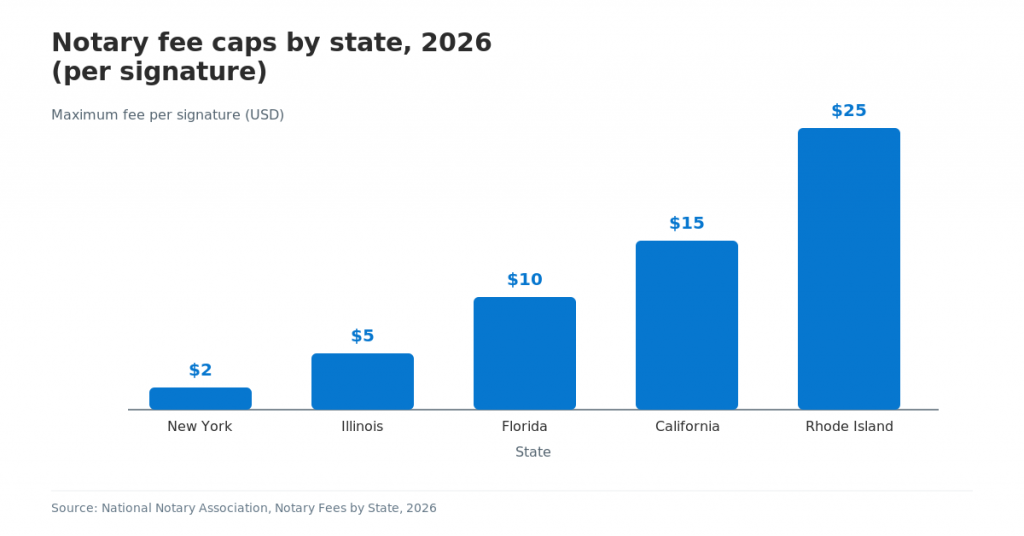
State law sets a maximum fee per signature or notarial act, and that cap ranges from $2 in New York to $25 in Rhode Island, with Illinois at $5, Florida at $10, and California at $15. On top of the base fee, mobile notaries commonly charge $40 to $75 for a local daytime appointment, more after hours, and RON sessions typically add $15 to $40 in platform or convenience fees, on top of whatever the underlying document platform itself costs, if the document didn’t already start on a SignNow pricing plan.
How to get a document notarized
Getting a document notarized is a short, in-person or on-camera process once you know what to bring.
- Confirm the specific document actually requires notarization by checking with the institution that will receive it.
- Find a notary through a bank branch, UPS Store, public library, county clerk’s office, a mobile notary, or an online notary session if your state permits RON.
- Bring valid, current government-issued photo identification.
- Do not sign the document beforehand; the notary needs to witness the signature or your acknowledgment of it.
- Sign in the notary’s physical presence, or on camera for a RON session, using a mobile app if the document was already routed to your phone, and answer any identity-verification questions asked.
- Pay the fee and keep the notarized copy, along with the notary’s certificate, for your records.
How SignNow helps you get your documents notarized
SignNow offers the option to get your documents legally notarized online, 24/7 via seamless integration with Notarize through SignNow API.
To use the service for any of the documents in your SignNow account:
- Prepare your document for signing and arrange a time with your collaborators.
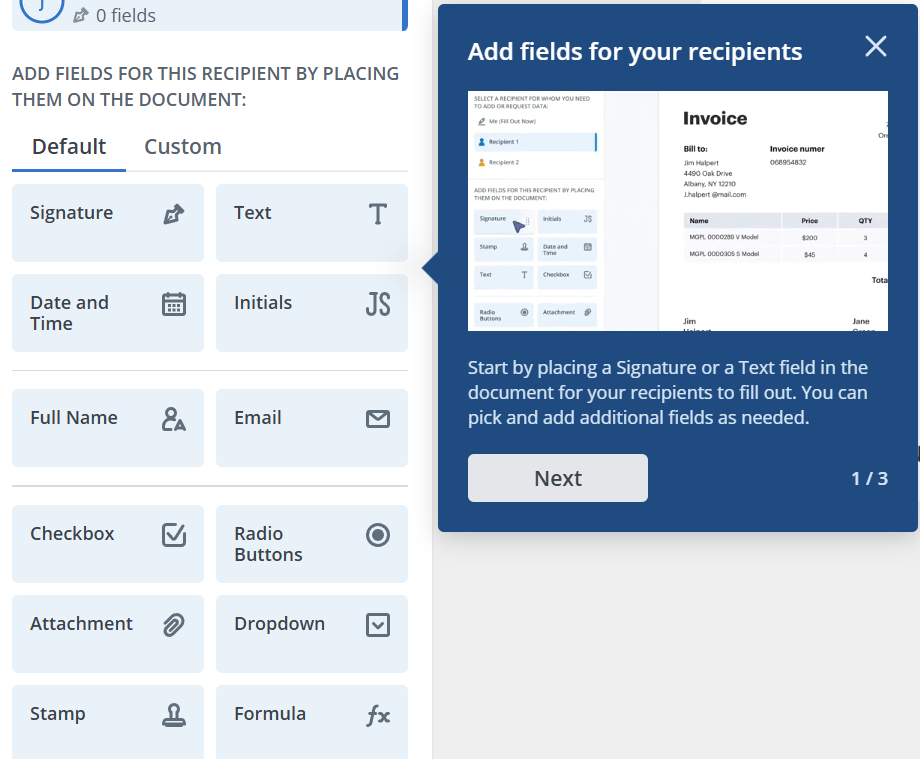
2. Use the Notarize option for your document.

3. Pass the document IDs, signer names, and email addresses to the Notarize service.
4. The signers will be invited to a live video call with a notary (up to 10 signers can participate in the session)
5. After the identity verification, the notary witnesses the electronic signature, and applies a digital seal.
6. The notarized document and audit trail are returned to SignNow automatically.
Note 1: All the signers should be located in the US to be able to use the service.
Note 2: You must provide your credit card details to pay the fee for notarization services.
Common misconceptions about notaries
The most persistent misconception is that a notary vouches for the truth or legality of what’s written in a document. A notary confirms who signed it and how, not whether the content is accurate, fair, or enforceable; that’s a matter for a lawyer, not a notary.
A second common mix-up is treating an eSigned document as automatically notarized. Signing electronically satisfies ESIGN and UETA on its own, but it doesn’t include the identity verification or record-keeping that a notarial act requires unless a separate notarization step, like IPEN or RON, is added to the workflow. A reader checking whether a specific state currently allows online notarization should confirm the current statute rather than assume the format used elsewhere applies at home.
A third misconception involves family. Most states disqualify a notary from notarizing a document for an immediate family member or in a transaction where they have a personal financial interest, since it undermines the “impartial” part of the role.
Finally, notary requirements are not uniform nationwide. Acceptable ID, RON availability, fee caps, and even what counts as a valid oath vary by state, so a process that works in one state may not transfer directly to another.
Becoming a notary public
Notary commissions are issued by the state, not the federal government, so eligibility, fees, and training requirements vary by jurisdiction. The general path involves submitting an application to the state’s commissioning authority, paying the required fee, completing any mandated training or exam, filing a bond and oath of office, and purchasing the required notary supplies, such as a stamp and journal. Commission terms are typically four years, though the exact length and renewal process are set independently by each state.
Final thoughts
A notary public provides an independent identity and willingness check when a document requires notarization. Requirements, permitted methods, and fees vary by state, so confirm the applicable rules before proceeding.
Try SignNow to prepare, notarize, and track documents through a streamlined electronic workflow.
FAQ
What is the main purpose of a notary public?
The main purpose is fraud deterrence: a notary confirms a signer’s identity and willingness before witnessing a signature, creating an impartial record that the signing happened as claimed.
Do you need an appointment to see a notary?
It depends on where you go. Bank branches and libraries often accept walk-ins during business hours, while mobile notaries and RON sessions are appointment-based by design.
Can a family member notarize your document?
Generally no. Most states bar a notary from acting on a document for an immediate family member or one in which they have a financial interest, since it conflicts with the impartial-witness requirement.
Is notarizing online legal in every state?
Not yet everywhere. Remote online notarization for real estate transactions is permitted in 45 states plus the District of Columbia, per the Mortgage Bankers Association; Alabama, Georgia, Mississippi, and South Carolina haven’t yet authorized it, and California’s law isn’t fully in effect until January 1, 2030.
What’s the difference between an oath and an acknowledgment?
An oath has the signer swear a statement is true under penalty of perjury at the time of signing. An acknowledgment has the signer, who may have already signed the document, confirm under oath that the signature is genuinely theirs.
How long does a notary commission last?
Commission length is set by the state; four-year terms are common, though some states use shorter or longer periods, and renewal typically repeats a version of the original application process.
Glossary
Acknowledgment: A notarial act in which a signer, who may have signed the document beforehand, confirms under oath that the signature is theirs.
Affirmation: A legal promise to tell the truth made on personal honor, used as a secular alternative to an oath.
ESIGN Act: The 2000 federal law establishing that electronic signatures and records cannot be denied legal effect solely because they’re electronic.
IPEN (in-person electronic notarization): A notarization where the signer and notary are physically together, but the document and signature are electronic.
Jurat: A notarial certificate confirming that a signer swore an oath or affirmation to the truthfulness of a document in the notary’s presence.
Notarial act: Any official action a notary is authorized to perform, including administering oaths, taking acknowledgments, and witnessing signatures.
Notary signing agent: A notary trained and background-screened to handle mortgage and refinance loan document signings.
RON (remote online notarization): A notarization performed over live video, with the notary and signer in different physical locations.
RULONA (Revised Uniform Law on Notarial Acts): A model state law standardizing traditional, electronic, and remote notarial acts.
UETA (Uniform Electronic Transactions Act): The 1999 model state law giving electronic signatures and records the same legal standing as paper, adopted by nearly every state.
Sources
- What is a notary public, National Notary Association
- 2023 Notary Survey Results, National Notary Association, 2024
- Notary fees by state, National Notary Association, 2026
- 2024 IC3 Annual Report, Federal Bureau of Investigation
 OpenOpen
 - Revised Uniform Law on Notarial Acts, Uniform Law Commission
- What states allow remote notary, 2026 guide, NotaryCam
- Notary public, Cornell Law School Legal Information Institute, Wex
- Uniform Electronic Transaction Act summary, Connecticut General Assembly
- TL;DR
- What does a notary public do?
- Notary public vs. civil-law notary vs. lawyer
- Types of notaries: in-person, mobile, IPEN, and RON
- When do you need a notary public?
- Notarization and eSignatures: what’s the legal difference
- What notarization costs
- How to get a document notarized
- Common misconceptions about notaries
- Becoming a notary public
- Final thoughts
- FAQ
- Glossary
- Sources