
Quick answer: A non-disclosure agreement (NDA) is a legally binding contract that creates a confidential relationship between parties sharing sensitive information, and it is one of the most common contracts in business. Think of it as a formal, enforceable version of “this stays between us”: instead of a verbal promise, both sides sign a document that spells out exactly what counts as confidential, who is bound to protect it, and what happens if that protection is broken. This article covers the main NDA types, what belongs inside one, how long confidentiality typically lasts, whether NDAs actually hold up if challenged, and how one gets signed in practice.
- An NDA (also called a confidentiality agreement or confidentiality disclosure agreement) is a contract obligating one or more parties to keep specified information private.
- NDAs come in three types: unilateral (one party protects the other’s information), mutual (both sides protect each other’s), and multilateral (three or more parties under one agreement).
- Confidentiality terms typically run one to five years, with two to three years the most common range; obligations tied to genuine trade secrets can run indefinitely.
- A properly drafted NDA is enforceable, but a vague or overly broad scope is the most common reason courts decline to enforce one.
- Federal law limits some NDAs: the Speak Out Act of 2022 voids pre-dispute confidentiality clauses covering future sexual harassment or assault disputes, and the Defend Trade Secrets Act requires a whistleblower-immunity notice in any NDA restricting trade-secret disclosure.
- NDAs can be signed electronically in the US; the ESIGN Act and UETA give an eSignature the same legal weight as a handwritten one.
What counts as an NDA
An NDA is any contract, standalone or embedded in a larger agreement, that legally obligates a party to keep defined information confidential. It does three things at once: it classifies which information is confidential and which isn’t, it creates a binding legal duty to protect that information, and, for inventors, it can protect patent rights by preventing a premature public disclosure that would otherwise void them. NDAs also go by other names: confidentiality agreement, confidentiality disclosure agreement, and non-disclosure contract, all of which refer to the same instrument.
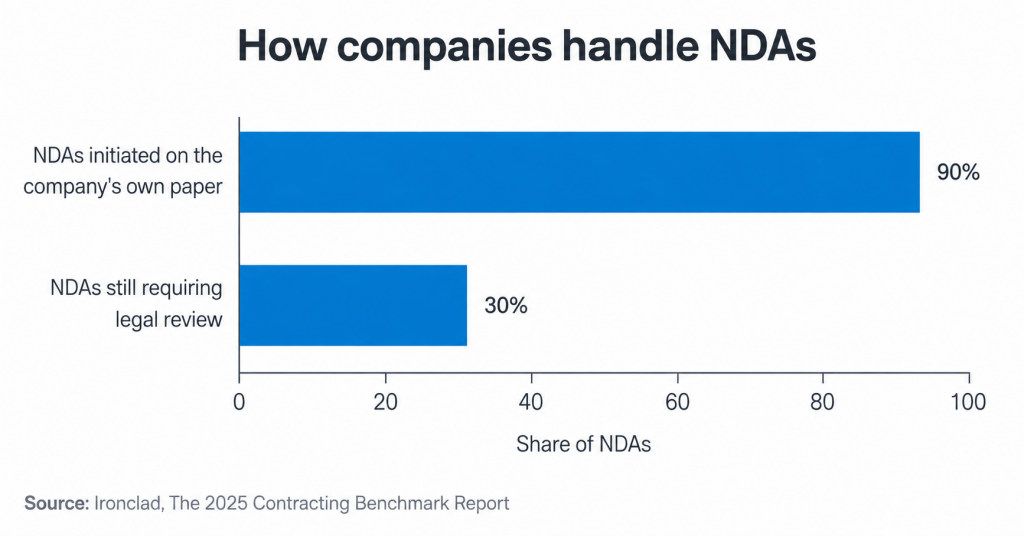
NDAs are also unusually routine. According to Ironclad’s 2025 Contracting Benchmark Report, 90% of NDAs are initiated on a company’s own paper, yet they still require legal involvement about 30% of the time, and estimates cited by Ironclad put between one-third and over half of all US workers under some form of NDA or similar confidentiality restriction.
That volume is why most organizations eventually standardize the process rather than draft each NDA from scratch, using SignNow’s NDA templates to keep the same defined terms and fields across every agreement instead of rewriting them each time.
Types of NDA: unilateral, mutual, and multilateral
NDAs fall into three types depending on how many parties disclose confidential information. In a unilateral NDA, only one party shares confidential information, so only the receiving party is restricted; this is the most common structure and covers most employment onboarding, contractor, and vendor relationships. In a mutual NDA, both sides share and are equally bound to protect each other’s information, which is standard for mergers and acquisitions, joint ventures, and partnership negotiations where both parties exchange sensitive material. A multilateral NDA extends the same idea to three or more parties under a single agreement, replacing what would otherwise be a separate bilateral NDA between every pair of participants.
| Type | Who is restricted | Typical use case |
|---|---|---|
| Unilateral | Only the receiving party | Employment onboarding, contractor and vendor relationships |
| Mutual (bilateral) | Both parties | Mergers and acquisitions, joint ventures, partnership talks |
| Multilateral | Three or more parties | Multi-party deals that would otherwise need separate bilateral NDAs |
Because unilateral NDAs are the default for hiring, they’re also where the one-third-to-over-half worker coverage figure mostly comes from: a new hire at a healthcare practice, a law firm, or a construction company is routinely asked to sign one before onboarding paperwork even starts, often through SignNow’s HR onboarding documents alongside the rest of a new-employee packet.
What goes inside an NDA
A complete NDA identifies the parties, defines what counts as confidential, and spells out the obligations, timeframe, exclusions, and remedies that apply if it’s broken. A standard NDA includes:
- Identification of parties: the names and addresses of the disclosing and receiving parties, and any relevant third parties such as attorneys or accountants who may also see the information.
- Definition of confidential information: the specific categories of information covered, not a bare, undefined reference to “proprietary information.”
- Obligations and permitted use: what the receiving party may and may not do with the information.
- Scope: the boundaries of what’s covered; this is the single most common weak point, since courts have voided NDAs whose wording “went further than could reasonably be required.”
- Time frame: how long the confidentiality duty lasts, or the conditions under which it ends.
- Exclusions: information that doesn’t need to stay confidential, such as material that’s already public, was already known to the receiving party, was developed independently, or must be disclosed under a legal order.
- Remedies: what happens if the agreement is breached, from a cease-and-desist letter to injunctive relief or damages.
Filling in these fields consistently is where most of the manual friction shows up, and it’s the reason SignNow’s fillable NDA fields exist: party names, dates, and defined terms populate the same way every time instead of being retyped into a fresh document.
NDA in a contract: standalone agreement vs. confidentiality clause
An NDA can exist as its own standalone contract or as a confidentiality clause embedded inside a larger agreement, such as an employment, vendor, or partnership contract. A standalone NDA is signed on its own, typically before any other agreement, specifically so information can be shared safely while the parties are still negotiating whether to work together at all. A confidentiality clause, also called a non-disclosure clause, is not a separate document: it’s a provision inside a broader contract that defines what information is protected, who has to protect it, and how long the obligation lasts within that contract.
The distinction matters most when both exist for the same relationship. If a company signed a standalone NDA during early talks and later signs a service agreement that also contains its own confidentiality clause, the contract should state which one controls so it’s clear which document’s terms, and which time frame, actually applies.
How long does an NDA last
Most NDAs specify a fixed confidentiality term, commonly one to five years, though obligations covering genuine trade secrets can run indefinitely. As a rough guide, short-term negotiations that will go stale quickly often use one- to two-year terms, standard business relationships tend to run two to three years, and deeper collaborations involving more sensitive data often use three to five years. Genuine trade secrets are the exception: because they only stay legally protected as long as they stay secret, the obligation not to disclose them is typically written to run indefinitely rather than expire on a fixed date.
Even an indefinite NDA usually states the conditions under which specific information stops being protected, most often once it becomes public through some means unrelated to the receiving party’s own disclosure. Organizations that want a specific stop date built into the document itself, rather than relying on a manually tracked calendar reminder, can set it directly using SignNow’s document expiration settings.
Are NDAs legally binding and enforceable?
Yes, a properly drafted and signed NDA is a legally binding contract, but enforceability depends on clear scope and compliance with a handful of federal limits.
Why it matters: An NDA that looks binding on paper can still fail in court if its terms are too vague, too broad, or conflict with a specific statute. At a baseline, enforcement requires mutual consent, a clearly and specifically defined scope, and valid signatures from every party; language broad enough to cover “any and all information” without further definition is a common reason courts decline to enforce a clause.
Three federal rules also carve out limits worth knowing. The Speak Out Act of 2022 voids pre-dispute non-disclosure and non-disparagement clauses as applied to future sexual harassment or sexual assault disputes, meaning a blanket NDA signed before any dispute arises cannot block someone from later speaking about a harassment or assault claim; trade-secret and proprietary-information provisions in the same NDA are unaffected. The Defend Trade Secrets Act’s whistleblower-immunity notice requires employers to include a notice of whistleblower immunity in any NDA, employment agreement, or consulting agreement that restricts disclosure of trade secrets; skipping it doesn’t void the NDA, but it does forfeit the employer’s access to enhanced DTSA remedies like attorney’s fees in a later suit. And the National Labor Relations Act can render NDA language unenforceable where it restricts employees from discussing wages or working conditions, since that activity is separately protected regardless of what a confidentiality clause says.
Breaching an enforceable NDA carries real consequences: the harmed party can sue for damages, seek injunctive relief to stop further disclosure, and in cases involving national security or government secrets, breach can even trigger criminal charges.
Who typically needs an NDA
NDAs come up whenever a business shares information it doesn’t want repeated, a pattern Workday’s contract-management guidance maps across hiring, vendor onboarding, partnership talks, and deal due diligence. A healthcare practice bringing on a new front-desk hire who will see patient intake data is a typical example: the practice (who) has the new employee (who) sign a unilateral NDA (what) as part of onboarding paperwork (where: HR/onboarding workflow), before the employee’s first day (when), because patient information carries both legal privacy obligations and competitive value (why), and the agreement is executed alongside the rest of the hiring packet so access to records doesn’t begin before the confidentiality duty does (how).
Other common scenarios follow the same logic in different industries. A law firm sharing case files with an expert witness or outside counsel typically uses a unilateral NDA scoped to that specific case, often through SignNow for legal services. Two companies negotiating a commercial property sale exchange financial and operational details under a mutual NDA before due diligence begins, a workflow supported by SignNow for real estate. A general contractor sharing bid specifications with subcontractors uses an NDA to keep pricing and scope details from reaching competing bidders on the same project.
Signing an NDA: from draft to a valid signature
An NDA becomes enforceable once every party signs it, and in the US, an electronic signature carries the same legal weight as a handwritten one under the ESIGN Act and UETA.
Why it matters: Timing is not a formality here. An NDA cannot retroactively protect information that was already shared before it was signed, so the signature has to come first.
In practice, signing an NDA follows a short sequence:
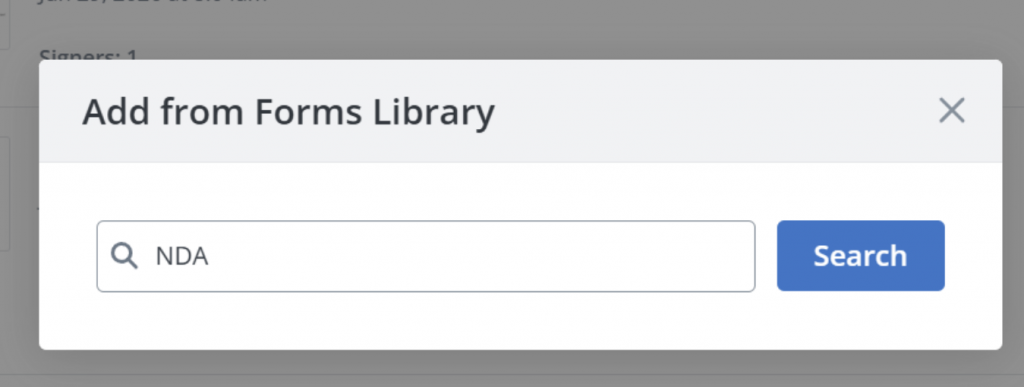
1. Start from a template rather than a blank page, using SignNow’s comprehensive Forms Library. Search for an NDA form, which keeps the standard fields (parties, scope, time frame) consistent across every agreement. To do so, click + Create > Document > Add from Forms Library. Once you find the template, click Save to Documents.
2. Fill in the parties, the definition of confidential information, and the time frame specific to this deal, using SignNow’s reusable templates so the same field layout applies to every NDA a team sends.
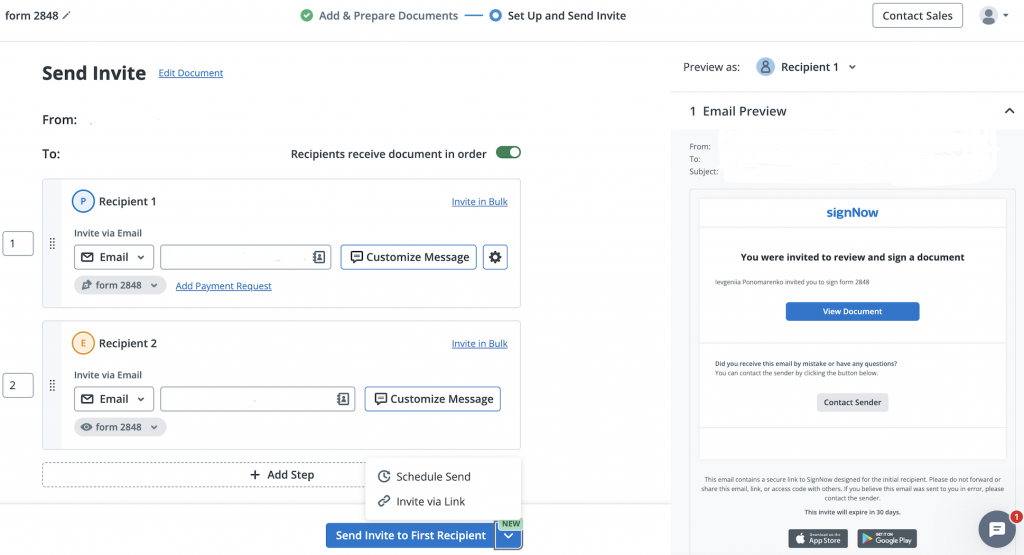
3. Set a signing order if the NDA is mutual, so SignNow’s role-based signing order routes the document to each party in sequence rather than all at once, which matters when one side’s signature is conditional on seeing the other’s first.
4. Send the document for signature and track it; a two-party mutual NDA typically needs both signature blocks configured before either party sees the request.
5. Keep the completed document and its SignNow audit trail, which records full names, email addresses, IP addresses, and timestamps for every action, as evidence that the agreement was actually executed if it’s ever challenged.
That last point matters more than it looks: an NDA that’s easy to prove was signed, by whom, and when, is easier to enforce if a dispute reaches court. It also cuts through what used to be a manual bottleneck. As Brian Fitzgibbons, COO of Optica Ventures LLC, put it: “The interface is simple and easy-to-use for our team; more importantly, it is just as easy for our customers. I have used a number of platforms over the years, none compare to the efficiency of SignNow. SignNow now drives our onboarding for new employees, non-disclosure agreements, and more.”
This isn’t the only route. Teams without a signing tool in place can still execute a valid NDA with a printed, wet-ink signature scanned back, or through any other ESIGN Act-compliant eSignature process; the legal requirement is a clear signature and a retained record of consent, not any single platform.
Common NDA mistakes to avoid
Most NDA problems trace back to vague scope, wrong assumptions about what the agreement can do, or signing after information has already been shared.
- Using vague language instead of specific categories. A bare reference to “proprietary information” with no further definition is exactly the kind of overly broad wording courts have declined to enforce; naming the actual categories of information covered holds up better.
- Assuming an NDA blocks every legal complaint. It doesn’t. An NDA cannot stop someone from filing a good-faith complaint with the EEOC or OSHA, or from exercising other statutory whistleblower protections, regardless of how the confidentiality language is written.
- Assuming every NDA needs to be mutual. Unilateral is the more common structure and often the more appropriate one; making an agreement mutual when only one side is actually disclosing information adds obligations neither party needs.
- Sharing information before the signature is in place. Whatever was disclosed before the NDA was signed is not protected by it. If confidential material needs to move quickly, the signature has to move first.
Disclaimer: The information contained in this blog post is provided for general informational purposes only and does not constitute formal legal advice.
Final thoughts
Non-disclosure agreements are one of the simplest ways to protect confidential business information, but they’re only effective when they’re clear, properly executed, and easy to manage at scale. Whether you’re onboarding employees, working with contractors, negotiating with partners, or sharing sensitive business data, using a standardized NDA process helps reduce legal risk while keeping work moving.
With SignNow, you can create NDAs from reusable templates, add fillable fields, collect legally binding eSignatures, automate signing workflows, and securely store every completed agreement with a detailed audit trail—all in one place. Instead of managing confidentiality agreements manually, your team can send, sign, and track NDAs in minutes.
Ready to simplify your NDA workflow? Start using SignNow today to create, send, and eSign non-disclosure agreements faster, while keeping every document organized, secure, and legally compliant.
Glossary
- Confidentiality clause: a provision inside a larger contract, rather than a standalone document, that creates the same kind of confidentiality obligation as an NDA.
- Disclosing party: the party sharing confidential information under the agreement.
- Mutual NDA: an NDA in which both parties share confidential information and both are bound to protect it, also called a bilateral NDA.
- Receiving party: the party that receives confidential information and is bound to protect it.
- Trade secret: information, such as a formula, process, or technique, that derives value from not being generally known and that its owner takes reasonable steps to keep secret.
- Whistleblower immunity notice: the notice required under the Defend Trade Secrets Act, stating that an employee cannot be held liable for disclosing a trade secret in confidence to report a suspected legal violation.
FAQ
1. What is an NDA and why is it used?
An NDA is a contract that legally obligates one or more parties to keep specified information confidential. It’s used any time a business needs to share sensitive material, such as trade secrets, financial data, or business plans, with someone outside the organization without risking that it reaches competitors or the public.
2. What is the difference between an NDA and a confidentiality agreement?
There isn’t one in practice; “confidentiality agreement” and “confidentiality disclosure agreement” are alternate names for the same type of contract as an NDA.
3. How long does an NDA last?
Typical terms run one to five years, with two to three years the most common range for standard business relationships. Confidentiality obligations tied to genuine trade secrets are commonly written to last indefinitely, since the information only stays legally protected while it stays secret.
4. Are NDAs legally binding?
Yes, once properly signed with clearly defined scope. Enforceability can fail if the language is too vague or too broad, and specific federal rules, including the Speak Out Act of 2022 and the National Labor Relations Act, limit what an NDA can restrict, regardless of its wording.
5. Do I need a lawyer to sign an NDA?
No. Signing an NDA doesn’t require legal representation, but having a lawyer review the scope and time frame before signing is worthwhile whenever the information at stake is high-value or the terms look broader than necessary.
6. Can an NDA be included as a clause inside another contract?
Yes. A confidentiality clause can sit inside a larger employment, vendor, or partnership contract instead of standing alone, though it typically only applies for the life of that contract unless the agreement specifies otherwise.
Sources
- Non-disclosure agreement (NDA)
- Non-Disclosure Agreements: Everything You Need to Know (cites The 2025 Contracting Benchmark Report)
- What is a nondisclosure agreement (NDA)
- Speak Out Act, S.4524
- Explaining the Defend Trade Secrets Act
- 15 U.S.C. § 7001 — ESIGN Act text
- The confidentiality clause: essential guidelines
- What counts as an NDA
- Types of NDA: unilateral, mutual, and multilateral
- What goes inside an NDA
- NDA in a contract: standalone agreement vs. confidentiality clause
- How long does an NDA last
- Are NDAs legally binding and enforceable?
- Who typically needs an NDA
- Signing an NDA: from draft to a valid signature
- Common NDA mistakes to avoid
- Final thoughts
- FAQ