Set the Signing Order with SignNow

Getting a document signed by more than one person is no longer an issue. Simply determine the signing order before sending a document to be signed.

Award-winning eSignature solution

What set the signing order means and why it matters

Set the signing order defines the sequence in which recipients receive, review, and sign an electronic document. It lets senders enforce a strict routing path or allow parallel signing, control which party acts next, and capture a clear trail of intent. In practice, ordering supports multi-party approvals, conditional routing based on role or data, and integration with templates and automation. Within signNow, setting the signing order is a configurable workflow control that operates across web, mobile, and API-driven processes to help teams coordinate signers and maintain consistent execution.

Why defining signing order improves document workflows

A defined signing order reduces errors, prevents missed signatures, and creates a single authoritative audit trail for compliance and records management.

Why defining signing order improves document workflows

Common challenges when configuring signing order

  • Unclear recipient roles create routing delays and signature rework across departments.
  • Mixing required and optional signers can cause incomplete workflows and stalled agreements.
  • Parallel and conditional routing misconfigurations may create duplicate or conflicting signature requests.
  • Lack of integration with CRM or storage systems forces manual tracking and status updates.

How specific users interact with signing order

Contract Manager

The contract manager configures sequential routing for multi-party agreements, assigns roles, and uses templates to enforce consistent signing order across similar contracts. They review audit reports to verify execution and resolve any routing exceptions reported by signNow.

HR Director

The HR director sets a two-step signing order for offer acceptance and executive countersignature, uses conditional routing for remote hires, and relies on the platform's notifications and records for compliance and onboarding audits.

Typical teams and roles that set the signing order

Legal, HR, sales, procurement, and operations teams commonly control signing order to ensure compliance and predictable approval flows.

  • Legal and compliance teams requiring sequenced approvals and archived audit trails.
  • Human resources managing offer letters, onboarding, and benefits forms with sequential signatures.
  • Sales and procurement coordinating contracts that require counterparty and internal approvals in sequence.

Defining order centrally reduces administrative overhead, clarifies responsibilities, and speeds execution across organizational processes.

Core capabilities that support setting signing order

A set of features work together to provide flexible, auditable, and enterprise-ready signing order controls across different use cases.

Sequential Routing

Define strict numeric order so each recipient waits for prior parties to complete signing before gaining access to their assigned fields and responsibilities.


Parallel Routing

Allow multiple recipients to sign at the same stage simultaneously to shorten execution time while preserving a clear audit trail of who signed when.

Conditional Routing

Route documents based on response data or role selection so only relevant signers receive requests, reducing unnecessary approvals and manual branching.

Signer Groups

Assign groups where any member can sign on behalf of the group, with configurable order relative to other signers and fallback options.

Template-Based Orders

Save signing order configurations as templates for repeatable transactions, ensuring consistent workflows across teams and document types.

API Control

Programmatically set or change signing order through the signNow API to support automated business processes and system integrations.

be ready to get more

Choose a better solution

Integrations and templates that enhance signing order

Integrations and reusable templates make applying a set signing order faster and more consistent across platforms and systems.

Google Docs Integration

Create documents in Google Docs and use signNow to set signing order, map recipients, and apply signature fields without manual downloads or uploads, preserving document fidelity and metadata.

CRM Connectors

Connect to Salesforce or other CRMs to pull contact data, automatically populate signer information, and trigger preconfigured signing orders from within the CRM workflow.

Cloud Storage Sync

Link Dropbox, Google Drive, or OneDrive so executed documents follow a routing order that ends with archival into a designated folder for retention and compliance.

Reusable Templates

Create template records that include predefined signing order, fields, and conditional logic so teams can send standardized, correctly ordered documents quickly.

How ordered routing flows during signing

A concise view of how signing order controls document movement and signer interactions.

  • Initial Sender: Sender defines order and dispatches the envelope.
  • First Recipient: Receives notification, reviews, and signs fields.
  • Subsequent Recipients: Each recipient is unlocked in defined sequence.
  • Completion: Final signature seals the document and stores audit data.
Collect signatures
24x
faster
Reduce costs by
$30
per document
Save up to
40h
per employee / month

Quick steps to set the signing order in signNow

Follow these basic steps to configure a sequential signing order when preparing a document for electronic signature.

  • 01
    Upload Document: Add the file to signNow via upload or template.
  • 02
    Add Recipients: List recipients and assign roles or email addresses.
  • 03
    Set Order: Assign numeric positions or enable parallel stages.
  • 04
    Add Fields: Place signature and data fields for each signer.

Audit trail steps for ordered signing events

Track these events in the audit trail to verify the sequence and actions taken by each recipient during signing.

01

Envelope Sent:

Timestamp when the sender dispatched the document.
02

Recipient Notified:

Notification timestamp per recipient.
03

Field Completed:

Each signature and field completion recorded.
04

Signer IP:

IP address logged for signer action.
05

Authentication Method:

Type of authentication used recorded.
06

Finalization:

Document sealed and hash recorded.
be ready to get more

Why choose airSlate SignNow

  • Free 7-day trial. Choose the plan you need and try it risk-free.
  • Honest pricing for full-featured plans. airSlate SignNow offers subscription plans with no overages or hidden fees at renewal.
  • Enterprise-grade security. airSlate SignNow helps you comply with global security standards.
illustrations signature

Recommended workflow settings to enforce signing order

Use these settings to configure consistent behavior for ordered signing across documents and teams.

Setting Name Configuration
Routing Mode Sequential or Parallel
Reminder Frequency 48 hours
Expiration Window 30 days
Default Authentication Email and optional SMS
Template Enforcement Required for team templates

Platform access, mobile behavior, and browser support

Setting signing order is supported on web, iOS, and Android apps and functions consistently across modern browsers for senders and signers.

  • Web browsers: Chrome, Edge, Safari support
  • Mobile apps: iOS and Android apps
  • API access: REST API available

For best results, use current browser versions and the latest mobile app; ensure recipients can receive email or SMS notifications for ordered workflows.

Security and authentication elements related to signing order

Transport encryption: TLS 1.2+ for data in transit
At-rest encryption: AES-256 encrypted storage
Access controls: Role-based permissions enforced
Authentication types: Email, SMS, password, SSO
Audit logging: Detailed event timestamps retained
Document integrity: Tamper-evident signature sealing

Industry examples of ordered signing workflows

Two brief examples show how ordered signing helps different teams maintain control and speed execution while preserving records.

Commercial Lease Execution

A property manager sends leases to a tenant then to a legal reviewer

  • Sequential tenant then legal reviewer routing
  • Ensures both parties sign in the correct order and captures approvals

Resulting in a complete, auditable lease record with clear signing chronology suitable for enforcement and recordkeeping.

Employee Onboarding Packet

HR initiates the onboarding packet to a new hire and then to the HR director for countersignature

  • Conditional routing if remote hire requires additional verification
  • Streamlines new-hire paperwork while applying required checks

Leading to consistent onboarding records and quick verification for benefits activation and payroll setup.

Practical best practices for reliable signing order

Follow these practical recommendations to reduce errors and maintain clear, auditable ordered signing workflows.

Define clear recipient roles and backup signees
Assign explicit roles and include fallback or group signers to prevent stalls when an intended signer is unavailable; document the reason for any reassignment to preserve a defensible audit trail.
Use templates for repeatable ordered workflows
Create and lock templates that include signing order, required fields, and conditional routing to ensure consistency across transactions and reduce configuration mistakes by individual senders.
Apply appropriate authentication per signer
Match authentication strength to the signer’s role and the document’s legal requirements; stronger methods for high-risk approvals support enforceability and regulatory compliance.
Monitor audit logs and configure notifications
Enable notifications and regularly review audit records to detect routing failures, review time-to-sign metrics, and identify opportunities to simplify or parallelize stages without compromising control.

FAQs About set the signing order

Answers to common questions about configuring, troubleshooting, and auditing signing order in signNow deployments.

Feature availability: signing order capabilities compared

A concise feature availability comparison showing support for ordered routing and related controls across major eSignature providers.

Criterion / Vendor signNow (Recommended) DocuSign Adobe Sign
Supports Sequential Routing
Supports Parallel Routing
API Routing Control
Bulk Send Availability
be ready to get more

Get legally-binding signatures now!

Risks of misconfigured signing order

Execution delays: Missed approvals
Contract disputes: Ambiguous signature sequence
Noncompliance: Regulatory exposure
Data exposure: Incorrect recipient access
Operational cost: Manual remediation
Reputational harm: Client trust impact

Pricing overview for ordered signing features

Representative pricing and plan details relevant to signing order features across signNow and comparable vendors.

Plan / Feature signNow (Featured) DocuSign Adobe Sign Dropbox Sign PandaDoc
Free tier availability Limited free plan available Trial only Included with Acrobat subscription Free limited plan Free eSignature plan
Entry-level monthly price per user $8 per user per month $10 per user per month $14.99 per user per month $15 per user per month $19 per user per month
Business-level monthly price per user $15 per user per month $25 per user per month $24.99 per user per month $25 per user per month $30 per user per month
Advanced authentication included Email + SMS and SSO options SMS and ID verification options Enterprise MFA available SMS and SSO options ID verification add-ons
API access included Available on paid plans Available on paid plans Available with enterprise plans Available on paid plans Available on paid plans
Annual discount availability Discounts for annual billing Discounts for annual billing Annual billing discounts Annual billing discounts Annual billing discounts

How to set a signing order with airSlate SignNow

Need your document signed by multiple parties one after the other? Create several signer roles and set a signing order to ensure that your document is automatically delivered to the designated recipients once it's their turn to sign.

Set up your eSignature workflow

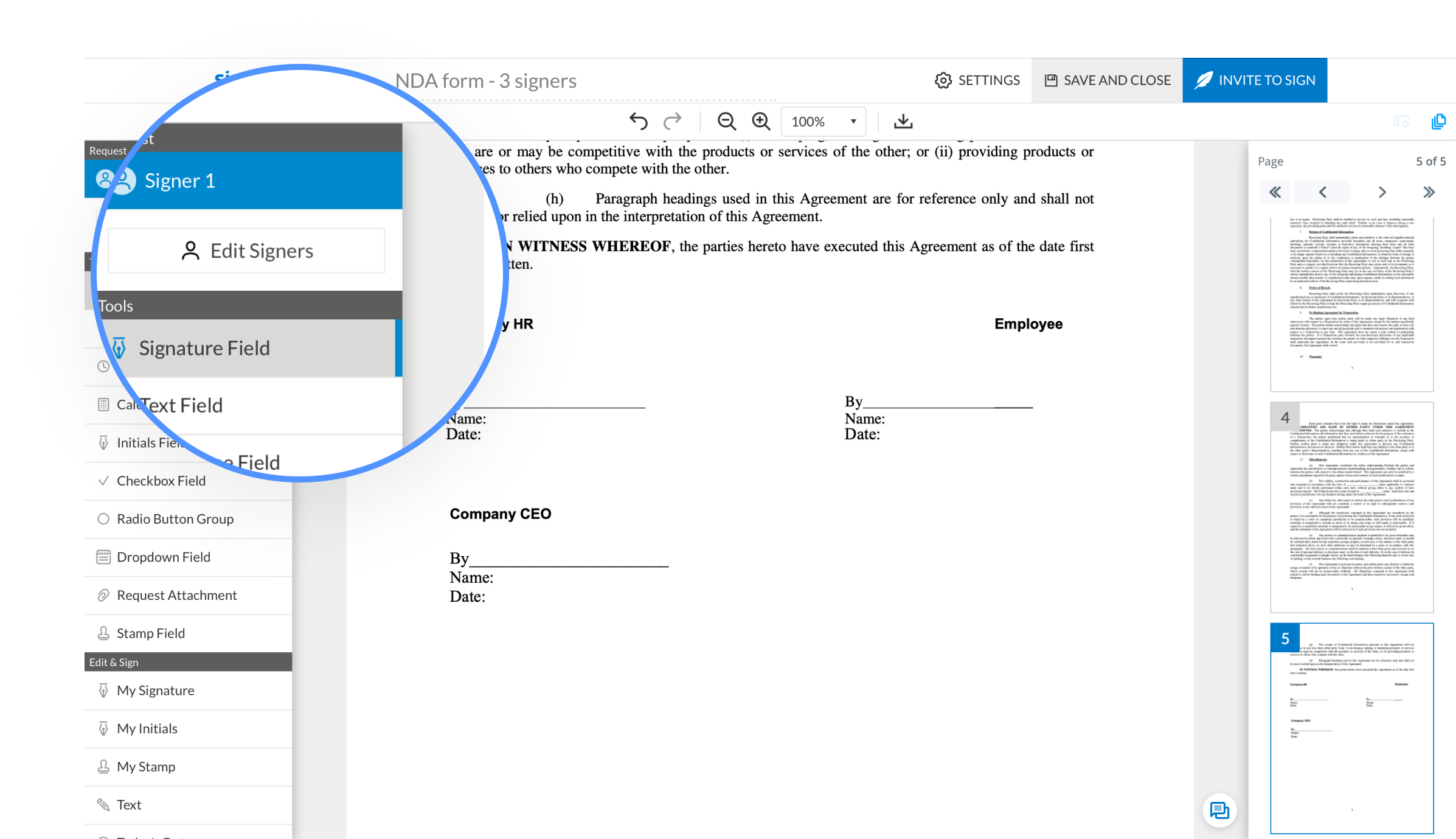
Open your document in the editor and click Edit Signers.
fill-guide-illustration

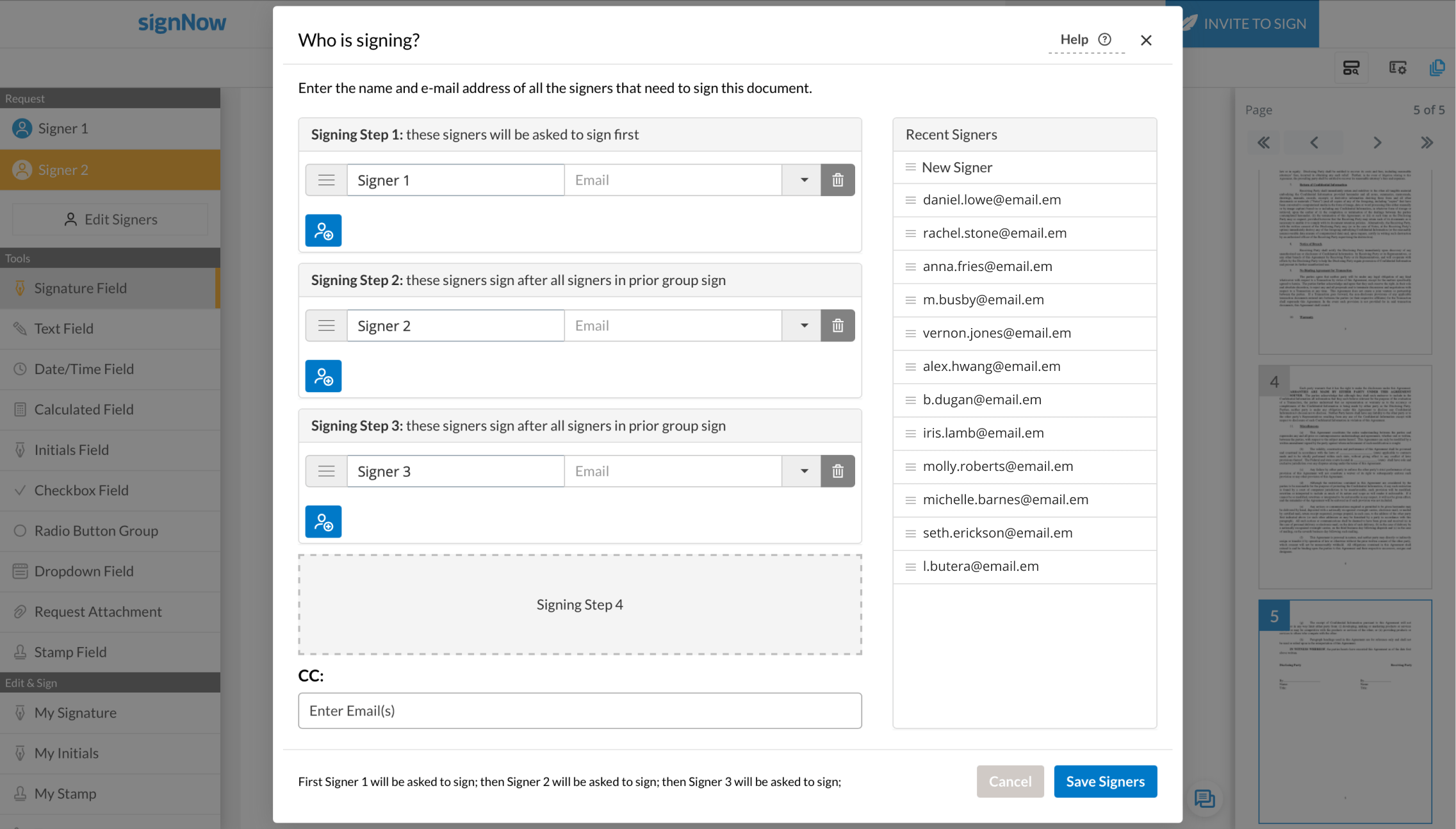
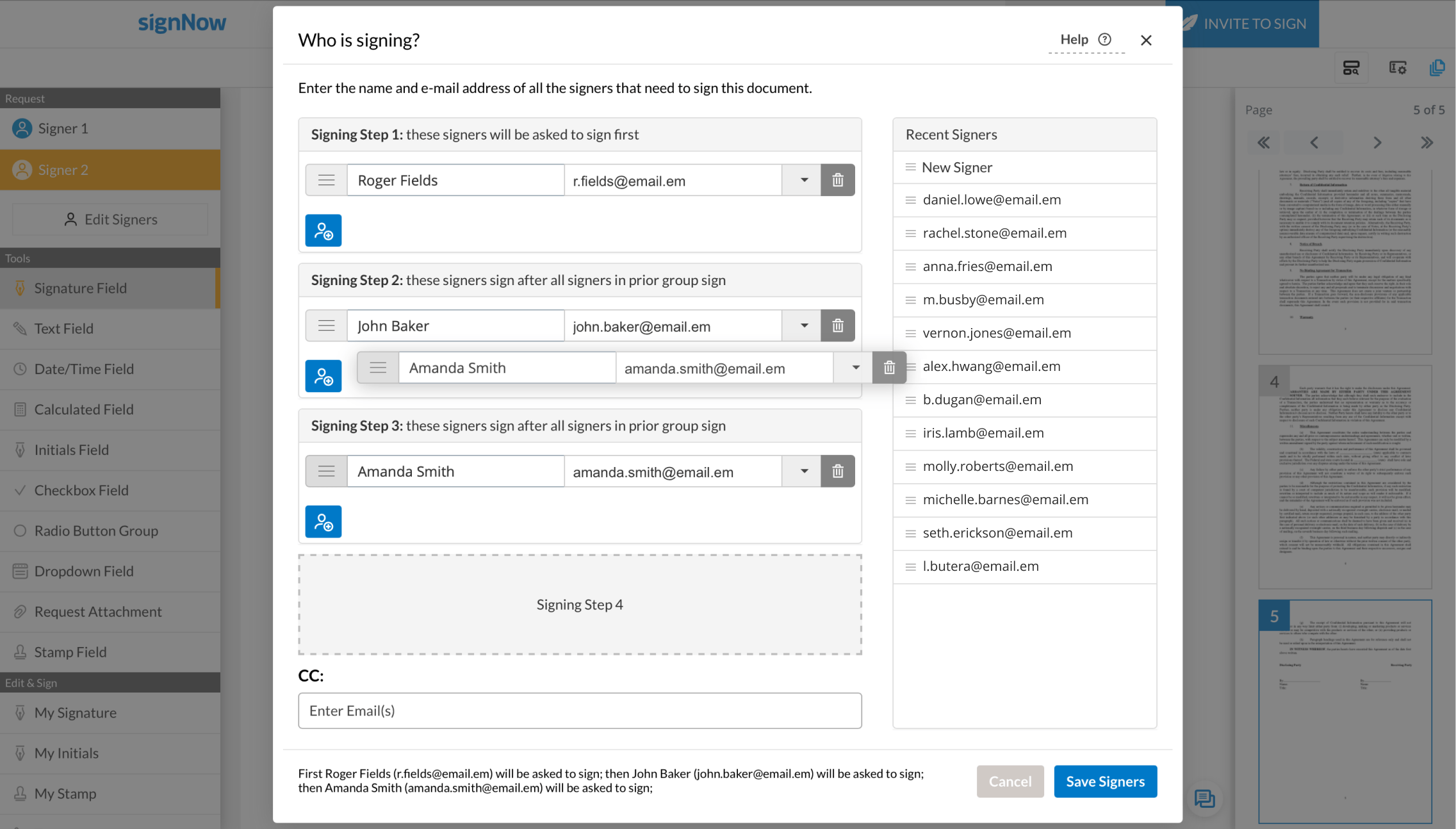
Create a new signing step by clicking on the Signing Step 2 area. To add a third signing step, click Signing Step 3, and so on.
fill-guide-illustration

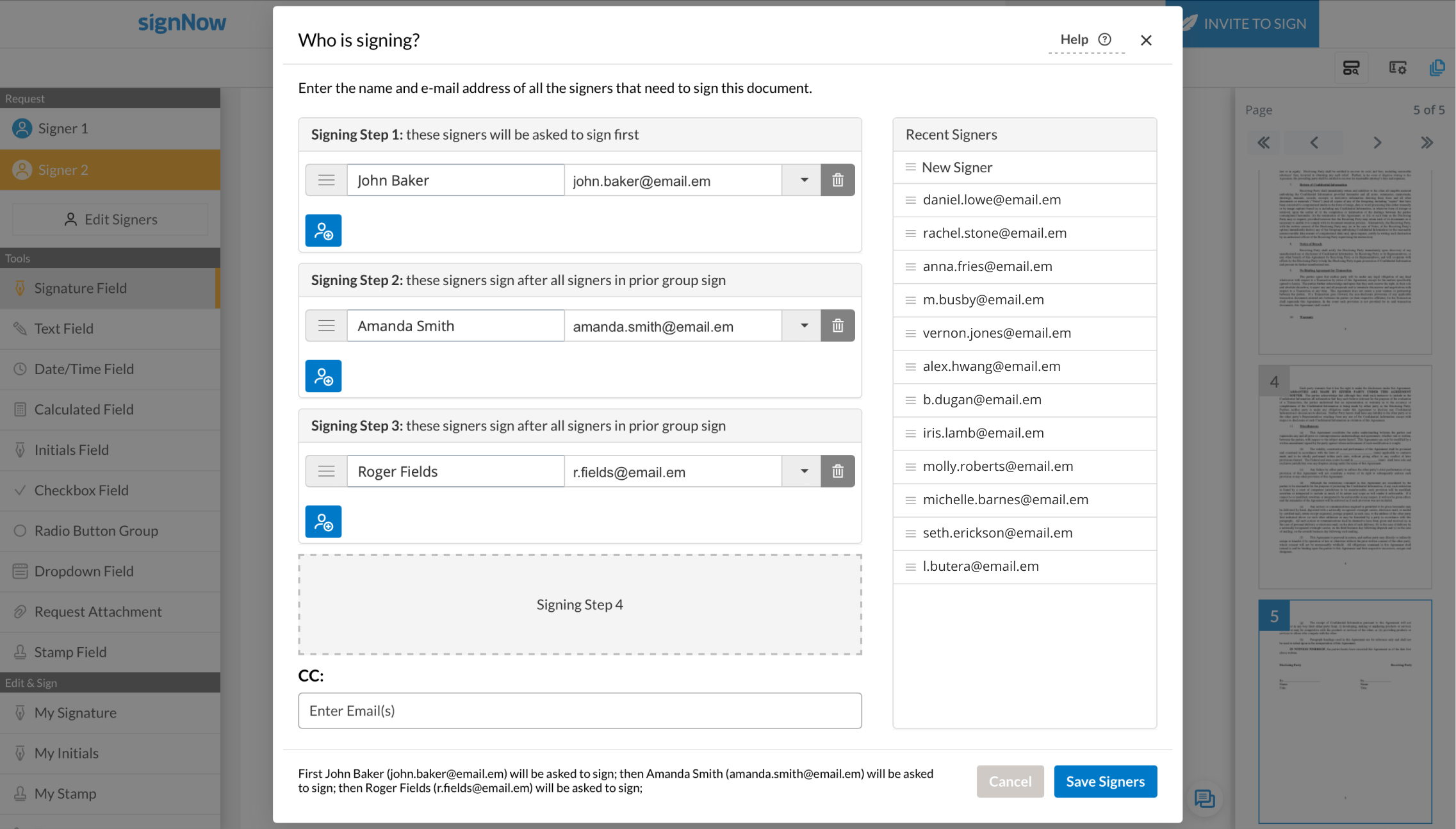
Customize signer names and enter your recipients’ email addresses in the corresponding boxes (optional). Add a new recipient within any signing step by clicking the blue silhouette icon.
fill-guide-illustration

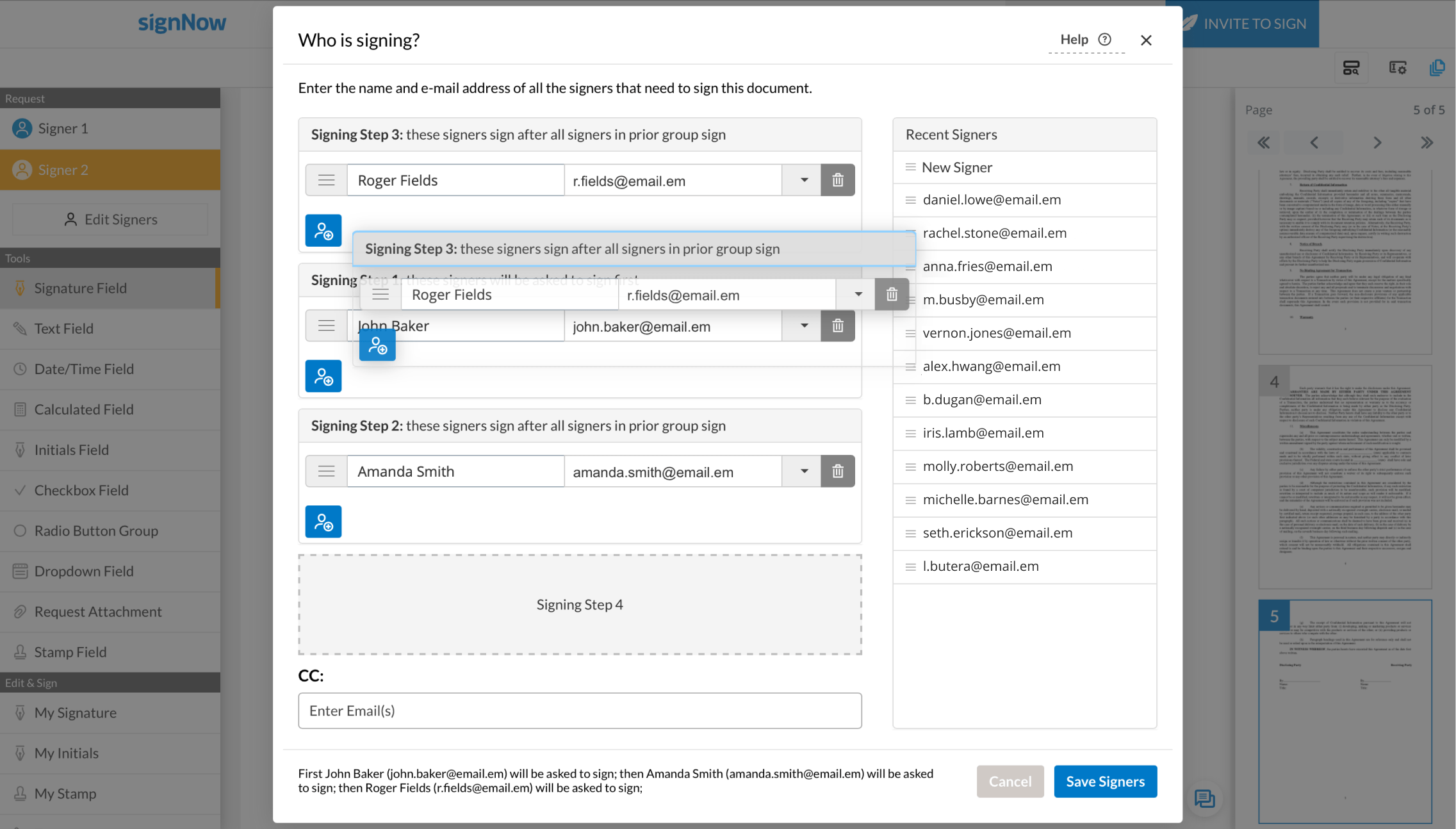
To rearrange your signing steps, drag any of them to the desired position.
fill-guide-illustration

Move a recipient from one signing step to another by dragging their email box and dropping it where needed.
fill-guide-illustration

To delete a signer and/or signing step, click on the trash bin icon next to a signer email box.

When you’ve finished setting up a signing order, click the Save Signers button.

Add fillable fields and assign roles

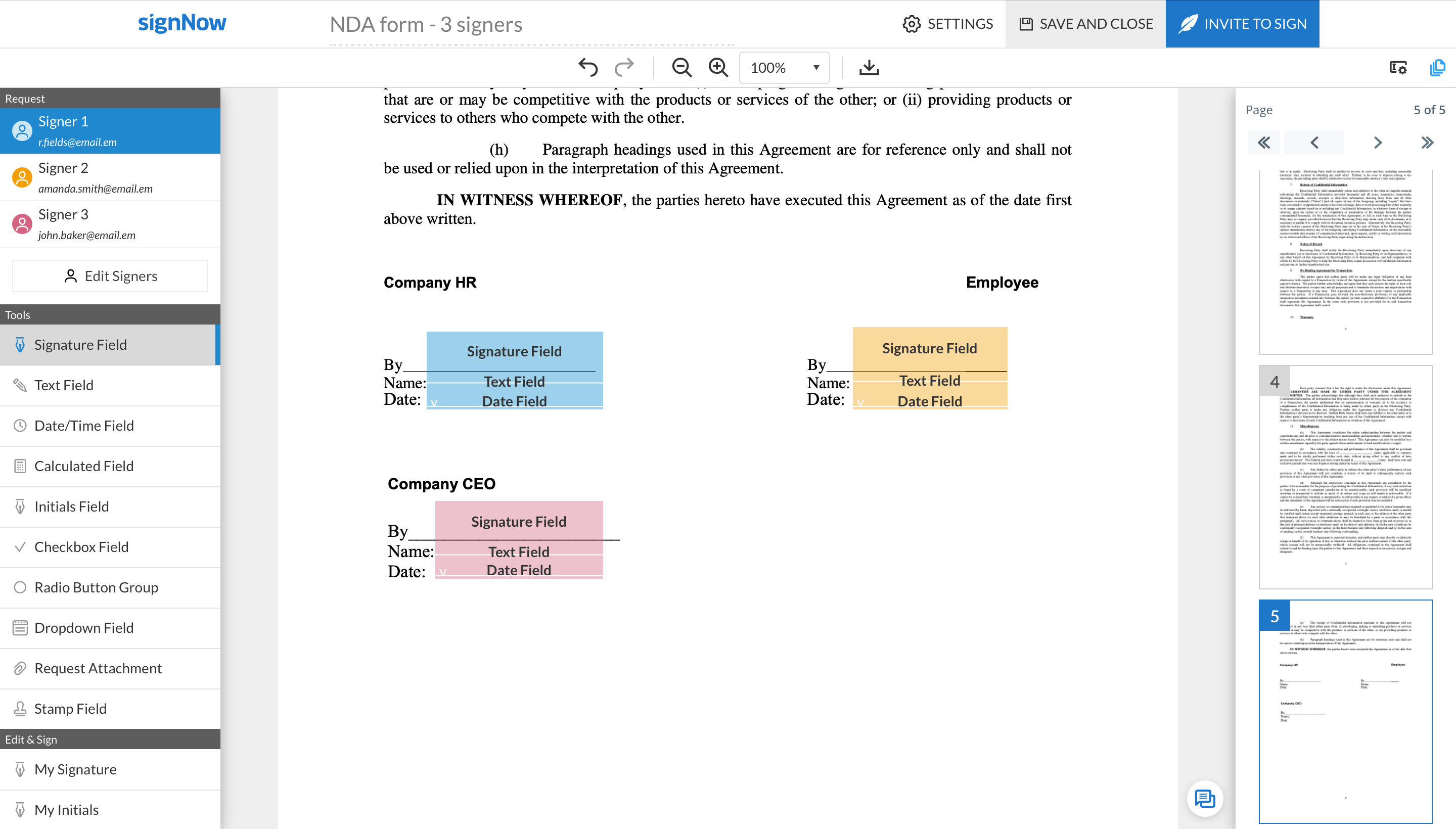
Select fillable fields from the left-hand toolbar of the editor and drop them anywhere on your document. To assign a specific role to a field, click on it, open the Role dropdown in the sidebar on the right, and select the signer you want to assign. Then, click Ok.
fill-guide-illustration

For your convenience, the fillable fields are rendered in different colors based on the signer role you assigned to them.

When you’ve finished configuring every fillable field, click Invite to Sign to send your document for eSignature.


walmart logo
exonMobil logo
apple logo
comcast logo
facebook logo
FedEx logo
be ready to get more

Get legally-binding signatures now!





