
A power of attorney template helps you authorize someone to handle specified legal or financial matters on your behalf. For adults planning ahead, families helping relatives, and people preparing for an absence, the right form can make financial decision making easier. Its usefulness depends on the powers granted, effective date, and applicable signing rules.
A signed form can still encounter problems at the bank: authority may not have started, a required witness may be missing, or the requested transaction may fall outside its scope. This guide explains what to check and how to prepare the document with SignNow.
This article provides general US information, not legal advice. Requirements vary by state, document, and transaction. Have a licensed attorney review your circumstances before signing.
Key takeaways
- Match the attorney form to your state and intended financial matters.
- Durability and the start date are separate choices.
- Electronic signing does not automatically satisfy witnessing or notarization requirements.
- Financial institutions may request supporting evidence before accepting authority.
- A financial POA does not replace health care planning or Social Security’s representative-payee process.
What a power of attorney template should include
A power of attorney is a legal document naming an agent to act on the principal’s behalf. The principal is the person granting authority; the agent, also called an attorney in fact, need not be a lawyer. California Courts explains that financial authority can cover financial, real estate, tax, or other matters you select.
Check that your attorney template identifies:
- People: the principal, primary agent, and any successor agent.
- Scope: the specific powers and any limits on financial transactions.
- Timing: when authority starts, ends, or survives incapacity.
- Instructions: restrictions, reporting expectations, and other special instructions.
- Execution: the principal’s signature, date, and required witness or acknowledgment sections.
Choose a trusted person who understands your wishes and can keep records. The agent’s authority should fit the task: paying household bills does not necessarily require broad authority over every asset. Under Virginia’s agent-duty rules, the agent acts within the authority granted, follows known reasonable expectations, and otherwise acts in the principal’s best interests.
Which type of power of attorney fits your needs
These labels describe different features of attorney documents; several can apply to one POA form.
| Type | Main purpose | What to check |
|---|---|---|
| General power of attorney | Broad financial and legal decisions | Exclusions and actions requiring specific authority |
| Limited or special POA | One task, asset, or transaction | Precise scope and ending conditions |
| Durable power of attorney | Authority continues through incapacity | Required durability wording |
| Springing power of attorney | Authority begins after a stated event | Whether allowed and how the event is established |
| Financial power of attorney | Financial affairs, bank accounts, and property | Whether each intended transaction is covered |
| Health care POA or directive | Health care decisions | Separate state requirements |
A general power is not automatically durable. A durable POA can be effective immediately or, where permitted, start later.
Define the transactions you actually need
Review banking, investments, tax matters, and property separately. A form may list real property transactions and tangible personal property transactions as different categories. Identify which financial decisions the agent may make and which legal actions need additional review.
For real estate transactions, ask the title company and county recorder about acknowledgment, recording, and document requirements before closing. A broad clause does not establish that every proposed action is legally permissible.
For example, someone traveling abroad might authorize an agent to complete a vehicle sale during a specified period. Someone planning for a future illness may need continuing authority over bills and accounts instead. Start with those actual tasks, then check whether the selected power of attorney form covers them. Ask about unusual transfers, gifts, or beneficiary changes individually rather than assuming a heading authorizes everything. Keep a list of intended transactions beside the draft during legal review.
A springing clause should explain the triggering event and the evidence needed. “Effective upon incapacity” can create uncertainty when someone must establish that the principal is mentally incapacitated.
Virginia Code § 64.2-1607 permits the principal to designate someone to determine that an event occurred. It also provides fallback determinations when an incapacity trigger lacks an available decision-maker. Missing instructions, therefore, do not automatically invalidate the document, but can complicate its use.
Discuss practical access to the required evidence before choosing a trigger. Who will contact the designated evaluator, where will the determination be kept, and how will the agent present it? An immediately effective document avoids that activation step, but gives the agent usable authority sooner. The choice should reflect the principal’s preferences and circumstances, with legal advice about available safeguards.
Florida § 709.2108 generally makes future-effective POAs ineffective, subject to exceptions for certain older documents and military deployment powers.
Durability needs a separate check. Under Virginia’s Uniform Power of Attorney Act, a POA is durable unless it expressly ends at incapacity. California court guidance requires wording showing that authority remains effective despite incapacity; Texas also requires qualifying wording for a durable instrument. Do not assume a generic attorney form PDF contains it.
State signing rules to check before sending
The examples below concern financial powers, with ordinary execution requirements summarized. Exceptions and recognition of documents signed elsewhere require separate review.
| State | Key requirements |
|---|---|
| Florida | Principal signs; two witnesses must sign; principal acknowledges execution before a notary public or another authorized officer. |
| New York | Generally, 12-point type or larger; principal signs, initials, and dates; acknowledgment and two qualified witnesses; acting agent signs, dates, and acknowledges. |
| California | Dated and signed; acknowledged before a notary or signed by two qualifying adult witnesses. |
| Texas | Durable POA signed by an eligible principal and acknowledged before an authorized officer. |
| Virginia | Principal signs, or directs another individual to sign in the principal’s conscious presence; acknowledgment creates a presumption of genuineness. |
Sources: Florida § 709.2105, New York § 5-1501B, California court guidance, Texas Chapter 751, and Virginia § 64.2-1603.
A California power of attorney signed under California rules should not automatically be treated as invalid elsewhere. Cross-state recognition provisions may apply.
Certain powers need extra attention. Florida § 709.2202 requires separate signed or initialed enumeration for specified actions, including certain gifts and beneficiary changes. It also restricts those powers in remotely witnessed documents executed by Florida domiciliaries.
What happens when a bank questions the document
Ask the receiving institution to identify the missing authority or evidence. Relevant institutions may need confirmation that the POA remains operative, rather than a replacement form.
Present the document before an urgent transaction if possible. Ask which department reviews powers of attorney, whether it accepts copies, and how to submit any requested certification. Record when the institution received the document and its response. A clear submission history helps an attorney assess any later delay without assuming that every refusal is unlawful.
Under Virginia § 64.2-1618, a third person generally has seven business days to accept an acknowledged POA or request specified supporting materials, then five business days after receipt to accept, subject to statutory exceptions. It cannot require a different POA form for authority already granted.
New York § 5-1504 generally gives ten business days to honor a statutory short form, explain rejection, or request an agent’s affidavit, with seven-business-day response requirements afterward. Valid refusal grounds still apply.
Federal agencies have separate processes. Social Security explains that a POA does not appoint a representative payee. The IRS accepts qualifying non-IRS powers, but requires an attached completed Form 2848 for entry on its Centralized Authorization File.
How to prepare a power of attorney in SignNow
SignNow helps you prepare fields and route documents for review and electronic signing where permitted. Establish the required execution method first; an ordinary eSignature session does not itself complete notarization.
1. Choose and open the template
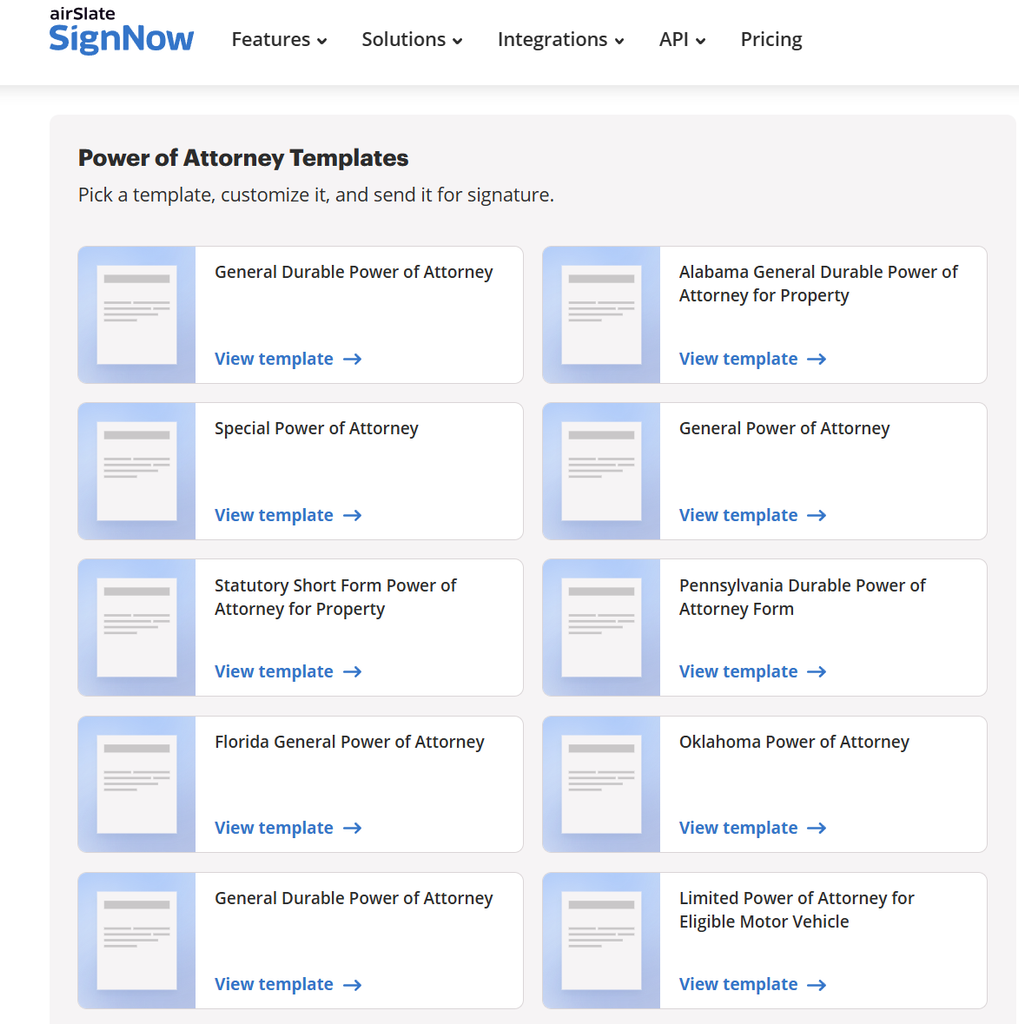
Visit SignNow’s power of attorney templates, select the relevant state and purpose, and click View template. On the selected template’s page, choose Sign Now to proceed. Alternatively, use +Create to upload a lawyer-approved document, following SignNow’s upload instructions
2. Complete the details and add recipients
Enter names, addresses, powers, start conditions, and restrictions. Add the principal as a signer and any agent whose signature is required. Where available, assign an attorney reviewer the Approver role before signers, as described in the fillable-fields guide.
3. Place and check the fields
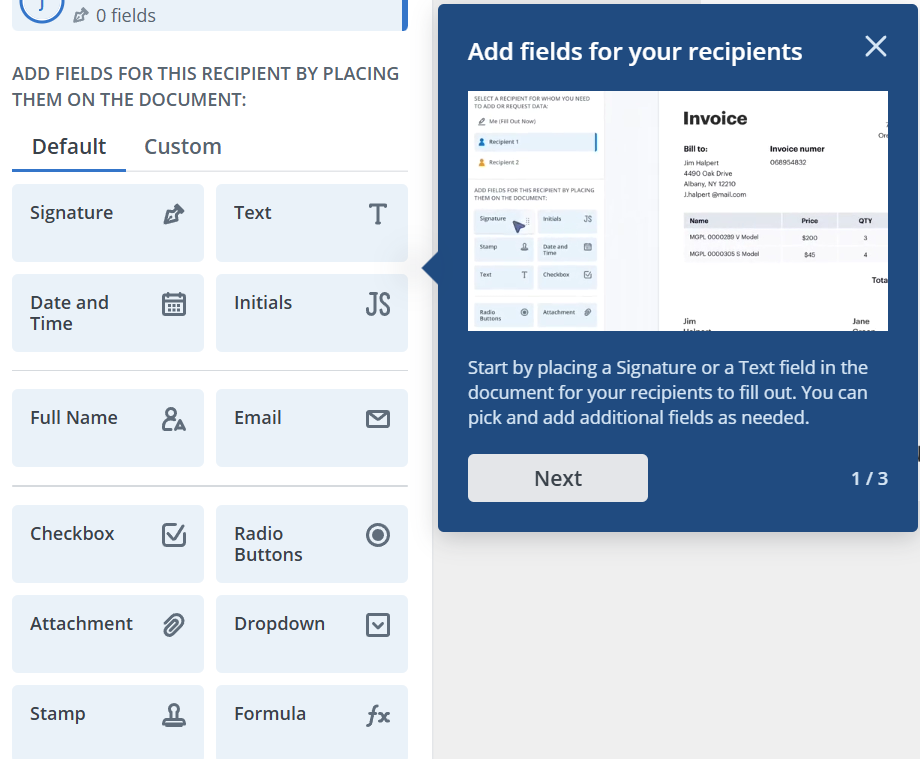
Assign Signature, Initials, Text, and Date fields to the correct person. Align each signature line with its signer’s role. Make required execution fields mandatory, but leave optional grants of authority selectable; do not force acceptance of every power. Preview the document before sending.
4. Route for review and the approved signing process
Set the signing order so review happens first. Explain any witness or notary arrangements in the invitation. Use electronic signing only when appropriate for this document and jurisdiction; arrange the commissioned notary’s process separately.

5. Preserve the completed record
Download the completed document and available signing history. Check dates, initials, acknowledgments, and attachments before distribution. Keep the original document accessible and give the agent usable copies. Confirm that the receiving institution accepts the intended format before the agent must rely on it.
Common mistakes after signing
Avoid outdated information about contact details, agents, or intended transactions. Under Virginia’s successor-agent rules, a named successor can serve when the predecessor cannot; planning for when an agent dies or resigns reduces disruption.
A new power does not necessarily revoke an existing one. Follow applicable revocation rules, prepare a written revocation document when appropriate, and notify affected agents and institutions. California court guidance recommends written cancellation and notice. Keep proof of delivery: reliance protections may depend on actual knowledge of termination. Older documents may remain valid, so age alone is not a reason to discard one. Review the operative instructions before replacing it.
Final thoughts
Confirm the legal authority needed before anyone relies on this document for important transactions.
A useful template connects the right authority with the right signing process. Check the wording, review institutional requirements, and arrange any required witnessing or notarization.
Start with a SignNow power of attorney template to prepare your document and route it through the appropriate workflow.
Glossary
- Principal: Person authorizing another to act.
- Agent: Appointed person exercising delegated authority.
- Durability: Continuation of authority despite incapacity.
- Acknowledgment: Formal declaration of execution before an authorized officer.
FAQ
1. Does appointing an agent remove my own decision-making rights?
Generally, appointing an agent does not remove your ability to make legal decisions while you have capacity. You can continue managing your affairs and sign documents yourself. Discuss overlapping authority with your agent to avoid conflicting instructions.
2. Can someone create a POA after losing capacity?
A person generally needs the legally required capacity when executing the document. Being described as mentally competent in a form does not establish capacity. If that requirement cannot be met, ask a lawyer about available court-supervised alternatives.
3. Can my financial agent make medical decisions?
Do not assume financial authority covers health related decisions. Health care directives address treatment decisions under separate requirements. Prepare the appropriate document for medical decision making.
Durability does not extend authority beyond the principal’s death, as Virginia’s termination rules illustrate. Estate administration belongs to the appropriate legal representative. Good-faith reliance protections do not authorize knowingly continuing POA transactions after death.
Sources
- California Courts — Wills, estates, and advance care planning
- Superior Court of California, County of Orange — Power of attorney
- Florida Statutes, Chapter 709 — Powers of attorney and similar instruments — §§ 709.2105, 709.2108, and 709.2202.
- IRS — Publication 947: Practice Before the IRS and Power of Attorney
- New York General Obligations Law § 5-1501B — Creation and effective date of a power of attorney
- New York General Obligations Law § 5-1504 — Acceptance of and reliance upon a statutory short form power of attorney
- Texas Estates Code, Chapter 751 — General provisions regarding durable powers of attorney
- Virginia Code, Chapter 16 — Uniform Power of Attorney Act — §§ 64.2-1602, 64.2-1603, 64.2-1607–1609, 64.2-1612, and 64.2-1617–1618.
- Social Security Administration — FAQs for beneficiaries who have a representative payee
- Key takeaways
- What a power of attorney template should include
- Which type of power of attorney fits your needs
- When authority starts and whether it survives incapacity
- State signing rules to check before sending
- What happens when a bank questions the document
- How to prepare a power of attorney in SignNow
- Common mistakes after signing
- Final thoughts
- Glossary
- FAQ
- Sources