
Quick answer: A digital signature is a cryptographic mechanism, built on public key infrastructure (PKI), that verifies both a signer’s identity and the integrity of a signed document. It works like a tamper-evident seal: unique to both the document and the signer, so changing even one character after signing breaks the seal and voids the proof. Where an ordinary electronic signature only shows someone intended to sign, a digital signature can prove mathematically that the document hasn’t been altered since.
- A digital signature uses cryptography (PKI, a hash function, and a private/public key pair) to prove both who signed a document and that it hasn’t changed since.
- It’s technically different from a standard electronic signature: every digital signature is an eSignature, but not every eSignature uses cryptographic verification.
- In the US, digital and electronic signatures are enforceable under the ESIGN Act and UETA; in the EU, eIDAS defines three tiers, and only a Qualified Electronic Signature carries automatic cross-border legal weight.
- A digital signature certificate is issued by a Certificate Authority or Trust Service Provider, not by the eSignature software itself.
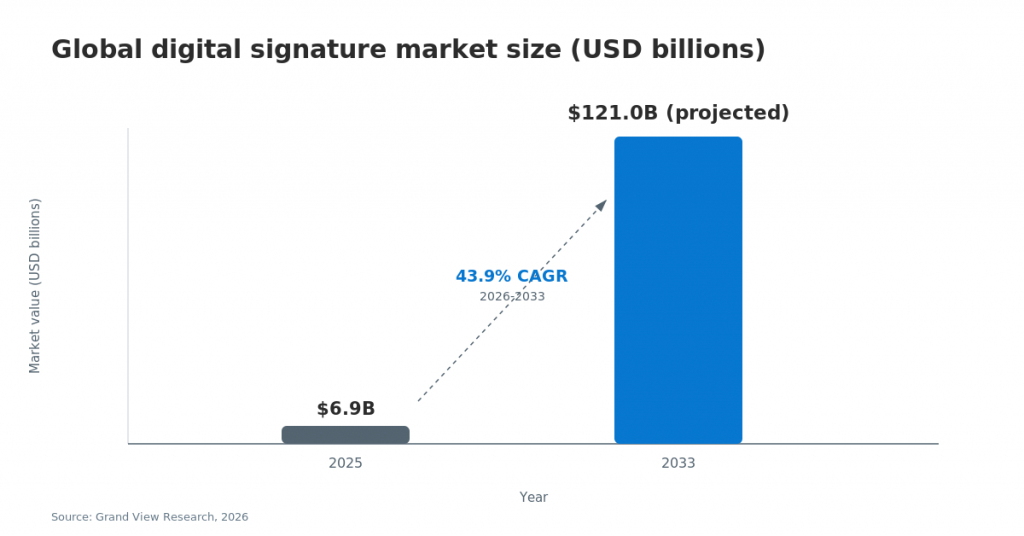
- The Grand View Research digital signature market was valued at $6.9 billion in 2025 and is projected to grow at a 43.9% compound annual growth rate through 2033.
- Most everyday contracts only need a standard eSignature; a digital signature or QES is worth the extra step when regulation, cross-border recognition, or transaction risk demands it.
Why does a digital signature matter?
A digital signature matters because it gives a signed document proof that can hold up in court or survive an audit, rather than just a record that someone clicked “I agree.” For many businesses, the underlying worry isn’t the technology itself: it’s not knowing whether a signature will actually be enforceable if a counterparty disputes it later, or which tier of signature, a plain eSignature, a digital signature, or a Qualified Electronic Signature, a specific document requires.
That uncertainty gets sharper in regulated industries. Healthcare organizations handling protected health information, pharmaceutical and biotech companies working under 21 CFR Part 11, and financial institutions all face a version of the same question: What does the regulator or the auditor actually require here? Getting the tier wrong in either direction creates risk: too weak, and a signature can be challenged; too strong, and a business adds friction and cost to a transaction that never needed it.
The market has grown around solving exactly this problem. The digital signature market growth was valued at $6.9 billion in 2025 and is projected to reach $121.0 billion by 2033, a 43.9% compound annual growth rate, according to Grand View Research.
How does a digital signature work?
A digital signature works by hashing a document, encrypting that hash with the signer’s private key, and letting anyone verify the result with the signer’s matching public key. The process runs in six steps:
- The document is run through a hash function, producing a fixed-length string unique to that exact file, called a hash or digest.
- The signer’s software encrypts that hash using the signer’s private key. This encrypted hash is the digital signature itself.
- The signature, along with the signer’s digital certificate, is attached to the document.
- When the recipient opens the document, their software decrypts the signature using the signer’s public key, recovering the original hash.
- The recipient’s software independently hashes the document as received.
- The two hashes are compared. A match proves two things at once: that the signature came from the holder of that private key, and that the document hasn’t changed since it was signed.
Picture a lender sending a loan agreement for signature. Once the borrower signs, the document is hashed, and the hash is locked with the borrower’s private key. If anyone edits so much as a single number in the interest rate afterward, re-hashing the altered file produces a completely different result, so the comparison in step six fails and the tampering is caught immediately. It works a bit like matching two halves of a torn ticket stub: the two pieces only line up if neither has been altered, and any mismatch is obvious at a glance.
Hashing exists because encrypting an entire document directly would be slow and impractical for large files; only the compact hash needs encrypting, while the comparison at the end still catches even a single-character change. This mechanism also produces something called non-repudiation: because only the signer holds the private key, they can’t later credibly deny having signed, which is why courts and auditors treat it as strong evidence. The digital certificate attached in step three is what lets a recipient trust that the public key really belongs to the claimed signer in the first place, a role covered in the next section.
The NIST digital signature standard (FIPS 186-5) specifies which cryptographic algorithms, RSA, ECDSA, and EdDSA, are approved for generating and verifying these signatures in federal systems, and it’s widely used as a technical baseline well beyond government use. SignNow’s own PKI certificates implementation follows this same underlying mechanism for the higher-assurance signing tiers it supports.
Digital signature vs. electronic signature
A digital signature is a cryptographically secured subset of the broader legal category of electronic signature: every digital signature is an eSignature, but not every eSignature is a digital signature. This is the single most common point of confusion in the space, since nearly every vendor and standards body discusses the two terms without drawing a clean line between them.
| Feature | Digital signature | Electronic signature |
| Mechanism | Public key cryptography: a hash function plus a private/public key pair | Any electronic sound, symbol, or process showing intent to sign |
| Identity verification | Certificate-based, independently verifiable by anyone with the public key | Depends on the method: click-to-sign, typed name, drawn signature, email confirmation |
| Legal category | A technical implementation that can satisfy the eSignature law | The legal term defined by the ESIGN Act and eIDAS |
| Tamper-evidence | Built in: Altering the document breaks the hash match | Depends on the platform’s audit trail and access controls |
| Typical use case | High-value or regulated transactions: loan documents, government filings, pharmaceutical records | Everyday business contracts, HR paperwork, sales agreements |
In practice, most day-to-day contracts only need a standard eSignature, which SignNow’s electronic signatures provide on every plan, backed by a court-admissible audit trail. A digital signature becomes necessary when the risk, regulation, or counterparty specifically calls for cryptographic, certificate-based proof rather than a simple electronic mark.
Are digital signatures legally binding?
Yes. Digital signatures are legally binding in the United States under the ESIGN Act and UETA, and in the European Union under eIDAS, provided the signature method meets each framework’s specific requirements.
In the US, the ESIGN Act, a federal law enacted in 2000, gives electronic records and signatures the same legal effect as their paper and handwritten counterparts once four conditions are met: the signer consented to do business electronically, showed clear intent to sign, the signature can be attributed to that signer, and the record is retained appropriately. UETA is the state-level counterpart, adopted with some variation by most US states, and provides the parallel framework for commercial and government transactions at the state level.
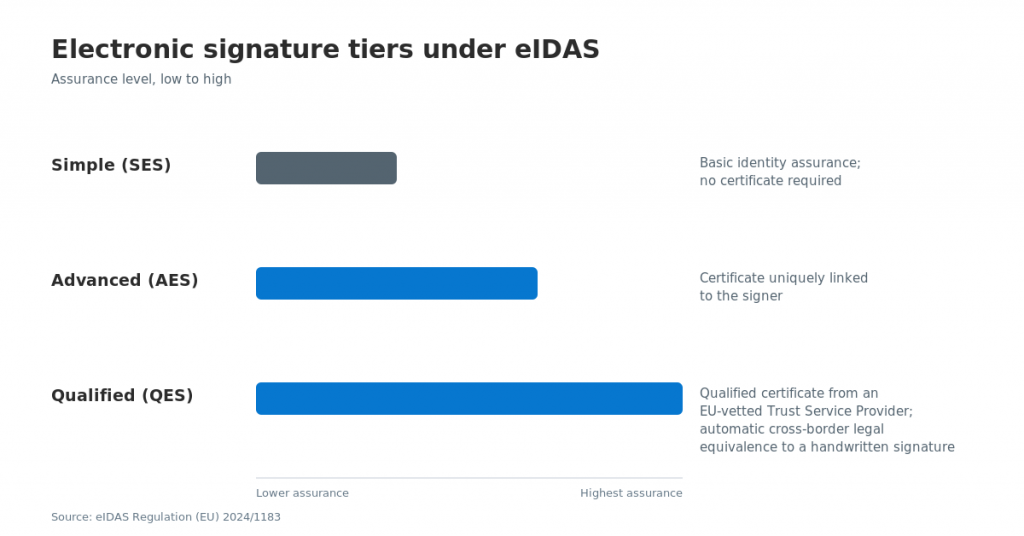
In the EU, eIDAS defines three tiers of electronic signature: Simple (SES), Advanced (AES), and Qualified (QES). Only a Qualified Electronic Signature carries automatic legal equivalence to a handwritten signature across every EU member state; SES and AES are recognized but can, in principle, be challenged and must prove their validity case by case. eIDAS 2.0 (Regulation (EU) 2024/1183) tightens this further: Qualified Trust Service Providers must align their remote signing systems with new technical requirements by May 21, 2026, and every member state is required to make a European Digital Identity Wallet available to citizens, capable of producing a Qualified Electronic Signature from a phone rather than a dedicated hardware token.
Regulated US sectors layer additional requirements on top of ESIGN and UETA. 21 CFR Part 11 governs electronic records and signatures for FDA-regulated industries such as pharmaceuticals and medical devices, requiring unique user signatures, validated systems, and audit trails. Healthcare organizations handling protected health information need a signed Business Associate Agreement with any eSignature vendor before using it for HIPAA-covered documents. SignNow maintains HIPAA compliance through a BAA, along with ESIGN/UETA and eIDAS SES coverage on every plan, and publishes its legality standing by country for businesses operating across multiple jurisdictions.
None of this means every signed document needs the strongest available tier. The legal frameworks set a floor, not a mandate for maximum assurance; a business only needs to match the tier to what the specific regulation or counterparty actually requires, a question addressed later in this article.
What is a digital signature certificate?
A digital signature certificate is a file, issued by a Certificate Authority or a Trust Service Provider, that binds a signer’s identity to their public key so anyone receiving a signed document can verify who actually signed it. The certificate authority verifies the applicant’s identity at a level of rigor that scales with the tier of certificate requested, before issuing it.
That rigor maps directly onto the eIDAS tiers already covered. A Simple Electronic Signature typically requires no certificate at all. An Advanced Electronic Signature requires a certificate uniquely linked to the signer. A Qualified Electronic Signature requires a qualified certificate, issued only by an accredited, EU-vetted Qualified Trust Service Provider, which is what gives QES its automatic cross-border legal standing.
It’s worth being precise about who issues what here: the Certificate Authority or Trust Service Provider issues the certificate, not the eSignature software a business uses day to day.
SignNow itself is not a certificate authority. It integrates with eIDeasy for identity verification and qualified certificates. Enabling specific authentication methods may require additional invoicing, depending on which options your team asks our Support to activate.
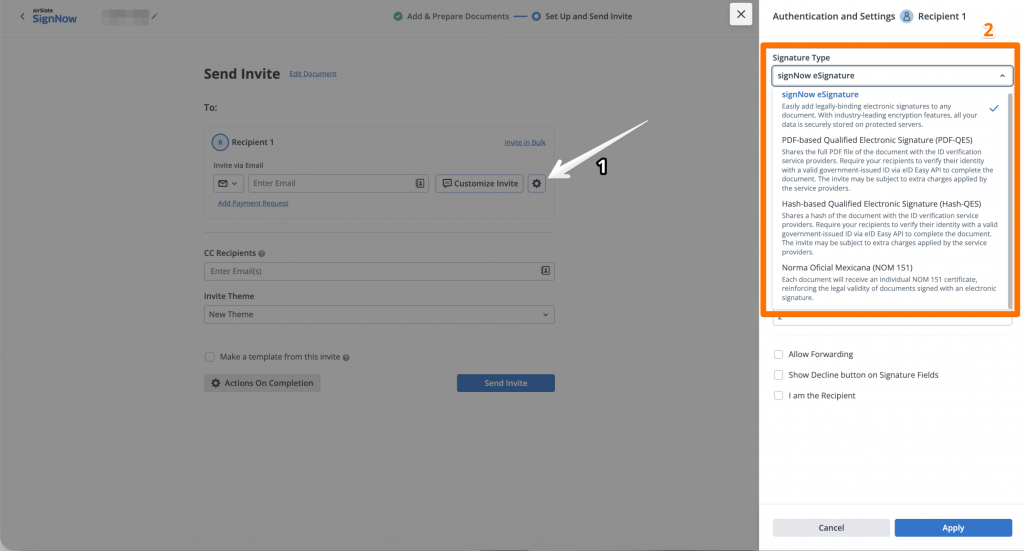
How does QES work in SignNow?
When using QES in SignNow, the process involves the following steps:
- Signer Authentication: The signer must authenticate their identity using methods such as an official ID verification process.
- Qualified Certificate: The signer will need to have or obtain a Qualified Certificate issued by a trusted Certificate Authority (CA).
- SignNow Integration: Once the identity is verified, and the QES is applied, the document is securely signed and sealed with a digital certificate.
Pro tip: SignNow generates, for every document signed on the platform, a certificate of completion and a detailed audit trail: full signer names, email addresses, IP addresses, and timestamps for every action taken on the document. That’s a separate, complementary form of evidence, useful for proving who signed and when, but distinct from a PKI-based digital certificate tied to a signer’s cryptographic identity.
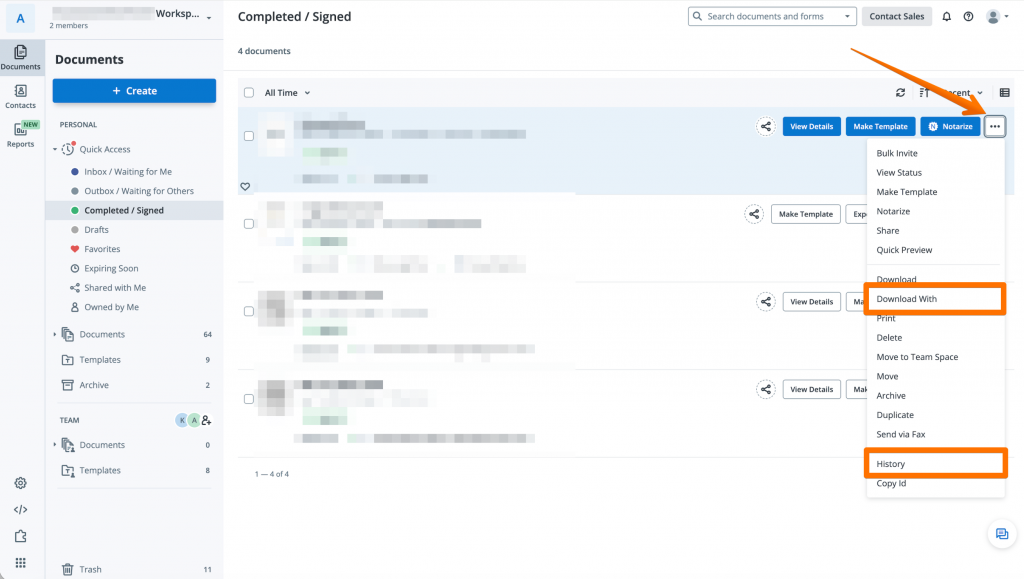
For businesses that need certificate-based assurance beyond that audit trail, SignNow’s security and compliance documentation outlines how stronger authentication and certificate-based options fit into the platform.
Digital signature tiers SignNow supports
SignNow supports standard electronic signatures on every plan and offers stronger, certificate-based options for regulated or higher-risk workflows.
- Legally-binding eSignatures with a full audit trail are included on the Business plan ($8/user/month, billed annually), covering ESIGN Act and UETA requirements for everyday contracts.
- eIDAS SES compliance is included on all paid plans, covering Simple Electronic Signature requirements for EU-facing business.
- Advanced, two-factor signer authentication is available from the Enterprise plan ($30/user/month) up, letting a business verify a signer’s identity via password, text message, or phone call before they can sign.
- 21 CFR Part 11 compliance is available as an add-on on the Site License plan for organizations with FDA-regulated recordkeeping requirements.
- HIPAA compliance is available on request through a signed Business Associate Agreement for healthcare documents containing protected health information.
- QES in SignNow. In SignNow, a QES combines strong identity verification with a qualified certificate issued by a Qualified Trust Service Provider (QTSP), plus a tamper-evident audit trail.
QES is available on Corporate (site license) plans only. It integrates with eIDeasy for identity verification and qualified certificates. Enabling specific authentication methods may require additional invoicing, depending on which options your team asks our Support to activate. Contact sales to learn more about volume-based discounts and unlock access.
For more information, visit our Help center and learn what is a QES in SignNow, how it enables EU-grade, court-admissible signatures.
Who uses digital signatures?
Digital signatures are used across finance, government, healthcare, and legal services wherever a document’s authenticity and integrity need to be provable beyond a simple electronic mark.
In financial services, a regional bank’s loan officer sends a signed loan agreement to a borrower at closing: the certificate-based signature and audit trail give both the bank and its regulators proof of who signed, what they signed, where the transaction took place, when it closed, why the verification mattered for compliance, and how the signature was cryptographically confirmed.
“SignNow provides us with the flexibility needed to get the right signatures on the right documents, in the right formats, based on our integration with NetSuite.” — Kodi-Marie Evans, Director of NetSuite Operations, Xerox
Government agencies use digital signatures on sensitive forms where two-factor signer authentication and a detailed audit trail are non-negotiable, since public-sector filings are often subject to open-records review. Healthcare providers apply digital or electronic signatures to intake and consent forms containing protected health information, under a signed Business Associate Agreement to satisfy HIPAA. In legal services, a firm sending a multi-party settlement agreement can set a signing order so a defendant’s counsel signs only after the plaintiff has, with each step logged in the audit trail.
Across SignNow’s industry solutions, the common thread is the same: the signature needs to prove more than intent, it needs to prove identity and document integrity together.
When should you use a digital signature instead of a standard eSignature?
Use a digital signature or a Qualified Electronic Signature when a document’s legal risk, regulatory requirement, or need for cross-border recognition outweighs the convenience of a standard eSignature. Four questions help decide:
- Does a specific regulation name a required tier? A pharmaceutical record governed by 21 CFR Part 11, or an EU public-sector filing that requires QES, has already answered this question for you.
- Is the transaction high-value or high-risk? Large financial transactions, real estate closings, and government filings typically warrant stronger, certificate-based verification than a routine internal form.
- Does the counterparty operate across EU borders and need automatic legal equivalence? Only a Qualified Electronic Signature carries that guarantee under eIDAS; Simple and Advanced tiers may still need to prove validity case by case.
- If none of the above apply, a standard eSignature is very likely sufficient. Most day-to-day contracts, HR paperwork, and sales agreements were never the source of the legal risk that digital signatures were built to address.
Over-provisioning has a real cost too: requiring QES or certificate-based verification on every document adds friction and cost to transactions that never needed it, which is part of why the decision is worth making deliberately rather than defaulting to the strongest option available. A business doesn’t need to choose one tier for every document it sends. SignNow’s templates and workflows let a team send most agreements with a standard eSignature and add stronger authentication only to the specific workflows, such as wire approvals or regulated filings, where the extra assurance is actually required.
Benefits of digital signatures
Digital signatures reduce fraud risk and speed up document turnaround by replacing manual verification with cryptographic proof that can be checked instantly.
- Faster turnaround. SignNow customers see an average document completion rate of 80%, reflecting how quickly signers act once the friction of printing, scanning, or mailing is removed.
- Reduced tamper risk. Because the signature depends on a hash of the exact document content, any post-signing edit is detectable immediately rather than discovered later.
- Audit-trail-backed compliance evidence. The certificate of completion and detailed audit trail give regulated industries a documented record to show an auditor or regulator on request.
- Provable non-repudiation. Because only the signer holds the private key, they can’t later credibly deny having signed, a property regulators and courts weigh heavily as evidence.
- Cross-border recognition where it matters. A Qualified Electronic Signature carries automatic legal equivalence across EU member states, removing the need to argue validity in each jurisdiction separately.
- Time savings at scale. SignNow customers report saving up to six hours per employee per week, and an average 8% improvement in deal-closing rates, once manual signature chasing is removed from the workflow.
Cost reduction follows the same pattern: eliminating printing, shipping, and manual filing removes a recurring expense from every signed document, not just the largest ones.
Disclaimer: The information contained in this blog post is provided for general informational purposes only and does not constitute formal legal advice.
Final thoughts
Digital signatures provide a higher level of assurance by proving both a signer’s identity and a document’s integrity. While most everyday agreements only require a standard electronic signature, certificate-based digital signatures and Qualified Electronic Signatures (QES) are the right choice for regulated industries, high-value transactions, and situations where stronger legal evidence is required.
With SignNow, you can securely send, sign, and manage documents from one platform while choosing the appropriate level of signature assurance for every workflow. From legally binding eSignatures and detailed audit trails to advanced authentication and QES support for eligible enterprise use cases, SignNow helps businesses simplify compliance and complete agreements faster. Start your free trial today and streamline your document workflows with confidence.
Glossary
- Certificate Authority (CA): An organization that verifies an applicant’s identity and issues digital certificates binding that identity to a public key.
- eIDAS: The EU regulation (910/2014, updated by 2024/1183) defining Simple, Advanced, and Qualified tiers of electronic signature and their legal recognition across member states.
- ESIGN Act: The 2000 US federal law giving electronic signatures and records the same legal effect as paper and handwritten ones, when consent, intent, attribution, and record retention requirements are met.
- Hash function: An algorithm that converts a document into a fixed-length string unique to its exact content; any change to the document changes the resulting hash.
- Non-repudiation: The property that a signer cannot credibly deny having signed a document, since only they hold the private key used to create the signature.
- Trust Service Provider (TSP): An organization, accredited under eIDAS, that issues qualified certificates and other trust services for electronic signatures in the EU.
FAQ
What is the difference between a digital signature and an electronic signature?
An electronic signature is a broad legal category: any electronic mark, symbol, or process showing intent to sign, covering everything from a typed name to a click-to-sign button. A digital signature is a specific, cryptographic method (using PKI, a hash function, and a private/public key pair) that can satisfy eSignature law with stronger identity and integrity proof.
Are digital signatures legally binding?
Yes, in the United States under the ESIGN Act and UETA, and in the European Union under eIDAS, provided the signature method meets each framework’s requirements. In the EU, only a Qualified Electronic Signature carries automatic legal equivalence to a handwritten signature across every member state.
What is a digital signature certificate?
It’s a file, issued by a Certificate Authority or Trust Service Provider after verifying the applicant’s identity, that binds the signer’s identity to their public key so a recipient can confirm who actually signed a document.
Do I need a digital certificate to use a digital signature?
It depends on the tier. A Simple Electronic Signature typically needs no certificate. An Advanced Electronic Signature requires a certificate uniquely linked to the signer. A Qualified Electronic Signature requires a qualified certificate from an accredited Trust Service Provider.
What is a Qualified Electronic Signature (QES)?
QES is the highest-assurance tier defined under eIDAS, built on a qualified certificate from an EU-vetted Qualified Trust Service Provider. It’s the only tier that carries automatic cross-border legal equivalence to a handwritten signature across the EU.
What industries require digital signatures rather than standard eSignatures?
Pharmaceutical and biotech companies operating under 21 CFR Part 11, financial institutions handling high-value transactions, government agencies processing sensitive filings, and businesses signing agreements that must carry automatic legal weight across EU borders are the most common cases.
Sources
- Grand View Research, Digital Signature Market Report 2026
- NIST FIPS 186-5, Digital Signature Standard
- eIDAS 2.0, Regulation (EU) 2024/1183 — 21 May 2026 QTSP deadline
- 21 CFR Part 11, Electronic Records and Signatures
- National Credit Union Administration, ESIGN Act
- Cornell Law School Wex, Digital Signature
- Why does a digital signature matter?
- How does a digital signature work?
- Digital signature vs. electronic signature
- Are digital signatures legally binding?
- What is a digital signature certificate?
- Digital signature tiers SignNow supports
- Who uses digital signatures?
- When should you use a digital signature instead of a standard eSignature?
- Benefits of digital signatures
- Final thoughts
- Glossary
- FAQ
- Sources