
Employee handbook template: What to include and how to collect acknowledgments

An employee handbook template solves the blank-page problem. It does not solve the compliance problem. Most handbooks get into trouble in the gap between the two. The policies that carry legal weight change with headcount. They change with the state an employee works in. They also change with agency decisions that arrive without warning. In January 2026, the Equal Employment Opportunity Commission voted to rescind its 2024 harassment guidance. Any handbook citing that document by name now cites something that no longer exists. A good employee handbook keeps new employees and your legal team on the same page. Treat a template as the first draft of company policies you will reissue every year.
TL;DR
- A handbook template gives you structure. It does not make your handbook legally compliant.
- Cover ten core blocks, from the welcome statement to the employee acknowledgment page.
- Federal law applies by headcount: 1, 15, 20, and 50 employees.
- FMLA eligibility needs 12 months of employment, 1,250 hours, and 50 employees within 75 miles.
- Under the NLRB’s Stericycle standard, broad conduct, social media, and confidentiality rules are risky.
- A clear, signed, and retrievable acknowledgment page is your strongest legal protection.
- Review the handbook every year, and put the version number on the acknowledgment page.
- SignNow lets you fill, sign, and track every acknowledgment from one employee handbook template.
What a handbook template actually solves
A template earns its place through structure, not legal advice.
What a good template gives you
The value of a good template is completeness and consistency. It gives you a section order that reads logically to a new hire. It keeps one tone across employment policies written by different people. It also works as a checklist for auditing a handbook you already have. Run an existing document against one. You will usually find two or three sections nobody remembered to write.
Free templates, employee handbook examples, and an employee handbook builder speed up this first draft. Even a free employee handbook needs your own policy documents behind it.
What a template cannot do
A template cannot tell you which policies you are legally required to carry. It does not know your headcount or the states your people work in. It does not know whether you hold federal contracts. It cannot tell which state and federal laws apply to you. Nor can it draft a conduct rule that will survive a labor-law challenge. That depends on wording rather than structure. Use reusable document templates for the parts that stay constant. Have the policy language reviewed by someone who knows your jurisdiction.
A template speeds up a customized handbook, but legal compliance still needs human review.
The sections every employee handbook template should carry
Most employee handbook examples follow the same core structure.
The ten core blocks
Ten blocks recur across the sample handbooks and builders ranking for this topic. A workable template covers all of them:
- Welcome statement, mission statement, core values, and company information
- Employment classifications: exempt and non-exempt employees, full-time, part-time, and temporary employees
- Hours, timekeeping, payroll procedures, pay periods, and overtime pay
- Leave and employee benefits: holidays, paid time off, health benefits, jury duty leave, military leave for active duty in the armed forces, and any statutory leave you are subject to
- Standards of conduct: equal employment opportunity, anti-harassment, attendance, dress code, and workplace violence prevention
- Workplace safety, security, and company property
- Technology, devices, social media, and confidentiality
- Performance reviews, discipline, and separation
- State and local addenda for each jurisdiction where you employ people
- The employee acknowledgment page
Add a table of contents so new employees can find each policy fast.
What the culture and conduct sections should say
The welcome statement and the company’s mission set the tone for company culture. Keep the company philosophy and company values short and concrete. New employees read this part first, so it should sound like your team.
The conduct section usually opens with an equal opportunity employer statement. It lists each status protected by federal law, such as race, religion, and national origin. Some states add others, such as marital status. The sexual harassment policy should define unwelcome sexual advances and conduct of a sexual nature. Each team member should immediately report incidents to an immediate supervisor or HR. It should also explain how to request reasonable accommodations. The safety policy should list key safety measures and how to report hazards. Attendance rules usually ask staff to give as much notice as possible before an absence.
Posters still sit outside the handbook
A handbook does not replace the notices the law requires you to post. The Department of Labor lists the federally required workplace posters separately. They include the Fair Labor Standards Act notice and the FMLA notice. They also include the Employee Polygraph Protection Act notice. The OSHA poster, “Job Safety and Health: It’s the Law,” is on the list too. Reprinting a policy in the handbook does not discharge the posting obligation.
Cover all ten blocks, then post the federal notices the handbook cannot replace.
Which policies the law makes mandatory at your headcount
Federal law ties most handbook obligations to how many people you employ.
Federal thresholds by employee count
This is the part most templates leave vague. Federal employment laws switch on at different employee counts. A five-person small business needs a shorter handbook than a sixty-person one. The EEOC explains these in its guidance on small business requirements. The Equal Pay Act applies from your first employee. Title VII, the Americans with Disabilities Act, and GINA apply from 15. The Age Discrimination in Employment Act applies from 20. The Family and Medical Leave Act arrives at 50.
Federal employment laws by employee-count threshold
| Employees | Law that applies at this threshold | What it covers |
|---|---|---|
| 1 or more | Equal Pay Act | Equal pay for equal work, regardless of sex |
| 15 or more | Title VII of the Civil Rights Act | Discrimination based on race, color, religion, sex, and national origin |
| 15 or more | Americans with Disabilities Act | Disability discrimination and reasonable accommodation |
| 15 or more | Genetic Information Nondiscrimination Act | Discrimination based on genetic information |
| 20 or more | Age Discrimination in Employment Act | Discrimination against workers aged 40 and older |
| 50 or more, in 20 or more workweeks | Family and Medical Leave Act | Up to 12 workweeks of job-protected leave in a 12-month period |
FMLA eligibility has a second test
The FMLA threshold has a second layer that handbooks routinely get wrong. Even at a covered employer, not all employees are eligible employees. Each must meet all three tests in the Department of Labor’s FMLA fact sheet. The first is 12 months of employment. The second is at least 1,250 hours of service in the prior 12 months. The third is a worksite with at least 50 employees within 75 miles. Promising 12 weeks to everyone without that test creates a reasonable expectation you cannot guarantee.
State and local employment laws add duties a generic template will never carry for you. If your company operates in multiple states, check each state’s legal requirements before you publish.
Map your headcount to these thresholds first, and the mandatory sections follow.
Writing rules that survive an NLRB challenge
How you word a rule now matters as much as which rules you include.
The Stericycle standard
The biggest recent change to handbook drafting has nothing to do with sections. In August 2023, the National Labor Relations Board adopted a new standard for work rules. The case was Stericycle, Inc., and it overruled the earlier Boeing framework. The test has two steps. First, the General Counsel shows a reasonable tendency to chill Section 7 rights. That makes the rule presumptively unlawful.
The employer can then rebut it only by proving two things. The rule must advance a legitimate and substantial business interest. That interest must not be achievable with a more narrowly tailored rule.
Why the standard still matters in 2026
The standard is still in force. SHRM reported in April 2026 that the Stericycle decision remains in place. It quoted Tom Luetkemeyer of Hinshaw: “While the words of the burden-shifting test of Stericycle give the employer a chance, it will be extremely difficult to prevail.”
Fisher Phillips made the same point in its May 2025 review of NLRB handbook rules. It added that savings clauses and general disclaimers do not cure facially overbroad language.
Which template sections to rewrite
In practice, this hits three sections of almost every off-the-shelf template. They are civility and professionalism rules, social media policies, and blanket confidentiality clauses. A rule against discussing company matters with outsiders is exactly what the standard targets.
Rewrite each rule to name the specific conduct prohibited and the business interest behind it. Drop anything you cannot justify that way.
Narrow wording that clarifies expectations is what keeps a work rule legally sound.
The acknowledgment page carries the legal weight
The shortest page in the handbook often matters most in a dispute.
What the acknowledgment page says
Most handbooks end with a page covering three points. Employment is at will. The handbook is not a contract. The company reserves the right to change it at any time.
The handbook outlines the rules, and the signed page shows employees understand them. That page does more work than the rest of the document combined. Courts have looked closely at it.
What Nicosia v. Wakefern teaches
In Nicosia v. Wakefern Food Corp., the New Jersey Supreme Court ruled on this in 1994. It held that a widely distributed handbook could create a binding implied contract. The employer’s disclaimer failed because it lacked prominence and clarity.
The lesson is not that disclaimers are worthless. Burying one in small type at the back does not work. The acknowledgment needs to be signed, dated, and retrievable.
Why retrievability matters
Retrievability matters because disputes surface years later. The EEOC received 88,531 new charges of discrimination in fiscal year 2024. That was 9.2 percent more than the previous year. The agency also secured close to $700 million for over 21,000 people.
EEOC enforcement activity, fiscal year 2024
| Measure | Fiscal year 2024 |
|---|---|
| New charges of discrimination received | 88,531 (up 9.2% on FY 2023) |
| Total monetary relief secured | Nearly $700 million |
| People who received relief | More than 21,000 |
| Relief, private sector, and state or local government | Over $469.6 million for 13,516 workers |
| Relief, federal employees, and applicants | More than $190 million for 3,041 individuals |
| Merits lawsuits filed | 111 |
Match your payroll recordkeeping
Recordkeeping for the handbook should match the discipline you already apply to payroll. The Department of Labor’s FLSA recordkeeping requirements set clear minimums. Payroll records must be kept for at least three years. Wage-computation records, such as time cards and work schedules, must be kept for two.
The FLSA does not govern handbook acknowledgments specifically. But an acknowledgment you cannot produce on request is as good as unsigned.
A signed acknowledgment only offers legal protection if you can produce it years later.
Fill, sign, and download your employee handbook template with SignNow
SignNow turns the finished handbook into a signable acknowledgment in a few clicks.
Start from a template
Once the policy text is settled, the remaining problem is distribution. Every employee must receive the handbook and sign the acknowledgment. That signature must be stored where you can find it.
Start from SignNow’s employee handbook templates, or upload your own PDF, Word, or Excel file.
Fill and send the handbook easily using SignNow
Follow these steps:
- Log in to SignNow, or start the 7-day free trial. No credit card required.
- Click + Create document to see options for document upload from a storage of your choice.
- Select Add from Forms Library, then enter employee handbook into the search field.
- Enter your company details into the fields.
- Add fillable fields. Drag Signature and Date and Time fields onto the acknowledgment page. Add a Text field for the employee’s printed name and job title. Mark each field required in the right-hand panel. SignNow’s fillable field and role setup covers each option.
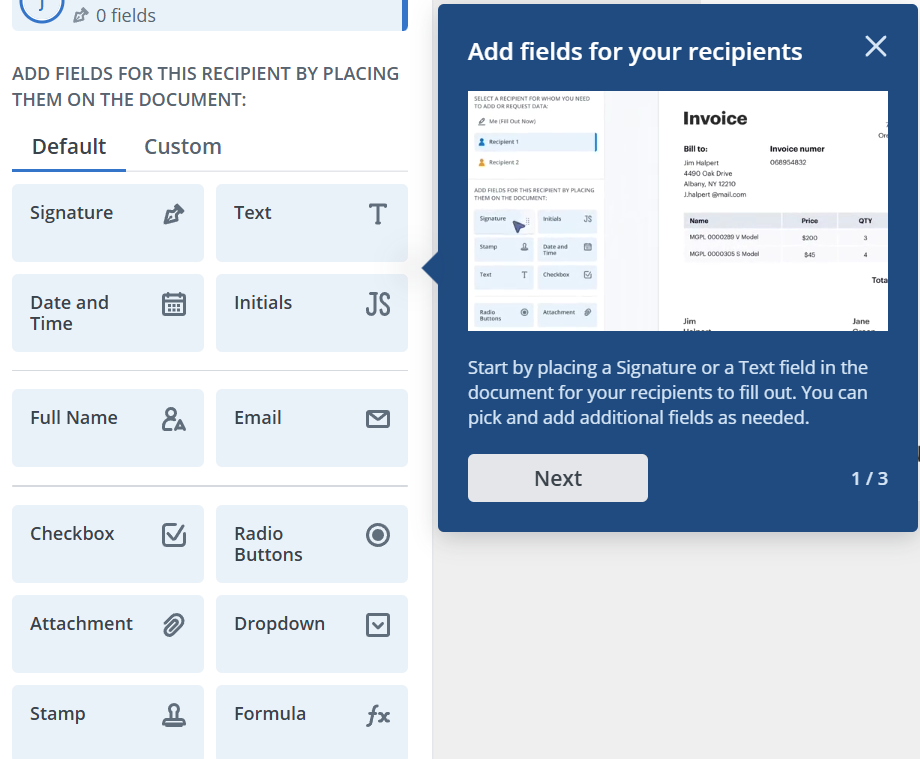
- Click Continue to proceed to sign request creation.
- Enter the recipient information, then send or schedule your invite to sign the document. Set the signing order if an HR approver signs after the employee. You can also send a document via a signing link.
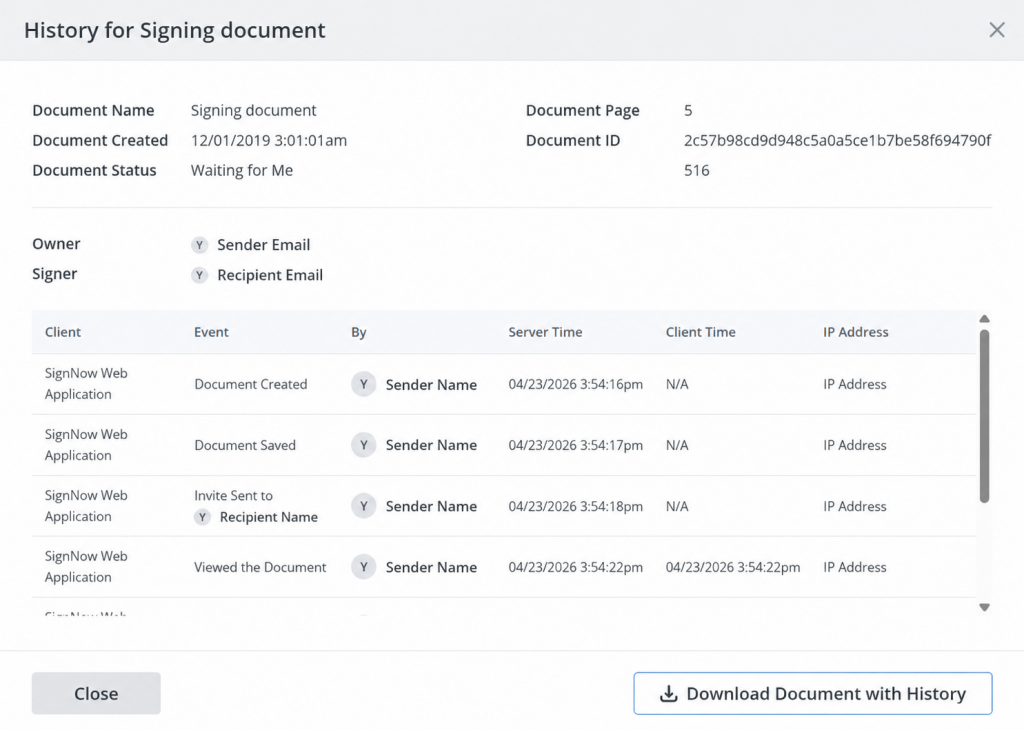
- Track progress through the “Waiting for Others” status and Document History.
Settings for an annual rollout
Two settings matter for an annual rollout. Signature invite expiration defaults to 30 days and can be extended to 180. That helps when chasing a long tail of part-time staff. Bulk send on the Business Premium plan reaches a whole workforce at once. Each employee gets a separate document rather than one shared file.
Each completed acknowledgment carries a document audit trail. You can recall information about eSignature audit trails from our blog article: eSignature audit trail: What it is, how it works, and why it protects your business. SignNow’s History records who signed, when, and from which IP address.
Once set up, you can provide employees with the same handbook and acknowledgment flow.
Keeping the handbook current
A handbook is only as good as its last update.
Test your update process
The EEOC rescission in January 2026 tests whether your process works. Your anti-harassment section may quote the 2024 enforcement guidance. If so, someone must find that reference and decide what replaces it. Then the revised handbook must go back in front of every employee. A locked PDF on a shared drive means finding out months later.
Assign an owner and version the handbook
An annual review with a named owner is the minimum. Put the version number and effective date on the acknowledgment page. Then, if an old policy is disputed, you can show which version the employee signed.
Give employees reasonable notice before a revised policy takes effect. When the handbook is a template and signatures are electronic, reissuing it takes an afternoon.
Regular, versioned updates keep the handbook legally compliant as the rules change.
Final thoughts
You now have the sections a handbook template should cover. You know the headcount thresholds that decide which policies are mandatory. You know the drafting standard your conduct rules must meet. You also have a process for collecting and storing acknowledgments. Have an employment lawyer review the policy language in each state where you operate.
The distribution problem is solved. Start from SignNow’s employee handbook templates, add the acknowledgment fields, and send the invite.
Glossary
- At-will employment. Either party may end the relationship at any time, for any lawful reason. Cause is not required. Handbooks state this explicitly to avoid implying fixed employment terms.
- Acknowledgment page. The signed page confirming an employee received the handbook. It also confirms they understand the at-will statement and the employer’s right to amend policies.
- Section 7 rights. Rights under the National Labor Relations Act to act together for mutual aid or protection. Rules that could reasonably chill them are presumptively unlawful under Stericycle.
- Exempt and non-exempt. The FLSA classification that decides overtime entitlement. Non-exempt employees are owed overtime pay. They are also covered by the FLSA’s recordkeeping rules.
- Equal employment opportunity. The principle that employment decisions must not turn on a legally protected status. Examples include race, sex, and national origin.
- Signing order. The sequence in which recipients receive and complete a document. It is used when an HR approver signs after the employee.
- Audit trail. The record attached to a completed electronic document. It shows each action taken, with timestamps and IP addresses.
FAQ
What is the best format for an employee handbook?
A searchable digital document you can update and reissue works best. Pair it with a separate signable acknowledgment page. A designed PDF reads well but is expensive to revise.
Are electronic signatures valid on a handbook acknowledgment?
Yes, in the United States. Under the federal ESIGN Act, a signature cannot be rejected just for being electronic. Keep the audit trail with each signed copy as evidence.
What if an employee refuses to sign the acknowledgment?
Don’t force it. Have a manager note the delivery date and the refusal on the form. Refusing to sign generally does not exempt an employee from company policies.
Should temporary and part-time employees get the handbook?
Yes, if the policies apply to them. Mark which sections cover which classifications, such as benefits only full-time employees receive. Temps placed by a staffing agency may also fall under the agency’s handbook. Clarify which rules apply in the placement agreement.
Which state’s rules apply to remote employees?
Generally, the state where the employee works, not where the company is based. Wage, leave, and final-pay rules usually follow the work location. Add a state addendum for each state where remote staff work.
What is the difference between an employee handbook and an offer letter?
An offer letter covers one person’s terms, such as role, pay, and start date. The handbook covers company-wide policies that apply to everyone. Neither replaces the other. Check that they do not contradict each other.
Do employees need to sign again when the handbook changes?
For material changes, collecting a new acknowledgment is the safer practice. Send the updated version and keep the signed copy of each version on file. Then you can show which version an employee agreed to. Small fixes, such as typos, usually don’t need a new signature. State the effective date of every change clearly.
How long should an employee handbook be?
Long enough to cover your required policies, and no longer. No law sets a page count. A five-person team needs fewer sections than a sixty-person one. Use plain language and short sections. Move state-specific rules into addenda so the main text stays short. A table of contents helps readers find answers fast.
Sources
- Board Adopts New Standard for Assessing Lawfulness of Work Rules, National Labor Relations Board, 2023
- NLRB’s Strict Decision on Work Rules Remains in Place, SHRM, 2026
- Employers Still Need to Follow NLRB’s Strict Handbook Rules, Fisher Phillips, 2025
- Small Business Requirements, U.S. Equal Employment Opportunity Commission
- EEOC Commission Votes to Rescind 2024 Harassment Guidance, U.S. Equal Employment Opportunity Commission, 2026
- EEOC Publishes Annual Performance and General Counsel Reports for Fiscal Year 2024, U.S. Equal Employment Opportunity Commission, 2025
- Fact Sheet #28: The Family and Medical Leave Act, U.S. Department of Labor
- Fact Sheet #21: Recordkeeping Requirements under the Fair Labor Standards Act, U.S. Department of Labor
- Workplace Posters, U.S. Department of Labor
- TL;DR
- What a handbook template actually solves
- The sections every employee handbook template should carry
- Which policies the law makes mandatory at your headcount
- Writing rules that survive an NLRB challenge
- The acknowledgment page carries the legal weight
- Fill, sign, and download your employee handbook template with SignNow
- Keeping the handbook current
- Final thoughts
- Glossary
- FAQ
- What is the best format for an employee handbook?
- Are electronic signatures valid on a handbook acknowledgment?
- What if an employee refuses to sign the acknowledgment?
- Should temporary and part-time employees get the handbook?
- Which state’s rules apply to remote employees?
- What is the difference between an employee handbook and an offer letter?
- Do employees need to sign again when the handbook changes?
- How long should an employee handbook be?
- Sources