
AI electronic signature workflows: 5 improvements changing how businesses sign in 2026

This guide explains the five core ways artificial intelligence is transforming AI electronic signature workflows, moving them from simple signing tools into intelligent, automated systems. After reading, you will understand how to apply AI for stronger identity verification, faster contract analysis, smarter document routing, proactive risk detection, and actionable post-signature insights.
Think of a traditional eSignature as a lock on a door — it keeps things secure, but it does nothing else. An AI-powered eSignature workflow is more like a smart building system: it knows who is entering, flags anything unusual, routes people automatically, and generates a report at the end of the day. That shift, from a passive event to an active system, is what this guide covers.
The demand is real. According to AIIM (2025), improved compliance and risk management are the top drivers for investing in AI for document workflow automation. Organizations that treat signing as a one-click event are leaving security gaps, legal exposure, and contract data on the table.
TL;DR: 5 key AI enhancements to eSignature workflows
- AI-powered identity verification uses biometrics, government ID scanning, and liveness detection to confirm who is signing — reducing identity spoofing by over 95% compared to static password methods (IEEE, 2024).
- Pre-signature contract analysis uses generative AI to draft, summarize, and flag risks in agreements before they are sent — cutting legal review time by up to 90% (Deloitte, 2024).
- Intelligent workflow automation routes documents dynamically based on content, value, or risk level rather than static rules — reducing manual form setup time by an average of 70% (IDC, 2024).
- Predictive risk analysis compares contract clauses against large datasets to flag non-standard or high-risk terms before anyone signs.
- Post-signature analytics extract renewal dates, payment terms, and obligations from signed agreements, turning your contract archive into a searchable, structured database.
Before you begin: What to look for in an AI-ready eSignature platform
To take advantage of AI in your eSignature workflows, your platform needs a strong foundation of security, automation, and compliance. AI enhancements layer on top of existing capabilities — if those capabilities are weak, AI cannot compensate.
Plan requirements for the features covered in this guide:
- Advanced recipient authentication (required for AI-driven identity verification): available on SignNow’s Enterprise plan at $30/user/month
- Conditional fields and smart fields (required for intelligent routing): available on the Enterprise plan
- Audit Trail (required for compliance and post-signature analytics): included on all paid plans, starting at $8/user/month
- SOC 2 Type II certification: included on all SignNow plans — no add-on required
- HIPAA compliance (for healthcare workflows): available as an add-on via Business Associate Agreement on the Site License plan
- 21 CFR Part 11 compliance (for FDA-regulated industries): available as an add-on on the Site License plan
- Reporting (foundation for post-signature analytics): included on all paid plans
Tools needed:
- A SignNow account (Business plan or higher for core features; Enterprise or Site License for advanced authentication and conditional logic)
- Documents in PDF, DOCX, or Excel format
- For AI contract analysis and advanced analytics: access to the Business Cloud features, which includes SignNow alongside contract management, contract negotiation, and advanced analytics tools
A key feature underpinning all AI improvements is a court-admissible audit trail, which records full names, email addresses, IP addresses, and timestamps for every action taken on a document. AI makes this record even more detailed and actionable.
Improvement 1: Fortify security with AI-powered identity verification
AI is changing signer identity verification by moving beyond simple email links to multi-layer biometric analysis. This matters because the person who receives a signing link is not always the person who signs — and a standard email delivery provides no way to detect the difference.
What AI-driven identity verification (IDV) does:
- Scans a government-issued ID (passport, driver’s license) and validates its authenticity using document recognition models.
- Performs a facial recognition check, comparing the signer’s live image to the ID photo.
- Runs a liveness detection test — asking the signer to blink, nod, or turn their head — to confirm they are a live person and not a static photograph.
- Analyzes behavioral biometrics such as typing cadence, mouse movement, and touch pressure patterns to build a continuous confidence score throughout the session.
- Flags anomalies in real time and can block the session or escalate for manual review.
According to IEEE (2024), AI-driven biometric authentication during the signing process can reduce identity spoofing by over 95% compared to static password-based methods. That is not a marginal improvement — it is a structural shift in how identity risk is managed.
Think of liveness detection like a brief video call where the system asks you to nod or smile. It proves you are a real person sitting in front of a camera right now, not someone who found a photo of you online. That single check eliminates an entire category of fraud that email-link authentication cannot address.
This shift is also regulatory. The EU’s eIDAS regulation distinguishes between Simple Electronic Signatures (SES), Advanced Electronic Signatures (AES), and Qualified Electronic Signatures (QES) — with AES and QES requiring identity verification that increasingly aligns with AI-driven IDV methods. SignNow supports eIDAS SES on all plans, with AES available on the Site License plan.
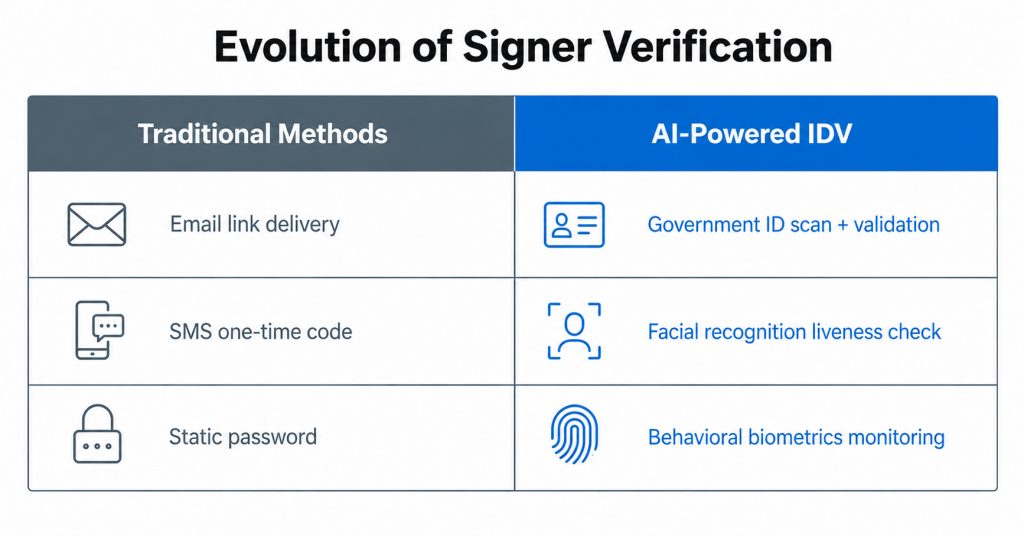
SignNow’s advanced recipient authentication — available on the Enterprise plan — supports two-factor signer authentication via password, text message, or phone call. This is the current foundation on which AI-driven IDV capabilities are being built across the eSignature market.
Improvement 2: Accelerate deals with AI pre-signature contract analysis
Generative AI is compressing the time between “contract drafted” and “contract sent” by automating the review work that used to require a lawyer or a paralegal to read every line. According to Deloitte (2024), AI-powered contract automation in legal departments can reduce contract review time by up to 90% and cut associated processing costs by 30–40%.
This is sometimes called a “shift-left” approach: moving intelligence earlier in the workflow so problems are caught before a document reaches a signer, not after it has been executed.
What AI pre-signature analysis does in practice:
- Uploads a draft contract and runs it through a generative AI model trained on legal language.
- Produces a plain-language summary of the agreement’s key terms, obligations, and deadlines.
- Flags clauses that deviate from your organization’s standard positions or that contain unusual risk language.
- Suggests replacement clauses from an approved library.
- Generates a risk score that legal or procurement teams can use to prioritize review time.
Forrester (2025) identified this as a primary trend: companies are using generative AI to draft, summarize, and analyze contracts for risks and non-standard clauses before they are sent for signature — not just after disputes arise. Gartner (2025) confirmed that generative AI is accelerating the drafting and negotiation phases specifically.

The practical starting point for most organizations is building a library of reusable templates in SignNow. Templates standardize your documents, which makes AI analysis more accurate — the model has a clear baseline to compare against. For teams that need full contract drafting and negotiation capabilities, the Business Cloud contract negotiation tools support redlining, commenting, and pre-filling from CRMs and spreadsheets.
Improvement 3: Create smarter AI eSignature workflows with intelligent automation
Traditional document routing works like a flowchart you draw once and never change: Document A always goes to Person B, then Person C, in that order. AI-driven intelligent routing works differently — it reads the document’s content, assesses its value or risk level, and decides the correct path dynamically, without a human reconfiguring the rules every time an exception arises.
According to IDC (2024), AI smart field recognition
 Open
OpenHow intelligent routing differs from conditional logic
| Feature | Traditional Conditional Routing | AI-Driven Intelligent Routing |
|---|---|---|
| Setup method | Manually defined rules per document | AI reads content and infers routing |
| Handles exceptions | Requires manual rule updates | Adapts based on document context |
| Risk-based routing | Not available | Routes high-value contracts to senior approvers automatically |
| Setup time | High (per document type) | Low (model learns from document patterns) |
SignNow’s Magic fields (automatic fields detection) already applies a version of this principle: the system scans an uploaded document and automatically identifies where signature, date, and initials fields should be placed — eliminating manual field placement for standard documents. This is the next evolution of features like SignNow’s conditional fields, where the logic becomes predictive rather than manually programmed.

For teams building complex approval chains today, signing order customization in SignNow allows you to define sequential or parallel signing paths. Pairing this with conditional documents — where document visibility changes based on signer responses — gives you the closest current approximation of content-aware routing.
Improvement 4: Mitigate risk with AI predictive contract analysis
AI contract risk analysis works somewhat like a spell-checker for contracts. Instead of identifying grammar errors, it identifies clauses that may create legal, financial, or compliance risk, such as unlimited liability, non-standard payment terms, or missing confidentiality protections.
Modern systems combine machine learning, large language models, clause classification, and company-specific legal playbooks to compare contract language against approved standards and market benchmarks. When potentially risky or non-standard language is detected, the system can flag the issue, assign a risk level, and suggest alternative wording for legal review.
Gartner (2024) projected that AI-enabled contract lifecycle management adoption will reach 30% of enterprises by 2026, up from less than 5% in 2023. That trajectory reflects how quickly legal and procurement teams are moving from manual review to AI-assisted risk detection.
What predictive risk analysis flags:
- Clauses that deviate significantly from your organization’s approved standard positions
- Missing standard protections (e.g., limitation of liability caps, governing law provisions)
- Unusual payment or penalty terms
- Compliance gaps relative to industry regulations
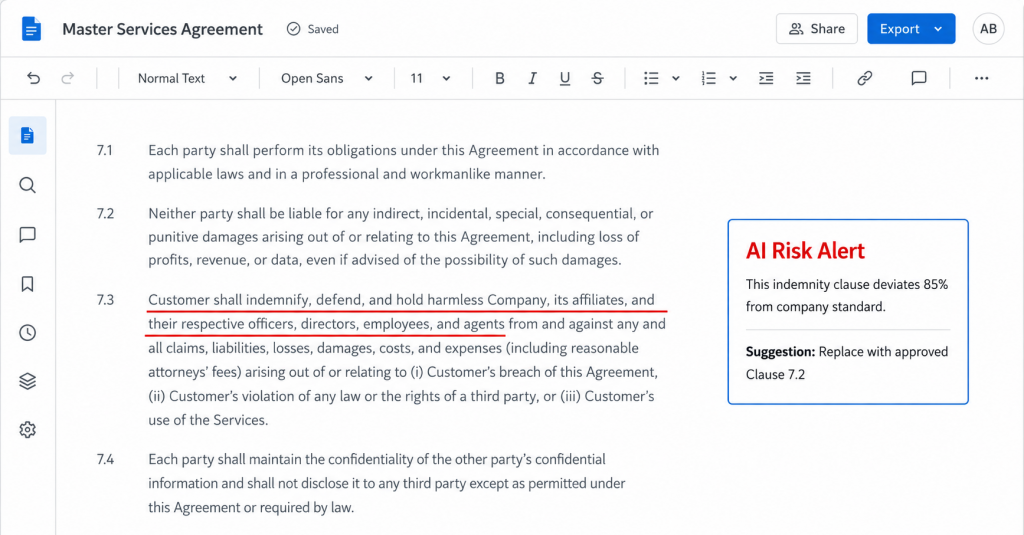
This capability is especially critical in regulated industries where compliance with standards like 21 CFR Part 11 is non-negotiable. In pharmaceutical and medical device companies, a contract that does not meet FDA documentation standards can invalidate an entire transaction. AI risk analysis catches those gaps before execution rather than during an audit.
The foundation for this level of analysis is a platform with verified compliance certifications. SignNow’s SOC 2 Type II certification provides the audited security baseline that enterprise legal teams require before deploying AI tools that process contract data. For teams in regulated industries, the HIPAA compliance add-on and 21 CFR Part 11 add-on establish the additional controls needed for sensitive document workflows.
Improvement 5: Unlock value with AI post-signature analytics
After a document is signed, most organizations file it in a folder and forget about it until a renewal deadline passes or a dispute arises. AI post-signature analytics changes that by treating every signed agreement as a structured data source.
According to AIIM (2024), 65% of organizations are actively investing in AI to automate document processing and information extraction. The goal is not just storage — it is turning a static archive of PDFs into a queryable database of obligations, dates, and financial commitments.
What AI extracts from signed agreements:
- Renewal and expiration dates (with automated alerts before they trigger)
- Payment terms and amounts
- Key obligations and deliverables by party
- Governing law and jurisdiction clauses
- Confidentiality and non-compete terms
- Counterparty contact information
SignNow’s built-in [reporting features|site:SignNow.com reporting] give teams visibility into document status, completion rates, and signing timelines. For organizations that need full contract data extraction and structured analytics, the [Advanced Analytics module in airSlate Business Cloud|site:SignNow.com advanced analytics] enables graph and report creation based on any field value, document action, or data point across your entire workspace — the next step beyond status tracking.
Common myths about AI in electronic signatures
Myth 1: AI makes eSignatures less secure because it introduces new attack surfaces.
The opposite is true. AI-driven continuous biometric authentication during the signing process reduces identity spoofing by over 95% compared to static password-based methods (IEEE, 2024). The additional verification layers — liveness detection, behavioral biometrics, ID scanning — make it significantly harder to impersonate a signer, not easier. SignNow encrypts all data at rest with AES-256 encryption and in transit with TLS 1.2/1.3, and holds SOC 2 Type II certification — the same security baseline applies whether AI features are enabled or not.
Myth 2: AI eSignature tools are too complex for non-technical teams.
SignNow holds a G2 ease-of-use score of 9.0 out of 10, based on verified user reviews. Brian Fitzgibbons, COO of Optica Ventures LLC, put it directly: “The interface is simple and easy-to-use for our team; more importantly, it is just as easy for our customers.” AI features like Magic fields (automatic field detection) reduce setup work rather than adding to it — the system does the field placement, not the user.
Myth 3: AI signatures are not legally valid.
An AI-enhanced eSignature is legally binding under the same laws that govern standard electronic signatures. SignNow complies with the US ESIGN Act and UETA, which establishes the legal validity of electronic signatures across all US states. AI adds layers of identity verification and audit evidence that strengthen legal enforceability — a more detailed audit trail and stronger proof of signer identity make the signature harder to challenge in court, not easier.
Myth 4: AI contract analysis requires replacing your existing legal team.
AI pre-signature analysis is a review tool, not a replacement for legal judgment. It surfaces anomalies and flags deviations from standard positions — the legal team still makes decisions. The practical outcome is that lawyers spend less time reading boilerplate and more time on clauses that actually require judgment, which is where their expertise creates value.
Disclaimer: The information contained in this blog post is provided for general informational purposes only and does not constitute formal legal advice.
Embrace the future of smart eSignatures with SignNow
AI electronic signature workflows are no longer a roadmap item — they are the current standard for organizations that manage high volumes of contracts, operate in regulated industries, or need to close deals faster than their competitors. The five improvements covered in this guide — identity verification, pre-signature analysis, intelligent routing, predictive risk detection, and post-signature analytics — each address a real gap in how traditional signing tools have operated.
SignNow provides the secure, compliant, and automation-ready foundation that makes each of these improvements possible: SOC 2 Type II certification on every plan, [advanced authentication|site:SignNow.com advanced recipient authentication] on Enterprise, a court-admissible audit trail across all plans, and access to the full airSlate Business Cloud for teams that need contract management and analytics beyond the signing event. Customers report an average 700% ROI within the first year and time savings of up to 6 hours per employee per week.
Explore how SignNow’s advanced features can prepare your business for the next wave of workflow automation by starting a free trial.
Glossary
- AI Contract Automation: The use of artificial intelligence to automate tasks in the contract lifecycle — including drafting, reviewing, routing, executing, and extracting data from agreements — without requiring manual intervention at each stage.
- AI Electronic Signature: An electronic signature process enhanced by artificial intelligence to provide capabilities beyond basic signing, including advanced identity verification, pre-signature risk analysis, intelligent workflow routing, and post-signature data extraction.
- Biometric Verification: An authentication method that uses unique biological traits — such as facial geometry, fingerprints, or voice patterns — or behavioral patterns such as typing cadence and mouse movement to verify a user’s identity during a signing session.
- Generative AI: A category of artificial intelligence that creates new content — text, summaries, suggested clauses, or risk assessments — based on patterns learned from large datasets. In contract workflows, generative AI drafts agreements, summarizes lengthy documents, and flags language that deviates from standard positions.
- Intelligent Document Processing (IDP): Technology that combines AI, machine learning, and optical character recognition to capture, classify, and extract structured data from documents in any format — turning unstructured contract text into searchable, actionable records.
FAQ
1. Is an AI signature legally valid?
Yes. As long as the platform complies with laws like the US ESIGN Act and UETA, the signature is legally binding regardless of whether AI features are enabled. AI enhances legal validity by creating more detailed audit trails and stronger identity verification evidence — both of which make the signature more defensible if challenged. SignNow complies with ESIGN and UETA on all paid plans.
2. How does AI verify a person’s identity during signing?
AI uses multiple simultaneous methods. First, it analyzes a government-issued ID (passport or driver’s license) to confirm authenticity. Second, it performs facial recognition with liveness detection — asking the signer to perform a small movement to prove they are present in real time, not using a photograph. Third, it monitors behavioral biometrics such as typing speed, mouse movement patterns, and touch pressure throughout the session to build a continuous confidence score. Any anomaly can trigger a block or escalation.
3. What is the difference between a standard eSignature and an AI-powered one?
A standard eSignature securely captures a signer’s intent and creates a timestamped record. An AI-powered eSignature adds intelligence at every stage: advanced identity verification before signing begins, automated risk analysis during the pre-signature review phase, dynamic document routing based on content, and structured data extraction after signing. The signature event itself is the same — what changes is everything surrounding it.
4. Which SignNow plan gives access to AI-ready features?
The Enterprise plan ($30/user/month, billed annually) unlocks advanced signer authentication, conditional fields, formula fields, and signer attachments — the features most directly relevant to AI-enhanced workflows. Full API access, SSO, and compliance add-ons (HIPAA, 21 CFR Part 11) require the Site License plan.
Sources
- AI in Document Workflows Report — AIIM, 2025
- AI in Legal Departments: Contract Review Time and Cost Reduction — Deloitte, 2024
- Generative AI in Contract Drafting and Negotiation — Gartner, 2025
- AI-Enabled Contract Lifecycle Management Adoption — Gartner, 2024
- AI Smart Field Recognition and Document Processing — IDC, 2024Open
- Contract Life Cycle Management Reviews and Ratings — Gartner
- AI Document Processing and Information Extraction Investment — AIIM, 2024
- eIDAS Regulation — European Commission
- Before you begin: What to look for in an AI-ready eSignature platform
- Improvement 1: Fortify security with AI-powered identity verification
- Improvement 2: Accelerate deals with AI pre-signature contract analysis
- Improvement 3: Create smarter AI eSignature workflows with intelligent automation
- Improvement 4: Mitigate risk with AI predictive contract analysis
- Improvement 5: Unlock value with AI post-signature analytics
- Common myths about AI in electronic signatures
- Embrace the future of smart eSignatures with SignNow
- Sources