
Anyone who has ever looked for a job may roll their eyes at one part of the process – writing a cover letter. It may be treated as a tedious task, with job hunters just summarizing their resumes and failing to catch the attention of hiring managers. The best cover letter examples are short and tailored to one specific job. They open with a concrete result. They connect your skills to the employer’s needs in about one page. That still matters to the people reading them. In a Resume Genius survey of hiring managers, 83% always or frequently read cover letters. This guide collects cover letter samples for common situations. It adds a free cover letter template and a repeatable writing process. It also shows how to sign your letter and save it as a PDF.
TL;DR
- Most hiring managers still read cover letters, and many read them before the resume.
- The first paragraph carries the most weight, so lead with your strongest, job-specific result.
- Keep your letter to one page and roughly 400 words.
- Pick the example that matches your situation: standard, short, student, career change, data-driven, or creative.
- AI can help you draft and proofread, but the final letter must sound like you.
- Send a signed PDF unless the employer asks for another format.
Do hiring managers still read cover letters in 2026?
Yes, most hiring managers read cover letters and use them in interview decisions. The clearest data comes from Resume Genius, which surveyed 625 US hiring managers. The survey ran in 2022 and 2023, so treat the figures as directional.
Here is what that survey found:
- 83% of hiring managers always or frequently read cover letters.
- 45% read the cover letter before the resume.
- 94% say cover letters influence who gets an interview.
- 49% say a strong letter can earn an interview for an otherwise weak candidate.
Why it matters: A resume lists what you did. A cover letter explains why it fits this role. That context is hard to show anywhere else in a job application.
Employers also look for specific qualities. The NACE Job Outlook 2025 survey found nearly 90% of employers seek problem-solving evidence. Nearly 80% look for teamwork. At least 70% look for written communication. Your cover letter is a direct writing sample. It proves the written communication skill before anyone calls you.
Anatomy of a strong cover letter
A strong cover letter has six parts: header, salutation, opening, body, closing, and sign-off. Each part has one job. Keep the whole letter to one page.
| Part | What to include | Typical length |
| Header | Your name, phone, email, city, LinkedIn or portfolio link, date, employer details | 4 to 8 short lines |
| Salutation | The hiring manager’s name, or “Dear Hiring Manager” | 1 line |
| Opening paragraph | The position, where you found it, and your strongest relevant result | 2 to 3 sentences |
| Body paragraphs | Two or three examples that match the job’s key requirements | 2 paragraphs |
| Closing paragraph | Interest in the role, availability to discuss it, thanks | 2 to 3 sentences |
| Sign-off | “Sincerely” or “Best regards,” your signature, and typed name | 2 to 3 lines |
MIT’s career advising office recommends one page and a 10 to 12 point font. It also suggests adding any job reference number so HR can track your application. Resume Genius data shows readers prefer about 400 words on average.
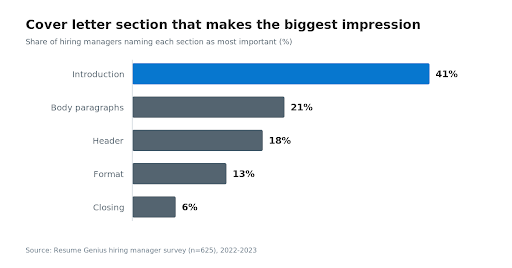
The opening deserves the most effort. In the same survey, 41% of hiring managers named the introduction as most important.
Best cover letter examples by situation
The best example is the one that matches your situation and the role. Each sample below is a starting point. Replace every detail with your own background, numbers, and company research. Names and figures in the samples are placeholders.
Standard professional cover letter example
Use this format for most corporate roles and mid-career moves. It keeps a formal tone and lets the results do the work.
Dear Ms. Patel,
I am applying for the Project Manager position posted on your careers website. At Northline Logistics, I led 14 cross-team projects in two years. Every project shipped on schedule, and two came in under budget.
Your posting mentions vendor coordination across three regions. I currently manage 22 vendors in the US and Canada. Last year I cut onboarding time for new vendors from six weeks to three.
I also bring a habit of clear reporting. My weekly status format is now the standard for my department.
I would welcome the chance to discuss how I can support your Q3 expansion. Thank you for your time.
Sincerely,
Jordan Lee
Why it works: The first paragraph names the role and a measurable result. The body mirrors one requirement from the posting. The close is short and specific.
Short cover letter example
A short cover letter fits quick online applications, referrals, and email submissions. Aim for 150 words or fewer.
Dear Hiring Manager,
I am excited to apply for the Sales Associate role at Brightway Outdoor. In my retail job, I hit my target in 10 of 12 months. I also train new team members on product knowledge.
I hike most weekends and know your gear well. I would enjoy helping customers choose the right equipment.
Thank you for considering my application. I look forward to hearing from you.
Best regards,
Sam Rivera
Why it works: It answers three questions fast: which job, what proof, and why this company. Nothing repeats the resume.
Entry-level and student cover letter example
Students and recent graduates should lead with coursework, campus roles, internships, or projects. Transferable skills count as real experience.
Dear Mr. Okafor,
I am a senior at Lakeview University studying communications. I am applying for your Marketing Coordinator role. I run social media for our campus career center. I grew its Instagram audience by 60% in one year.
I planned and ran four student events with 200 or more attendees each. That work taught me to manage deadlines, budgets, and vendors.
Your team’s recent nonprofit campaign stood out to me. I would bring the same focus on community stories.
Thank you for your consideration. I would welcome a conversation about the role.
Sincerely,
Priya Nair
Why it works: It treats campus work as professional work. It also shows research on the organization in one sentence.
Career change cover letter example
A career change letter explains the move and connects past skills to the new field. Address the change directly in the first paragraph.
Dear Hiring Team,
After eight years as a high school math teacher, I am moving into data analysis. I recently completed a professional data analytics certificate. I am applying for your Junior Data Analyst position.
Teaching required me to analyze student results every week. I built spreadsheets that tracked 150 students across four classes. I used that data to adjust lessons and raised pass rates by 18%.
I also explain numbers to non-technical audiences every day. Your posting lists stakeholder reporting as a core duty.
I would value the chance to discuss how my background fits your team. Thank you for your time.
Sincerely,
Alex Morgan
Why it works: The reader knows the story in the first two sentences. Each body example maps a teaching task to an analyst task.
Data-driven cover letter example
A data-driven letter suits sales, marketing, finance, and operations roles. Use two or three numbers you can explain in an interview.
Dear Ms. Chen,
I am applying for the Digital Marketing Manager role at Fernhill. In my current role, I increased qualified leads by 47% in 12 months. I also cut cost per lead by 22%.
I achieved this by rebuilding our email nurture program and testing landing pages weekly. I report results to our CMO every month.
Your job post emphasizes paid search growth. I manage a $40,000 monthly ad budget across Google and LinkedIn.
I would welcome the chance to discuss your 2026 growth goals. Thank you for considering my application.
Best regards,
Chris Walker
Why it works: Every number connects to a requirement in the posting. The letter shows the method behind each result.
Creative cover letter example
Creative letters fit design, media, and brand roles. Keep the standard parts, and let the opening show your voice.
Dear Mr. Alvarez,
Last spring, a bakery asked for a logo that would “taste like cinnamon.” Six sketches later, its online orders doubled. I am applying for the Junior Brand Designer role at Studio North.
I have designed identities for 12 small businesses. My portfolio link is in the header above.
Your recent rebrand for a local library caught my eye. I would love to bring that same warmth to your clients.
Thank you for your time. I hope to talk soon.
Sincerely,
Taylor Kim
Why it works: The story hook earns attention. The letter still names the role, offers proof, and closes professionally.
Referral cover letter example
A referral letter works when someone inside the organization recommended you. Name your contact in the first sentence, since that line earns attention.
Dear Ms. Brooks,
Daniel Ortiz on your engineering team suggested I apply for the QA Analyst role. Daniel and I worked together at Corbel Software for three years.
In that time, I built a test suite that cut release bugs by 35%. I also wrote the onboarding guide our new testers still use.
Daniel mentioned your team is moving to weekly releases. I have supported that exact shift before.
Thank you for your time. I look forward to speaking with you.
Sincerely,
Morgan Hale
Why it works: The referral appears first, before any claim. The body then proves the recommendation with results.
Which cover letter example fits your situation
Use this table to choose your starting point.
| Your situation | Best example to start from | Lead with |
| Mid-career, same field | Standard professional | Your strongest measurable result |
| Quick or email application | Short | Role, one proof point, company fit |
| Student or recent graduate | Entry-level and student | Campus roles, projects, internships |
| Changing industries | Career change | The reason for the move and transferable skills |
| Sales, marketing, finance | Data-driven | Two or three explainable numbers |
| Design, media, brand | Creative | A short story that shows your work |
| Referred by an employee | Referral | Your contact’s name and how you know them |
Free cover letter template you can copy
This cover letter template follows the structure hiring managers expect. Copy it into your editor and replace each bracket.
[Your name]
[Phone] | [Email] | [City, State] | [LinkedIn or portfolio URL]
[Date]
[Hiring manager’s name]
[Title]
[Company name]
Dear [Mr./Ms./Mx. Last name or Hiring Manager],
I am applying for the [position] role at [company]. [One sentence with your strongest result related to the job.]
[Body paragraph 1: Match one key requirement with a specific example and number.]
[Body paragraph 2: Show what you know about the company and why you want in.]
I would welcome the chance to discuss [goal from the posting] with you. Thank you for your time and consideration.
Sincerely,
[Signature]
[Typed name]
Save your finished letter as a Word document converted to PDF. That keeps the layout intact on any device.
How to write a cover letter step by step
Writing a cover letter takes about seven steps, from research to final proofreading. Follow them for every job you apply to.
- Read the job posting twice. Highlight the three requirements that appear most often. Note key words the employer uses for skills and tools.
- Research the company. Check its website, recent news, and LinkedIn page. Find one project, value, or goal you can mention.
- Find the hiring manager’s name. Look on LinkedIn or the team page. If you can’t find it, use “Dear Hiring Manager.”
- Draft the first paragraph last. Write the body first, then pick your strongest result for the opening.
- Match each body paragraph to a requirement. Use one example and one number per paragraph.
- Close with a clear next step. Say you’d like to discuss the role, and thank the reader.
- Proofread out loud. Check names, dates, and the company name. Then export the letter as a PDF.
Why it matters: Tailoring is visible to readers. In a 2023 Resume Genius survey, 72% of hiring managers called customization important.
A tailored letter does not mean writing from zero each time. Keep a master letter with your best stories. Then swap in the details for each specific job.
Using AI to write your cover letter
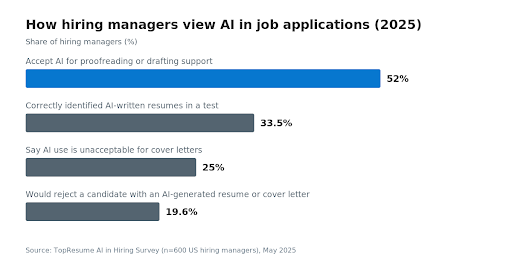
AI tools are acceptable for drafting support and proofreading. A fully AI-written letter carries risk. The TopResume AI in Hiring Survey asked 600 US hiring managers in May 2025. 19.6% said they would reject a candidate with an AI-generated resume or cover letter. Also, 25% said AI use is unacceptable for cover letters.
Most were more flexible. 52% called AI acceptable for proofreading or drafting support. Respondents also expect the final product to sound human. In a short test, 33.5% correctly identified AI-written resumes.
Accuracy matters as much as tone. Curtis Britt of Korn Ferry spoke to IEEE-USA InSight about dishonest applications. He said the interview process “is set up to specifically root out those missed truths.”
Use AI with these limits:
- Ask it to tighten your own draft, not to invent achievements.
- Replace generic phrases with your real projects and numbers.
- Check every fact, date, and company detail yourself.
- Read the final version aloud to confirm it sounds like you.
Cover letter checklist before you send
Run this check on every letter before you submit it. It takes about two minutes.
| Check | What to confirm |
| Company and role | The company name and job title match the posting exactly |
| Hiring manager | The name is spelled correctly, or you used “Dear Hiring Manager” |
| First paragraph | It names the position and one specific result |
| Key words | Two or three skills from the posting appear naturally |
| Length | One page, about 250 to 400 words |
| Proof | Each claim has an example or number you can discuss in an interview |
| Contact details | Phone, email, and portfolio link work |
| File | Signed PDF with a clear file name |
An employer may screen letters with an applicant tracking system. Using the posting’s own key words helps your letter match. Avoid stuffing them in, since a person still reads the final shortlist. Some employers also use an online job application form. Keep its details consistent with your letter.
Common cover letter mistakes to avoid
Most weak cover letters fail for the same few reasons. Avoid these mistakes before you send.
- Repeating the resume. Add context and stories instead of listing the same jobs.
- Using one letter for every application. Generic letters ignore the specific job and company.
- Opening with “My name is.” The header already shows your name. Start with the role and a result.
- Focusing on what you want. Explain what you can do for the employer instead.
- Mentioning salary unprompted. Leave pay discussions for the interview unless the posting asks.
- Going past one page. Long letters bury your best example.
- Typos in the company or manager’s name. These errors suggest the letter was mass-produced.
- Leaving the letter unsigned. A signature adds a finished, professional touch. You can sign a PDF online in under a minute.
How to format, sign, and send your cover letter as a PDF
Send your cover letter as a signed PDF unless the employer requests a different format. Resume Genius survey results show PDF is the format hiring managers prefer. It keeps fonts, spacing, and your signature in place.
Signing is a recommended practice. The ABA’s Student Lawyer guidance advises signing emailed letters. It warns that an unsigned letter or a typed “/s/” can look impersonal. A clean electronic signature solves that without printing and scanning.
Sign your cover letter in SignNow
SignNow’s Fill Out Now fields let you sign your own letter in a few clicks. Upload your letter as a PDF or Word file first. SignNow supports files up to 50 MB.
- Open your uploaded cover letter in the SignNow editor.
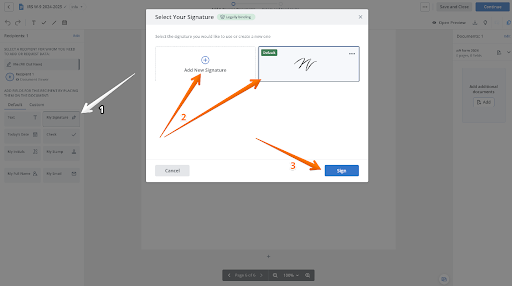
- Click Me (Fill Out Now) in the left-side panel.
- Select the My Signature field and click where your signature belongs.
- In the Select Your Signature window, choose a saved signature or click Add New Signature.
- Click Sign, then add Today’s date or your Full name if needed.
- Download the signed PDF and attach it to your job application.
Your My Full Name and My Email fields prefill from your account details. Fill Out Now fields work only before a document reaches Signed status. You can also create a handwritten signature online and reuse it across documents.
Combine your cover letter and resume into one PDF
Some application portals accept only one file. In that case, merge your cover letter and resume into a single PDF. Put the cover letter first, then the resume.
SignNow can merge documents into one PDF before you download. The Fill Out Now Text field lets you add text to a PDF. Name the file clearly, for example “Jordan-Lee-Cover-Letter-Resume.pdf.” A clear name is easy to find among many downloads.
Completed documents can be downloaded, emailed, or exported to cloud storage like Google Drive. That keeps every version of your own cover letter in one place.
Save your cover letter as a reusable template
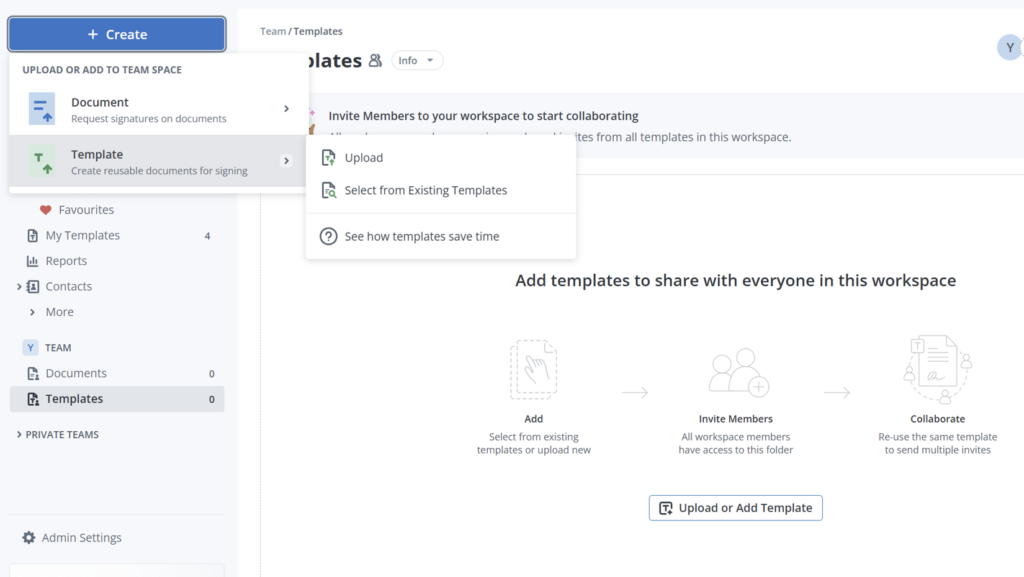
A template lets you reuse your header, layout, and signature field for each new application. In SignNow, open the letter and click Make Template. The template then appears in the Templates folder.
To start a fresh template instead, follow these steps:
- Go to the Templates folder.
- Click +Create in the top-left corner.
- Select Templates.
- Click Upload, or choose Select from Existing Templates.
The same workflow helps hiring teams on the other side of the desk. HR coordinators often send offer letter templates and HR onboarding documents for signature. Applicants notice the difference too.
Final thoughts
A strong cover letter connects your experience to the employer’s needs. Use these examples as a starting point, add real achievements, and tailor every letter to the role. Before submitting, proofread carefully and follow the employer’s formatting instructions.
Ready to add the finishing touch? Try SignNow to electronically sign your cover letter and download a signed PDF for your next application.
Glossary
- Applicant tracking system (ATS): Software employers use to collect, sort, and filter job applications.
- Cover letter: A one-page letter that explains your fit for a specific job.
- Cover letter template: A pre-formatted layout with placeholders you replace for each application.
- Electronic signature: A digital mark of intent to sign, typed, drawn, or uploaded.
- Hiring manager: The person who leads the team and often picks who gets interviewed.
- Salutation: The greeting line of a letter, such as “Dear Ms. Patel.”
- Transferable skills: Abilities from one role or field that apply to a different job.
Frequently asked questions
What is the best cover letter example to use?
The best example is the one closest to your situation. Use a standard letter for most roles and a short letter for quick applications. Students should use an entry-level example. Career changers should use a career change example.
What are the 3 parts of a cover letter?
The three core parts are the opening, the body, and the closing. The opening names the job and your strongest result. The body proves your fit with examples. The closing restates interest and thanks the reader.
How long should a cover letter be in 2026?
Keep it to one page. Resume Genius found hiring managers prefer about 400 words on average. Short letters of 150 words work for quick or email applications.
Can I use AI to write my cover letter?
Yes, for drafting help and proofreading. TopResume’s 2025 survey found 52% of hiring managers accept it. Respondents also expect the final letter to sound human. Even so, 19.6% would reject an AI-generated letter. Always edit the draft with your own facts.
Do I need to sign a cover letter?
Signing is a recommended practice, especially for emailed letters. For emailed letters, insert a signature image or electronic signature, then save as PDF. A signature makes the letter look complete.
Should I send my cover letter as a PDF?
Yes, unless the employer asks for Word or plain text. PDF keeps your formatting the same on every device. Some application portals ask you to paste text, so keep a plain version too.
How do I start a cover letter without a name?
Use “Dear Hiring Manager” or “Dear [Team name] Team.” Avoid “To whom it may concern,” which sounds dated. First, try LinkedIn or the company website to find a name.
Sources
- Cover letter statistics: hiring manager survey, Resume Genius
- AI in Hiring Survey, TopResume, 2025
- What Tech Hiring Managers Really Think of AI-Created Resumes, IEEE-USA InSight, 2025
- What employers seek on a resume, NACE Job Outlook 2025
- How to write an effective cover letter, MIT CAPD, 2026
- Signing electronic cover letters, ABA Student Lawyer
- TL;DR
- Do hiring managers still read cover letters in 2026?
- Anatomy of a strong cover letter
- Best cover letter examples by situation
- Free cover letter template you can copy
- How to write a cover letter step by step
- Using AI to write your cover letter
- Cover letter checklist before you send
- Common cover letter mistakes to avoid
- How to format, sign, and send your cover letter as a PDF
- Final thoughts
- Glossary
- Frequently asked questions
- Sources