Digital signature vs. electronic signature: Differences, security, and legal use in 2026

Quick answer: Digital signatures and electronic signatures can both be used to sign documents electronically, but they provide different types of evidence. An electronic signature primarily records a person’s intent to sign. A digital signature uses cryptographic keys and a digital certificate to provide additional evidence about the signer’s identity and whether the document has changed after signing.
The distinction matters most when deciding how much assurance a transaction requires. A routine business agreement may only need an eSignature backed by authentication and an audit trail. A regulated, government, or cross-border transaction may call for certificate-based signing or a particular electronic signature level under applicable law.
TL;DR
- An electronic signature (eSignature) is a broad legal concept covering electronic sounds, symbols, or processes a person adopts with the intent to sign.
- A digital signature is a cryptographic signing method that uses public key infrastructure (PKI) to authenticate signed data and reveal subsequent changes.
- The practical difference is evidence: eSignature platforms can establish intent and document activity through authentication and audit records, while digital signatures add certificate-based cryptographic verification.
- In the US, the ESIGN Act and UETA generally do not require one specific signing technology for ordinary electronic transactions.
- In the EU, eIDAS recognizes simple, advanced, and qualified electronic signatures, with different requirements and levels of assurance.
- The right choice depends on the document, jurisdiction, identity requirements, and whether independent cryptographic verification is necessary.
Digital signature vs. electronic signature: What does each one prove?
The most useful way to understand digital signature vs. electronic signature is to ask what evidence each method is designed to provide.
An electronic signature focuses on the act of signing. It records an electronic action that demonstrates the signer’s intent to approve or accept a record. Depending on the platform and workflow, supporting evidence can include authentication data, timestamps, email addresses, IP addresses, and an audit trail.
A digital signature adds another layer: cryptographic verification. It uses a private key to sign data and a corresponding public key to verify it. A digital certificate can also connect that key to an identified signer.
This creates four useful points of comparison:
- Intent: Did the person intend to sign the document?
- Identity: What evidence connects the signing action to that person?
- Integrity: Can you determine whether the document changed after it was signed?
- Verification: Can the signature and signed data be independently checked using cryptographic information?
Both approaches can provide reliable evidence. The difference is how that evidence is created, stored, and verified.
What counts as an electronic signature?
An electronic signature is any electronic sound, symbol, or process that a person attaches to or logically associates with a record with the intent to sign it. The definition focuses on the signer’s action and intent rather than requiring one particular technology.
US federal law defines an electronic signature in the ESIGN Act definitions as an electronic sound, symbol, or process associated with a contract or other record and adopted by a person with the intent to sign. The EU’s eIDAS framework likewise defines electronic signatures broadly as electronic data attached to or logically associated with other electronic data and used by the signatory to sign.
In practice, an eSignature can include:
- Typing your name into a signature field
- Drawing a signature with a mouse, finger, or stylus
- Clicking an “I agree” button in an electronic workflow
The visible signature itself is only part of the evidence. Intent, consent, authentication, and the record of what happened during the signing process can also matter.
That is why SignNow pairs legally-binding eSignatures with a timestamped audit trail rather than relying on the appearance of a signature alone.
What makes a digital signature different?
A digital signature is based on cryptography. Instead of simply recording a signing action, it mathematically links signed data to a cryptographic key so that the recipient can verify the signature and detect changes to the signed content.
NIST’s Digital Signature Standard (FIPS 186-5) describes digital signatures as a way to detect unauthorized modifications to data and authenticate the identity associated with a signature. The FDA also defines a digital signature in 21 CFR 11.3 as an electronic signature based on cryptographic methods of originator authentication.
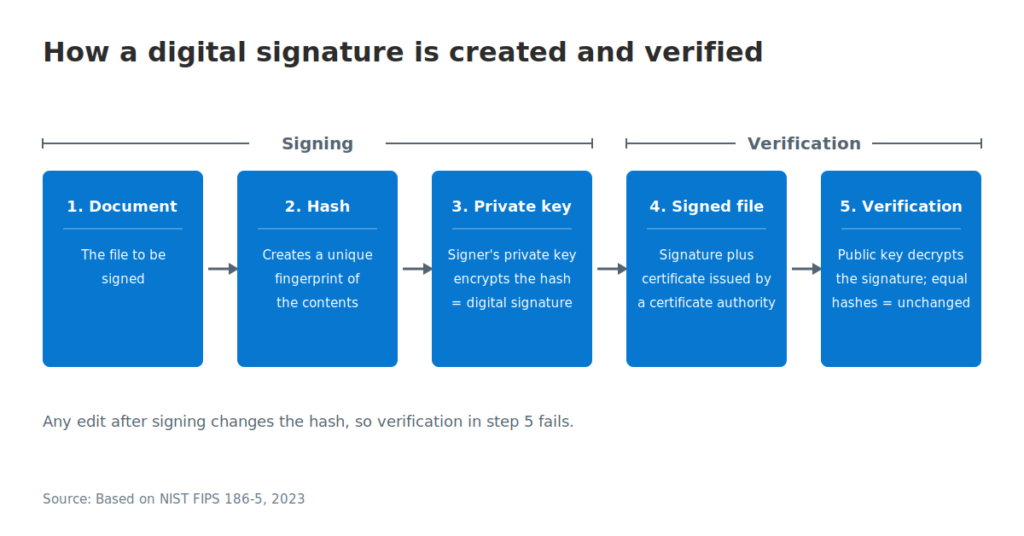
A typical digital-signature process works like this:
- The signing software applies a hash function to the document, creating a compact fingerprint of its contents.
- The signer’s private key is used to create a digital signature from that data.
- A digital certificate can associate the corresponding public key with the signer’s verified identity.
- Verification software uses the public key and the signed data to determine whether the signature is valid and whether the document has changed.
If the signed content is modified after signing, cryptographic verification should no longer produce the expected result.
For a deeper walkthrough of certificates, CAs, and signature tiers, SignNow’s digital signature guide covers the mechanics in detail.
How electronic and digital signatures differ in practice
The difference between digital and electronic signatures is not simply that one is “secure” and the other is not. They use different mechanisms for establishing and preserving evidence.
Question | Electronic signature | Digital signature |
What does it primarily establish? | Intent to sign and evidence of the signing process | Cryptographic authenticity and integrity of signed data |
How can a person sign? | Type, draw, upload, click, or use another electronic process | Use a cryptographic private key |
Where does identity evidence come from? | Authentication methods and workflow records | Digital certificate, plus the surrounding signing process |
How is document integrity demonstrated? | Platform controls, document locking, and audit evidence | Cryptographic verification detects changes to signed data |
What evidence accompanies signing? | Names, emails, timestamps, IP addresses, and other audit data | Cryptographic signature and certificate information |
Does the signer need certificate infrastructure? | Not necessarily | Typically yes |
US legal framework | ESIGN Act and UETA | ESIGN Act and UETA also apply when used as an electronic signature |
EU framework | May qualify as SES, AES, or QES depending on implementation | Cryptographic technology can support higher-assurance implementations such as AES or QES |
Typical use | Everyday contracts, HR documents, NDAs, approvals | High-assurance, regulated, government, or certificate-based workflows |
The practical distinction is therefore where the proof comes from.
With a standard eSignature workflow, much of the evidence is recorded by the signing platform. SignNow’s audit trail, for example, records activity associated with the document.
With a digital signature, cryptographic verification is associated with the signed data itself. Compatible software can use the signature and certificate information to check whether the signed content remains intact.
Which provides stronger security?
Digital signatures provide strong built-in integrity verification, but comparing security requires looking beyond the signature technology alone.
A certificate does not automatically make an entire signing workflow secure. Account security, authentication, access controls, certificate protection, encryption, device security, and document handling all affect the final risk.
For standard eSignature workflows, organizations can strengthen evidence by combining several controls, such as:
- signer authentication;
- two-factor authentication;
- encrypted transmission and storage;
- access restrictions;
- timestamps;
- audit trails; and
- locked completed documents.
Digital signatures add cryptographic verification of signed data and can provide certificate-based identity evidence. This becomes particularly valuable when a recipient needs to verify the signed file independently or when a workflow specifically requires certificate-based signing.
SignNow, for example, encrypts documents with TLS 1.2/1.3 in transit and AES-256 at rest and supports two-factor signer authentication by password, text message, or phone call.
The security question is therefore not simply “Is a digital signature safer than an electronic signature?” A better question is “What evidence and assurance does this transaction require?”
Digital signature vs. electronic signature under US law
In the United States, the central legal question generally is not whether a signature uses PKI. Federal and state electronic-signature laws are designed to recognize electronic transactions without mandating one specific signing technology for every use case.
ESIGN Act and UETA
The ESIGN Act establishes that a signature or contract cannot be denied legal effect solely because it is in electronic form.
The Uniform Electronic Transactions Act performs a similar role at the state level and has been adopted by 49 states, the District of Columbia, and the U.S. Virgin Islands.
As a result, a typed electronic signature and a certificate-based digital signature can both be legally effective when the applicable requirements are satisfied.
That does not mean every document can always be signed electronically.
The federal ESIGN Act exclusions cover categories including wills, codicils, and testamentary trusts, certain family-law matters, official court documents, and specified notices involving areas such as utility services, foreclosure or eviction, and health or life insurance.
Organizations should therefore determine both:
- Whether electronic signing is permitted for the transaction; and
- What level of authentication, integrity, and evidence the transaction requires.
Digital signature vs. electronic signature under eIDAS
The EU takes a more explicitly tiered approach through eIDAS.
eIDAS Article 25 establishes that an electronic signature cannot be denied legal effect or admissibility as evidence solely because it is electronic or because it does not meet the requirements for a qualified electronic signature. It also gives a qualified electronic signature the equivalent legal effect of a handwritten signature.
The framework distinguishes three levels:
- Simple electronic signature (SES): the broadest category of electronic signature.
- Advanced electronic signature (AES): must meet the requirements in Article 26, including being uniquely linked to the signatory, capable of identifying them, created using signature-creation data under their control, and linked to signed data so subsequent changes are detectable.
- Qualified electronic signature (QES): an advanced electronic signature created using a qualified signature creation device and based on a qualified certificate issued under the eIDAS framework.
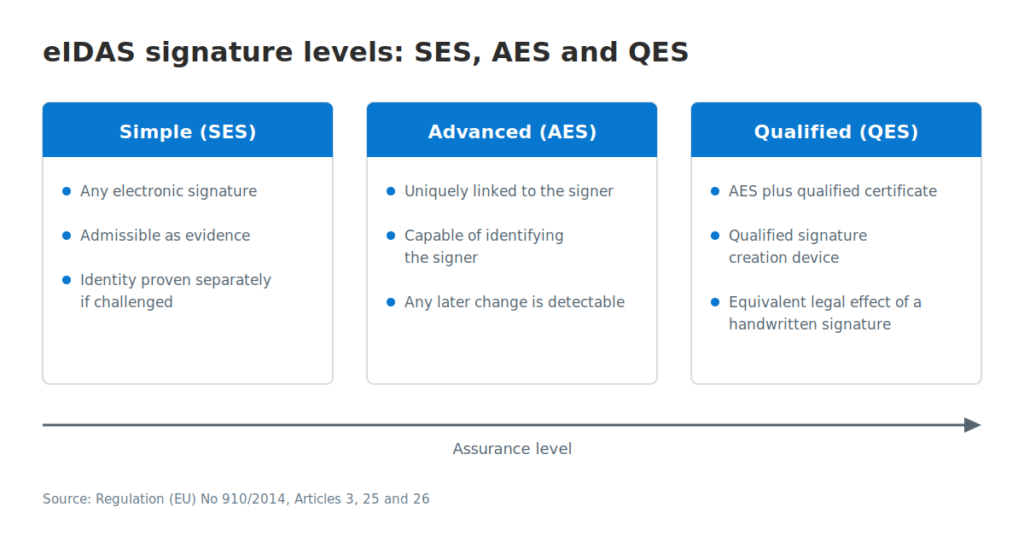
The key point is that digital signature technology and eIDAS signature levels are related but not interchangeable concepts. “Digital signature” describes a cryptographic mechanism. SES, AES, and QES describe legal categories with specific requirements.
The framework is also evolving. eIDAS 2.0 (Regulation 2024/1183) entered into force on May 20, 2024, and introduced the framework for EU Digital Identity Wallets.
SignNow maintains country-specific eSignature legality guides for teams signing across borders.
How to choose between an electronic signature and a digital signature
For most organizations, the choice should start with the requirements of the transaction rather than the technology.
Ask these questions before choosing a signing method:
- Does a law or regulation specify a signature type?
Check whether the document is eligible for electronic signing and whether a particular assurance level is required. - Does the recipient require certificate-based verification?
Government bodies, regulated organizations, or counterparties may impose their own technical requirements. - How strongly must the signer’s identity be verified?
Email authentication may be appropriate for one workflow, while another may require stronger identity verification. - How must document integrity be demonstrated?
An audit trail may provide sufficient evidence for many business agreements. Other transactions may call for cryptographic verification embedded in or associated with the signed file. - Will the document cross jurisdictions?
Cross-border transactions can involve different legal standards and assurance requirements. - Does the transaction require an eIDAS AES or QES?
For EU workflows, determine the required electronic-signature level before selecting the technology.
When a standard eSignature is usually appropriate
A standard eSignature backed by suitable authentication and audit evidence can fit many routine business workflows, including:
- Sales contracts, order forms, and renewals
- NDAs and vendor agreements
- Offer letters and employee onboarding forms
- Internal approvals
- Policy acknowledgments
- Routine consent forms
Consider an HR coordinator sending offer letters to candidates in the US. Requiring every candidate to obtain a digital certificate could add unnecessary friction if the applicable workflow does not require it. An eSignature process with appropriate authentication and a detailed audit trail may provide the evidence the organization needs.
The goal is not to use the most technically complex signature available. It is to use an electronic-signature process appropriate for the transaction’s legal, identity, security, and evidentiary requirements.
When a digital or higher-assurance signature may be appropriate
Certificate-based digital signatures become more relevant when a transaction requires independently verifiable cryptographic evidence, stronger identity assurance, or a particular regulatory or contractual standard.
Examples may include:
- Government tenders or filings that specify certificate-based signing
- Cross-border transactions where a particular eIDAS assurance level is required
- High-value agreements where the parties agree to stronger identity verification
- Regulated electronic records subject to additional signature controls
- Workflows in which recipients need to verify document integrity outside the original signing platform
For example, a legal team completing a cross-border agreement with a German counterparty might be asked to use a QES. In that case, a routine click-to-sign workflow would not satisfy a requirement specifically calling for a qualified electronic signature.
A quality manager handling electronic records that fall within FDA requirements may likewise need controls designed for the applicable regulatory environment rather than simply choosing a signature based on convenience.
SignNow supports workflows configured for 21 CFR Part 11 compliance, including controls such as two-factor authentication and locked signature timestamps.
How SignNow supports different signing requirements
SignNow provides legally-binding eSignatures across its plans and offers additional authentication and signature-assurance options for organizations with more demanding workflows.
It is important to distinguish SignNow’s role from that of a certificate authority. SignNow is not itself a certificate authority. Qualified certificates and associated identity checks for QES are provided through its integration with eID Easy.
According to SignNow pricing plans with annual billing:
- Business: 8/user/month when billed annually (20/user/month when billed monthly). Includes core eSignature capabilities such as sending documents for signature, fillable forms, reusable templates, audit trails, and mobile apps.
- Business Premium: 15/user/month when billed annually (30/user/month when billed monthly). Adds features such as bulk sending, signing/invite links, payment requests, and Kiosk Mode.
- Enterprise: 30/user/month when billed annually (50/user/month when billed monthly). Adds advanced capabilities such as advanced signer authentication, formula and conditional fields, and advanced integrations.
- Site License: $1.50 per signature invite. Designed for higher-volume organizations and includes capabilities such as SSO, full API access, phone support, and dedicated customer success management. QES, HIPAA via BAA, and 21 CFR Part 11 support are available as add-ons.
Every completed document also receives supporting evidence, including a certificate of completion, a unique document ID, and a detailed history containing information such as names, email addresses, IP addresses, and timestamps associated with document activity.
SignNow also supports XML digital signatures, giving organizations a way to use PKI-based signing alongside standard electronic signatures within the platform. For completed signing workflows, SignNow provides a certificate of completion and a detailed audit trail that records key document events and signer information. Together, these capabilities help illustrate the practical difference between an everyday eSignature workflow and a digital-signature workflow that relies on cryptographic mechanisms for additional authentication and integrity assurance. For organizations that need different levels of signing evidence, this means SignNow can support both standard eSignature processes and more technically demanding digital-signature use cases without treating the two concepts as interchangeable.

For organizations evaluating an eSignature platform, these surrounding controls can be as important as the visual signature itself.
Dan Rotelli, CEO of BIS, a legal services provider, put it this way: “We felt most comfortable investing with SignNow given their SOC 2 certification and strict focus on ESIGN and UETA act compliance.”
The full list of certifications, including SOC 2 Type II, GDPR, HIPAA, and CCPA, is available on the SignNow security and compliance page.
What is changing for digital signatures in 2026?
The digital-signature landscape continues to develop in two important areas: digital identity and cryptography.
In Europe, eIDAS 2.0 is expanding the EU digital identity framework through European Digital Identity Wallets. This creates a broader infrastructure for verified digital identity and trust services that organizations operating across EU borders should follow.
At the same time, cryptographic standards are being prepared for future threats from quantum computing.
NIST published FIPS 204 (ML-DSA) on August 13, 2024. ML-DSA is a post-quantum digital-signature standard designed to resist attacks from sufficiently capable quantum computers.
The transition to post-quantum cryptography will take time, but it illustrates an important difference between electronic and digital signatures: digital signatures depend on cryptographic standards that must evolve as computing capabilities and security threats change.
Market demand is also growing. MarketsandMarkets projects the digital signature market will grow from USD 17.68 billion in 2026 to USD 66.26 billion by 2031, representing a compound annual growth rate of 30.2%.
Disclaimer: The information contained in this blog post is provided for general informational purposes only and does not constitute formal legal advice.
Final thoughts
The digital signature vs. electronic signature comparison is ultimately about the kind of evidence a transaction needs.
Electronic signatures provide a flexible way to capture intent and execute everyday agreements electronically. When combined with authentication, audit trails, encryption, and document controls, they can support a wide range of business workflows.
Digital signatures address a different requirement: cryptographic verification. They can provide certificate-based evidence associated with signer identity and make changes to signed data detectable, which can be important for higher-assurance, regulated, government, or cross-border transactions.
Neither option should be chosen simply because it sounds more secure. Start with the applicable law, the document type, the required level of identity assurance, and the evidence a recipient or regulator expects.
SignNow helps businesses apply the appropriate signing workflow, from everyday legally binding eSignatures to stronger authentication and eIDAS signature options. Start using SignNow to create secure electronic-signature workflows and choose the level of assurance that fits your documents.
Glossary
- Advanced electronic signature (AES): an eIDAS electronic-signature level that must be uniquely linked to the signer, capable of identifying them, created using signature-creation data under their control, and linked to the signed data so later changes can be detected.
- Certificate authority (CA): a trusted organization that issues digital certificates used to associate cryptographic keys with identified entities.
- Electronic signature: an electronic sound, symbol, or process adopted by a person with the intent to sign a record.
- Public key infrastructure (PKI): the system of cryptographic keys, digital certificates, policies, and trusted entities used to support secure digital identities and digital signatures.
- Qualified electronic signature (QES): an advanced electronic signature based on a qualified certificate and created using a qualified signature creation device; under eIDAS, it has the equivalent legal effect of a handwritten signature.
FAQ
1. What is the main difference between a digital signature and an electronic signature?
An electronic signature is a broad legal concept for electronically indicating intent to sign. A digital signature is a cryptographic method that uses keys and typically digital certificates to authenticate signed data and detect subsequent changes.
2. Is a digital signature more secure than an electronic signature?
A digital signature provides built-in cryptographic integrity verification, but overall security depends on the complete signing workflow. Authentication, encryption, access controls, certificate protection, audit trails, and device security can all affect how secure a transaction is.
3. Are electronic signatures and digital signatures legally binding in the US?
Both can be legally effective under the ESIGN Act and applicable state electronic-transactions laws. US law generally does not require every electronic transaction to use certificate-based digital-signature technology. Specific documents and regulated workflows may be subject to additional rules.
4. Does a digital signature require a digital certificate?
Certificate-based digital-signature workflows typically use a digital certificate to associate a public key with an identified person or organization. The certificate also allows recipients to evaluate who issued it and whether it remains valid.
5. What is the difference between a digital signature and a QES?
A digital signature describes a cryptographic technology. A qualified electronic signature (QES) is a legal category under eIDAS with specific requirements, including a qualified certificate and a qualified signature creation device. The terms, therefore, should not be used interchangeably.
6. Do I need a digital signature to sign a PDF electronically?
No. Many PDFs can be signed using a standard eSignature without the signer obtaining a digital certificate. A certificate-based method may be needed when a law, regulator, government authority, counterparty, or internal policy specifically requires stronger cryptographic or identity assurance.
Sources
- 15 U.S. Code 7006, Definitions (ESIGN Act), Cornell LII
- 15 U.S. Code 7003, Specific exceptions (ESIGN Act), Cornell LII
- 21 CFR 11.3, Definitions, Cornell LII
- Regulation (EU) No 910/2014 (eIDAS), EUR-Lex
- eIDAS Articles 25 and 26, legislation.gov.uk
- FIPS 186-5, Digital Signature Standard, NIST, 2023
- FIPS 204, ML-DSA, NIST, 2024
- Digital Signature Market, MarketsandMarkets, 2026
- Digital signature vs. electronic signature: What does each one prove?
- What counts as an electronic signature?
- What makes a digital signature different?
- How electronic and digital signatures differ in practice
- Which provides stronger security?
- Digital signature vs. electronic signature under US law
- Digital signature vs. electronic signature under eIDAS
- How to choose between an electronic signature and a digital signature
- When a standard eSignature is usually appropriate
- When a digital or higher-assurance signature may be appropriate
- How SignNow supports different signing requirements
- What is changing for digital signatures in 2026?
- Final thoughts
- Sources