Purchase agreement template: choose the version that fits what you are selling

Buying a house, selling equipment, or transferring business assets? Start with a purchase agreement template that matches the sale, then adapt the purchase price, payment terms, conditions, and closing date to your deal. For buyers, sellers, and professionals preparing the paperwork, the right starting point helps identify what needs to be agreed before signing.
A purchase agreement records the terms of a sale, but the details depend on what changes hands. A real estate purchase agreement needs property details and relevant disclosures; an equipment contract needs an accurate item description and quantity. This guide explains how to choose a version, check the terms, and prepare it for signature in SignNow.
What follows is general information, not legal advice. State law varies, and a lawyer should review any agreement for a significant sale.
TL;DR
- Choose the template by the asset: goods, real estate, a vehicle, or a business.
- Under UCC 2-201, goods priced at $500 or more generally require a signed writing, subject to exceptions and the applicable state enactment.
- Most housing built before 1978 requires federal lead-based paint disclosures before the buyer becomes obligated, subject to exemptions.
- Vehicles from model year 2011 on need an odometer statement on the title until they are 20 years old.
- In qualifying business asset sales, both buyer and seller generally file IRS Form 8594.
- E-SIGN covers these contracts, but deed recording and notarization are separate steps, and SignNow does not notarize documents.
What a purchase agreement does, and what it does not
A purchase agreement sets out what the buyer agrees to buy, what the seller agrees to sell, and the agreed upon terms. Depending on its wording and applicable laws, it can become a legally binding contract before closing. Ownership transfer depends on the asset, contract, and required formalities: real property generally requires a deed, while a vehicle sale also requires the applicable title paperwork.
You may also see the labels purchase and sale agreement, sales agreement, sales contract, or sales and purchase agreement; check the substance of each legal document rather than relying on its title. A lease agreement generally grants use of an asset rather than ownership. A purchase order is a buyer’s order, often issued inside an existing supply relationship. The overlap is narrow: between merchants, a written confirmation of an oral deal can satisfy the goods writing rule described below.
Whatever the asset, the core terms are the same:
- the parties’ legal names and addresses
- a description that identifies the item, such as a serial number, VIN, legal description, or asset schedule
- total purchase price, initial deposit, payment method, and the balance due
- contingencies, such as financing, inspection, or title review
- the condition of the item, including any “as is” language
- closing date, delivery, and who bears the risk of loss until then
- signatures and dates for the parties involved, plus the effective date
Six purchase agreement templates and when each fits
The SignNow template hub sorts purchase agreements into six variants by what the buyer walks away owning.
- Real estate purchase agreement: residential or commercial property, with contingencies and a closing date.
- Business purchase agreement: a company bought as the entity or as its assets.
- Vehicle purchase agreement: a car or other motor vehicle identified by VIN, sold privately or by a dealer.
- Equipment purchase agreement: machinery with specifications and warranty terms, usually between businesses.
- Asset purchase agreement: a defined list of assets and liabilities taken from a business.
- Bulk or goods purchase agreement: a large or recurring wholesale order.
Because UCC 2-105 defines goods as things “movable at the time of identification to the contract for sale”, equipment, vehicles, and bulk orders all fall under the next section.
Goods, equipment, and bulk orders: the $500 writing rule
A sale of goods priced at $500 or more generally needs a signed writing to be enforceable. UCC section 2-201, enacted in every state except Louisiana, which governs sales through its Civil Code, says such a contract “is not enforceable by way of action or defense unless there is some writing sufficient to indicate that a contract for sale has been made between the parties and signed by the party against whom enforcement is sought.”
A writing “is not insufficient because it omits or incorrectly states a term”, with one hard limit: the contract is not enforceable “beyond the quantity of goods shown in such writing.” On a bulk order, the quantity line is the term that has to be right.
Between merchants, a written confirmation satisfies the rule against the recipient unless they object in writing within 10 days. Other exceptions address qualifying specially manufactured goods, admissions in court, and goods paid for and accepted or received and accepted. Their scope depends on the statutory conditions; a clear written contract remains a practical safeguard.
Older commentary sometimes cites a $5,000 threshold from the 2003 amendments to Article 2. They met opposition in every legislature that considered them, and the Uniform Law Commission withdrew them in 2011, as Henry Gabriel’s Barry Law Review history records. The $500 figure is the one in force; confirm your own state’s version.
Under UCC 2-316, “as is” or “with all faults” language generally excludes implied warranties, and a written disclaimer of the implied warranty of merchantability must mention merchantability and be conspicuous. Have warranty disclaimers reviewed for the transaction and applicable law; bold formatting alone does not establish enforceability.
Real estate: the disclosure that must travel with the contract
For most housing built before 1978, federal law requires lead-based paint disclosures as part of the sale, subject to exemptions. Under 42 U.S.C. 4852d, before the buyer is obligated under the contract, the seller must provide a lead hazard information pamphlet, disclose any known lead-based paint or hazards, and allow a 10-day period for an inspection or risk assessment, unless the parties agree on a different period or the buyer waives the opportunity in writing. A seller who knowingly violates the requirement is liable to the buyer for three times the damages.
40 CFR 745.113 lists what the contract has to carry, including the Lead Warning Statement, the seller’s disclosure, the buyer’s acknowledgment of the pamphlet, a statement that the inspection opportunity was used or waived, and signatures and dates. The EPA real estate disclosure guidance, last updated 27 May 2026, adds that sellers keep a signed copy for three years and lists exemptions, including foreclosure sales and housing certified lead-free.
The deed is a separate document, recorded under state and county rules that commonly expect a notarial acknowledgment. The Los Angeles County Registrar-Recorder, for example, states that “the document must be properly acknowledged, unless exempt.”
What to check in a real estate purchase agreement template
Before both the buyer and seller sign, check that the real estate purchase contract reflects their actual deal. Prospective buyers can use the following checklist to prepare questions for a real estate agent or attorney; it is not a substitute for a jurisdiction-specific form or legal review.
| Term to review | What to clarify before signing |
|---|---|
| Property description | Identify the real property using the appropriate legal description and address. List included personal property, such as appliances, separately so both the seller and buyer understand what stays. |
| Purchase price and payment terms | Record the agreed upon purchase price, deposit, balance, and payment deadlines. Keep the sales price consistent across the purchase contract and related documents. |
| Earnest money deposit | State who holds the earnest money, when it is due, whether it is credited at closing, and the conditions for its return or release. Avoid assuming every deposit is automatically refundable. |
| Financing contingency | If the real estate purchase depends on the buyer obtaining financing, specify the deadline, required efforts, and notice procedure. Acquiring financing and receiving preapproval are different stages; address seller financing separately with legal advice. |
| Inspection and termination rights | Define inspection deadlines and any termination right exercisable at the buyer’s option. Explain how written notice must be delivered and what happens to the deposit if a contingency is properly exercised. |
| Title and deed | Identify responsibility for the title search, objections, and any title insurance policy. Confirm the required deed type rather than assuming every sale uses a warranty deed; a title company or attorney can explain the closing requirements. |
| Closing costs and possession | Allocate closing costs, including applicable transfer taxes, recording fees, and title insurance charges. Set the closing date and possession arrangements, and explain how the parties will pay taxes or adjust property taxes and utility bills at closing. |
| Supporting records | Identify required disclosures and any documents needed for review, such as property tax statements, surveys, or inspection reports. Use those records to check property details rather than treating the template as verification. |
| Default and dispute resolution | Explain what happens if either party fails to perform, including a buyer’s default. Have counsel review liquidated damages, attorney fees, and procedures for resolving disputes before accepting those provisions. |
| Governing law and amendments | Check governing law, notice addresses, and any entire agreement clause. Record changes in the manner the written agreement requires, with review for state and local laws. |
For example, if the parties agree on a $300,000 purchase price and a $5,000 deposit credited toward that price, the remaining price is $295,000 before closing adjustments. That does not establish the buyer’s final cash requirement: loan proceeds, credits, and closing costs also affect the amount due. The CFPB’s Closing Disclosure explainer helps borrowers review those figures in a financed real estate transaction.
If the seller is a foreign person disposing of a U.S. real property interest, FIRPTA withholding rules may apply. Ask a qualified tax professional to assess withholding and any exception before the closing process.
Watch for boilerplate such as “buyer acknowledges” or “for valuable consideration.” Confirm that acknowledgments are accurate and obligations are clear; these phrases alone do not make an agreement enforceable.
Vehicles: the mileage statement belongs on the title
Most vehicle sales require a federal odometer disclosure, made on the title rather than in the purchase agreement alone. 49 CFR 580.5 requires the odometer reading without tenths, the date of transfer, both parties’ printed names and current addresses, and the make, model, year, body type, and VIN, on “the physical or electronic title” or the document used to reassign it.
Under 49 CFR 580.17, vehicles over 16,000 pounds gross vehicle weight rating are exempt, as are model year 2010 and older vehicles transferred at least 10 years after their model year. For model year 2011 and newer the period is 20 years, a change made by NHTSA’s 2019 final rule. In 2026, that leaves a model year 2010 car exempt and a model year 2011 car covered until 2031. The rule also let states adopt electronic odometer disclosure without federal approval, so it exists only where a state has built a system.
A private seller should still put the mileage, the VIN, and the “as is” terms in the agreement, then complete the title as the state requires. The FTC’s Used Car Rule and its Buyers Guide apply to dealers who sell or offer for sale more than five used vehicles in a 12-month period, a threshold a private seller parting with the family car does not reach.
A business is bought either as the company or as a set of its assets, and the template has to match. In an asset sale, Form 8594 must be used by “both the seller and purchaser of a group of assets that makes up a trade or business” where goodwill or going concern value attaches, or could attach, and the buyer’s basis is set only by the amount paid. Line 5 of the form itself asks: “Did the purchaser and seller provide for an allocation of the sales price in the sales contract or in another written document signed by both parties?” An allocation schedule in the agreement answers yes and gives both sides the same figures to report.
Liabilities follow the structure too. In a stock purchase the buyer, as the Corporate Finance Institute puts it, “takes the target as it finds it, in regard to both assets and liabilities.” In an asset purchase the buyer “can dictate what, if any, liabilities it is going to assume”, although customer and supplier contracts may need to be renegotiated.
What each purchase agreement variant has to cover
| Variant | Rule that applies | What the document must carry |
|---|---|---|
| Equipment, bulk order, or other goods at $500 or more | UCC 2-201; UCC 2-316 | A signed writing; the quantity stated; any “as is” or merchantability disclaimer made conspicuous |
| Real estate: housing built before 1978 | 42 U.S.C. 4852d; 40 CFR 745.113 | Lead Warning Statement, seller’s disclosure, pamphlet acknowledgment, inspection used or waived (10-day default), signatures and dates |
| Vehicle | 49 CFR 580.5; 49 CFR 580.17 | Odometer reading, date, both parties’ names and addresses, make, model, year, body type, and VIN, on the title; model year 2011 and newer exempt after 20 years |
| Business sold as assets | IRS Form 8594 (asset acquisition statement) | Asset schedule and agreed price allocation; seller and buyer both file Form 8594 where goodwill or going concern value attaches |
| Business sold as shares | Stock purchase: the company itself changes hands | Shares transferred; buyer takes the company’s assets and liabilities as they stand |
Source: UCC 2-201 and 2-316, 42 U.S.C. 4852d, 40 CFR 745.113 and 49 CFR 580.17 (Cornell Legal Information Institute); 49 CFR 580.5 (eCFR, current as of 22 September 2026); IRS, About Form 8594 (reviewed 30 March 2026); Corporate Finance Institute, Asset purchase vs stock purchase. All retrieved 25 September 2026.
Can you sign a purchase agreement electronically?
For the contract itself, in most cases yes. Under 15 U.S.C. 7001(a)(2), a contract “may not be denied legal effect, validity, or enforceability solely because an electronic signature or electronic record was used in its formation.”
15 U.S.C. 7003 excludes the Uniform Commercial Code “other than sections 1-107 and 1-206 and Articles 2 and 2A”, so sales and leases of goods are covered. It does carve out notices of default, repossession, foreclosure, and similar events under a credit agreement secured by a primary residence, so on a seller-financed home sale those notices follow their own delivery rules.
State law sits alongside E-SIGN. A New York City Bar report dated 16 January 2026 records UETA as enacted in the other 49 states, the District of Columbia, Puerto Rico, and the US Virgin Islands. New York has its own Electronic Signatures and Records Act (ESRA), which governs purely intrastate matters, while E-SIGN governs interstate and international transactions there. As of September 2026, New York had not enacted UETA.
SignNow does not notarize documents. Where a deed, a title, or a state form needs a notary, that is a separate step with a commissioned notary, in person or through a remote online notarization provider where the state allows it.
Which purchase paperwork can be e-signed, checked 25 September 2026
| Document | E-signature position | Basis |
|---|---|---|
| Contract for the sale of goods | Covered by E-SIGN | 15 U.S.C. 7003(a)(3) keeps UCC Articles 2 and 2A inside E-SIGN |
| Real estate purchase contract | Covered by the general rule | 15 U.S.C. 7001(a); not among the 7003 exclusions |
| Deed for recording | Set by state and county recording rules; often needs a notarial acknowledgment (SignNow does not notarize) | Example: Los Angeles County Registrar-Recorder, “must be properly acknowledged, unless exempt” |
| Odometer disclosure | Electronic only where the state has implemented a system; otherwise, on the paper title | 49 CFR 580.5; NHTSA final rule, Federal Register, 2 October 2019 |
| Default, foreclosure, or repossession notice on a primary residence | Excluded from E-SIGN | 15 U.S.C. 7003(b)(2)(B) |
Source: 15 U.S.C. 7001 and 7003 (Cornell Legal Information Institute); 49 CFR 580.5 (eCFR); Federal Register, Odometer Disclosure Requirements, 2 October 2019; Los Angeles County Registrar-Recorder/County Clerk, Recording Requirements. All retrieved 25 September 2026. General information, not legal advice.
Sending a purchase agreement for signature in SignNow
The steps below follow the SignNow Help Center as of 25 September 2026.
- Start from a template. Go to the purchase agreement templates on SignNow.
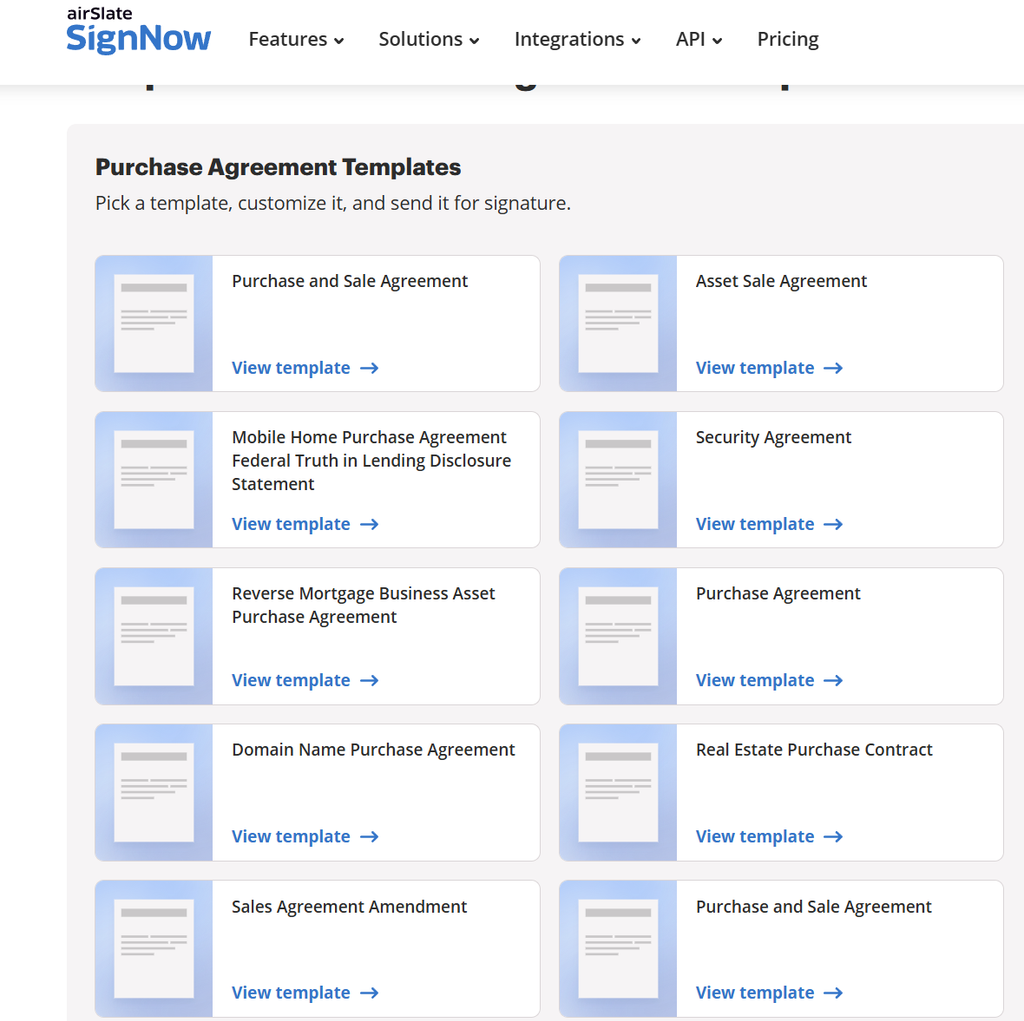
- Choose the template that matches your selling needs.
- Click View template to open it, then click SignNow. The template opens in the SignNow editor, ready for the buyer and seller details, the item or property, the price, and the closing terms.
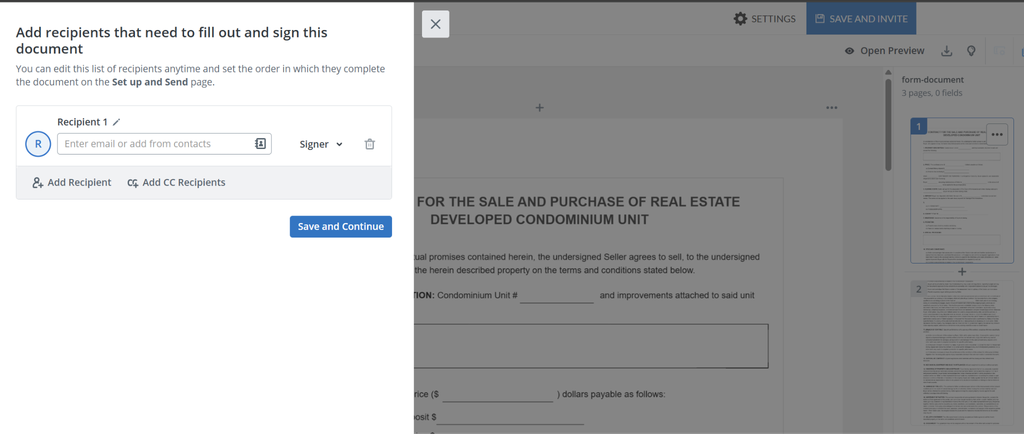
- Add the parties. Enter the emails in the Add recipients panel
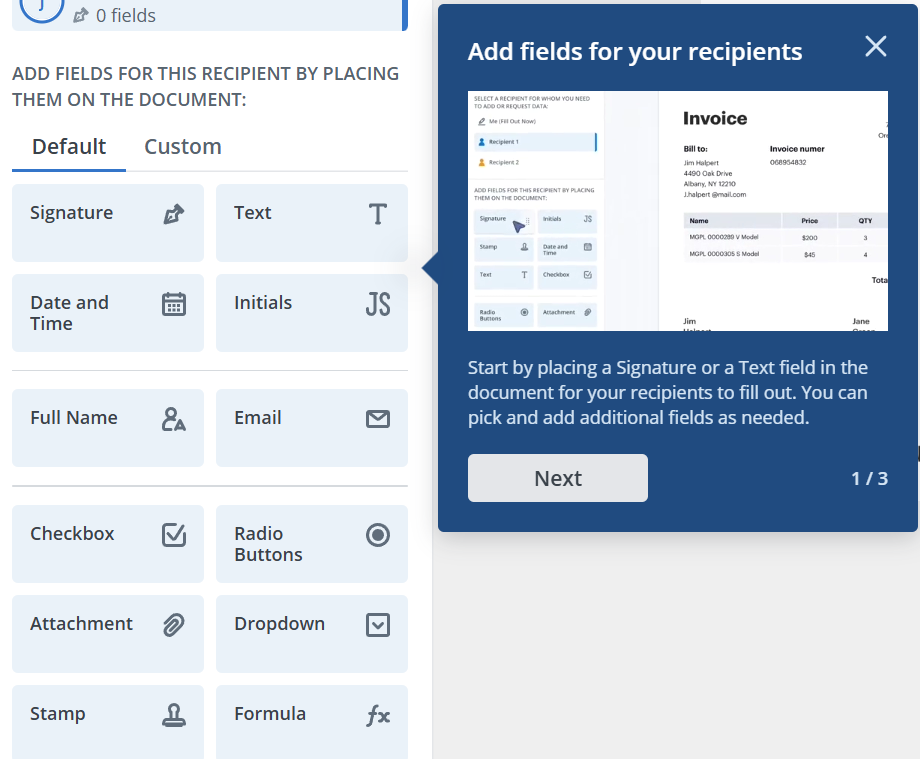
- Place fields role by role. Select a recipient in the left panel, then drag Signature, Initials, Text, Date and Time, or Checkbox fields onto the page. The fillable fields guide also lists Number, Currency, and Formula fields for the price, deposit, and balance. Mark relevant fields as required. A required field does not replace a disclosure obligation or the state process for completing a vehicle title.
- Preview, then continue to the Invite page. Open Preview shows the document as a signer sees it. Continue leads to the Signing Order, Customize Message, and Manage Additional Settings for authentication and reminders. Signing order controls let the buyer sign the offer first and the seller second.
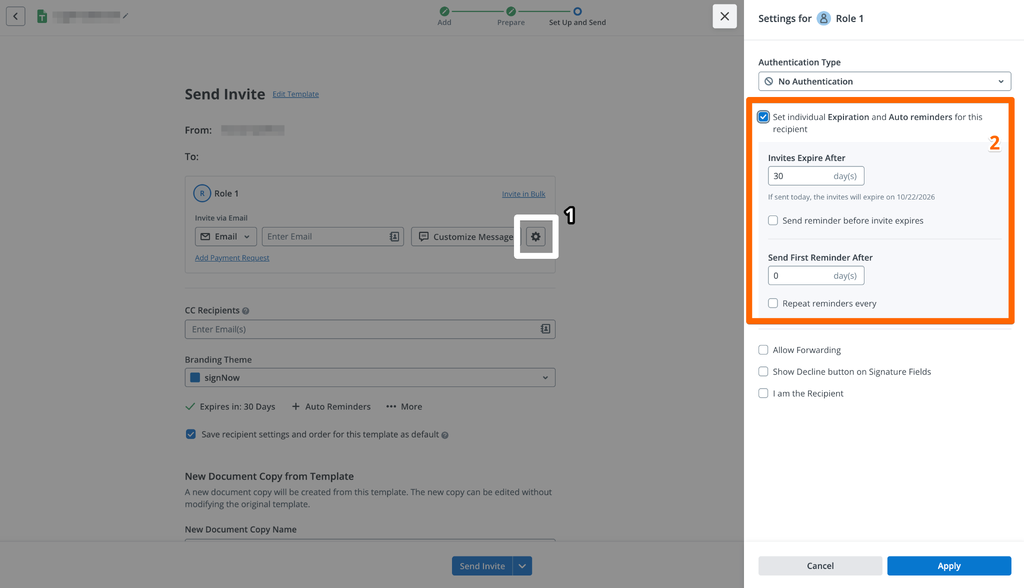
- Set the invitation expiry. On the Invite page, click the gear icon next to a recipient to open the Settings panel, then tick Set individual Expiration and Auto reminders for this recipient. Invites expire after 30 days by default and can run to 180, per the invite expiration guide.
- Save your version and keep the record.
The Make Template function in SignNow turns the finished agreement into a reusable form in the Templates folder, as the reusable templates guide describes, so next time only the deal terms change. The invitation expiry controls access to the signing request; specify contractual acceptance and notice deadlines in the agreement itself. Once everyone signs, SignNow’s document history records full names, email and IP addresses, and timestamps for each action.
Final thoughts
Choose the agreement template that fits the asset, then confirm the price, responsibilities, disclosures, and deadlines before sending it. Have the completed document reviewed where the transaction calls for legal or tax advice, and retain the signed agreement with its supporting records.
Choose a purchase agreement template in SignNow, customize it for your sale, and prepare it for electronic signature.
Key terms
- Purchase agreement: a contract setting the terms of a sale before ownership transfers.
- Statute of frauds: a rule requiring certain contracts to be in a signed writing; for goods, UCC 2-201.
- Goods: under UCC 2-105, things movable at the time they are identified to the contract.
- Lead Warning Statement: the federally required notice in a contract to sell housing built before 1978.
- Odometer disclosure: the seller’s mileage statement, made on the title at transfer under 49 CFR 580.
- Asset purchase: buying selected assets and agreed liabilities of a business rather than the entity.
FAQ
Can I write my own purchase agreement?
Yes. The risk is using a version built for another asset, such as a house template with no quantity term for a bulk order. For a business sale or any large transaction, have counsel review it.
What makes a purchase agreement valid?
Validity depends on applicable law, the transaction, and requirements such as agreement, capacity, lawful purpose, consideration where required, and any required writing. Both parties signing does not automatically cure missing terms, unlawful provisions, or required disclosures. Have an attorney review whether the document creates a binding contract for your sale.
What should a purchase agreement include?
The core terms listed above, plus the asset-specific pieces: quantity for goods, the lead disclosure for pre-1978 housing, VIN and mileage for a vehicle, and an asset schedule for a business.
Does a purchase agreement need to be notarized?
Federal law does not require the contract itself to be notarized. A real estate deed typically needs an acknowledgment before a county will record it, and some state title forms ask for a notary. SignNow does not notarize documents.
Is there a purchase agreement template in Word?
If you have a Word draft, upload it: SignNow accepts DOC and DOCX files up to 50 MB. The templates on the SignNow page are edited and sent in the browser, so no Word copy is needed.
Can a purchase agreement be signed electronically?
In most cases, yes. E-SIGN covers contracts for the sale of goods under UCC Article 2 and most real estate purchase contracts. Deed recording, notarization, and default or foreclosure notices on a primary residence follow their own rules.
Sources
- Cornell Legal Information Institute. UCC § 2-201: Formal requirements; statute of frauds.
- Cornell Legal Information Institute. UCC § 2-316: Exclusion or modification of warranties.
- U.S. Environmental Protection Agency. Real estate disclosures about potential lead hazards.
- Internal Revenue Service. FIRPTA withholding.
- Cornell Legal Information Institute. 49 CFR § 580.5: Disclosure of odometer information.
- National Highway Traffic Safety Administration. Consumer alert: changes to odometer disclosure requirements.
- Internal Revenue Service. About Form 8594: Asset acquisition statement under section 1060.
- Cornell Legal Information Institute. 15 U.S.C. § 7001: General rule of validity.
- Cornell Legal Information Institute. 15 U.S.C. § 7003: Specific exceptions.
- TL;DR
- What a purchase agreement does, and what it does not
- Six purchase agreement templates and when each fits
- Goods, equipment, and bulk orders: the $500 writing rule
- Real estate: the disclosure that must travel with the contract
- What to check in a real estate purchase agreement template
- Vehicles: the mileage statement belongs on the title
- Buying a business: assets or shares
- Can you sign a purchase agreement electronically?
- Sending a purchase agreement for signature in SignNow
- Final thoughts
- Key terms
- FAQ
- Sources