
Quick answer: Documents need notarization when applicable laws, government agencies, recording offices, or receiving organizations require an authorized notary to perform a specific notarial act. Common examples include property deeds, financial powers of attorney, sworn affidavits, and certain vehicle title transfers. Many everyday contracts do not require notarization, while eligible documents can be notarized remotely through an authorized online service. The rules depend on state law, the document’s purpose, and the requirements of the organization receiving it.
TL;DR
- Notarization is not required for every signed document. The requirement usually comes from state law, an agency, a recording office, or the receiving party.
- Common notarized documents include real estate deeds, financial powers of attorney, affidavits, certain vehicle titles, and parental consent forms.
- Most routine business contracts, including service agreements and NDAs, generally do not require notarization to be legally binding.
- Acknowledgments and jurats are different notarial acts. An acknowledgment confirms the signer acknowledged executing the document, while a jurat involves an oath or affirmation.
- Online notarization may be available for eligible transactions. SignNow helps users prepare documents and access remote notarization through its integration with Notarize.
Knowing when notarization is necessary helps individuals and businesses avoid rejected paperwork, unnecessary fees, and processing delays. This guide covers common documents that require notarization, explains important exceptions, and briefly shows how to prepare eligible documents for online notarization using SignNow.
Disclaimer: This article provides general information about U.S. notarization requirements and does not constitute legal or financial advice. Requirements vary by jurisdiction and document type. Consult a qualified legal professional or the receiving agency when necessary.
Why do some documents need a notary and others don’t?
A notary public is a government-authorized official who performs specific acts intended to help verify a signer’s identity, confirm an acknowledgment, or administer an oath or affirmation. A document requires a notary when someone with authority over it demands a notarized signature.
Notarization requirements generally come from three sources:
- State or federal law. Certain documents must follow specific execution requirements, which may include notarization or acknowledgment before an authorized official.
- Government agencies and recording offices. County recorders, motor vehicle departments, and other agencies may require a properly completed notarial certificate before accepting paperwork.
- Receiving organizations. Banks, lenders, title companies, and other institutions may request notarized signatures as part of their document-verification procedures.
Why it matters: the source of the requirement tells you what kind of notarization to ask for, whether remote online notarization will be accepted, and who to call if a notarized document is rejected. A notary verifies identity and willingness to sign. The notary does not confirm that the document is accurate, legal, or enforceable.
Notarization does not automatically make a document legally binding. A notary generally does not certify that the document’s contents are accurate, that its terms are lawful, or that an agreement is enforceable.
Which documents typically require notarization?
The most commonly notarized documents include property ownership, legal authority, sworn statements, and transactions that require additional verification.
The table below summarizes common examples of notarized documents and the requirements to check before signing.
Document | Who usually requires notarization | Typical notarial act |
Real estate deeds and mortgages | Often required for recording | Acknowledgment |
Financial powers of attorney | Required in some states; may also be required by financial institutions | Acknowledgment |
Affidavits and sworn statements | Generally required when a notarized sworn affidavit is requested | Jurat |
Vehicle title transfers | Required in certain states | Depends on state requirements |
Form DS-3053 (minor passport consent) | Required when using the notarized consent procedure | Oath/affirmation under the form’s instructions |
Loan modifications and bank forms | Depends on the lender and transaction | Often acknowledgment |
Self-proving affidavits for wills | Usually notarized, where this procedure is available | Jurat or applicable statutory procedure |
Trust documents and certifications | Depends on state law and receiving institution | Often acknowledgment |
Everyday business contracts | Generally not required | Usually none |
Important: A document’s title alone does not determine whether notarization is mandatory. The same type of document may have different requirements depending on where it is executed, recorded, or submitted.
What legal, financial, and personal documents may need notarization?
Many documents may require notarization to verify signatures, confirm a signer’s identity, or meet specific legal and administrative requirements. Let’s look at the most common document categories that may need notarization, along with examples and important state-specific considerations.
Real estate deeds and mortgage documents
Real estate deeds, mortgages, and deeds of trust are among the most frequently notarized documents in the United States.
These documents may transfer ownership interests or establish rights involving real property. Recording offices commonly require an acknowledgment or another legally recognized method of authenticating execution.
For example, Florida Statutes § 695.03 establishes requirements for acknowledging, proving, or authenticating certain real estate instruments before they can be recorded.
Common examples include:
- Warranty deeds and quitclaim deeds.
- Mortgage agreements and deeds of trust.
- Certain mortgage modifications.
- Documents releasing or transferring property interests.
The specific requirements depend on the state, recording office, and transaction. Some documents may also require witnesses.
Practical tip
Before signing property documents, ask the title company or recording office whether an in-person acknowledgment is required and whether an electronic or remotely notarized document will be accepted.
For businesses managing real estate transactions, SignNow’s real estate solutions can help prepare forms, collect electronic signatures, and manage document workflows before any required notarization takes place.
Powers of attorney
A power of attorney (POA) allows one person, called the principal, to authorize another person, called the agent, to act on their behalf.
Notarization requirements vary according to state law and the type of authority being granted.
For example, under the North Carolina Uniform Power of Attorney Act (N.C. Gen. Stat. § 32C-1-105), a financial power of attorney must be signed and acknowledged. Acknowledging the signature before a notary public or other authorized official creates a legal presumption that the principal’s signature is genuine.
Common documents in this category include:
- General financial powers of attorney.
- Durable financial powers of attorney.
- Limited powers of attorney for specific transactions.
- Certain powers of attorney used in property transactions.
Healthcare powers of attorney and advance directives may follow different state-specific rules, including requirements for witnesses, notarization, or alternative execution methods.
Banks and brokerage firms may also require particular documentation before accepting an agent’s authority.
Practical tip
Use a power-of-attorney form that complies with the applicable state’s requirements. Confirm whether witnesses, notarization, or both are necessary before the principal signs. SignNow provides pre-built power of attorney templates that you can prepare online before signing them in front of a notary public.
Affidavits and sworn statements
An affidavit is a written statement of facts that the signer swears or affirms is true.
When a notarized affidavit is required, the notary generally performs a jurat. This means the signer takes an oath or affirmation and signs in the notary’s presence.
Common examples include:
- Affidavits of heirship.
- Affidavits of residence or identity.
- Small-estate affidavits.
- Certain financial or property-related affidavits.
- Sworn statements submitted to courts or government agencies.
However, not every written declaration requires notarization. Under applicable federal or state laws, some proceedings accept unsworn declarations signed under penalty of perjury instead.
Practical tip
Check whether the receiving organization requires a notarized affidavit or permits an unsworn declaration. The two should not be treated as interchangeable without confirming the applicable rules.
Vehicle titles and bills of sale
Vehicle title transfers require notarization in some states but not others.
For example, Ohio generally requires the seller’s signature on a paper vehicle title assignment to be notarized. The exact procedures depend on the title type and transaction.
The Ohio Bureau of Motor Vehicles provides guidance on vehicle ownership documents and title transfers.
Some states also require notarized signatures for specific odometer disclosures, lien releases, or other vehicle-related documents.
A vehicle bill of sale, however, does not automatically require notarization simply because it records a sale.
Practical tip
Before completing a private vehicle sale:
- Check the requirements of the state where the vehicle will be titled.
- Confirm whether the title assignment must be notarized.
- Review any separate requirements for the bill of sale.
- Make sure the seller and buyer complete the required information.
- Arrange the required notarization before submitting the documents.
Parental consent for minor passport applications
When applying for a U.S. passport for a child under 16, both parents or legal guardians generally must participate unless an applicable exception or alternative procedure applies.
If one parent or guardian cannot appear, the applying adult may need to submit Form DS-3053, Statement of Consent. A separate minor travel consent letter, used when a child travels with one parent or another adult, is not the same as Form DS-3053. Travel authorization requirements may depend on the destination country, airline, or circumstances.
Practical tip
Important requirements include:
- Do not sign the form before being instructed by the authorized official.
- Present acceptable identification.
- Attach a clear photocopy of the front and back of the identification presented.
- Submit the consent within 90 days of the official’s signed date.
The official form instructions control how the document must be completed.
Business and financial documents
Most routine business agreements do not require notarization merely because they create legal obligations. However, certain financial or corporate transactions may require notarized documents.
Examples include:
- Commercial loan and mortgage documents.
- Loan modifications.
- Corporate documents submitted to government offices.
- Financial authorizations and guarantees.
- Agreements for which the receiving institution expressly requires notarization.
For example, a lender may require a notarized acknowledgment of a document related to a secured loan, whereas a standard vendor service agreement may require only the parties’ signatures.
Employment agreements, offer letters, and workplace policy acknowledgments generally do not require notarization as a standard legal condition.
With SignNow’s electronic signature tools, organizations can prepare routine agreements, collect signatures, and manage document completion online. Documents that require a separate notarization can follow the appropriate notarization process.
Wills, trusts, and estate planning documents
Estate planning documents deserve special attention because their execution requirements vary considerably.
In most states, a conventional written will does not need notarization to be valid if it satisfies the applicable signature and witness requirements. For example, Ohio Revised Code § 2107.03 generally requires a written will to be signed and witnessed by at least two competent witnesses. It does not impose a general notarization requirement for the will itself.
However, some states permit a self-proving affidavit, which is commonly notarized and may simplify probate proceedings by providing evidence of proper execution.
Other estate planning documents, including trusts, certifications of trust, beneficiary deeds, and certain healthcare directives, may have separate signing, witness, or acknowledgment requirements.
Practical tip
Do not assume notarization replaces legally required witnesses. If you are preparing a will or trust, follow the execution rules of the applicable jurisdiction and seek legal advice when necessary.
Which documents generally don’t need notarization?
Many documents can be legally effective without a notarial act.
Common examples include:
- Standard service agreements and sales contracts.
- Non-disclosure agreements (NDAs).
- Routine employment offers and policy acknowledgments.
- Many residential lease agreements.
- Purchase orders and ordinary business correspondence.
- Electronic agreements that satisfy applicable signature laws.
Specific forms, like Form I-9, don’t require notarization. Employers may ask a notary to verify a remote employee’s identity documents for Form I-9, but the notary acts solely as an authorized representative. Per National Notary Association guidance, the form requires no notary seal or certificate wording.
Vital records also don’t need notarization. Notaries cannot notarize or certify copies of birth, death, or marriage certificates. “Only that agency is authorized to issue certified copies of the vital record in question,” the NNA explains. A notary can notarize your signature on the request form you send to the issuing office.
What is the difference between an acknowledgment and a jurat?
An acknowledgment and a jurat are two common notarial acts. An acknowledgment confirms who signed, and a jurat confirms the signer swore the contents are true.
The table below shows the main differences between these acts.
Acknowledgment | Jurat | |
Main purpose | Confirms that the identified signer acknowledges executing the document | Records that the signer made an oath or affirmation about the document |
Signer’s appearance | Required under the applicable procedure | Required under the applicable procedure |
Must the signer sign before the notary? | Not necessarily; an existing signature may be acknowledged | Generally, yes |
Oath or affirmation | Not required | Required |
Typical documents | Deeds, powers of attorney, and certain loan documents | Affidavits and sworn statements |
Notarial certificate | Acknowledgment wording | Jurat wording |
A notary generally cannot provide unauthorized legal advice about which notarial act a document needs. If the required act is unclear, consult the receiving party or the attorney responsible for the document.
What does a notarized document contain?
A completed notarized document generally contains a notarial certificate that records the act performed.
Depending on state requirements, the certificate may include:
- Venue: The state and county or other required location information.
- Date: When the notarial act occurred.
- Certificate wording: The prescribed acknowledgment, jurat, or other notarial statement.
- Signer’s name: Identification of the person appearing before the notary.
- Notary’s signature: The signature of the authorized notarial officer.
- Official seal: A stamp or seal when required by applicable law.
The certificate’s format and required wording vary by jurisdiction.
The table below shows how those parts appear on a completed acknowledgment. The wording is an illustrative sample; always use the certificate language your state requires.
Certificate part | What it looks like on a completed example |
Venue | “State of Ohio, County of Franklin” |
Body | “On March 3, 2026, before me personally appeared Jane Doe, who proved to me on the basis of satisfactory evidence to be the person whose name is subscribed to the within instrument and acknowledged that she executed the same.” |
Notary’s signature | Signed exactly as the name appears on the notary commission |
Notary’s seal | Official seal or stamp placed clearly and legibly next to the signature |
Before you leave the appointment, check that every blank in the certificate is filled, the signer’s name matches the ID and the document, and the date is correct. Most states require the seal to be clear and legible, according to the NNA.
Can documents be notarized online?
Yes. Remote online notarization (RON) allows an authorized notary to perform an eligible notarial act via live audio-video communication and legally required identity verification procedures. Unlike traditional notarization, RON does not necessarily require the signer and notary to be physically present in the same room.
The process typically involves:
- Uploading or preparing the document.
- Providing identifying information.
- Completing identity verification.
- Joining a live audio-video session with a commissioned notary.
- Completing the required signature and notarial act.
- Receiving the electronically notarized document.
RON requirements vary by jurisdiction, document type, and receiving organization.
Is remote online notarization legal in every state?
The answer depends on whether you mean a notary’s authority to perform RON or a receiving party’s ability to accept a remotely notarized document.
Many states authorize their commissioned notaries to perform RON. However, some jurisdictions have not implemented full permanent RON procedures for their own notaries.
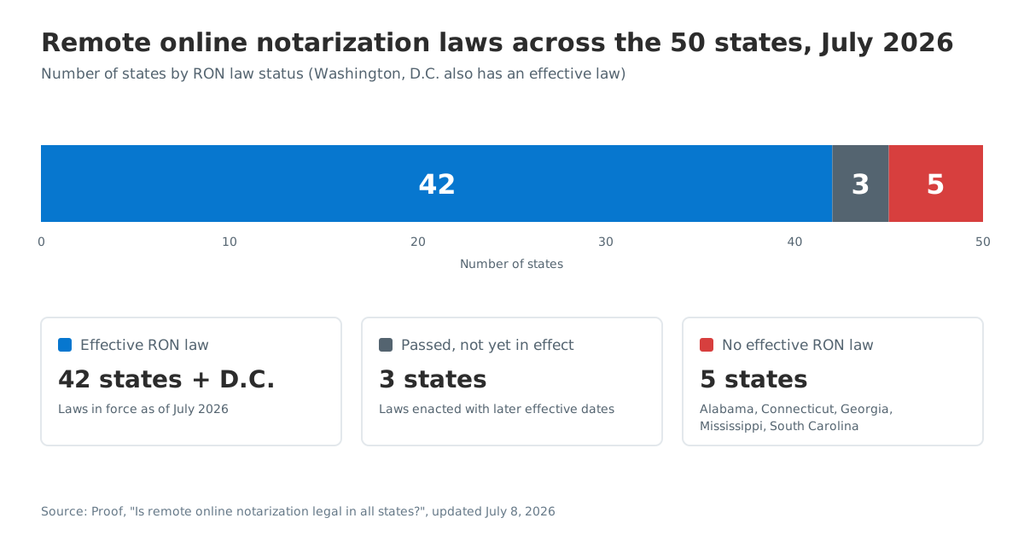
For example, the California Secretary of State explains that California notaries currently cannot perform remote online notarizations under the state’s permanent RON framework. Implementation depends on completion of the required technology project or January 1, 2030, whichever occurs first. For additional context, see an overview of remote online notarization.
Residents of states without their own RON law can often use a notary commissioned in a RON state, but acceptance depends on the receiving party. Federal legislation would standardize this: the SECURE Notarization Act of 2025 (S. 1561) would set minimum standards for remote notarization and require interstate recognition. It was introduced on May 1, 2025, and referred to the Senate Judiciary Committee, according to the bill record on GovInfo.
How much does document notarization cost?
Notary fees are capped by state law, and the maximum for a standard acknowledgment or jurat ranges from $2 to $15 per act in the states shown below, according to the NNA’s 2026 notary fees by state.
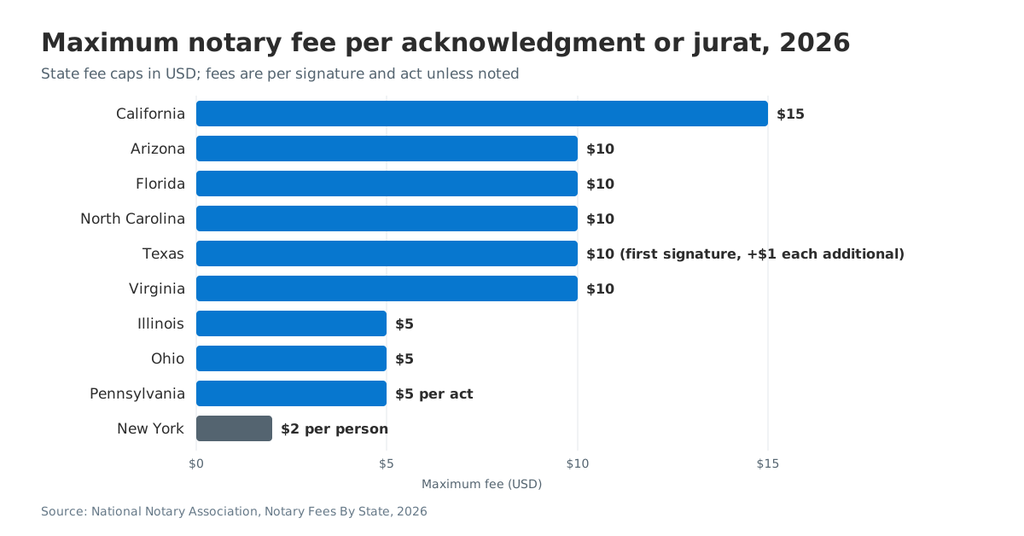
Remote online notarization has separate caps: $25 in Florida, New York, Illinois, and Virginia, $25 plus the regular fee in Texas, and $30 plus up to a $10 technology fee in Ohio.
These figures describe specific statutory fee limits, not necessarily the full cost of obtaining notarization. Additional costs may apply for travel, remote notarization, technology services, or other permitted charges.
How to prepare and notarize a document online with SignNow
SignNow connects a prepared document to a live, commissioned online notary through its Notarize (Proof) integration, so the document doesn’t need to be printed or carried to an office. SignNow online notarization is listed as a 24/7 feature of the Professional, Business, and Enterprise plans (see SignNow pricing plans).
SignNow handles document preparation and workflow management, while the authorized notary performs the notarial act.
How to notarize a document online in SignNow
Follow these steps to prepare a document in SignNow and proceed to the remote online notarization service without leaving your account:
- Log in to SignNow with your credentials or a Google, Facebook, or Microsoft account.
- From the dashboard, click +Create > Document and upload the file.
- Prepare the document. If you need to complete some fields yourself, click Me (Fill Out Now) in the left sidebar.
- Click Save and Close, then open the three-dot menu next to the file name and select Notarize.
- Verify your identity using a valid photo ID, then join the video call with the notary via the Proof (Notarize) platform.
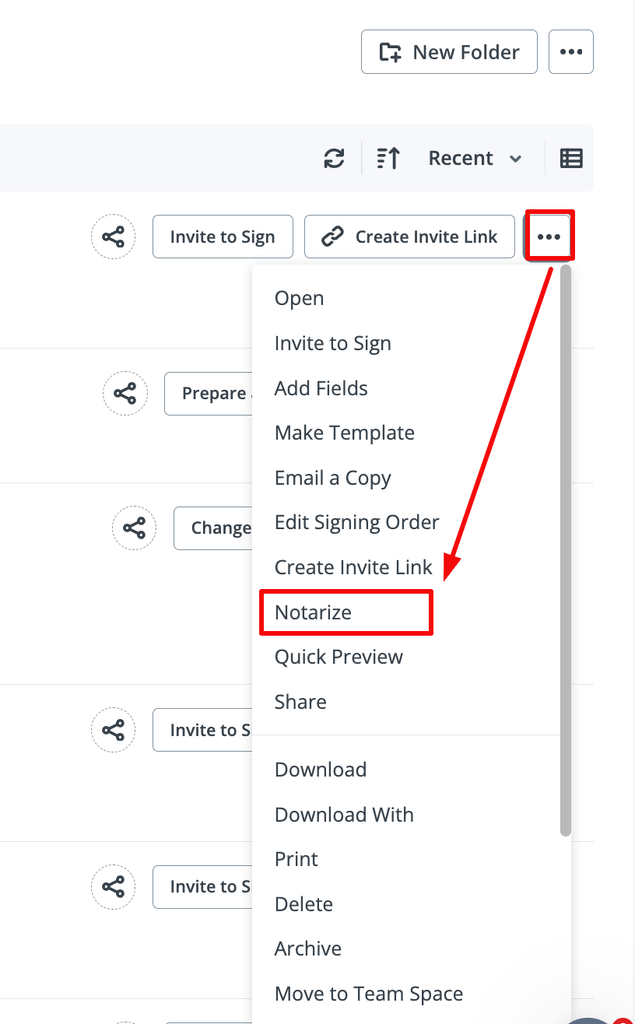
The notary will assist you with the signing and notarization process, and you will receive your notarized document in your mailbox within minutes.
For the detailed step-by-step process, see the SignNow guide on notarizing a document.
Remember that during an online notarization session, you may need to:
- Present an acceptable government-issued photo ID to verify your identity.
- Check your camera, microphone, and internet connection.
- Review the document.
- Provide your credit card details to pay the applicable notarization fee.
- Join a live video session with the commissioned notary.
What mistakes should you avoid when getting documents notarized?
Most rejected notarizations fail on preparation, not on the notary’s work. Carefully preparing the document can reduce delays and prevent problems with its acceptance.
- Signing before the appointment when the document needs a jurat. Leave the signature line blank until the notary is present.
- Blank spaces. Notaries often refuse documents with empty fields that could be filled in later, so complete or strike every blank before the appointment.
- Name mismatches. The name on the document, the ID, and the certificate should match. “Jane A. Doe” on the deed and “Jane Doe” on the license may be questioned.
- Expired or unacceptable ID. Bring a current, government-issued photo ID; a birth certificate doesn’t qualify because it lacks a photo and signature.
- Wrong certificate type. A deed with jurat wording, or an affidavit with an acknowledgment, may be refused.
- Foreign use without an apostille. Documents headed to another country usually need an apostille or authentication after notarization; see the State Department’s apostille requirements.
Final thoughts
Whether a document needs to be notarized depends on who will rely on it: a statute, a recording office or agency, or the party on the other side of the transaction. Deeds, powers of attorney, affidavits, some vehicle titles, and minor passport consent forms are the clearest cases, while the will itself, Form I-9, and vital records don’t receive a notarial act at all. Before booking an appointment, confirm which notarial act the receiving party expects, complete every blank, and bring a current photo ID.
If you’d rather skip the trip to a notary’s office, SignNow lets you prepare the document, add fillable fields, and send it to a commissioned online notary from the same document menu, with 24/7 online notarization included in the Business plan for signers located in the U.S. Try SignNow free for 7 days and get your next document signed and notarized without printing a single page.
Key terms
- Acknowledgment: a notarial act in which the signer confirms their identity and that they signed the document willingly.
- Jurat: a notarial act in which the signer swears or affirms the document’s contents are true and signs in front of the notary.
- Notarial certificate: the wording, signature, and seal that record the notarial act on a document.
- Remote online notarization (RON): notarization performed over a live audio-video session, with identity checked through methods such as credential analysis or knowledge-based verification.
- Self-proving affidavit: a notarized statement by a will’s witnesses that lets probate courts accept the will without witness testimony.
- Apostille: a certificate that authenticates a public document for use in countries that belong to the 1961 Hague Convention.
- Venue: the part of a notarial certificate that states where the notarization took place.
FAQs
1. What documents need to be notarized?
Documents need notarization when a statute, recording office, agency, or receiving party requires it. Common examples include real estate deeds, certain financial powers of attorney, affidavits, vehicle title transfers, and parental consent forms for minor passport applications. Whether notarization is required depends on state law, the type of transaction, and the receiving organization’s instructions.
2. Do all legal documents need to be notarized?
No. Many legal documents, including routine contracts, NDAs, and employment agreements, are generally valid without notarization when they satisfy applicable legal requirements. Some transactions impose additional requirements, such as witnesses, acknowledgments, or sworn statements. Always check the rules governing the particular document.
3. Does a will need to be notarized?
In most states, a conventional written will does not need notarization to be valid if it meets the applicable signing and witness requirements. However, a self-proving affidavit for a will commonly requires notarization where such a procedure is available. Requirements vary by state, so follow local estate planning laws.
4. What documents cannot be notarized?
A notary generally cannot issue an officially certified copy of a government vital record, such as a birth or death certificate. Form I-9 also does not require a notarial act, even when a notary serves as an employer’s authorized representative. Other restrictions depend on state law, the notarial act requested, and the document’s purpose.
5. Can I get a document notarized online?
Yes, remote online notarization is available for many eligible transactions. As of July 2026, 42 states plus Washington, D.C., have effective remote online notarization laws, and SignNow’s Business plan includes 24/7 online notarization for signers located in the U.S.
6. What do I need to bring to a notary?
You generally need the document, a current government-issued photo ID, and any witnesses the document requires. You also need to pay a fee. For remote online notarization, you also need a device with a camera and microphone, a reliable internet connection, and any identification required by the service. Also, you should confirm whether you should leave the document unsigned until the appointment.
7. How much does it cost to notarize a document?
Fees vary by state and the notarial act performed. State caps for a standard acknowledgment or jurat range from $2 per person in New York to $15 in California, according to the National Notary Association’s 2026 fee chart. Remote online notarization caps are $25 per act in Florida, New York, Illinois, and Virginia. Review your state’s fee rules and request the full price before completing the transaction.
Trusted sources
- National Notary Association — 2026 notary fees by state
- Proof: Is remote online notarization legal in all states?
- Florida Statutes section 695.03
- N.C. Gen. Stat. 32C-1-105
- Ohio BMV: Vehicle titles
- Federal Register: Form DS-3053 Statement of Consent
- NNA: What is a vital record, and can I notarize it?
- NAR: Online real estate fraud climbed to $275M in 2025
- GovInfo: S. 1561, SECURE Notarization Act of 2025
- U.S. Department of State: Apostille requirements
- California Secretary of State — Notary public FAQs
- TL;DR
- Why do some documents need a notary and others don’t?
- Which documents typically require notarization?
- What legal, financial, and personal documents may need notarization?
- Which documents generally don’t need notarization?
- What is the difference between an acknowledgment and a jurat?
- What does a notarized document contain?
- Can documents be notarized online?
- How much does document notarization cost?
- How to prepare and notarize a document online with SignNow
- What mistakes should you avoid when getting documents notarized?
- Final thoughts
- Key terms
- FAQs
- Trusted sources