Crear Formulario Prellenado Para Simplificar El Proceso De Firma Y Completado

Usando las etiquetas de airSlate SignNow y la función de texto prellenado, el proceso de completar un documento se ha simplificado. Siga las instrucciones del documento y use datos prellenados para llenar un d

Solución de firma electrónica galardonada

What it means to create pre filled form to simplify the completing process

Creating pre filled form to simplify the completing process refers to preparing documents with predefined field values so recipients spend less time entering repetitive information. This approach uses templates, data mapping, and integrations to populate names, addresses, dates, and account details before delivery. In eSignature systems like signNow, pre-filled fields reduce errors, accelerate approvals, and integrate with contact directories or CRMs to pull authoritative data. Properly implemented, pre-filled forms also support conditional logic and field validations to ensure completed documents meet organizational and regulatory requirements.

Why pre-filled forms matter for process efficiency

Pre-filled forms cut manual entry, reduce mistakes, and shorten cycle times by delivering documents already populated with verified data, improving user experience and operational consistency.

Why pre-filled forms matter for process efficiency

Common challenges when implementing pre-filled forms

  • Data synchronization issues between source systems can cause outdated or inconsistent pre-filled values across documents.
  • Incorrect field mapping may place data in the wrong location, requiring rework and delaying execution.
  • Privacy and consent requirements complicate pre-filling sensitive fields without proper disclosures and controls.
  • Template proliferation without governance makes updates difficult and can result in non-compliant or obsolete forms.

User roles who benefit from pre-filled forms

HR Manager

An HR Manager uses pre-filled forms to standardize onboarding packets and benefits enrollment. By populating employee name, role, and start date from an HRIS, the manager reduces repetitive data entry and minimizes errors while ensuring consistent policy language and signatures are applied.

Mortgage Officer

A Mortgage Officer relies on pre-filled applications to insert borrower details and loan parameters from the CRM. This approach shortens application completion time, improves data accuracy for underwriting, and ensures required disclosures and signature fields are present and correctly placed.

Typical teams that create pre filled form to simplify the completing process

Organizations across HR, finance, sales, and legal commonly use pre-filled forms to speed routine workflows and standardize data capture.

  • Human resources teams for onboarding, tax forms, and benefits enrollment.
  • Sales operations for quotes, proposals, and recurring order forms.
  • Finance and accounts payable for invoices, purchase orders, and vendor onboarding.

Teams that implement a governed template strategy see fewer errors and faster turnaround while maintaining control over document content and compliance.

Advanced capabilities that enhance pre-filled form workflows

Beyond basic templates, these features support scale, integration, and regulatory controls for enterprise form automation.

Bulk Send

Distribute a pre-filled document to many recipients at once using variable fields; useful for mass releases like invoices, policy acknowledgements, or payroll documents.

API Access

Programmatic endpoints allow applications to create, pre-fill, send, and retrieve signed documents, enabling automated workflows and integration with back-office systems.

SSO and SAML

Single sign-on integration centralizes authentication and user provisioning for secure access to templates and pre-fill configurations across the organization.

Role-based access

Assign granular permissions to control who can create templates, map fields, send pre-filled forms, and view completed documents.

Dynamic fields

Fields that adapt based on mapped data, calculations, or conditional logic reduce manual adjustments and ensure accurate populated values.

Audit-ready records

Generate tamper-evident, timestamped audit trails that record pre-fill actions, signer events, and IP or authentication details for compliance.

prepárate para obtener más

Elige una mejor solución

Key tools for effective pre-filled forms

These essential features streamline setup, ensure data integrity, and maintain compliance when pre-filling documents for recipients.

Template Library

Store and manage standardized templates with predefined fields, version control, and access permissions so authorized users can reuse compliant forms without rebuilding documents each time.

Field Mapping

Map fields to CRM, HRIS, or form databases to automatically populate names, dates, addresses, and identifiers, reducing manual entry and data mismatch risk during signing.

Conditional Logic

Apply rules that show, hide, or require fields based on input values; this ensures recipients only see relevant fields and helps maintain form clarity and accuracy.

Validation Rules

Enforce formatting and required fields with pattern checks and dropdowns so pre-filled and recipient-entered data meet policy and downstream processing needs.

How pre-filled forms operate in an eSignature workflow

Understanding the data flow clarifies integration points and expected outcomes when using pre-filled forms in a signing process.

  • Template creation: Author a reusable document template.
  • Data mapping: Connect fields to data sources.
  • Pre-fill delivery: Send documents with fields populated.
  • Signature capture: Recipients review and sign completed fields.
Recoger firmas
24x
más rápido
Reduce los costos en
$30
por documento
Guardar hasta
40h
por empleado / mes

Step-by-step: create pre filled form to simplify the completing process

Follow these concise steps to configure a pre-filled form template that reduces manual entry and enforces field validation.

  • 01
    Prepare source data: Identify authoritative fields and data sources.
  • 02
    Design template: Place fields and set validations.
  • 03
    Map fields: Link template fields to data records.
  • 04
    Test and deploy: Run test cases and publish templates.

Managing audit trails for pre-filled form transactions

Maintainable audit trails document pre-fill activity, template edits, and signing events to support compliance and dispute resolution.

01

Capture events:

Log pre-fill and sign actions
02

Record metadata:

Store IP and timestamps
03

Version control:

Keep template histories
04

Secure storage:

Protect logs with encryption
05

Export options:

Provide downloadable evidence
06

Retention rules:

Apply compliance schedules
prepárate para obtener más

Por qué elegir airSlate SignNow

  • Prueba gratuita de 7 días. Elige el plan que necesitas y pruébalo sin riesgos.
  • Precios honestos para planes completos. airSlate SignNow ofrece planes de suscripción sin cargos adicionales ni tarifas ocultas al renovar.
  • Seguridad de nivel empresarial. airSlate SignNow te ayuda a cumplir con los estándares de seguridad globales.
illustrations signature

Typical workflow settings for pre-filled form automation

Configure core settings to control delivery, reminders, and retention for automated pre-filled form workflows.

Setting Name Configuration
Reminder Frequency 48 hours
Signature Order Sequential
Default Expiration 30 days
Audit Trail Capture Enabled
Auto-archival Period 6 years

Supported platforms for creating and using pre-filled forms

Pre-filled forms can be created and completed across common devices and browsers, enabling flexible user engagement.

  • Web browsers: Chrome, Edge, Safari compatible
  • Mobile apps: iOS and Android apps
  • Desktop integration: Windows and macOS supported

Ensure your environment meets basic security and browser requirements, enable JavaScript and TLS, and keep mobile apps up to date to maintain compatibility and data protection.

Security and authentication for pre-filled forms

Encryption at rest: AES-256 standard
TLS in transit: TLS 1.2 or higher
User authentication: Password or SSO
Access controls: Role-based limits
Audit logging: Comprehensive trails
Document locking: Field-level protection

Industry examples of creating pre-filled forms to simplify the completing process

Real-world implementations show how pre-filled forms address specific operational needs while maintaining compliance and auditability.

Healthcare patient intake

A community clinic pre-populates patient demographic and insurance fields from the patient portal database to reduce front-desk time and data entry errors.

  • Automated population of name, DOB, and insurance ID.
  • Faster check-in and fewer transcription mistakes.

Resulting in reduced wait times and clearer medical records for follow-up care.

Mortgage application workflow

A mortgage lender integrates CRM and credit systems to pre-fill borrower information on loan applications and disclosure forms to ensure consistency.

  • Pulls borrower name, income, and property details.
  • Improves underwriting speed and accuracy.

Leading to shorter approval cycles and fewer requests for corrected documentation.

Best practices for secure and accurate pre-filled forms

Adopt operational, technical, and governance measures to protect data, maintain accuracy, and ensure user clarity when creating pre-filled forms.

Establish single sources of truth for data
Use authoritative systems like HRIS or CRM as the only source for pre-filled values to avoid conflicts and reduce stale or inconsistent information across templates.
Apply least-privilege access and template governance
Restrict who can edit templates, audit changes, and require approval for content updates so that only vetted documents are used for external signing.
Use clear field labels and visible pre-fill indicators
Mark pre-filled fields clearly so recipients know which data was provided and which fields they can modify, reducing confusion and accidental edits.
Regularly test templates and audit pre-fill mappings
Include validation and periodic audits in change control to confirm mappings still point to correct data sources and to detect misconfigurations before they reach signers.

FAQs About create pre filled form to simplify the completing process

Common questions and solutions cover implementation, compliance, user experience, and integrations for pre-filled forms in eSignature workflows.

Feature availability comparison for pre-filled form capabilities

A concise feature comparison shows whether common capabilities are available across major eSignature providers.

Signature vendor capability comparison table signNow (Recommended) DocuSign Adobe Sign
Legal validity under ESIGN and UETA
HIPAA compliance option available Offered Offered Offered
Bulk Send for mass distribution
API access and developer tools REST API REST API REST API
prepárate para obtener más

¡Obtenga firmas legalmente vinculantes ahora!

Retention and timing guidelines for pre-filled documents

Define retention and action windows for pre-filled documents to meet business needs and compliance obligations while keeping records manageable.

Immediate action window:

7 to 30 days to sign

Short-term retention:

Keep drafts 90 days

Long-term retention:

Store executed records 6+ years

Audit log retention:

Retain trails for statutory periods

Template review cadence:

Review annually or upon regulation changes

Regulatory risks and compliance considerations

HIPAA exposure: Unauthorized data release
FERPA concerns: Student record breaches
ESIGN noncompliance: Invalid signatures
Data retention lapses: Recordkeeping failures
Consent omissions: Legal challenges
Third-party risk: Vendor misconfiguration

Entry-level pricing and plan features for pre-filled form functionality

Pricing varies by provider and plan; the table summarizes entry-level costs, trial options, API availability, and compliance features relevant to pre-filled forms.

Plan Comparison and core details signNow (Recommended) DocuSign Adobe Sign Dropbox Sign PandaDoc
Starting monthly price (per user, billed yearly) $8 / user / month $10 / user / month $12 / user / month $8 / user / month $19 / user / month
Free trial or demo availability 14-day trial 30-day trial Trial via Adobe account 30-day trial 14-day trial
API included in entry plan Included Limited Included Included Included
HIPAA-compliant option available Yes with BA Yes with BA Yes with BA Yes with BA Yes with BA
Bulk Send or mass-send in plan Included Add-on available Included Included Included

Cómo prellenar documentos con airSlate SignNow

Permita que los destinatarios completen sus formularios más rápido ingresando datos relevantes en campos rellenables por usted mismo. Sus destinatarios verán la información prellenada en los cuadros, pero también podrán cambiar la información si es necesario. Prellenar documentos mejora la experiencia de firma para sus destinatarios y también acelera los ciclos de sus documentos.

Agregar campos rellenables

Suba su documento y ábralo en el editor. Seleccione el tipo de campo que desea agregar y colóquelo en cualquier parte de su documento. Tenga en cuenta que solo puede prellenar los siguientes tipos de campos: Campos de texto, Campos de fecha/hora, Casillas de verificación, Grupos de botones de opción y campos desplegables.

Agregue tantos campos rellenables como necesite, ajuste su tamaño y posición, y distribuya roles de firma.
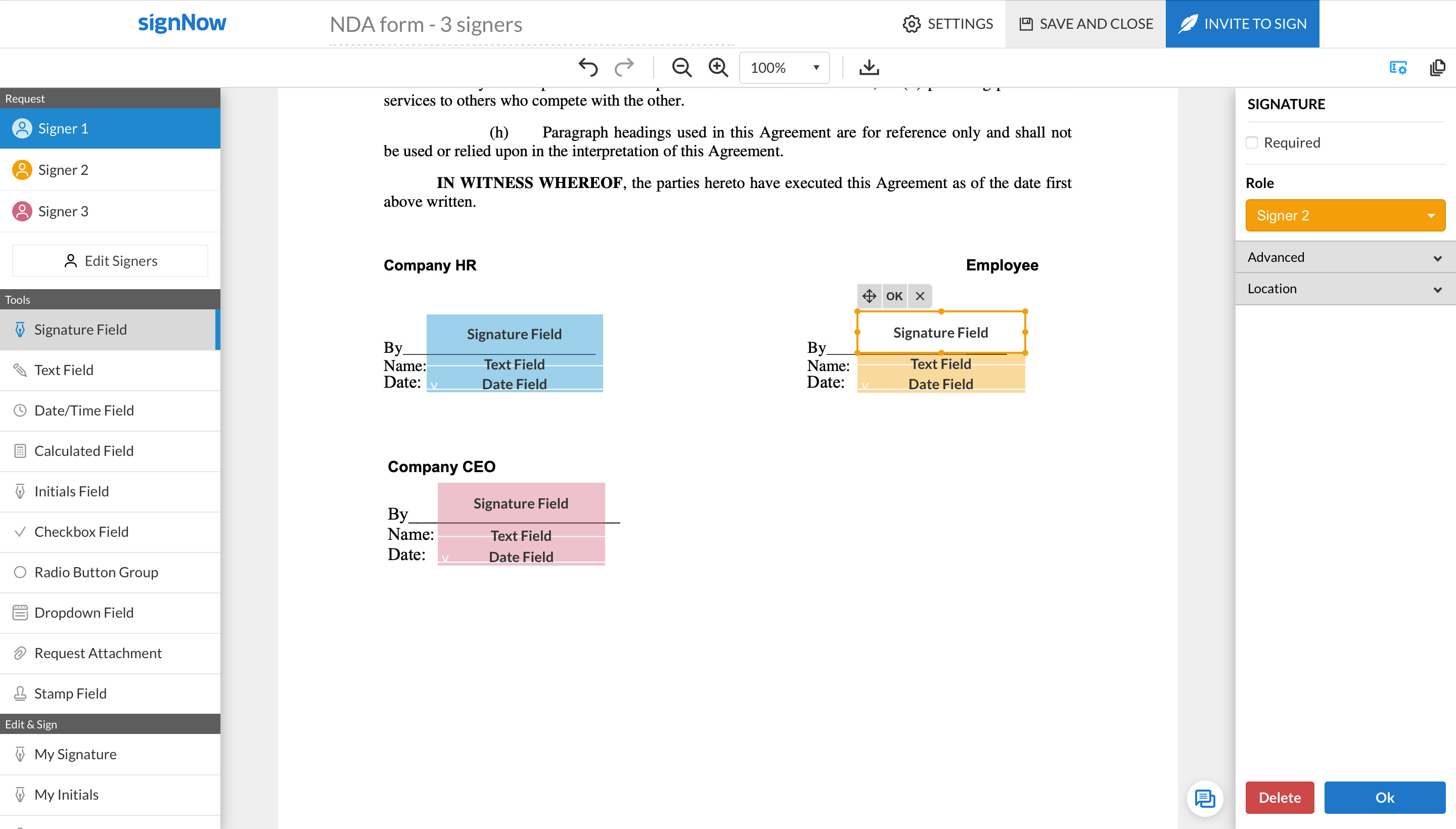
ilustración-guía-llenado

Prellenar campos con datos

Haga clic en el campo que desea prellenar e ingrese datos en el cuadro Texto prellenado en la barra lateral derecha. Luego, haga clic en el botón Ok.
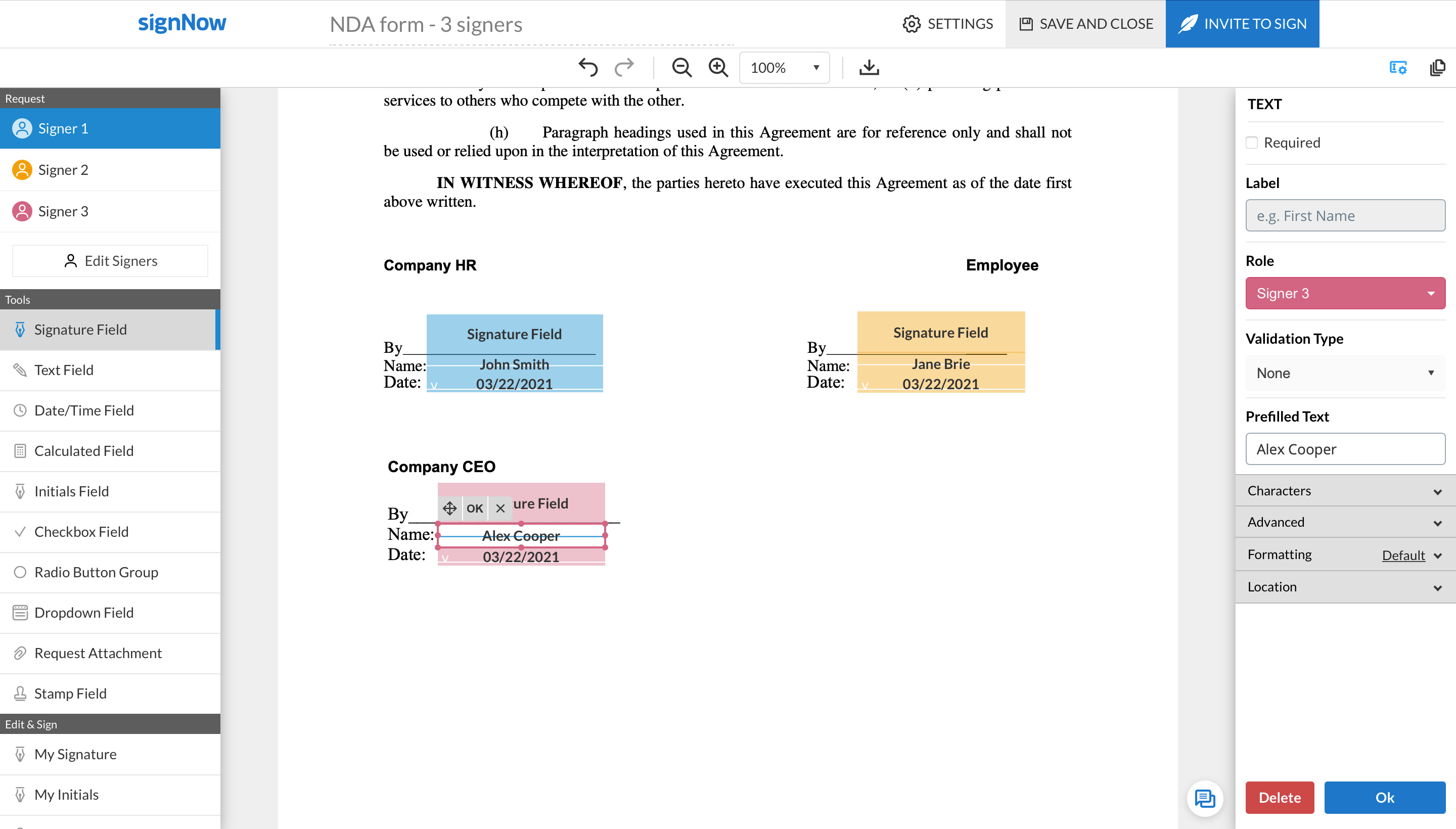
ilustración-guía-llenado

Cuando sus firmantes reciban su documento, ya estará prellenado con los valores que ha añadido. Sin embargo, podrán cambiar estos valores en cualquier momento haciendo clic en un campo prellenado y escribiendo su respuesta.
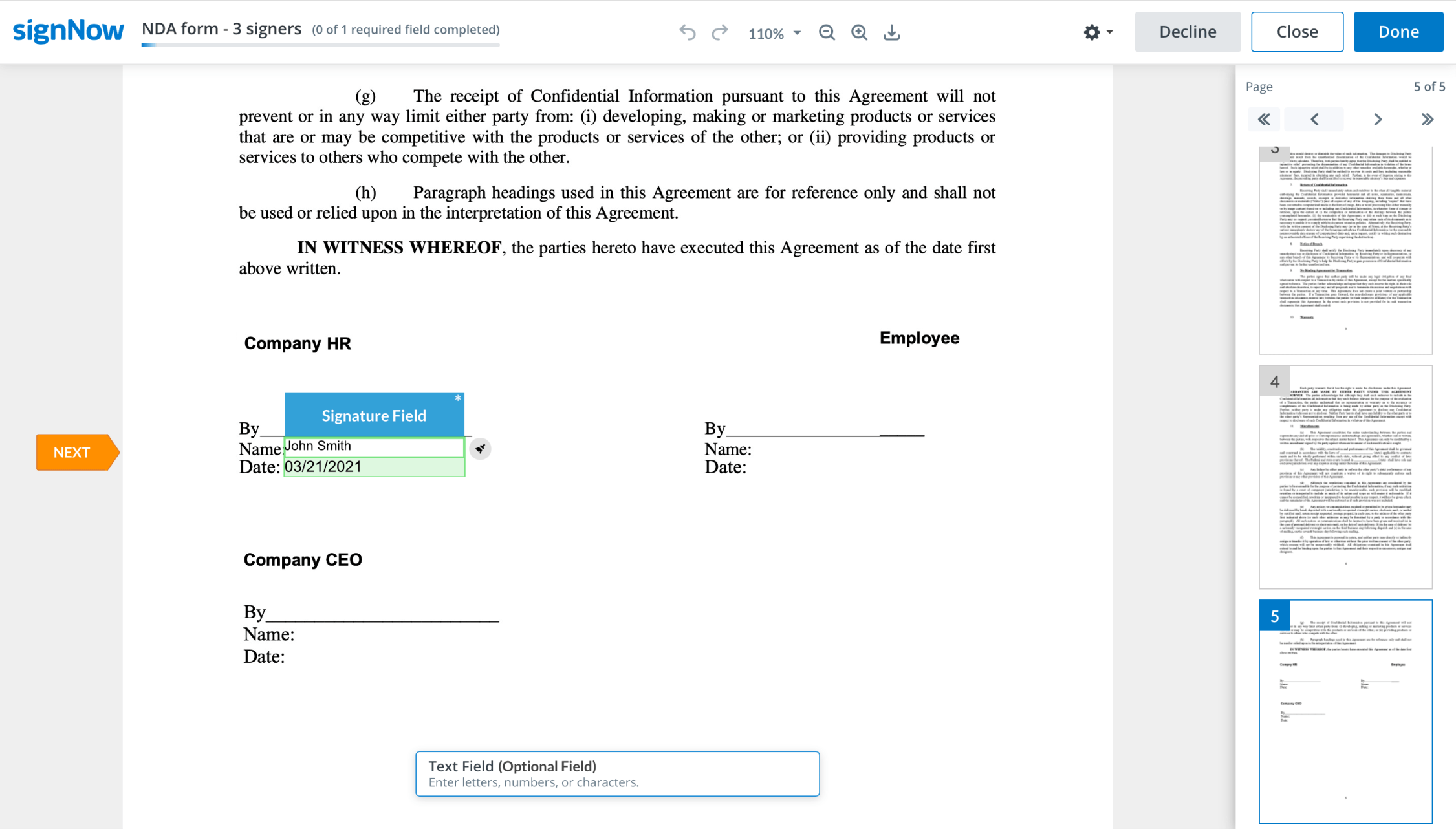

ilustración-guía-llenado
walmart logo
exonMobil logo
apple logo
comcast logo
facebook logo
FedEx logo
esté listo para obtener más

¡Obtenga ahora firmas vinculantes desde el punto de vista jurídico!









