Personaliza El Asunto Y El Mensaje En Tu Correo Electrónico Para La Solicitud De Firma Electrónica
What it means to customize subject and message in your email
Why customize email subject and message matters
Clear subject lines and tailored messages increase recipient engagement, reduce signature delays, and provide a written record of intent that supports legal enforceability and auditability in electronic transactions.
Common challenges when customizing email content
- Inconsistent subject lines across templates can confuse recipients and slow response times.
- Overly generic messages reduce trust and make documents look like spam to busy recipients.
- Manual editing for each envelope wastes time and increases the chance of human error.
- Missing or incorrect variable mapping can produce unreadable messages or expose placeholder text.
Representative user roles who edit email text
Contracts Manager
Oversees agreement distribution and ensures subject lines reference the correct counterparty and contract type. They create template defaults for subject and message fields to standardize legal notices and reduce administrative overhead across repeated contract workflows.
HR Administrator
Manages mass onboarding and benefits communications, customizing email messages with employee-specific fields. They rely on template variables to populate role, start date, and required next steps while keeping messages consistent and compliant.
Who typically customizes email subjects and messages
Professionals across legal, HR, sales, and procurement teams set custom subjects and messages to communicate context and deadlines clearly.
- Legal teams preparing contract summaries and formal notices for signers.
- HR departments sending offer letters, onboarding packets, and policy acknowledgements.
- Sales and account teams sending proposals, quotes, and renewal notices.
Tailoring email content reduces follow-up questions and creates a consistent recipient experience across business units.
Elige una mejor solución
Key features that support email customization
Template Defaults
Define a default subject line and message body at the template level so every envelope created from the template inherits consistent, pre-approved communication text while allowing senders to override when needed.
Variable Fields
Use merge tags or variables to inject recipient-specific data into the subject or message, ensuring personalization without manual edits and reducing the risk of incorrect or missing details.
Per-Envelope Overrides
Allow senders to edit the subject and message when composing an envelope to reflect one-off details, deadlines, or clarifications while retaining the template's audit history for compliance.
API Parameters
Pass subject and message text via API calls for automated workflows, enabling precise control from CRMs, HR systems, or contract management platforms while keeping message content consistent with system logic.
How customization flows when sending an envelope
-
Template layer: Set standardized subject and message defaults.
-
Envelope layer: Override defaults per-recipient or transaction.
-
API layer: Pass subject and message via parameters.
-
Recipient view: Recipient receives the final customized email.
Step-by-step: set default email subject and message
-
01Open template: Select the template you want to edit.
-
02Edit defaults: Enter a default subject and message body.
-
03Insert variables: Add placeholders for names, dates, or amounts.
-
04Save settings: Apply and confirm template-level defaults.
Por qué elegir airSlate SignNow
-
Prueba gratuita de 7 días. Elige el plan que necesitas y pruébalo sin riesgos.
-
Precios honestos para planes completos. airSlate SignNow ofrece planes de suscripción sin cargos adicionales ni tarifas ocultas al renovar.
-
Seguridad de nivel empresarial. airSlate SignNow te ayuda a cumplir con los estándares de seguridad globales.
Recommended workflow settings for email customization
| Setting Name | Configuration |
|---|---|
| Default Subject | Template-specific |
| Default Message Body | Template text block |
| Reminder Frequency | 48 hours |
| Signer Order | Sequential or parallel |
| Template Assignment | By team or role |
Platform and client requirements for editing email content
Most modern eSignature platforms allow editing subjects and messages via web UI, mobile apps, and APIs for broad compatibility.
- Web browser: Chrome, Edge supported
- Mobile app: iOS and Android apps
- API access: REST API available
Confirm your environment meets platform minimums and that API keys and permissions are configured for template and envelope customization to ensure consistent behavior across sender interfaces.
Industry examples of customizing email subject and message
Leasing Agreement Workflow
A property manager sends lease renewals with a subject that includes unit number and renewal date to avoid confusion
- Uses variables for tenant name and move-in details to personalize messages
- Provides short next-step instructions and links to payment or questions for quick action
Resulting in faster tenant responses, fewer follow-ups, and a clear record of the notice and recipient confirmation.
New Hire Onboarding
An HR team sends offer letters with a subject referencing candidate name and role so emails are immediately recognizable
- Inserts start date and required paperwork checklist into the message body for clarity
- Includes contact info, secure instructions for submitting IDs, and expected timelines to reduce back-and-forth
Leading to more complete onboarding packets returned on time and consistent archived communications for audit purposes.
Best practices for secure and effective email customization
FAQs About customize subject and message in your email
- Why does my merge tag show as plain text in the message?
Merge tags display as placeholders until envelope creation; ensure the variable is defined at template or envelope creation and that the field name matches the data source. If using an API, confirm the JSON payload includes the variable mapping and that the data type is correct; review logs to see the rendered message before sending.
- Can I set different default messages per team or department?
Yes. Use role-based templates or assign templates to specific groups so each team has its own default subject and message. Configure template permissions so only designated users can edit those defaults to maintain consistency and compliance with internal policies.
- Is it safe to include deadlines in the email body?
Including deadlines improves clarity but avoid placing sensitive personal data directly in the email. Use secure links and reference deadlines in the message while storing specific sensitive details inside the secure document view for compliance and reduced exposure.
- How do I change the email subject via API when sending envelopes?
Pass subject and message parameters in the API request payload according to the provider's REST API schema. Ensure you authenticate with an API key or OAuth token that has permission to create envelopes and that your payload fields align with the template variables if using a template.
- Why did a recipient report the message looked like spam?
Spam-like appearance often stems from vague subjects, missing sender identification, or content with many links. Use descriptive subjects, include identifying information about your organization, and ensure SPF/DKIM are configured for your sending domain to improve deliverability.
- What audit records exist for customized email text?
Most platforms log the final subject and message used in the envelope audit trail, including timestamps and the user who edited text. These logs support legal validity and internal reviews and should be retained according to your document retention policies.
Feature comparison: email customization capabilities
| Feature | signNow (Recommended) | DocuSign | Adobe Sign |
|---|---|---|---|
| Custom email subject | |||
| Per-template default message | |||
| API subject/message parameters | REST API | REST API | REST API |
| Variable/merge tag support |
¡Obtenga firmas legalmente vinculantes ahora!
Risks of incorrect or insecure email customization
Pricing and plan notes related to email customization
| Provider | signNow (Recommended) | DocuSign | Adobe Sign | HelloSign | PandaDoc |
|---|---|---|---|---|---|
| Starting price (per user) | From $8/mo billed annually | From $10/mo billed annually | From $9.99/mo billed annually | From $15/mo billed annually | From $19/mo billed annually |
| Free tier or trial | Free trial available | Free trial available | Free trial available | Free trial available | Free trial available |
| API access included | Available on select plans | Requires business plan | Available on enterprise plans | Available on paid plans | Enterprise API available |
| HIPAA-compliant option | Available with BAA | Available with BAA | Available with BAA | Requires inquiry | Requires inquiry |
| Support level | Email and phone support options | Tiered support plans | Tiered enterprise support | Email support standard | Enterprise support tiers |
Cómo personalizar un mensaje y asunto de correo electrónico con airSlate SignNow
Al enviar documentos para firmar, puedes cambiar libremente la línea de asunto y el mensaje introductorio de tu correo electrónico según lo consideres conveniente.
Además, puedes prellenar un asunto y un mensaje para tus plantillas, de modo que no tengas que volver a escribirlos cada vez que envíes una invitación de firma.
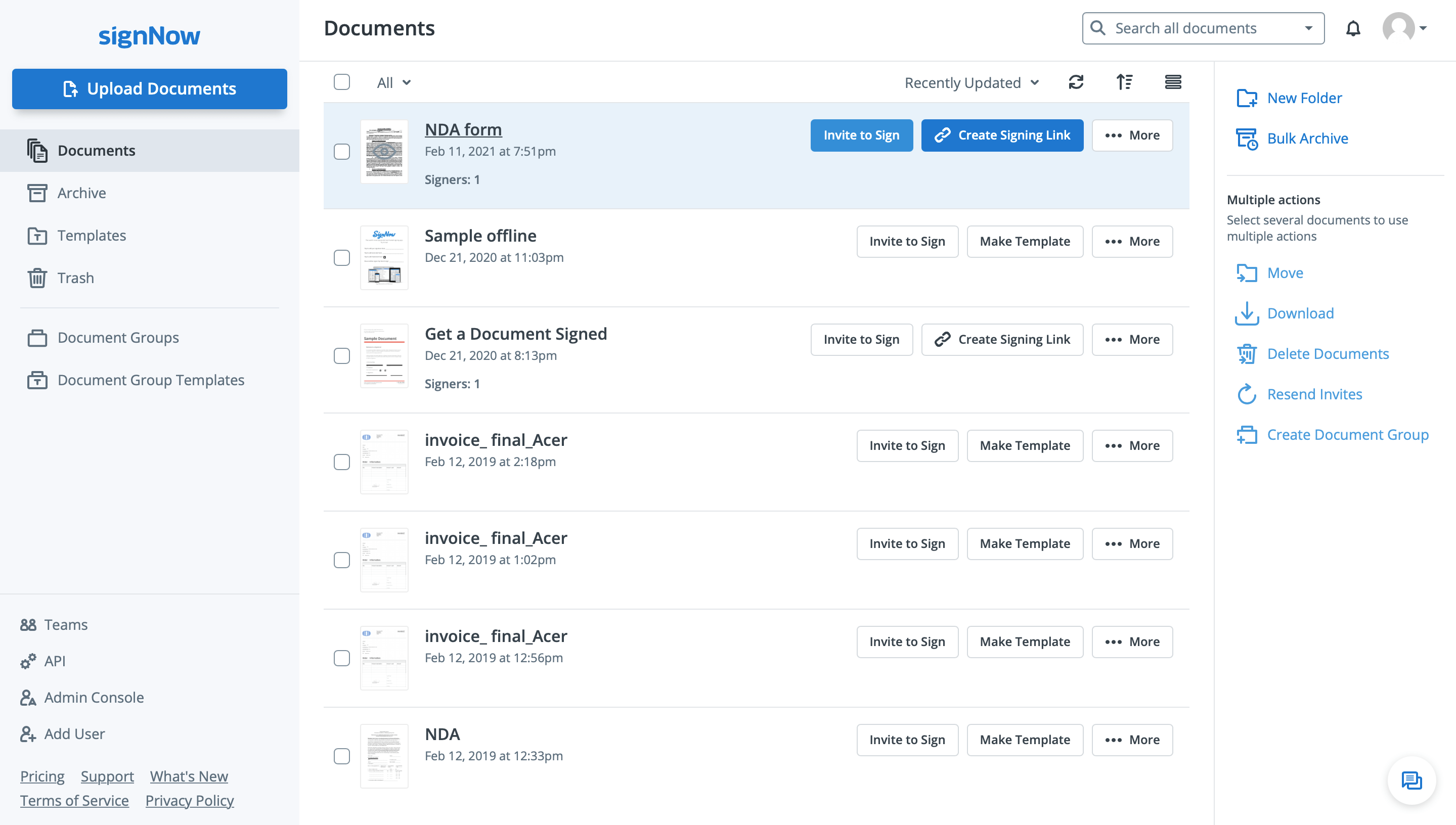
Prepara tu documento para enviarlo
Haz clic en el botón Invitar a Firmar junto al nombre del documento que necesitas que sea firmado electrónicamente.
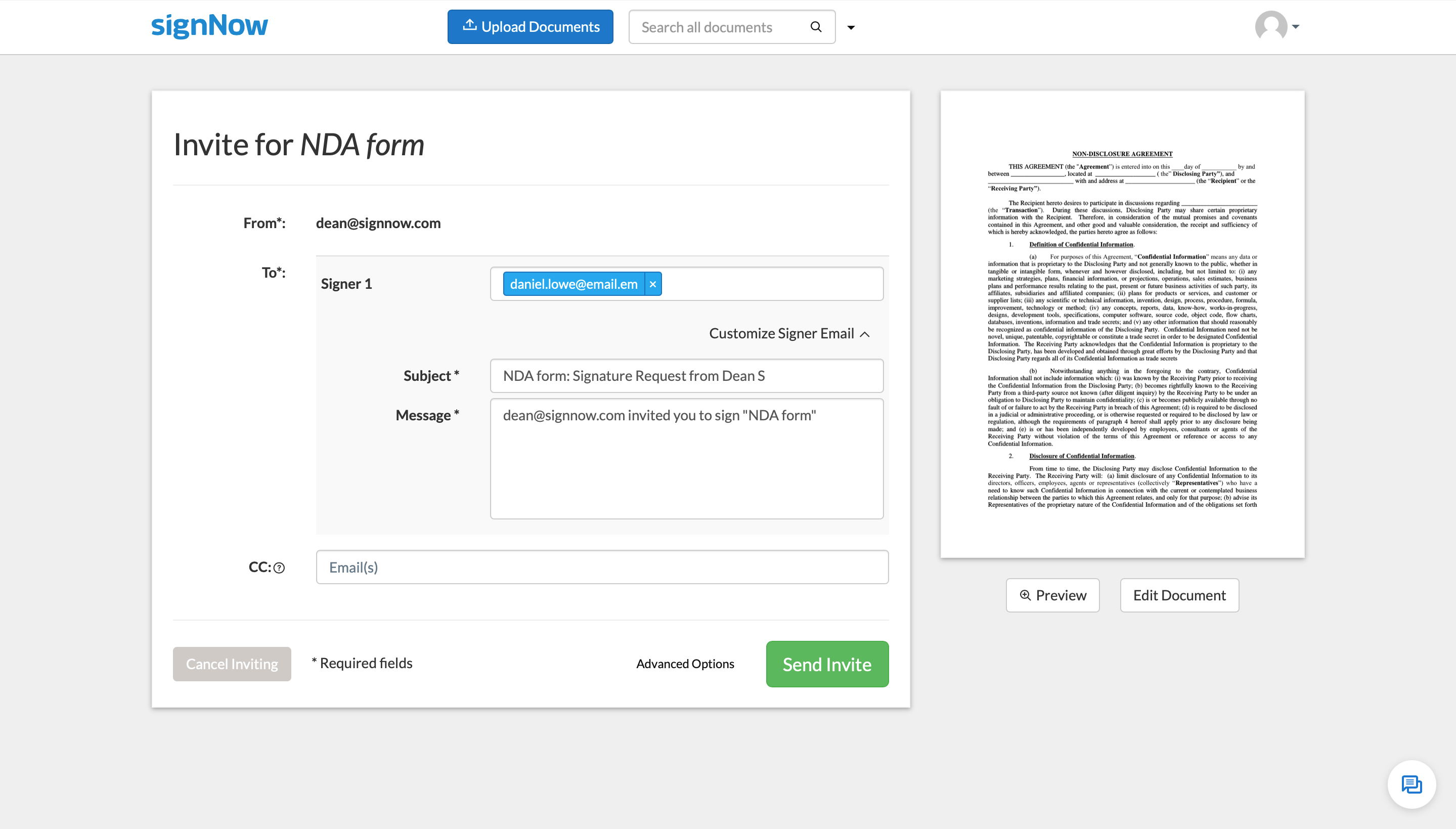
Personaliza tu correo electrónico
Haz clic en el desplegable Personalizar correo del firmante. Agrega o modifica los datos en los campos Asunto y Mensaje.
Después de ingresar la dirección de correo del destinatario, haz clic en Enviar invitación. Tu solicitud de firma será entregada al firmante y mostrará el asunto y el mensaje que has configurado.
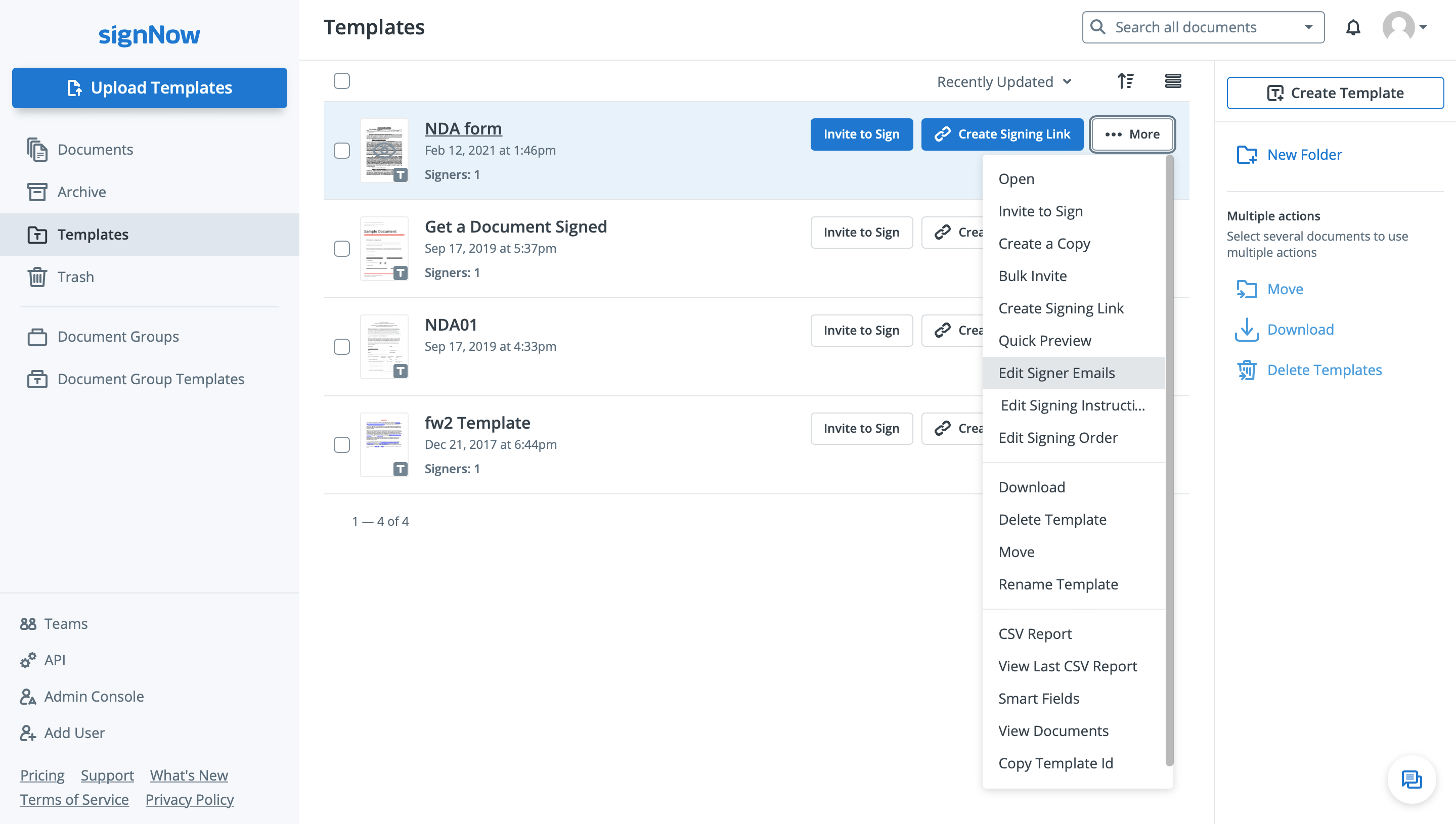
Personaliza correos para plantillas
Prellenar el asunto y el mensaje del correo para tus plantillas, para evitar ingresar datos una y otra vez. Ve a la pestaña Plantillas a la izquierda y haz clic en Más junto al nombre de la plantilla que necesitas configurar. Luego, haz clic en Editar correos del firmante.
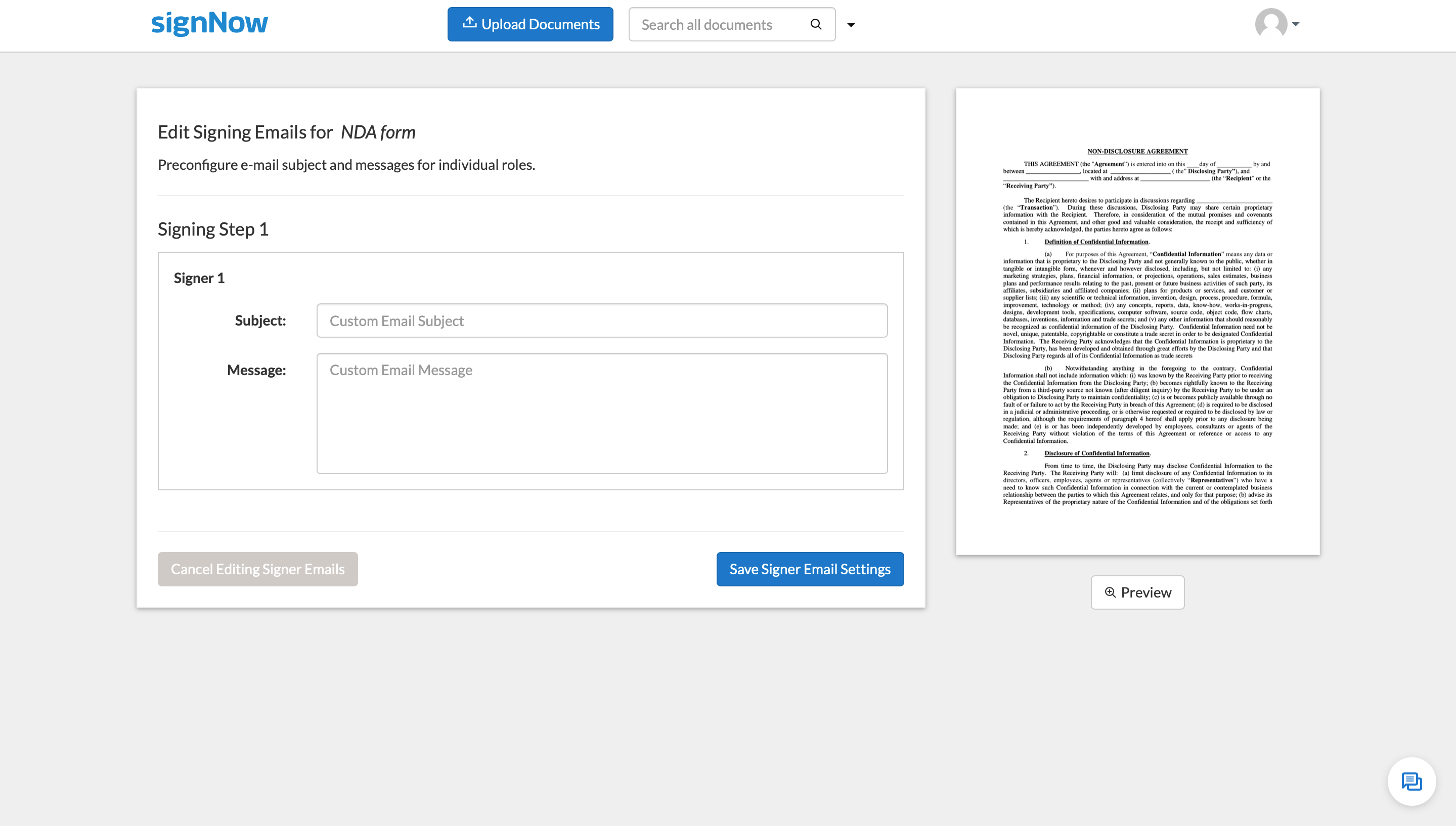
Ahora, simplemente llena los campos Asunto y Mensaje y haz clic en Guardar configuración de correo del firmante. A partir de ahora, todas las solicitudes de firma electrónica generadas desde esta plantilla se enviarán usando el asunto y el mensaje que has preestablecido.
Descubra más herramientas de firma electrónica
- Cómo cambiar la firma en Adobe PDF con airSlate ...
- Cómo cambiar la firma en Microsoft Mail fácilmente
- Cómo cambiar la firma en Zoho Mail fácilmente
- Cómo cambiar la firma de Outlook con airSlate SignNow
- Descubre cómo cambiar la firma en MS Outlook con ...
- Aprende Cómo Cambiar la Firma en Office Outlook ...
- Aprende Cómo Cambiar la Firma en Outlook 2010 ...
- Descubre cómo cambiar la firma en Outlook 2020 con ...
- Aprende cómo cambiar la firma en Outlook 365 en Mac ...
- Cambia tu firma en Outlook 365 Web fácilmente
- Cómo cambiar la firma en Outlook.com
- Aprende a cambiar la franja de firma en Outlook ...
- Cómo cambiar el color de una firma en PDF con airSlate ...
- Cómo cambiar la firma en Windows Live Mail
- Aprende a cambiar la firma en Windows Mail con airSlate ...
- Descubre cómo cambiar la firma en Outlook Mail sin ...
- Descubra cómo cambiar el color de su firma en Adobe
- Cómo cambiar la línea de firma en el correo ...
- Aprende a cambiar la firma en Adobe Fill and Sign ...
- Aprende a cambiar el nombre de la firma en Outlook ...












