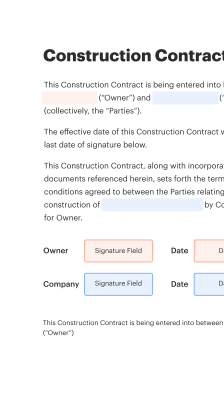
Firma Electrónica En Escritorio Fácil De Usar

Elimina papel y automatiza el procesamiento digital de documentos para mayor eficiencia y oportunidades ilimitadas. Disfruta de la mejor estrategia para hacer negocios con airSlate SignNow.

Solución de firma electrónica galardonada

What an electronic signature on desktop means

An electronic signature on desktop is a digital method for signing documents from a computer environment using software that records intent, signer identity, and a tamper-evident audit trail. In U.S. contexts, valid desktop eSignatures must satisfy ESIGN and UETA standards by capturing consent and preserving records. Desktop eSignature workflows often support document preparation, signer routing, multi-factor authentication, and integration with local or cloud storage. Organizations choose desktop-based signing for larger documents, complex templates, or when administrators need advanced configuration and centralized policy controls while maintaining secure, auditable records.

Why desktop eSignature can matter for organizations

Desktop electronic signatures reduce turnaround time, minimize printing and scanning, and improve document control with consistent templates and audit trails, helping teams meet regulatory and operational requirements.

Why desktop eSignature can matter for organizations

Common desktop signing challenges

  • Compatibility issues when desktop apps require specific OS versions or browser plug-ins for full functionality.
  • User onboarding friction for staff unfamiliar with digital signing workflows and authentication options.
  • Document formatting breaks when Word or PDF sources are not prepared for field placement or locking.
  • Ensuring legal admissibility across jurisdictions if identity verification and audit capture are insufficient.

Representative desktop eSignature users

Legal Counsel

Corporate counsel uses desktop eSignatures to prepare complex contracts, apply signature blocks, and maintain an unalterable audit trail. They rely on role-based access and version history to support compliance reviews and dispute resolution, ensuring contract integrity across negotiation rounds.

Sales Manager

Sales managers use desktop signing to send templated proposals and execute bulk sends for repeatable offers. They track signer status, apply automated reminders, and export completed agreements to CRM systems for pipeline and revenue recognition workflows.

Teams and roles that commonly use desktop eSignatures

Desktop eSignature solutions are used across legal, HR, sales, and finance teams that need controlled workflows and auditable records.

  • Legal departments handling agreements and redlines with multi-signer approval requirements.
  • Sales operations managing contracts that require prepared templates and bulk sending.
  • Human resources processing onboarding packets and consent forms needing signature capture.

Organizations select desktop signing when they require centralized policy control, integration with internal systems, and stronger administrative oversight.

Expanded feature checklist for desktop eSignature platforms

Evaluate a broad set of capabilities beyond basic signing to support enterprise needs and compliance obligations.

Bulk Send

Bulk Send enables a sender to distribute the same document to many recipients with individualized signing links, customizable fields, and aggregated status reporting to streamline mass agreement workflows.

Role-based access

Role-based access controls let administrators assign fine-grained permissions for template creation, sending, and audit viewing to protect sensitive workflows and enforce separation of duties.

Conditional fields

Conditional fields show or hide sections based on prior inputs, improving signer clarity and reducing the need for multiple document versions or manual edits.

Prefill data

Prefill capabilities populate known information from integrations or local directories to minimize signer effort and reduce data-entry errors during the signing process.

Document watermarking

Watermarking and access restrictions help prevent unauthorized distribution of draft or confidential documents prior to final execution and archival.

Compliance reporting

Built-in reporting provides visibility into signing activity, retention status, and policy adherence for audits and regulatory reviews.

prepárate para obtener más

Elige una mejor solución

Core desktop eSignature features to evaluate

When assessing desktop signing tools, prioritize secure authentication, auditability, integration options, and template management to support repeatable workflows.

Template library

A centralized template library lets administrators create reusable, locked templates with pre-placed fields, conditional logic, and assigned roles to reduce setup time and maintain consistent document structure across signers.

Audit trail

Comprehensive audit trails record signer events, timestamps, IP addresses, and document hashes to support chain-of-custody needs and assist legal admissibility for signed agreements.

Authentication options

Support for email verification, SMS one-time passcodes, and identity proofing provides layered assurance of signer identity appropriate for the document's risk level.

Integrations

Pre-built connectors for major CRMs, cloud storage, and business systems enable automatic routing of completed documents and reduce manual data entry across back-office systems.

How desktop electronic signing flows typically operate

A typical desktop signing flow includes document setup, recipient assignment, identity checks, signature capture, and archival with an audit trail.

  • Document setup: Upload and position required fields.
  • Routing: Set signing order and notifications.
  • Signer actions: Sign using mouse, trackpad, or typed signature.
  • Recordkeeping: Store signed document with audit log.
Recoger firmas
24x
más rápido
Reduce los costos en
$30
por documento
Guardar hasta
40h
por empleado / mes

Step-by-step: completing an electronic signature on desktop

Follow these core steps to prepare, send, and finalize a document using a desktop eSignature application.

  • 01
    Prepare document: Upload PDF or Word and add signature fields.
  • 02
    Add recipients: Define signer roles and signing order.
  • 03
    Authentication: Choose required identity verification methods.
  • 04
    Finalize: Send, monitor status, and download completed copies.

Grid: practical steps for administrators setting up desktop signing

Administrators can follow this checklist when configuring a desktop eSignature environment for teams.

01

Install client:

Deploy desktop application to workstations.
02

Configure SSO:

Enable single sign-on for user access.
03

Define roles:

Set sender and admin permissions.
04

Create templates:

Build reusable, locked templates.
05

Set retention:

Establish document lifecycle policies.
06

Train users:

Provide brief operational training.
prepárate para obtener más

Por qué elegir airSlate SignNow

  • Prueba gratuita de 7 días. Elige el plan que necesitas y pruébalo sin riesgos.
  • Precios honestos para planes completos. airSlate SignNow ofrece planes de suscripción sin cargos adicionales ni tarifas ocultas al renovar.
  • Seguridad de nivel empresarial. airSlate SignNow te ayuda a cumplir con los estándares de seguridad globales.
illustrations signature

Suggested default workflow settings for desktop signing

These common configuration settings help standardize signing workflows while balancing security and usability.

Setting Name Configuration
Reminder Frequency 48 hours
Signing Order Sequential or parallel
Default Authentication Email verification
Retention Period 7 years
Audit Log Export CSV or PDF

Desktop platform and browser requirements

Desktop eSignature applications typically require a modern operating system, up-to-date browser or a supported native client, and stable network connectivity for authentication and document exchange.

  • Operating systems: Windows 10+, macOS 10.13+
  • Browsers: Chrome, Edge, Safari supported
  • Network: TLS-enabled connectivity required

Validate compatibility with your organization's OS versions, single sign-on configuration, and endpoint security controls; confirm that any necessary plug-ins or client installers meet IT policies and that offline signing options are evaluated for continuity.

Security and authentication elements for desktop signing

Encryption at rest: AES-256 encryption
Encryption in transit: TLS 1.2 or higher
Multi-factor options: SMS or email OTP
Access controls: Role-based permissions
Audit logging: Detailed event records
Document locking: Tamper-evident seals

Industry examples of desktop electronic signatures

Desktop signing is used in regulated and operational workflows where control, auditability, and integration with local systems matter.

Healthcare consents

A hospital implements desktop eSignature for release forms to capture patient consent on clinician workstations

  • Role-based signing and identity verification
  • Reduces paper handling and streamlines recordkeeping

Leading to faster admissions and clearer audit records for HIPAA compliance.

Commercial contracting

A mid-sized manufacturer centralizes contract execution on desktop clients for complex purchase agreements

  • Template-driven field placement and version control
  • Ensures consistent clause application and signer accountability

Resulting in shorter negotiation cycles and reliable legal evidence in audits.

Best practices for secure and accurate desktop eSigning

Apply consistent processes and technical controls to reduce risk and ensure signatures are captured accurately and defensibly.

Standardize templates and fields across teams
Create locked templates with mandatory fields and clear role assignments to prevent missing data, reduce signer confusion, and maintain consistent contract language across multiple transactions.
Select appropriate authentication based on risk
Use simple email verification for low-risk documents and multi-factor or identity proofing for higher-value contracts or regulated information to balance usability and legal defensibility.
Maintain retention and audit policies
Define retention schedules and export completed agreements with audit logs to secure storage, aligning with internal policy and regulatory obligations such as HIPAA or FERPA where applicable.
Train staff on workflow and legal basics
Provide concise guidance on signer responsibilities, acceptable identity checks, and how to verify completed records to reduce errors and ensure compliance with ESIGN and UETA requirements.

FAQs About electronic signature on desktop

Answers to common questions about legal validity, security, and practical issues for desktop-based electronic signatures.

Feature availability: signNow and competitors

A concise feature availability snapshot comparing signNow with leading alternatives for desktop signing capabilities.

Feature signNow (Recommended) DocuSign Adobe Sign
Audit trail
Bulk Send
HIPAA support
API access
prepárate para obtener más

¡Obtenga firmas legalmente vinculantes ahora!

Typical signing timeline milestones

Sample timeline milestones describe how long each stage of a desktop signing process commonly takes.

01

Draft creation

1–2 days to prepare complex documents

02

Internal review

1–3 days for approvals and redlines

03

Send to signers

Immediate delivery upon send

04

Signer response

24–72 hours typical turnaround

05

Follow-ups

Automated reminders every 48 hours

06

Completion and archive

Immediate archival after final signature

07

Audit readiness

Records available on demand

08

Retention review

Annual policy verification

Common retention and deadline practices for signed desktop documents

Establish retention and access timelines aligned to legal, tax, and operational requirements to manage storage and retrieval efficiently.

Short-term access window:

30 days for quick retrieval

Standard retention period:

7 years for many agreements

Records for tax purposes:

Retain required financial docs

HIPAA-specific retention:

Follow covered entity requirements

Archival review cycles:

Annual policy review recommended

Risks and compliance consequences

Non-compliance fines: Civil penalties
Breach exposure: Regulatory investigations
Contract disputes: Admissibility challenges
Data loss: Operational impact
Privacy violations: Potential penalties
Operational delays: Workflow disruptions

Pricing posture and plan availability across vendors

High-level plan availability and positioning for signNow and major eSignature providers to inform cost comparisons and procurement planning.

Plan Metric signNow (Recommended) DocuSign Adobe Sign Dropbox Sign OneSpan Sign
Entry-level plan availability Individual and small business plans offered Personal and small business plans offered Individual plans available Individual plan available Primarily enterprise-focused offerings
Business plan offering SMB and business tiers with per-user billing Multiple business tiers with per-user billing Business plans integrated with Adobe ecosystem Business tiers with simple setup Enterprise and regulated-market plans
Enterprise capabilities Enterprise features and SSO available Extensive enterprise controls and compliance Enterprise integrations with Adobe stack Enterprise features through Dropbox business Enterprise-grade security and compliance focus
Free trial or demo Free trial or demo available for evaluation Free trial and sandbox options Free trial for individuals and businesses Free trial available Trial or demo available on request
Volume and contract pricing Volume discounts and enterprise contracts available Negotiated pricing for large accounts Volume pricing for enterprise agreements Volume pricing for business plans Customized enterprise pricing and contracts

Agiliza flujos de trabajo complejos

Crea, ejecuta y mantiene flujos de trabajo de cualquier complejidad, electrónicamente desde casi cualquier lugar. La funcionalidad escalable de firma electrónica te permite compartir documentos con los usuarios adecuados de la manera correcta y establecer roles para cada receptor. Completa los flujos de trabajo de documentos más rápido y más fácil que nunca.

Automatiza la gestión de documentos

Optimiza procesos complicados de firma con las capacidades efectivas de airSlate SignNow para potenciar tu negocio. Gestiona tus flujos de firma automatizados para asegurar que funcionen con máxima eficiencia mediante notificaciones y alertas rápidas.

Mejora la comunicación en equipo

Reúne a los equipos en un entorno seguro y compartido. Gestiona documentos, usa plantillas de formularios y notificaciones para crear una interacción más efectiva entre empresas. Libera a tus empleados de tareas repetitivas para que puedan concentrarse en tareas beneficiosas y cruciales para el negocio.

Integra en tu marco existente

Trabaja en tus tareas con integración de primera clase. Integra Salesforce, Microsoft Teams y SharePoint en un solo flujo de negocio. Conecta tus aplicaciones en una sola unidad para posibilidades infinitas y mayor eficiencia.

Permanece conforme con la seguridad de datos líder en mercado

Siente confianza sabiendo que tus datos permanecen seguros con la encriptación más actualizada. airSlate SignNow cumple con GDPR y eIDAS y te proporciona transparencia en tu proceso de firma electrónica con registros de auditoría admisibles en corte. Configura la autorización y derechos de usuario para gestionar quién tiene acceso a qué.


walmart logo
exonMobil logo
apple logo
comcast logo
facebook logo
FedEx logo
esté listo para obtener más

¡Obtenga ahora firmas vinculantes desde el punto de vista jurídico!