eSign Individually with SignNow's Secure Solution

Remove paperwork and improve digital document management for increased productivity and unlimited possibilities. Enjoy a greater strategy for running your business with airSlate SignNow.

Solución de firma electrónica galardonada

Qué es esign individually y por qué importa

esign individually es el proceso de firmar electrónicamente un documento por una sola persona mediante una plataforma segura y verificable. En el contexto de empresas y organizaciones en Estados Unidos, esta modalidad permite obtener consentimientos y acuerdos con validez legal bajo ESIGN y UETA, generar un registro auditable de cada firma y reducir tiempos administrativos. Además, facilita integración con flujos digitales existentes, manteniendo controles de acceso y autenticación que protegen la integridad del documento y la identidad del firmante, sin necesidad de imprimir, escanear ni enviar versiones en papel.

Ventajas rápidas de implementar esign individually

Significa menor tiempo de gestión, menor riesgo de pérdida y un registro legalmente admisible en EE. UU.

Ventajas rápidas de implementar esign individually

Retos comunes al usar esign individually

  • Dificultad de validar identidad sin medidas de autenticación robustas.
  • Formatos incompatibles que requieren preparación manual del documento.
  • Confusión sobre requisitos regulatorios específicos por industria.
  • Gestión de retención y eliminación conforme a políticas internas.

Perfiles de usuarios típicos

Administrador de TI

Gestiona la configuración de seguridad, integraciones y permisos de la plataforma. Coordina autenticación multifactor y políticas de retención para alinear la solución con las normativas internas y requisitos de cumplimiento.

Responsable de Contratos

Prepara plantillas, define el orden de firma y supervisa el flujo de documentos. Asegura que cada contrato incluya campos obligatorios y que los registros de auditoría estén completos para auditorías futuras.

Quién utiliza esign individually en la práctica

Organizaciones de distintos tamaños usan esign individually para firmar acuerdos, formularios y aprobaciones con rapidez y trazabilidad.

  • Departamentos legales que necesitan registros auditables y prueba de consentimiento.
  • Recursos humanos para contratos laborales y autorizaciones internas.
  • Ventas y operaciones para acuerdos de clientes y órdenes de compra.

El uso se extiende a proveedores y clientes que requieren una experiencia de firma clara y conforme a la normativa de EE. UU.

Herramientas avanzadas que mejoran esign individually

Características adicionales que aportan control, eficiencia y cumplimiento en procesos de firma individual.

Audit Trail

Registro detallado de cada interacción con el documento, incluyendo visualizaciones, envíos y la información técnica necesaria para demostrar integridad en auditorías.


Autenticación multifactor

Permite combinar correo, SMS o autenticación basada en aplicaciones para verificar la identidad del firmante y reducir el riesgo de suplantación.

Sello de tiempo

Incorpora marcas temporales verificables que dejan constancia exacta del momento de la firma, útil para validez legal y conservación probatoria.

Personalización de roles

Definir permisos por rol para limitar edición, visualización y opciones de firma según responsabilidades dentro del flujo documental.

Conservación y retención

Configuración de políticas de retención y eliminación automática que cumplen requisitos internos y regulatorios en Estados Unidos.

APIs y webhooks

Puntos de integración que permiten automatizar envíos, recibir notificaciones en tiempo real y conectar la firma individual con sistemas empresariales.

prepárate para obtener más

Elige una mejor solución

Funciones clave para gestionar esign individually

Funciones esenciales que facilitan la firma individual segura y la integración con procesos de negocio existentes.

Plantillas reutilizables

Crear y gestionar plantillas reduce la preparación manual; permite campos obligatorios y variables que garantizan consistencia en documentos recurrentes sin necesidad de recrearlos cada vez.

Autenticación avanzada

Opciones de autenticación por correo, SMS o verificación de identidad ayudan a confirmar la identidad del firmante y fortalecer la admisibilidad legal del proceso.

Historial y auditoría

Registro cronológico de acciones, direcciones IP y sellos de tiempo que respaldan integridad y ofrecen evidencia en caso de disputa legal o revisión.

Integraciones comunes

Conexión con CRM, almacenamiento en la nube y sistemas de gestión documental para automatizar el flujo y archivado tras cada firma individual.
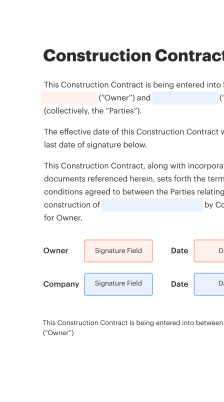
Cómo funciona esign individually paso a paso

Proceso típico: edición, asignación de firmante, firma y registro, todo con trazabilidad completa.

  • Edición: Preparar campos y roles en el documento.
  • Asignación: Designar al firmante individual y método de autenticación.
  • Firma: Firmante completa y valida el documento electrónicamente.
  • Registro: Generar y conservar el historial de auditoría.
Recoger firmas
24x
más rápido
Reduce los costos en
$30
por documento
Guardar hasta
40h
por empleado / mes

Pasos rápidos para completar esign individually

Siga estos pasos básicos para preparar, enviar y archivar un documento para firma individual.

  • 01
    Preparar documento: Cargar PDF y ubicar campos de firma.
  • 02
    Configurar firmante: Añadir datos de contacto y autenticación.
  • 03
    Enviar para firma: Enviar por correo electrónico o enlace seguro.
  • 04
    Guardar registro: Almacenar con auditoría y sello temporal.
prepárate para obtener más

Por qué elegir airSlate SignNow

  • Prueba gratuita de 7 días. Elige el plan que necesitas y pruébalo sin riesgos.
  • Precios honestos para planes completos. airSlate SignNow ofrece planes de suscripción sin cargos adicionales ni tarifas ocultas al renovar.
  • Seguridad de nivel empresarial. airSlate SignNow te ayuda a cumplir con los estándares de seguridad globales.
illustrations signature

Configuración de flujo para esign individually

Parámetros sugeridos para automatizar envíos, recordatorios y la conservación del documento firmado.

Feature Configuration
Reminder Frequency 48 hours
Signature Expiration 30 days
Default Storage Location Cloud archive
Notification Settings Email and SMS

Requisitos técnicos para usar esign individually

Compatibilidad básica: navegador moderno, conexión segura y cuenta configurada con permisos adecuados.

  • Navegadores soportados: Chrome, Edge, Safari
  • Conexión: TLS 1.2+
  • Dispositivos: Móvil, tablet y escritorio

Para integraciones avanzadas se recomiendan credenciales API, claves seguras y pruebas en entorno sandbox antes de desplegar en producción.

Controles y protección en esign individually

Cifrado: Cifrado AES-256
Transporte seguro: TLS 1.2+
Autenticación: MFA opcional
Integridad: Sellos de tiempo
Acceso: Roles y permisos
Registros: Auditoría completa

Casos de uso sectoriales de esign individually

Escenarios reales muestran cómo una firma individual digital optimiza procesos en distintos sectores y mantiene cumplimiento regulatorio.

Sector salud

Un hospital digitaliza consentimientos médicos en formularios electrónicos para pacientes

  • Integración con el registro clínico electrónico
  • Reduce tiempos de admisión y errores de transcripción

Resultando en mejor cumplimiento HIPAA y procesos de atención más eficientes.

Recursos humanos

Una empresa contrata personal remoto usando firmas electrónicas para contratos de trabajo

  • Plantillas estandarizadas y campos obligatorios
  • Acelera incorporación y asegura almacenamiento seguro

Garantizando trazabilidad y cumplimiento de retención documental.

Buenas prácticas para firmar individualmente con seguridad

Recomendaciones operativas para minimizar riesgos y asegurar validez legal en firmas individuales.

Verificar identidad antes del envío
Confirme la identidad del firmante mediante correo verificado, SMS o procesos KYC cuando corresponda para aumentar la fuerza probatoria del registro de firma.
Estandarizar plantillas y campos obligatorios
Utilice plantillas para documentos recurrentes y marque campos críticos como obligatorios para evitar omisiones que puedan invalidar acuerdos o generar disputas.
Mantener registros de auditoría completos
Asegure la conservación de sellos de tiempo, direcciones IP y secuencia de eventos; estos registros son esenciales para defensas legales y comprobación de integridad.
Aplicar controles de acceso y permisos
Limite ediciones y descargas mediante roles definidos; registre cambios administrativos y mantenga revisiones periódicas de usuarios y privilegios.

Preguntas frecuentes y solución de problemas sobre esign individually

Respuestas prácticas a dudas habituales sobre firma individual, autenticación, cumplimiento y problemas técnicos.

Comparativa rápida de proveedores para esign individually

Comparación de disponibilidad de funciones clave entre proveedores líderes del mercado enfocados en firmas individuales.

Criteria signNow (Recommended) DocuSign Adobe Sign
Bulk Send
API REST REST API REST API REST API
Cumplimiento HIPAA
Autenticación multifactor
prepárate para obtener más

¡Obtenga firmas legalmente vinculantes ahora!

Riesgos y consecuencias de prácticas deficientes

Firmas no verificadas: Disputas contractuales
Configuración insegura: Pérdida de datos
Retención insuficiente: Sanciones regulatorias
Acceso no autorizado: Exposición legal
Logs incompletos: Fallas en auditoría
Dependencia de papel: Costes continuos

Comparación de modelos de precio para esign individually

Resumen comparativo de planes y características de coste habituales entre proveedores relevantes en el mercado estadounidense.

Criteria signNow (Recommended) DocuSign Adobe Sign Dropbox Sign PandaDoc
Plan inicial (precio por usuario) Desde $8 por usuario/mes Desde $10 por usuario/mes Desde $12 por usuario/mes Desde $15 por usuario/mes Desde $19 por usuario/mes
Prueba gratuita disponible Sí, periodo limitado Sí, periodo limitado Sí, periodo limitado Sí, periodo limitado Sí, periodo limitado
API incluida en plan API en planes intermedios API en planes profesionales API en planes empresariales API disponible API disponible
Soporte empresarial Opciones SLA y soporte dedicado SLA opcional SLA opcional Soporte por tiers Soporte por tiers
Funcionalidades avanzadas incluidas Plantillas, Bulk Send, auditoría completa Firmas avanzadas, plantillas Gestión y workflows Firmas básicas y plantillas Envíos y plantillas

Streamline complicated workflows

Create, deliver, and maintain workflows of any complexity, electronically from almost anywhere. Scalable eSignature capabilities allow you to share papers with the right people in the correct way and set up roles for each signee. Perform document workflows faster and simpler than ever before.

Automate document flow

Improve complex signing tasks with airSlate SignNow�s highly effective features to boost your business. Take control of your automatic eSignature workflows to ensure they're running at top functionality with immediate notifications and reminders.

Optimize in team collaboration

Join teammates together in a protected, shared environment. Handle documents, use form templates and notifications to deliver more efficient cross-organization communication. Relieve your workers from having to hang out on repeated activities to enable them to center on valuable, business-vital projects.

Integrate into your current systems

Work your jobs with best-in-class integration. Collect Salesforce, Microsoft Teams, and SharePoint all in one business stream. Connect your applications to a single environment for limitless opportunities and more productiveness.

Remain compliant with market-leading data security

Feel confident understanding that your data is protected by the latest in encryption security. airSlate SignNow is GDPR and eIDAS compliant and provides you awareness into your signing process with court-admissible audit trails. Set up user access permissions and roles to manage who has access to what.

ESIGN and eIDAS regulations

Today all developed and most of developing countries have separate legal acts confirming the legality of electronic signatures on their territories. Two most frequently mentioned of them are ESIGN in the USA and eIDAS of the European Union. Legislation on eSigning in other countries worldwide have been developed mostly after these two, using them as best practices.

So, what exactly does legislation say about eSigning?

ESIGN Act

ESIGN was actually not the first legal act in the United States concerning eSigning. Its precursor was UETA - Uniform Electronic Transactions Act, adopted by 47 states and the District of Columbia back in 1999. The UETA confirmed that if all parties agreed to proceed with signing electronically, their later eSignatures must be considered as fully legal and equal to standard on-paper signatures.

UETA became the legal basis for a federal law passed in 2000, it got the name of ESIGN Act.

In a nutshell, both UETA and ESIGN Act are all about two key provisions:

  • Signature in its electronic form cannot be denied its legal effect;
  • Any contract signed electronically cannot be denied legal effect solely because of electronic signature.

Apart from granting full legality to electronic signatures, ESIGN Act also sets quite strict requirements to electronic signing procedures:

  1. Electronic signature will be considered legal only if the signer has clearly demonstrated the intention to sign.
  2. Prior to eSigning itself, the parties must consent to do business electronically. Also, all signers must have an option to withdraw their consent to do business electronically and choose on-paper signing instead.
  3. An electronic signature must be accompanied by an electronic record which clearly reflects the process of eSignature creation.
  4. Records retention requirement: electronic records on the signature must remain accessible to all legally entitled parties. All parties involved in eSigning must be properly instructed on how to access these records.

Any rules has its exceptions. ESIGN Act does not apply to the following types of documents:

  • All documents related to courts' functioning, including court orders in the first place;
  • Nearly all documents related to life and/or health insurance;
  • Wills, codicils, testamentary trusts;
  • Any other matter in the field of family law, including marriage, divorce and adoption;
  • Official recalls of products in cases when the latter are endangering safety or health of their users/consumers;
  • All documents related to transportation of toxic or other hazardous materials;
  • Notices on utility services' termination.

eIDAS Regulation

eIDAS stands for 'electronic identification and trust services'. As it is obvious from the name, the core here is identification and authenticity verification.

The eIDAS Regulation was approved by the Council of the European Union back in 2014, but came into effect on 01 July, 2016, thus replacing the Electronic Signature Directive. The Regulation is equally applicable to all EU country members.

(It is also applicable to the UK though there are several additional provisions - the UK eIDAS Regulations)

eIDAS has two parts.

The first part covers the issues of citizens' identification through electronic IDs across the whole EU. This section concerns mostly the public sector and has very little and indirect effect on business.

The second part deals directly with electronic signatures. It sets the rules on how eSigning and e-sealing can be applied in all EU member countries.

What's inside this second part? Translating from the legal language into simple one, the key regulations are as follows:

  • Electronic signatures, electronic seals and their timestamps shall be treated as court-admissible evidence in legal proceedings;
  • The Regulation differentiates between three types of electronic signatures: simple electronic signature; advanced electronic signature (AdES); qualified electronic signature (QES);
  • Electronic seal gets the same recognition as electronic signature but is available for use by legal entities only. (This indirectly means that in many business situations, if need be, electronic seal can be used instead of an eSignature by an authorized top manager).

Now let's clarify what are these three types of eSignatures differentiated by the eIDAS Regulation?

Simple electronic signature - can be service-based (performed in a software) or just drawn by hand using desktop or mobile device (using a stylus on a touchscreen, for example). In a nutshell, this is just a digital image of your signature.

Advanced electronic signature - an eSignature, the authenticity of which is confirmed by a digital certificate issued by a certified authority. This means that prior to eSigning itself, the signer needs to get a certificate from a certified authority. Then, in the process of eSigning, this encrypted certificate is 'attached' to the signature using a secret key known to the signer. The key can be installed on a computer or can be stored alternatively, on a separate smart card, for example. Digital certificate attached to eSignature confirms: a) identity of the signer; b) that no changes have been made in the document after it was eSigned.

Qualified electronic signature: the key difference of qualified electronic signature from advanced electronic signature is that the former has a qualified certificate attached. This certificate can be issued only by a qualified service provider. Qualified certificates must be stored on a qualified signature creation device (USB token, smart card or in a secure cloud). This is the most preferable type of eSigning on the EU territories as only QES is treated as a fully legally binding eSignature.

What is the difference between the US and European approaches to electronic signatures?

The US definition of electronic signature is much broader and does not insist on a particular technology to be applied. It covers mostly the procedures required in the course of eSigning (demonstration of the intention to eSign, decline to sign option, retention of records).

In contrast, European regulations differentiate between three types of eSignature. Moreover, when it comes to public sector use, European laws provide quite specific requirements to eSigning.

Also note that eIDAS leaves all EU member countries an option to specify the list of documents that should not be eSigned and should be sign on paper instead. In most cases such documents would be wills, powers of attorney and statements made under oath. Though each particular state within the EU has the right to amend this list, thus, it is usually recommended to consult a local lawyer in case you are dealing with a highly specific type of document.

walmart logo
exonMobil logo
apple logo
comcast logo
facebook logo
FedEx logo
esté listo para obtener más

¡Obtenga ahora firmas vinculantes desde el punto de vista jurídico!