Ajouter Des Champs Conditionnels Au Document Pour La Signature électronique

Faites en sorte qu'un destinataire de votre document remplisse certaines conditions pour voir et remplir les champs conditionnels. Cette fonctionnalité garantit que votre document sera complété correctement.

Solution eSignature primée

What it means to add conditional fields to the document

Adding conditional fields to the document refers to configuring form fields that appear, hide, or change behavior based on prior inputs, role assignments, or logical rules during a signing session. In eSignature platforms like signNow, conditional fields let creators tailor the document experience so recipients only see relevant fields, reduce entry errors, and enforce required data collection. This capability supports branching workflows, dynamic pricing sections, and adaptive disclosures while preserving a single source document. Proper configuration improves accuracy and streamlines downstream processing for recordkeeping and integrations.

Why add conditional fields to your documents

Conditional fields reduce clutter, limit user errors, and ensure only relevant data is requested, improving form completion rates and operational consistency across signing workflows.

Why add conditional fields to your documents

Common challenges when implementing conditional fields

  • Designing rules that cover every recipient scenario without creating conflicting logic can be complex and time-consuming.
  • Failing to test conditional flows often results in hidden required fields or sections that block completion unexpectedly.
  • Poorly named fields or unclear conditions increase maintenance overhead when templates change or new variables are introduced.
  • Integrations and data mappings may break if conditional outputs vary in format or expected field keys.

Representative user profiles

Sales Manager

A sales manager uses conditional fields to present pricing and optional products only when a buyer selects certain packages. They rely on templates to reduce negotiation time and ensure all required acceptance checkboxes and signature fields appear when applicable, minimizing back-and-forth with customers.

HR Administrator

An HR administrator configures conditional fields for new hires so only applicable tax, benefits, and confidentiality sections appear based on employee status and location. This reduces data entry errors and ensures documents collected meet internal policy and recordkeeping standards.

Teams and roles that typically use conditional fields

Legal, HR, sales, and operations teams often use conditional fields to tailor forms by role or transaction type.

  • Sales teams for quotes and order forms that change with selected options.
  • HR for onboarding forms that differ by employment type or location.
  • Legal and compliance for disclosures that vary by jurisdiction or user responses.

Conditional logic is also useful for IT and integrations teams that route data to downstream systems only when necessary.

Advanced capabilities to enhance conditional fields

Beyond basics, advanced features reduce errors and scale conditional logic across enterprise templates and integrations.

Nested logic support

Nested or hierarchical conditions allow multi-level decisioning so later fields react to combined earlier choices, enabling complex forms like multi-option benefit selections or tiered pricing calculators.

API-driven values

Dynamic values fetched via API let conditional fields populate options or defaults based on external data, such as account status, inventory levels, or previously stored customer preferences.

Version control for templates

Template versioning preserves prior conditional rules and document snapshots so teams can roll back changes or audit which rule set applied to a signed document.

Bulk test and validation

Automated test suites can run multiple conditional scenarios across templates to detect rule conflicts, missing mappings, or unreachable fields before templates are published to production.

Role and permission enforcement

Granular permissions control who may create, edit, or publish conditional rules, reducing governance risks and ensuring only authorized staff change live templates.

Cross-template variables

Shared variables let multiple templates reference the same conditional parameters, keeping business logic consistent and simplifying updates across related documents.

soyez prêt à en obtenir plus

Choisissez une meilleure solution

Core tools to support conditional field logic

Several practical features within an eSignature solution make conditional fields manageable, testable, and maintainable across templates and workflows.

Visual rule builder

A drag-and-drop rule builder simplifies creation of conditional logic by letting administrators combine field triggers, logical operators, and target field actions without writing code, while providing a readable rule summary for audits and reviews.

Role-based rules

Rules tied to signer roles ensure that only designated recipients see specific fields; this isolates sensitive questions, limits editing to authorized parties, and supports multi-role document flows in contracts and agreements.

Preview and testing

Built-in preview tools allow creators to simulate multiple signer scenarios, test conditional outcomes, and capture screenshots or logs of each path to validate expected behavior before sending to external recipients.

Data mapping

Conditional outputs can be consistently mapped to external systems using stable field keys, enabling predictable integrations with CRMs, ERPs, or document storage while preserving the conditional context.

How conditional fields operate during signing

Understanding runtime behavior helps avoid surprises: conditions evaluate in order, impacting field visibility and validation dynamically.

  • Input evaluation: Conditions evaluate when a triggering field value changes.
  • Visibility toggles: Fields are shown or hidden without reloading the document.
  • Validation rules: Required status updates based on active conditions.
  • Data propagation: Visible fields submit values for integrations and audit logs.
Collecter les signatures
24x
plus rapide
Réduire les coûts de
$30
par document
Économisez jusqu'à
40h
par employé / mois

Step-by-step: configure conditional fields in a template

Follow these four essential steps to add conditional fields to the document template and verify behavior prior to production use.

  • 01
    Draft template: Upload document and add base fields where static input is needed.
  • 02
    Define triggers: Create conditions based on field values, checkboxes, or signer role.
  • 03
    Assign visibility: Set field visibility or requirement states tied to each trigger.
  • 04
    Test flows: Run signings for each scenario and validate data mappings and completeness.
soyez prêt à en obtenir plus

Pourquoi choisir airSlate SignNow

  • Essai gratuit de 7 jours. Choisissez le forfait dont vous avez besoin et essayez-le sans risque.
  • Tarification honnête pour des forfaits complets. airSlate SignNow propose des abonnements sans frais supplémentaires ni frais cachés lors du renouvellement.
  • Sécurité de niveau entreprise. airSlate SignNow vous aide à respecter les normes de sécurité mondiales.
illustrations signature

Recommended workflow settings for conditional fields

The following settings describe a typical configuration to enable conditional fields, enforce testing, and maintain template governance across teams.

Workflow Setting Name and Configuration Details Default configuration and recommended values
Conditional Fields Activation and Scope Enable conditional logic for templates and limit scope to specific user groups or roles
Rule Testing and Validation Procedures Require test signings and checklist validation before publishing templates to production
Template Versioning and Change Approval Enable version control and require approvals for changes to conditional rules
Audit Logging and Rule Change Tracking Capture rule edits, user IDs, and timestamps for compliance review
Integration Mapping and Field Key Management Enforce stable field keys and document mapping guidelines for external systems

Platform and device considerations for conditional field use

Ensure the eSignature platform and recipient devices support dynamic field logic, modern browsers, and current mobile OS versions for consistent behavior.

  • Supported browsers: Latest Chrome, Safari, Edge
  • Mobile OS: iOS and Android recent versions
  • PDF compatibility: Flattened vs interactive forms

Test conditional templates across web, iOS, and Android devices and validate how PDFs render when exported or archived; ensure integrations handle conditional outputs consistently to preserve data integrity and compliance.

Security controls relevant to conditional fields

Field-level access: Restrict who can view or edit fields
Role-based visibility: Show fields per signer role
Data masking: Hide sensitive values in view mode
Encryption at rest: Protect stored field data
Transport encryption: TLS for data in transit
Audit logging: Track changes to conditional rules

Industry examples using conditional fields

Two concise examples show how conditional fields streamline common workflows in regulated and commercial settings.

Healthcare intake form

A provider uses conditional fields to show insurance, consent, and medical history sections only when patients indicate relevant conditions

  • Rules reference selected checkboxes and role-based access for staff
  • The form maps conditional outputs to the EHR and billing system with consistent field keys

Resulting in fewer entry errors, faster intake, and clearer audit trails for HIPAA compliance.

Variable commission agreement

A sales organization configures conditional fields to display commission tiers only when sales exceed defined thresholds

  • Logic is based on numeric inputs and product selections
  • Conditional outputs feed the CRM and payroll system to automate payouts

Leading to accurate commission calculations, reduced manual reconciliation, and auditable records for finance.

Best practices for reliable conditional field setups

Follow these practical practices to design conditional fields that are maintainable, testable, and compliant within organizational processes.

Use descriptive field names and stable identifiers
Choose clear, consistent names and unchanging field keys so rules remain understandable and external integrations continue to map values correctly when templates evolve. This reduces errors and simplifies audits.
Limit nesting depth and document complexity
Avoid deeply nested conditions that are hard to reason about; keep logic flat where possible and split complex flows into multiple templates or sequential steps to improve maintainability and reduce testing scope.
Document rules and test cases for each template
Maintain a short rulebook and a set of representative test signings for each template to ensure every conditional path is validated. Include expected data outputs for integration fields to catch mapping issues early.
Assign governance and review cycles for rule changes
Establish who can modify conditional logic, require peer review for significant changes, and keep a change log to meet compliance and to enable rollback if an unintended behavior is introduced.

FAQs and troubleshooting for conditional fields

Common questions and solutions for conditional field configuration, testing, and integration issues when adding conditional fields to the document.

How signNow compares for conditional field capabilities

A concise comparison of conditional field availability and key technical details across common enterprise eSignature vendors, with signNow presented first as Recommended.

Comparison Criteria and Vendor Options signNow (Recommended) DocuSign Adobe Sign
Conditional Fields Availability
Visual Rule Builder
Nested Logic Support Limited
API Access to Conditional Events
soyez prêt à en obtenir plus

Obtenez des signatures juridiquement contraignantes dès maintenant !

Risks and compliance considerations

Incomplete records: Missing required data
Regulatory exposure: Noncompliant disclosures
Data leakage: Unintended field visibility
Signature validity: Questioned intent or consent
Integration failures: Broken data flows
User confusion: Increased support requests

Pricing and plan differences affecting conditional fields

Plan features and pricing commonly influence access to advanced conditional field tools; signNow is listed first as Recommended and shown alongside other major vendors.

Vendor and Plan Header signNow (Recommended) DocuSign Adobe Sign PandaDoc HelloSign
Conditional Field Availability by Plan Included in business plans and above Advanced plans required Enterprise plans required Business plan add-on Available in higher tiers
API and Integration Access Available on business and enterprise Enterprise API Enterprise API Available on business Available on business
Template Versioning and Governance Included in enterprise and business plans Enterprise-level Enterprise-level Included in enterprise Included in higher tiers
Starting Price for Business Plan From $8/user/month From $10/user/month From $16/user/month From $15/user/month From $15/user/month
Support and SLAs Business support; enterprise SLAs optional Enterprise SLAs Enterprise SLAs Business support Business support

Comment ajouter des champs conditionnels avec airSlate SignNow

Si vous souhaitez que vos formulaires remplissables aient une apparence plus professionnelle tout en assurant la cohérence et la précision du processus de complétion, envisagez de configurer des champs conditionnels. Un champ conditionnel devient disponible pour le remplissage une fois qu'un autre champ spécifié (ou plusieurs) est rempli (ou laissé vide).

Supposons que vous ayez besoin que quelques champs de texte apparaissent dans un formulaire sous la condition qu'une de vos cases à cocher soit cochée. Voici comment faire avec airSlate SignNow.

Ajouter des champs remplissables

Sélectionnez le Champ de case à cocher dans la barre d'outils à gauche et déposez-le sur votre document. Ajoutez autant de champs de case à cocher que nécessaire
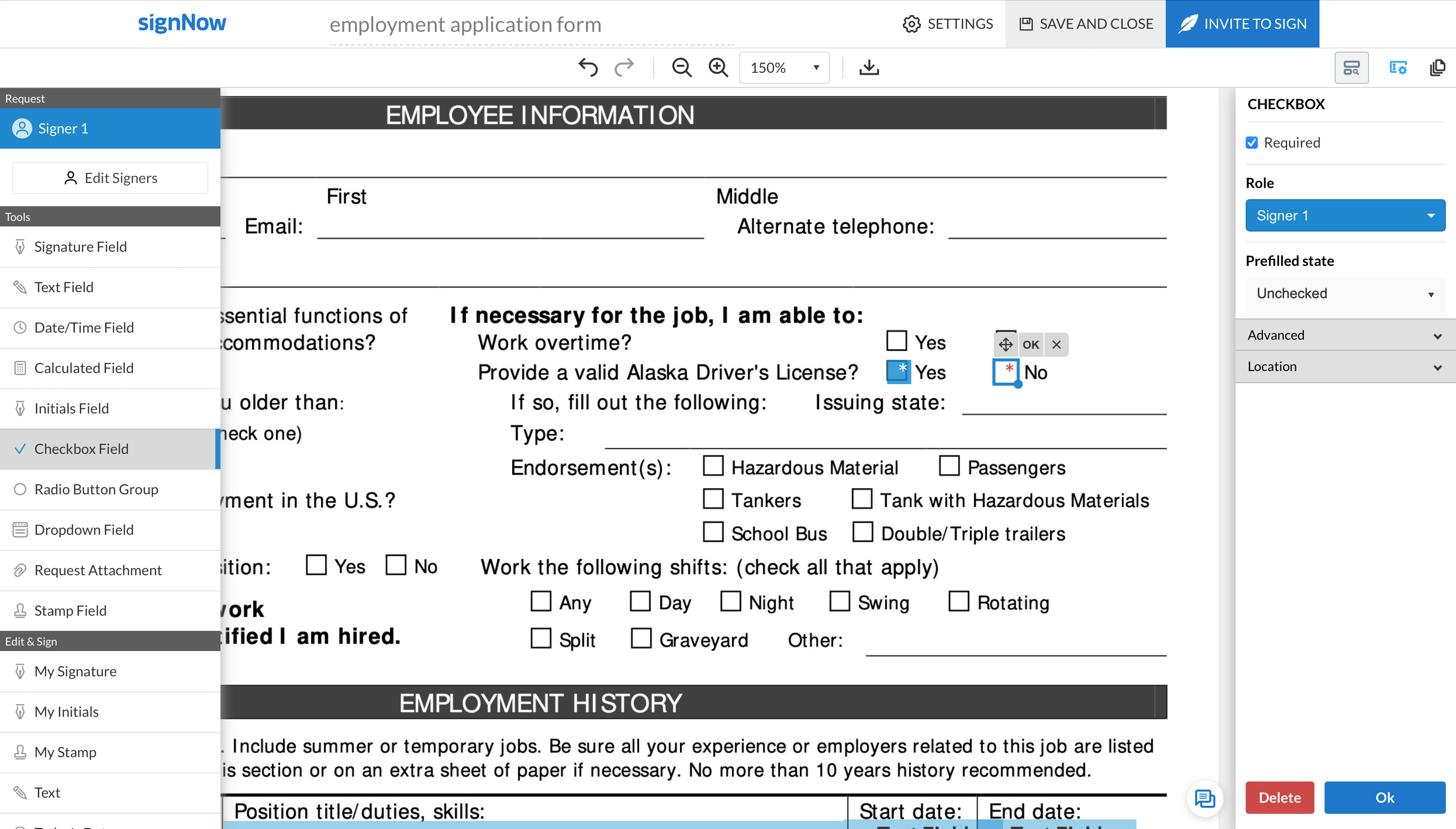
illustration-guide-remplissage

Puis, ajoutez des champs de texte. Ajustez leur taille et leur positionnement pour qu'ils s'intègrent correctement dans les espaces vides.
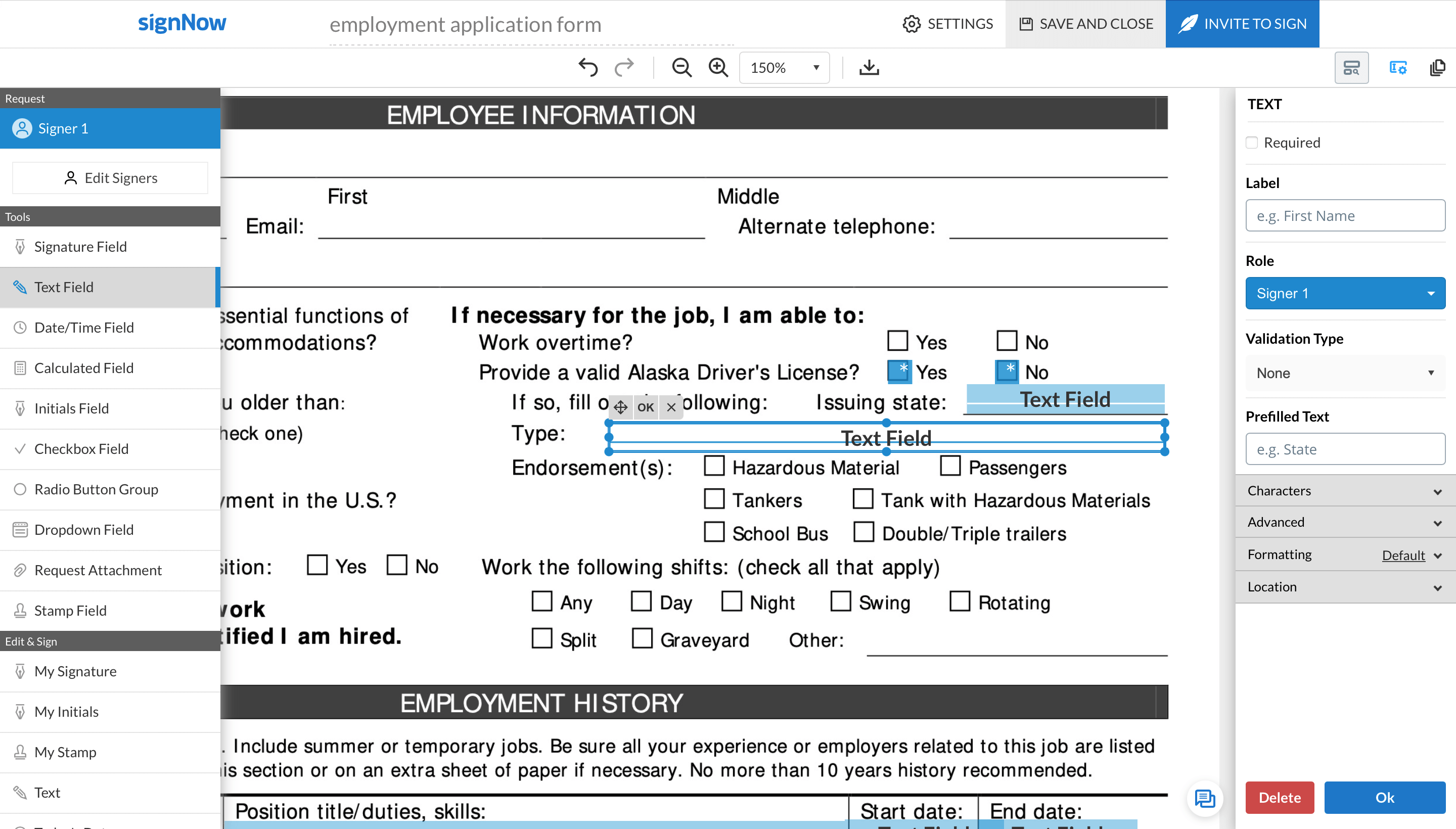
illustration-guide-remplissage

Rendre les champs conditionnels

Vous devez maintenant vous assurer que vos champs de texte ne deviennent visibles que si votre destinataire coche la case Oui.

Sélectionnez le premier champ de texte, ouvrez le menu déroulant Avancé dans la barre latérale à droite, et cochez la case Rendre ce champ conditionnel.
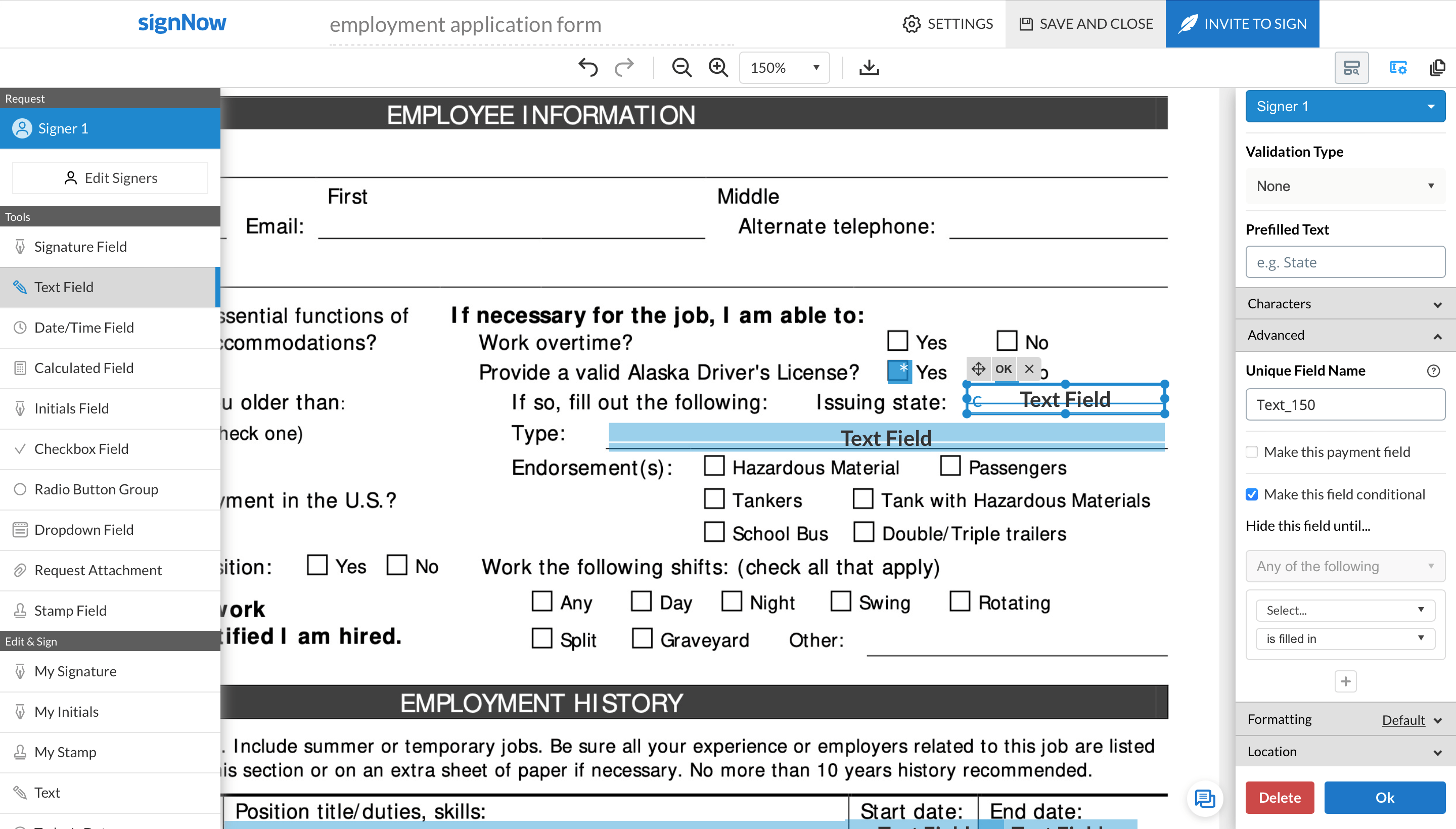
illustration-guide-remplissage

Choisissez le champ qui déclenchera la condition. Ouvrez le menu déroulant supérieur dans la section Masquer ce champ jusqu'à et sélectionnez Choisir en cliquant. Cliquez sur la case Oui que vous avez ajoutée précédemment.
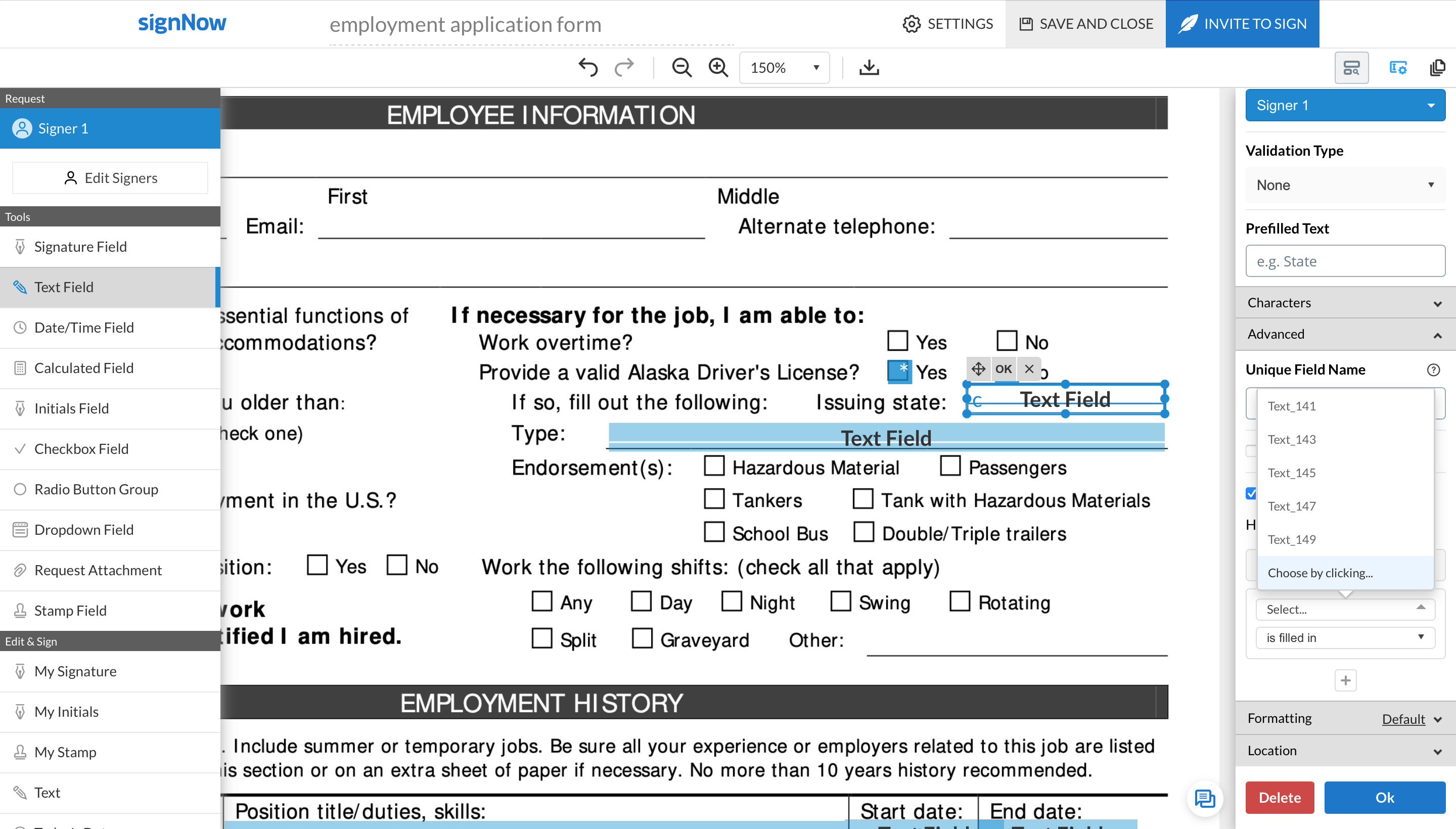
illustration-guide-remplissage

Enfin, sélectionnez la condition pour le champ choisi. Dans notre cas, il faut que la case Oui soit cochée pour déclencher la condition. Sélectionnez l'option correspondante dans le menu déroulant inférieur et cliquez sur Ok pour terminer. Répétez le même processus pour le deuxième champ de texte.
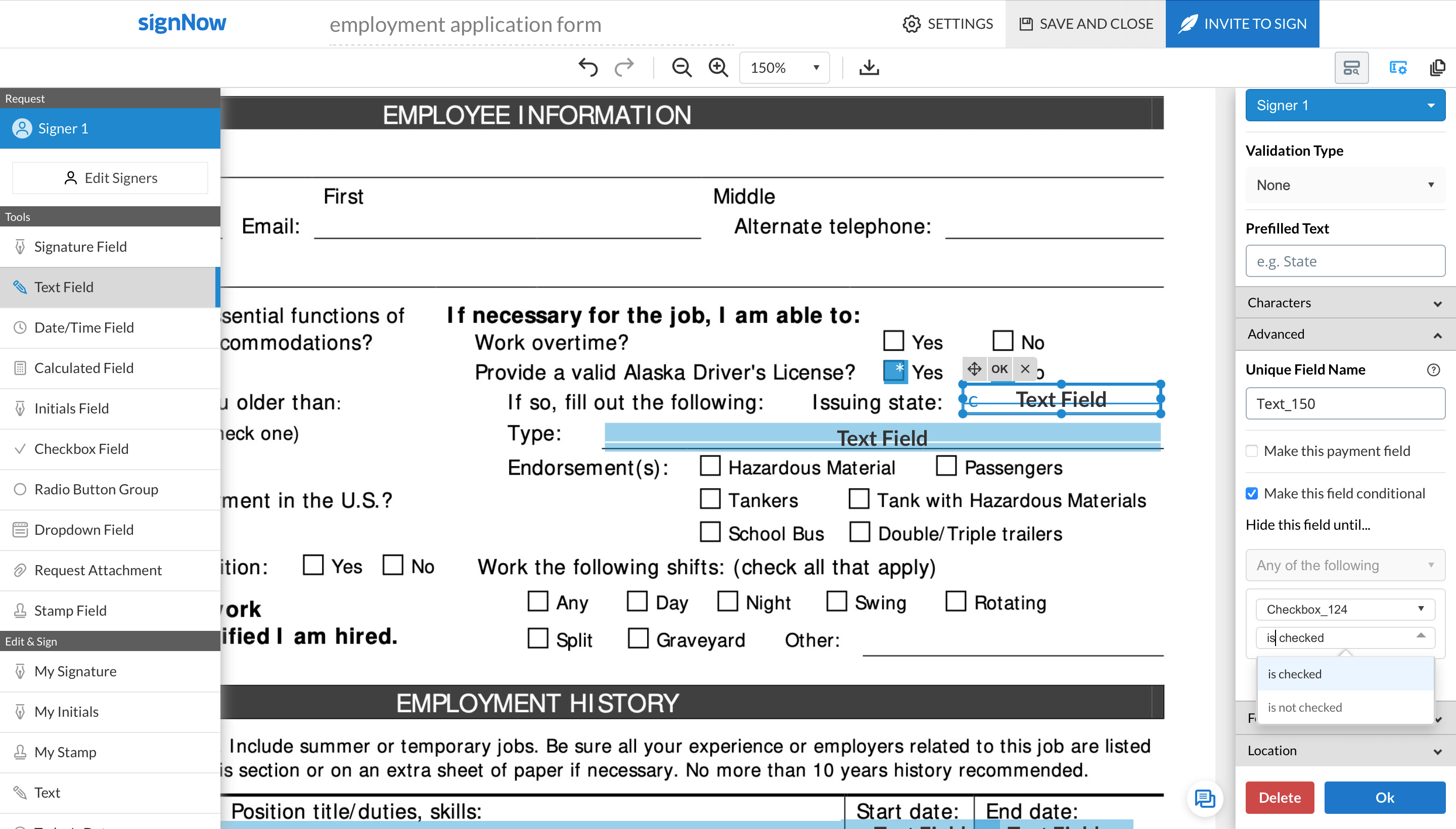
illustration-guide-remplissage

Maintenant, lorsque le destinataire reçoit votre invitation à la signature électronique, il ne verra pas les champs de texte donnés jusqu'à ce qu'il remplisse la condition prédéfinie — qui consiste à cocher la case Oui.
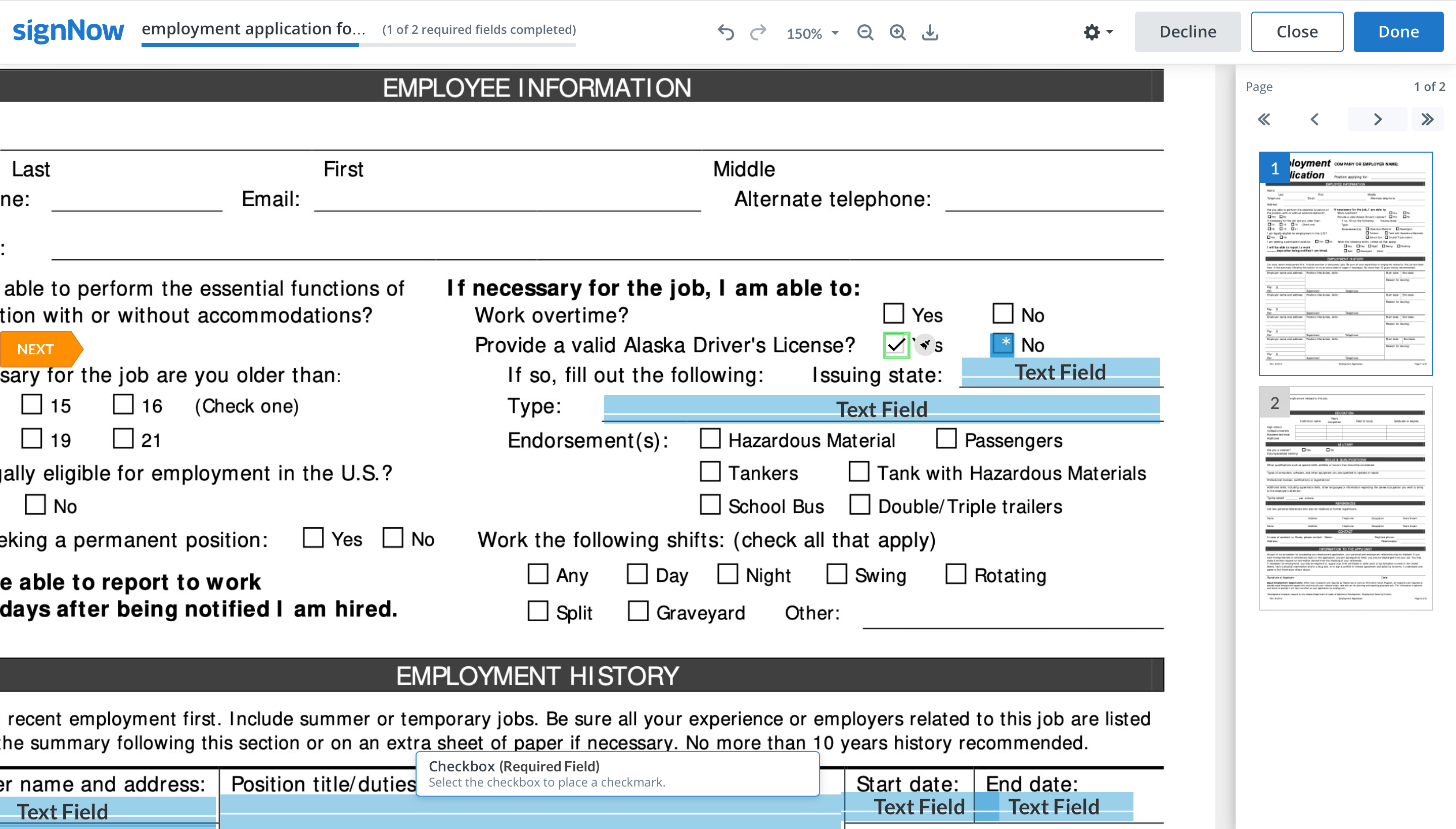

illustration-guide-remplissage
walmart logo
exonMobil logo
apple logo
comcast logo
facebook logo
FedEx logo
être prêt à en obtenir plus

Obtenez dès maintenant des signatures juridiquement contraignantes !









