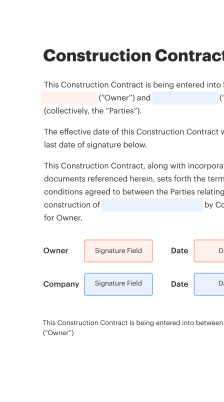
Découvrez Le Meilleur Logiciel De Gestion De Contrats Juridiques Pour Les Entreprises

Simplifiez vos flux de travail documentaires avec la solution intuitive de signature électronique d'airSlate SignNow. Expérimentez une gestion rentable des contrats et accords en toute simplicité.

Solution eSignature primée

Overview of the best legal contract management software for businesses

The best legal contract management software for businesses centralizes creation, negotiation, execution, and storage of contracts while maintaining legal enforceability and auditability. These systems typically combine electronic signature capabilities, version control, role-based access, search and retrieval, and reporting to reduce manual steps and speed cycle times. For organizations managing many agreements, a purpose-built contract management platform enforces approval workflows, tracks obligations, and preserves an evidentiary audit trail that supports compliance with ESIGN and UETA in the United States and internal retention policies.

Why businesses adopt contract management solutions

Contract management software reduces time-to-signature, minimizes human error, and centralizes risk controls so legal, procurement, and sales teams can enforce consistent policies and accelerate revenue and compliance workflows.

Why businesses adopt contract management solutions

Common implementation and operational challenges

  • Resistance to change when teams rely on established manual review and email-based signature routines that feel familiar.
  • Inconsistent templates and clause libraries leading to version drift and increased risk during negotiations and renewals.
  • Complex integration needs with CRMs, HR systems, and cloud storage creating delays and higher technical costs.
  • Maintaining compliance and data residency rules across jurisdictions requires clear policies and regular audits.

Representative user roles

Legal Counsel

In-house lawyers use contract management software to review and redline agreements, apply approved clause language, and maintain an auditable negotiation history that supports dispute resolution and compliance reporting.

Contract Manager

Contract administrators centralize templates, set routing rules and reminders, and manage renewals and obligations to reduce missed deadlines and ensure operational teams meet contractual commitments.

Typical users and team roles for contract management

Legal, procurement, sales operations, human resources, and finance commonly use contract management platforms to standardize processes and record approvals.

  • In-house legal teams that need version control, redline history, and clause libraries for risk mitigation.
  • Sales and account teams that require fast signature cycles and CRM integration to close deals quicker.
  • Procurement and vendor managers tracking supplier terms, renewals, and compliance obligations.

Organizations with medium to high contract volumes or regulatory obligations gain the most measurable benefits from structured contract management.

Core features to compare in contract management platforms

Evaluate core capabilities that affect day-to-day operations and legal defensibility, from document automation to audit functionality.

Document automation

Template-driven generation with conditional clauses and merge field population to produce accurate contracts quickly while ensuring approved language and data consistency across agreements.

E-signature

Legally recognized signing options with audit logs, signer authentication choices, and tamper-evident seals that support enforceability under ESIGN and UETA.

Workflows

Configurable routing and approval sequences with reminders and escalation rules to ensure timely reviews and reduce bottlenecks in multi-stakeholder negotiations.

Reporting

Dashboards and exportable reports that surface cycle times, upcoming renewals, and contractual obligations to improve decision-making and oversight.

Integration APIs

RESTful APIs and prebuilt connectors for CRM, ERP, and storage platforms to automate data flow and reduce manual entry errors.

Compliance tools

Features such as data residency controls, retention policies, and configurable audit trails that help meet regulatory and internal governance needs.

soyez prêt à en obtenir plus

Choisissez une meilleure solution

Integration and template capabilities to evaluate

Check integration breadth for your tech stack and the robustness of document templates, as both directly impact administrative overhead and user adoption.

Google Docs integration

Native connectors that convert collaborative drafts into controlled templates and push signed copies back to the document location to maintain version consistency and reduce manual export steps.

CRM connectors

Prebuilt integrations with CRM systems that populate contract fields from account and opportunity records, enabling one-click generation and tracking of contract lifecycle tied to sales processes.

Cloud storage sync

Two-way synchronization with providers like Dropbox or OneDrive so executed agreements are archived automatically and accessible to records teams without manual downloads.

Reusable templates

Template libraries with pre-mapped fields and conditional logic that reduce drafting time and ensure each contract uses approved language and required data capture.

How online contract management typically operates

Online contract management platforms guide documents through creation, review, signature, and storage while recording each action for auditability.

  • Document upload: Add templates or import files.
  • Field placement: Apply signature and data fields.
  • Routing: Define signer order and approvals.
  • Execution: Capture signatures and archive.
Collecter les signatures
24x
plus rapide
Réduire les coûts de
$30
par document
Économisez jusqu'à
40h
par employé / mois

Quick setup steps for deploying contract management

A phased deployment helps control risk: establish templates and permissions first, then onboard pilot teams before wider rollout.

  • 01
    Assess needs: Map volume, users, and integrations.
  • 02
    Centralize templates: Create approved clause libraries.
  • 03
    Configure workflows: Set routing, approvals, and reminders.
  • 04
    Pilot and train: Run a controlled pilot and collect feedback.

Step-by-step signing process for a typical contract

A consistent signing process ensures clarity and maintains an evidentiary record for each executed agreement.

01

Prepare document:

Load template, populate fields.
02

Assign signers:

Set signer roles and order.
03

Set authentication:

Choose verification method.
04

Send for signature:

Dispatch via email or link.
05

Capture signatures:

Collect signed records.
06

Archive and notify:

Store executed copy and alert teams.
soyez prêt à en obtenir plus

Pourquoi choisir airSlate SignNow

  • Essai gratuit de 7 jours. Choisissez le forfait dont vous avez besoin et essayez-le sans risque.
  • Tarification honnête pour des forfaits complets. airSlate SignNow propose des abonnements sans frais supplémentaires ni frais cachés lors du renouvellement.
  • Sécurité de niveau entreprise. airSlate SignNow vous aide à respecter les normes de sécurité mondiales.
illustrations signature

Typical workflow configuration items for contract automation

Configure workflows to match approval matrices and automate reminders so contracts progress without manual follow-up while retaining full auditability.

Approval Sequence Reminder Rules
Reminder Frequency 48 hours
Approval Escalation Threshold 72 hours
Conditional Routing Rules Value-based routing
Signature Order Sequential
Retention Policy 7 years

Supported platforms and requirements for contract management

Most vendors support modern web browsers, iOS, and Android apps; ensure your environment meets minimum browser and OS versions before deployment.

  • Web browsers: Chrome, Edge, Safari
  • Mobile OS: iOS 14+, Android 9+
  • Enterprise auth: SAML/SSO support

Verify mobile feature parity for signing and authentication and confirm single sign-on (SSO) and API compatibility with enterprise identity providers to reduce friction during rollout and ensure secure access across devices.

Security controls commonly provided

Encryption at rest: AES-256 encryption
Encryption in transit: TLS 1.2+ protocols
Role-based access: Granular permissions
Two-factor authentication: MFA options
Audit logging: Immutable trails
Data residency controls: Regional options

Industry use cases for the best legal contract management software for businesses

Different industries use contract management for specific regulatory and operational needs, from healthcare compliance to high-volume sales agreements.

Healthcare provider contracts

Hospitals and clinics centralize consent forms and vendor agreements for consistent processing

  • Template controls ensure required clauses are present
  • Reduces missing signatures and supports HIPAA-aligned handling

Leading to clearer compliance records and faster vendor onboarding.

Commercial sales agreements

SaaS and hardware vendors streamline quote-to-contract workflows to shorten sales cycles

  • CRM and eSignature integrations maintain revenue recognition timing
  • Automated renewals and reminders cut churn risk

Resulting in faster deal closure and more predictable contract administration.

Best practices for secure and accurate contract management

Adopting a few core practices improves control and reduces downstream risk when using contract management systems.

Maintain an approved clause library
Centralize frequently used clauses in a searchable repository and require their use in templates so negotiation stays within risk tolerances while saving drafting time and improving consistency across contracts.
Use role-based approvals
Configure approval chains tied to contract value or risk so that higher-risk agreements trigger legal or executive review automatically rather than relying on ad hoc manual escalation.
Enforce signature authentication
Require appropriate signer authentication levels—email, SMS OTP, or digital certificates—based on the contract’s legal importance and regulatory requirements to strengthen evidentiary quality.
Log and retain audit trails
Preserve immutable logs of edits, views, and signature events and align retention schedules with corporate policy to support compliance and legal defensibility.

FAQs About the best legal contract management software for businesses

Common questions cover legality, authentication, integration, and routine issues encountered during adoption and daily use.

Feature availability comparison among leading eSignature and contract platforms

A concise feature matrix highlights availability and key technical distinctions relevant to selecting the best legal contract management software for businesses.

Feature or Criteria for Contract Systems signNow (Recommended) DocuSign Adobe Sign
Legally recognized eSignature (US)
Bulk Send capability Limited
API access and SDKs REST API REST API REST API
HIPAA compliance support Available Available Available
Detailed audit trail
soyez prêt à en obtenir plus

Obtenez des signatures juridiquement contraignantes dès maintenant !

Operational timeline for post-launch governance

Regular governance checkpoints and updates keep the system aligned with legal and business changes and ensure ongoing adoption.

01

Initial governance meeting

Establish owners and policies.

02

Monthly adoption review

Track usage and bottlenecks.

03

Quarterly compliance check

Validate retention and logs.

04

Quarterly training refresh

Address common user issues.

05

Biannual integration audit

Confirm connector reliability.

06

Annual policy update

Refresh clause library.

07

Annual security review

Assess controls and MFA.

08

Executive summary report

Present outcomes and metrics.

Recommended timeline for implementation milestones

A practical timeline phases discovery, configuration, pilot, and full rollout across 8–14 weeks, depending on integration complexity and organizational size.

01

Discovery and planning

2–3 weeks

02

Template and workflow build

3–4 weeks

03

Integration and testing

2–4 weeks

04

Pilot and training

1–3 weeks

Typical post-deployment milestones and checkpoints

After launch, schedule checkpoints to validate adoption, performance, and compliance adherence at regular intervals.

30-day review:

Assess pilot feedback and adjust templates.

60-day adoption check:

Measure activity and user issues.

90-day compliance audit:

Verify retention and audit trails.

6-month optimization:

Tune workflows and integrations.

Annual policy review:

Update templates and access controls.

Operational and compliance risks to watch

Unauthorized access: Data exposure
Incomplete audit trail: Legal disputes
Noncompliant signatures: Enforceability issues
Poor retention: Regulatory fines
Integration failures: Process disruption
Template errors: Contractual risk

Pricing and commercial comparison for common entry plans

Compare entry-level plans and common commercial attributes to gauge typical cost and support differences across providers.

Plan vs Vendor Pricing signNow (Recommended) DocuSign Adobe Sign HelloSign PandaDoc
Entry-level plan name Business Standard Acrobat Sign Essentials Essentials
Typical starting price From $8/user/month (annual) From $25/user/month From $12.99/user/month From $15/user/month From $19/user/month
Free trial availability 14-day trial available Trial options available 7-day trial 7-day trial 14-day trial
User seat model Tiered seats Per-user pricing Seat-based licensing Per-seat model Seat-based
Advanced workflow availability Conditional routing and templates Extensive workflow features Template workflows Limited workflows Document workflows available
Enterprise support options Dedicated enterprise plans and support Enterprise SLA options Enterprise support available Business support tiers Enterprise services
walmart logo
exonMobil logo
apple logo
comcast logo
facebook logo
FedEx logo
être prêt à en obtenir plus

Obtenez dès maintenant des signatures juridiquement contraignantes !