OCR mathématique
Reconnaissance et conversion automatique des formules imprimées vers un format éditable et structuré pour réutilisation.



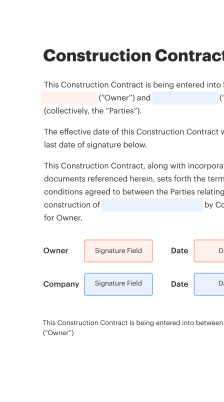
Le graph equation record standardise la capture d'équations et visuels complexes, améliore la traçabilité des versions et simplifie les validations légales et techniques dans les processus numériques.

Travaille avec des équations complexes et des graphiques pour enseigner et publier; utilise le graph equation record pour partager des versions pédagogiques, recevoir des validations et conserver un historique des modifications pour chaque autorisation académique.
Documente des simulations et des modèles en ingénierie, synchronise les équations avec des rapports de test et des approbations internes, et applique des contrôles d'accès pour protéger les secrets industriels lors des échanges avec des partenaires.
Utilisateurs variés tirent parti du graph equation record pour assurer exactitude et conformité dans leurs dossiers techniques et académiques.
Dans les organisations, l'usage favorise la collaboration interdisciplinaire tout en maintenant des pistes d'audit exploitables.
Reconnaissance et conversion automatique des formules imprimées vers un format éditable et structuré pour réutilisation.
Gestion fine des versions avec comparaisons pour retracer modifications et revenir à des états antérieurs si nécessaire.
Flux multi-niveaux et validations conditionnelles selon la nature des équations ou la sensibilité des données.
Export vers LaTeX, PDF vectoriel et formats d'échange pour publication ou calcul reproductible.
Endpoints documentés pour automatiser importation, validation et export dans des systèmes tiers.
Notifications configurables pour échéances d'approbation, révisions programmées et expirations de conservation.
Création de modèles réutilisables pour uniformiser la capture des équations, définir des champs obligatoires et préremplir métadonnées afin d'accélérer la production et réduire les erreurs de formatage.
Règles d'acheminement et workflows automatiques pour validation, rappels et archivage, réduisant les tâches manuelles et assurant le respect des étapes de conformité.
Connexions natives avec stockage cloud, systèmes CRM et plateformes de collaboration pour synchroniser données, limiter la duplication et centraliser les versions autorisées.
Enregistrement immuable des actions et horodatages qui documente chaque modification, approbation et accès pour des examens et des audits officiels.
| Feature | Value |
|---|---|
| Reminder Frequency | 48 hours |
| Approval Escalation | 72 hours |
| Default Access Role | Editor |
| Retention Policy | 7 years |
Le graph equation record doit être accessible depuis mobiles, tablettes et postes de travail avec fonctionnalités essentielles.
Assurez-vous que les appareils disposent des mises à jour de sécurité, d'un navigateur moderne et d'une connexion chiffrée; pour les mobiles, privilégiez les applications certifiées offrant gestion des sessions et chiffrement local.
Une équipe de recherche centralise équations et graphiques en un seul document structuré pour les publications et subventions.
Resulting in des dossiers prêts pour révision et subventionnement, réduisant les délais administratifs.
Un fabricant conserve modèles mathématiques associés à tests produits dans des graph equation record signés numériquement.
Leading to une capacité à démontrer conformité réglementaire lors d'audits clients et autorités.
| Criteria | signNow (Recommended) | DocuSign | Adobe Sign |
|---|---|---|---|
| eSignature légale | |||
| API disponible | REST API | REST API | REST API |
| Support HIPAA | |||
| Bulk Send | Bulk Send | Bulk Send | Bulk Send |
Identifier exigences et rôles
Créer modèle et flux test
Connecter systèmes tiers
Configurer chiffrement et ACL
Recueillir retours et ajuster
Former administrateurs et utilisateurs
Passer en production contrôlée
Surveiller et améliorer
Conserver 3 ans minimum
Conserver 7 à 10 ans
Migration vers archive froide
Vérifier chaque année
Purge après délai légal
| Criteria | signNow (Recommended) | DocuSign | Adobe Sign | HelloSign | PandaDoc |
|---|---|---|---|---|---|
| Tarif de base | À partir de 8 USD par utilisateur par mois avec facturation annuelle | À partir de 10 USD par mois pour utilisateurs individuels | À partir de 9,99 USD par utilisateur par mois (abonnement) | À partir de 13 USD par mois utilisateur (plan pro) | À partir de 19 USD par utilisateur par mois sur plans standards |
| Essai gratuit | Essai gratuit 7 jours disponible pour nouvelles équipes | Essai standard 30 jours souvent proposé | Essai limité ou démonstration commerciale | Essai gratuit 14 jours courant | Essai gratuit et démonstration commerciale |
| Offres entreprise | Remises volume et contrats entreprise personnalisés disponibles | Plans entreprise avec conformité et SSO | Solutions entreprises intégrées et licences globales | Plans entreprise avec API et SSO | Solutions orientées ventes avec tarification personnalisée |
| Intégrations natives | Connecteurs natifs pour Google Workspace, Salesforce et stockage cloud | Large écosystème d'intégrations tiers | Intégration étroite avec Creative Cloud et Document Cloud | Intégrations Google et CRM courantes | Intégrations CRM et automatisation orientées ventes |
| Support et SLA | Support clients selon forfait, assistance entreprise et SLA disponibles | Support client standard et options premium payantes | Support standard et options premium pour entreprises | Support par email et premium selon plan | Support client et gestion de compte pour entreprise |
La fonction d'enregistrement de l'équation graphique devient facilement accessible lorsque vous utilisez la plateforme complète de signature électronique airSlate SignNow. Utilisez cette solution pour votre entreprise, quel que soit le secteur dans lequel vous travaillez. La gamme de fonctionnalités proposée par airSlate SignNow convient parfaitement aux personnes qui cherchent à rendre leurs stratégies d'entreprise plus productives et à rationaliser leur flux de travail.
Soyez assuré que vos contrats seront toujours bien organisés, remplis par les parties appropriées et signés numériquement avec la signature électronique conforme à la loi ESIGN et autres exigences gouvernementales. Intégrez des champs remplissables pour rendre tout document interactif, collectez des signatures de plusieurs personnes et appliquez une authentification du destinataire pour garantir que le document a été reçu par la personne appropriée. Tout cela est possible lorsque vous travaillez depuis un ordinateur de bureau ou un appareil mobile pour gagner du temps et conclure des affaires importantes en déplacement.