Insérer Un Champ De Date Dans Votre Document Pour Signer

Facilement dater un document ou demander à votre destinataire d'entrer la date et l'heure de la complétion du document. Insérez un champ de date dans votre document et personnalisez-le selon vos besoins.

Solution eSignature primée

What it means to insert a date field in your document

Inserting a date field in your document creates a dedicated, machine-readable element that captures a specific date when the signer completes or interacts with the form. Date fields can be static (pre-filled) or dynamic (auto-populated at signing or when a workflow step completes), and they support validation rules to ensure correct formatting. In eSignature platforms like signNow, date fields integrate with templates, conditional logic, and audit trails so dates are tracked consistently across copies and stored with signature metadata for legal and operational use.

Why add a date field to signed documents

A dedicated date field ensures consistent, auditable timestamps on agreements, reduces manual entry errors, and supports downstream automation such as reminders and retention rules. This improves accuracy and simplifies compliance reporting while making documents easier to index and retrieve.

Why add a date field to signed documents

Common obstacles when inserting date fields

  • Incorrect format selection can lead to inconsistent dates across regions and break integrations that expect ISO or MM/DD/YYYY formats.
  • Placing date fields in templates without validation risks blank or malformed values if signers skip required entries.
  • Relying on visible text dates instead of structured fields prevents automated extraction and complicates audit trail accuracy.
  • Missing timezone handling may produce misleading timestamps when signers are in different U.S. time zones.

Roles that configure and use date fields

Contract Administrator

A Contract Administrator sets up templates and places date fields at signature points, configures validation and default values, and ensures the audit trail captures when each party signed and when dates were entered.

HR Manager

An HR Manager adds hire, eligibility, and acknowledgment dates to onboarding packets, linking date fields to downstream systems and retention policies while ensuring entries comply with company formatting rules.

Who typically inserts date fields and why it matters

Legal, HR, sales, and operations teams frequently add date fields to ensure contracts, onboarding forms, and approvals include precise, auditable timestamps.

  • Legal teams for execution and effective date tracking
  • Human resources for hire dates, acknowledgements, and enrollment forms
  • Sales and procurement for contract signing and renewal schedules

Standardizing date fields across templates reduces disputes, supports regulatory compliance, and makes automated reporting reliable across departments.

Additional platform features that enhance date fields

Beyond basic placement, several advanced features make date fields more useful in enterprise workflows and automation.

Conditional Fields

Make date fields appear only when other inputs trigger them, reducing clutter and ensuring signers see only relevant fields tied to their responsibilities.

Auto-population

Auto-fill date fields with the current date, signature date, or data from integrated systems to minimize signer input and avoid typographical errors.

Time zone handling

Record time zone context with date fields so timestamps reflect the signer’s locale and preserve accurate event ordering across regions.

Field-level permissions

Restrict which roles can edit or view particular date fields to protect sensitive scheduling or internal deadline information.

Bulk field placement

Apply date fields to multiple documents or across many templates at once to scale consistent configurations for enterprise needs.

Reporting exports

Export date field values in CSV or API payloads for analytics, compliance reporting, and reconciliation tasks.

soyez prêt à en obtenir plus

Choisissez une meilleure solution

Key tools that support date fields and accuracy

Platforms offer integrations and controls that improve date field reliability, validation, and downstream use across systems and templates.

Template Library

Reusable templates let you place date fields consistently across documents and teams, reducing setup time and ensuring consistent validation rules and default values for a uniform signing experience.

Field Validation

Validation options enforce date formats, minimum or maximum allowed dates, and required entry so signers cannot submit an agreement with an invalid or empty date field.

Conditional Logic

Conditional field rules show or hide date fields based on other answers, ensuring only relevant dates appear and reducing the chance of incorrect or extraneous entries.

System Mapping

Mapping date fields to CRMs, HRIS, or document management systems ensures captured dates flow into downstream records and reporting without manual export or rekeying.

How inserting a date field works online

Inserting a date field in an online eSignature platform attaches metadata, enforces validation, and ties the value to the document's audit log for traceability.

  • Add field: Drag a date control into the page.
  • Set rules: Pick format, required state, or default.
  • Assign signer: Bind the field to a recipient role.
  • Complete signing: Date is captured and recorded.
Collecter les signatures
24x
plus rapide
Réduire les coûts de
$30
par document
Économisez jusqu'à
40h
par employé / mois

Step-by-step: insert a date field in your document

Follow these practical steps to place and configure a date field so it captures the correct timestamp and integrates with your eSignature workflow.

  • 01
    Open document: Upload or select the template to modify.
  • 02
    Select Date field: Choose the date control from the form tools.
  • 03
    Configure validation: Set format, default, and required status.
  • 04
    Lock or map field: Lock after signing or map to systems.

Audit trail and recordkeeping for date fields

Maintain a clear record of who entered or changed date values and when, using platform audit tools and exportable logs.

01

Capture event:

Record the timestamp for each action.
02

Record actor:

Log user identity and role.
03

Store locale:

Include time zone metadata.
04

Preserve history:

Keep immutable change records.
05

Export logs:

Allow CSV or API extraction.
06

Retain securely:

Apply retention policies to logs.
soyez prêt à en obtenir plus

Pourquoi choisir airSlate SignNow

  • Essai gratuit de 7 jours. Choisissez le forfait dont vous avez besoin et essayez-le sans risque.
  • Tarification honnête pour des forfaits complets. airSlate SignNow propose des abonnements sans frais supplémentaires ni frais cachés lors du renouvellement.
  • Sécurité de niveau entreprise. airSlate SignNow vous aide à respecter les normes de sécurité mondiales.
illustrations signature

Recommended workflow configuration for date fields

Configure workflows to enforce date rules, automate population, and integrate with downstream systems for timely actions and retention.

Workflow Feature and Configuration Names Default configuration values for each setting
Date Validation Policy Enforce MM/DD/YYYY or ISO
Auto-populate Signature Date Enabled by default
Field Lock After Signature Lock immediately
Timezone Metadata Capture Record UTC and local
Integration Mapping Target CRM date fields

Supported devices and system requirements for date fields

Most modern browsers and the majority of mobile apps support placing and interacting with date fields; ensure your platform version supports structured form controls.

  • Windows and macOS: Latest browsers supported
  • iOS and Android apps: Native app support
  • API access: REST endpoints available

Confirm minimum browser versions and app releases with your administrator before rolling out template changes, and test date behavior on mobile devices to verify locale, format, and auto-population function correctly across platforms.

Security and protection measures for date fields

Field-level locking: Prevents edits after signing
Encryption at rest: Protects stored values
TLS in transit: Secures data transfer
Audit logging: Records value changes
Access controls: Restricts field editing
HIPAA safeguards: Supports healthcare requirements

Industry examples showing date field value

Two short examples illustrate how structured date fields reduce risk and speed processes in common U.S. workflows.

Healthcare Intake

A clinic inserts a date field for patient consent dates to ensure accurate service records.

  • Validation enforces MM/DD/YYYY format.
  • This prevents misdated consents and supports billing.

Resulting in clearer records and faster claims reconciliation under HIPAA-aware controls.

Sales Contracts

A sales team adds execution and effective date fields to digital contracts to standardize timelines.

  • Fields auto-populate at signature time.
  • This reduces manual entry and errors in renewal cycles.

Leading to reliable renewal alerts and consistent revenue recognition across CRM integrations.

Best practices for secure and accurate date fields

Implementing simple standards helps ensure date fields remain reliable and defensible throughout a document lifecycle.

Standardize a single date format across workflows
Define and enforce a standard format such as MM/DD/YYYY or ISO 8601 across templates and integrations to avoid ambiguity and parsing errors when exchanging dates with other systems.
Require validation and set sensible defaults
Use validation rules to prevent invalid entries and set defaults like 'date of signature' where appropriate, while allowing manual override only when justified and logged.
Map date fields to backend systems
Ensure date fields are mapped to the correct database fields in CRMs or document stores so automated reports and retention schedules use the captured date without manual intervention.
Lock fields after signing and preserve audit trails
Lock completed date fields to prevent post-signature changes and maintain a complete, timestamped audit trail that documents the field value and the time it was captured.

FAQs about how to insert a date field in your document

Common questions and clear answers address formatting, validation, and integration issues encountered when adding date fields to digital documents.

Feature availability: inserting date fields across platforms

A concise compatibility check for core date-field capabilities across common eSignature providers used in U.S. workflows.

Feature Availability and Support Matrix signNow (Recommended) DocuSign Adobe Sign
Insert Date Field
Auto-populate signature date
Field validation rules
Timezone metadata capture
soyez prêt à en obtenir plus

Obtenez des signatures juridiquement contraignantes dès maintenant !

Retention and deadline considerations for date fields

Date fields interact with document retention, legal deadlines, and operational timelines. Plan storage and expiration around regulatory and business needs.

Contract retention schedule:

Follow company retention policies for signed contracts.

Regulatory hold windows:

Preserve documents during investigations.

Renewal notice timing:

Use date fields to trigger renewal workflows.

Records disposal dates:

Map date fields to disposal rules.

Audit readiness periods:

Keep date-stamped records for required years.

Risks of mishandled date fields

Contract disputes: Invalid dates
Compliance fines: Retention failures
Operational delays: Incorrect timelines
Data integrity loss: Overwritten values
Audit failures: Incomplete trails
Privacy exposure: Uncontrolled sharing

Pricing and plan comparison for date-field capable platforms

Representative plan-level features and pricing indicators relevant to teams that depend on structured fields and integrations; actual prices vary by contract and promotions.

Plan or Feature signNow (Recommended) DocuSign Adobe Sign HelloSign PandaDoc
Starting monthly per-user price $8 $10 $9 $15 $19
Free trial availability Yes Yes Yes Yes Yes
API access included Paid plans Paid plans Paid plans Paid plans Paid plans
Bulk send capability Included Add-on Included Add-on Included
SSO and enterprise support Available Available Available Available Available

Comment ajouter un champ Date/Heure à un document avec airSlate SignNow

Permettez aux destinataires de dater vos documents en ajoutant un champ Date/Heure. Personnalisez le champ pour faciliter le processus de complétion du document.

Utilisez l'éditeur de document pour ajouter un champ à remplir

Ouvrez votre document dans l'éditeur airSlate SignNow en double-cliquant dessus. Dans la barre d'outils à gauche, sélectionnez le Champ Date/Heure puis cliquez n'importe où sur le document pour placer le champ. Ajustez le placement du champ en le faisant glisser sur la page et redimensionnez-le en faisant glisser les bords du champ. Une fois terminé, cliquez sur OK.
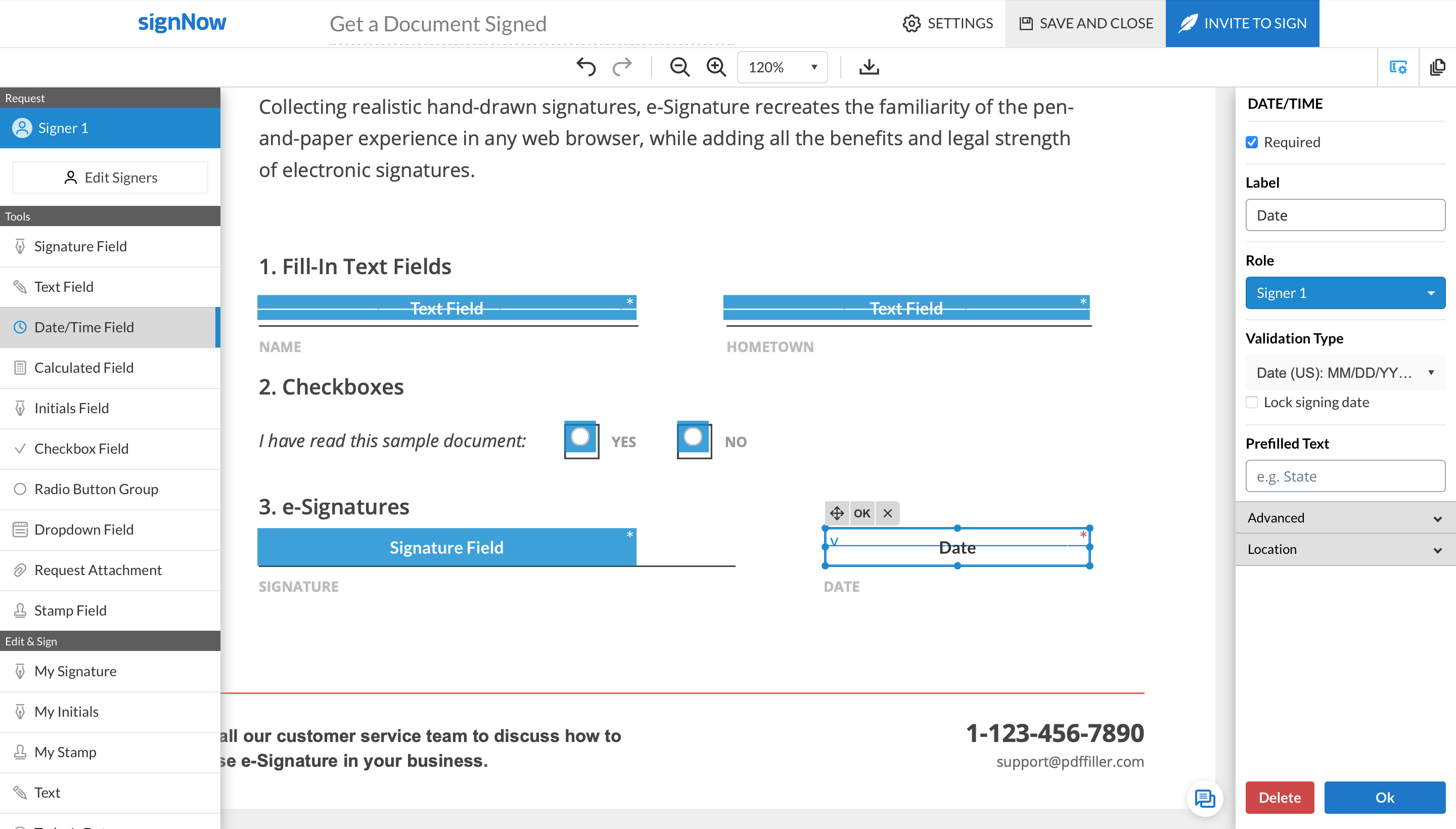
illustration-guide-remplissage

Personnalisez le champ selon vos besoins

Cliquez sur le champ pour accéder à ses paramètres. Le panneau de paramètres apparaîtra à droite.
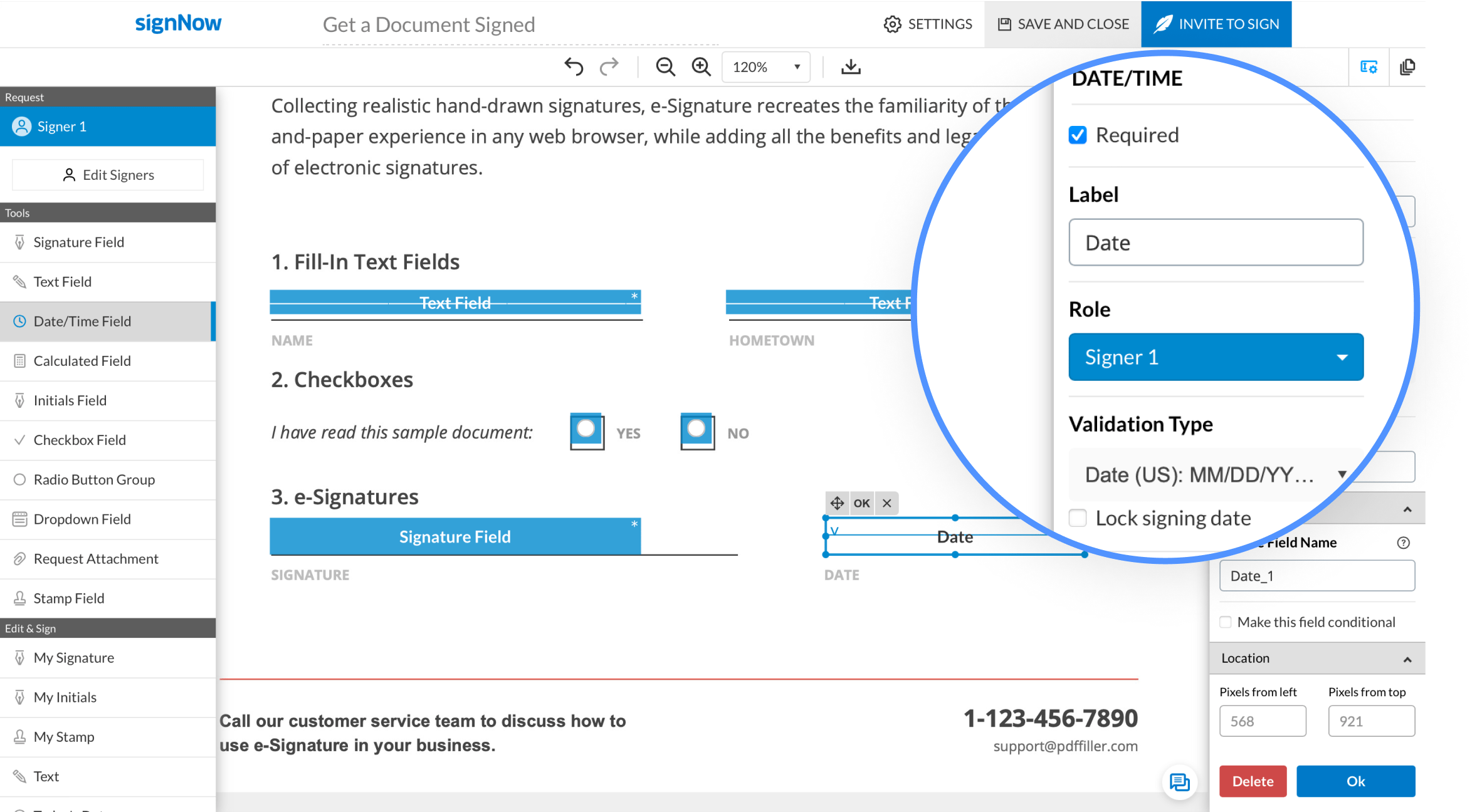

  • Rendez le champ obligatoire en cochant la case Obligatoire.
  • Changez le nom du champ ou entrez des instructions pour un signataire dans la case Étiquette.
  • Sélectionnez le rôle du signataire en utilisant le menu déroulant Rôle.
  • Définissez votre format de date préféré en utilisant l'une des options de validation (par exemple, format US, format EU, etc.)
  • Entrez une date par défaut en tant que texte pré-rempli.
  • Ouvrez le menu déroulant Avancé pour donner au champ un ID unique ou le rendre conditionnel.
  • Dans le menu déroulant Emplacement, vous pouvez ajuster la position du champ en définissant les valeurs requises en pixels.
illustration-guide-remplissage
walmart logo
exonMobil logo
apple logo
comcast logo
facebook logo
FedEx logo
être prêt à en obtenir plus

Obtenez dès maintenant des signatures juridiquement contraignantes !









