Automatisation des tâches
Workflows conditionnels déclenchant étapes selon statut de commande ou approbation, réduisant interventions manuelles et accélérant le traitement des factures.



Maîtriser la distinction réduit les erreurs comptables et améliore les délais de facturation et paiement.

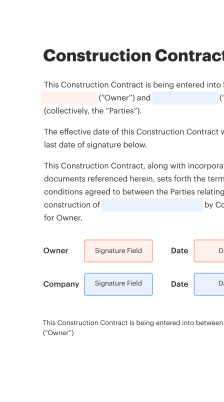
Utilise les order forms pour capturer les commandes clients, valider prix et quantités, et envoyer des documents signés électroniquement. Coordonne avec la facturation pour déclencher la génération d'invoices et assurer le suivi des paiements en attente.
Réconcilie les invoices avec les bons de commande, enregistre les écritures comptables et gère les taxes. Vérifie la conformité des documents signés et conserve les preuves pour audits et obligations fiscales.
Services commerciaux, comptabilité et équipes opérationnelles s'appuient sur ces documents pour exécuter ventes et règlements.
Une coordination interfonctionnelle minimise les erreurs et accélère les cycles de paiement.
Workflows conditionnels déclenchant étapes selon statut de commande ou approbation, réduisant interventions manuelles et accélérant le traitement des factures.
Règles complexes pour remises, escalades de prix et frais additionnels, appliquées automatiquement en fonction de critères client ou volume.
Conversion fluide d'un devis signé en order form puis en invoice, conservant historique et versions pour audit et suivi commercial.
Fonctions de réconciliation automatique entre invoices et paiements reçus, synchronisées avec systèmes bancaires et comptables.
Tableaux de bord personnalisables affichant factures impayées, délais moyens de paiement et performances par client.
Paramètres pour exiger mentions légales, clauses contractuelles et conservation selon exigences sectorielles et fiscales.
Templates réutilisables pour order forms et invoices, permettant de standardiser champs, mentions légales et calculs de taxe afin d'accélérer la création et réduire les erreurs humaines.
Moteur de calcul intégré pour totaux, taxes et remises qui applique règles complexes et variations de tarif selon client ou territoire, assurant précision systématique.
Intégrations avec prestataires de paiement pour accepter cartes, ACH ou autres moyens et lier automatiquement le règlement à la invoice correspondante pour une réconciliation simplifiée.
Connexions natives avec CRM, ERP et stockage cloud pour synchroniser clients, commandes et factures, réduire saisies manuelles et maintenir données à jour.
| Feature | Value |
|---|---|
| Rappel de paiement | 48 heures |
| Validation multi-étapes | Oui, approbation requise |
| Notification client | E-mail immédiat |
| Archivage automatique | Conserver 7 ans |
Les order forms et invoices doivent être accessibles et signables depuis appareils mobiles, tablettes et postes de travail modernes.
Pour garantir accessibilité et sécurité, vérifiez versions de navigateurs et mises à jour système, et testez signatures mobiles avant déploiement en production.
Un distributeur saisit un order form détaillant quantités et conditions
Produisant un enregistrement comptable clair, aboutissant à une réconciliation plus rapide et à une réduction des litiges.
Une agence signe un order form pour valider périmètre et tarifs
Garantissant un suivi des paiements structuré et une meilleure traçabilité pour audits et rapports financiers.
| Criteria | Digital Signing | Paper Signing | Notes |
|---|---|---|---|
| Validité légale | ESIGN/UETA reconnus | Validité variable | Dépend juridiction et preuve |
| Vitesse de traitement | Immédiate | Plusieurs jours | Délais postaux et traitement manuel |
| Traçabilité | Audit trail complet | Preuve limitée | Horodatage et métadonnées absents |
| Coût par transaction | Faible marginal | Imprimante/timbre | Papier et envoi augmentent coûts |
| Criteria | signNow (Recommended) | DocuSign | Adobe Sign | HelloSign | PandaDoc |
|---|---|---|---|---|---|
| Prix de départ | $8 par utilisateur/mois pour plans basiques | À partir de $10 par utilisateur/mois | À partir de $12 par utilisateur/mois | À partir de $15 par utilisateur/mois | Plans à partir de $19 par utilisateur/mois |
| Essai gratuit | Essai 7 jours disponible | Essai gratuit limité | Essai gratuit standard | Essai gratuit disponible | Essai gratuit disponible |
| Support HIPAA | Options de conformité HIPAA disponibles | Offres HIPAA sur demande | Support HIPAA via contrats | Non standard | Non standard |
| API et intégrations | API REST robuste et SDK disponibles | API complète et écosystème | API intégrée à Adobe Cloud | API disponible | Intégrations CRM natives |
| Envoi en masse | Fonction Bulk Send pour lots | Fonction Bulk Send avancée | Envoi groupé disponible | Envoi groupé limité | Envoi groupé via plan supérieur |