Establishing secure connection…Loading editor…Preparing document…

Louisiana Real Estate Donation Act

This template is fully customizable. Edit the text, fill out the fields, and send it for signature. Give it a try!
Louisiana Real Estate Donation Act

What the Louisiana Real Estate Donation Act covers

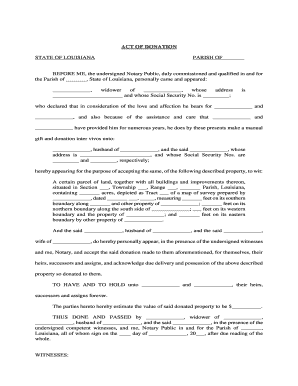
The Louisiana Real Estate Donation Act refers to the statutory and transactional framework used when immovable property in Louisiana is transferred by donation or gift to another party, often a nonprofit or individual donee. Transfers typically require a notarized act, proper identification of donor and grantee, a clear legal description of the parcel, and recording in the parish conveyance records. Electronic processes can be used for preparation and signature, but recording, notarization, and witness requirements remain governed by Louisiana civil-law practice and applicable state recording rules.

Why this statute matters to donors and recipients

Understanding the Louisiana Real Estate Donation Act helps protect title, meet recording and witness rules, and ensure tax and charitable documentation are preserved; it reduces disputes and supports clear chain of title when transfers are contested or audited.

Why this statute matters to donors and recipients

Who typically completes a Louisiana donation deed

Several parties are commonly involved in preparing and completing a donation deed under Louisiana law.

  • Donors and their counsel preparing the conveyance and disclosures for recording and tax reporting.
  • Nonprofit recipients verifying title acceptance, recording details, and tax-exempt documentation.
  • Title companies and notaries facilitating notarization, witness presence, and parish recording logistics.

Each participant has specific responsibilities—donor identity, legal description accuracy, notarial formalities and recording steps are critical to a valid transfer.

Step-by-step: completing a Louisiana donation deed

Follow these core steps in order to prepare, execute, notarize, and record a donation of real estate in Louisiana.

  • 01
    Prepare deed: Draft clear granting language and full legal description.
  • 02
    Verify title: Order title search and resolve liens or encumbrances.
  • 03
    Notarize: Execute before notary with required witness presence.
  • 04
    Record deed: File at parish recorder's office and obtain recording number.

Typical workflow for a donation transfer

The transaction usually flows from preparation through recording, with discrete responsibilities for each party and steps that can be monitored electronically.

  • Document drafting: Attorney or title agent prepares the donation deed.
  • Clearances: Obtain payoff letters, lien releases and surveys if required.
  • Signing session: Donor signs before notary and witnesses; documentation recorded.
  • Post-recording: Provide recorded copy to grantee and update title insurance if applicable.

Digital workflow settings recommended for donation deeds

When using an e-signature platform, configure authentication, field placement, and notarization support before sending documents to signers.

Field Configuration
Signer Authentication Email link plus SMS code or ID check for stronger verification
Notary Support Enable remote notarization workflow if state and parish permit
Witness Fields Add two witness signature fields where Louisiana practice requires them
Audit Trail Capture timestamps, IP addresses, and action logs for record

Technical requirements for ePreparation and eSigning

Use an e-signature platform that supports PDF, word templates, and clear audit trails for legal documents.

  • File formats: PDF and DOCX
  • Integrations: Title systems and document storage
  • Authentication: Email, SMS, or KBA

Ensure the chosen platform can produce a tamper-evident signed file and export the audit record for parish recording or counsel review.

eSignature vendor comparison for signing and managing donation deeds

Basic vendor differences include starting price, trial availability, bulk-send capability, audit trail support, HIPAA readiness, and envelope or session caps.

signNow DocuSign Adobe Sign PandaDoc HelloSign
Starting Price $8/user/mo $15/user/mo $14/user/mo $19/user/mo $15/user/mo
Free Trial 7-day free trial Varies by plan Varies by plan Varies by plan Varies by plan
Bulk Send Yes Yes Yes Yes Varies
Audit Trail Yes Yes Yes Yes Yes
HIPAA Compliant Yes Varies Varies Varies Varies
Envelope Cap No cap 100 envelopes/user/year Varies Varies Varies

Essential elements to include in a professional donation deed

A well-structured donation deed protects parties and ensures clerks can record the instrument without need for revision or resubmission.

Granting Clause

Clear language stating donor conveys ownership interest gratuitously to the named grantee and specifying the exact interest transferred.
Legal Description

Full metes-and-bounds or recorded lot description copied verbatim from the current deed or assessor's records.

Donor Consideration

Statement of consideration, e.g., 'for love and affection' or 'no monetary consideration', to clarify the transfer nature.

Title and Encumbrances

Disclosure of known liens, mortgages, or encumbrances and any required lien releases or payoff instructions.

Notary Acknowledgment

Notarial block with space for seal and parish of acknowledgment consistent with Louisiana formalities.

Signature Blocks

Separate signature lines for donor, witnesses (two), and notary plus printed names and dates for record clarity.

Practical tips to reduce recording delays and title issues

Follow these practices to reduce rejections, protect title integrity, and speed recording in parish clerks' offices.

Confirm legal description accuracy
Cross-check the parcel description against the current recorded deed and assessor records to avoid clerical rejections and indexing errors.
Resolve liens pre-signing
Obtain lien payoffs or written releases to prevent surprise encumbrances that can void or cloud the donated title.
Use clear notarial language
Follow Louisiana notarial and witness conventions precisely, including parish notation and notary seal placement to meet recorder requirements.
Keep recorded originals
Retain the recorded original and provide certified copies to the grantee and any title insurer for future defense.

Time-sensitive steps and approximate processing expectations

Timing for donation transactions depends on title clearance, notary availability and parish recording workload; budget extra days for review.

Title Search Turnaround:

3–10 business days depending on complexity and provider availability.

Notary Scheduling:

1–7 business days to coordinate notary and witness availability.

Parish Recording:

Recording can be same-day to several weeks based on parish backlog.

Tax Reporting Window:

Donor should consult tax advisors for reporting timelines; consult IRS rules for federal obligations.

Follow-up Deliveries:

Provide recorded copies to grantee and title insurer promptly after recording.

Potential legal and financial risks of incorrect transfers

Tax Penalties: Incorrect reporting may trigger IRC §6721 penalties.
Void Transfer: Defective notarization or missing signatures can render the deed unenforceable.
Title Disputes: Unresolved liens or ambiguous descriptions invite litigation and clouded title.
Recording Rejection: Clerks may reject deeds with improper acknowledgments or incorrect parish references.
Charitable Compliance: Nonprofit grantees must verify charitable acceptance rules to avoid unrelated business tax consequences.
Revocation Risk: Improperly executed transfers can be reversed or challenged by heirs or creditors.

Common preparation errors to avoid

  • Incomplete legal descriptions or use of property nicknames instead of recorded metes-and-bounds cause clerk rejections and title confusion.
  • Mismatched donor names between ID, deed, and title records prompt additional identity verification and can delay recording.
  • Failing to obtain a formal lien release or payoff statement results in unexpected encumbrances remaining on the recorded title.
  • Using informal or ambiguous consideration language invites tax scrutiny and may complicate charitable acceptance documentation.

Real-world examples of electronic document workflows in real estate

These short examples show how electronic preparation and signing support property transfers while preserving audit trails.

Martin Properties

A mid-size brokerage digitized donor forms and remote signatures to streamline closings.

  • Quick mobile signing accelerated execution.
  • The firm reported consistent compliance with recording-ready documents and faster delivery of recorded copies to clients.

Optica Ventures LLC

Private investor use of templates reduced drafting time for donation deeds.

  • Template reuse ensured consistency across parcels.
  • Reusing vetted templates reduced attorney review hours while preserving customized notarial blocks for each parish.

Frequently asked questions about donation deeds in Louisiana

Answers to technical and legal questions commonly raised when preparing, signing, and recording donation deeds in Louisiana.


Need help? Contact support

be ready to get more
Join over 28 million airSlate SignNow users