Parties
Full legal names and current addresses for donor and donee. For entities include formation details and authorized signer information to confirm authority to convey.
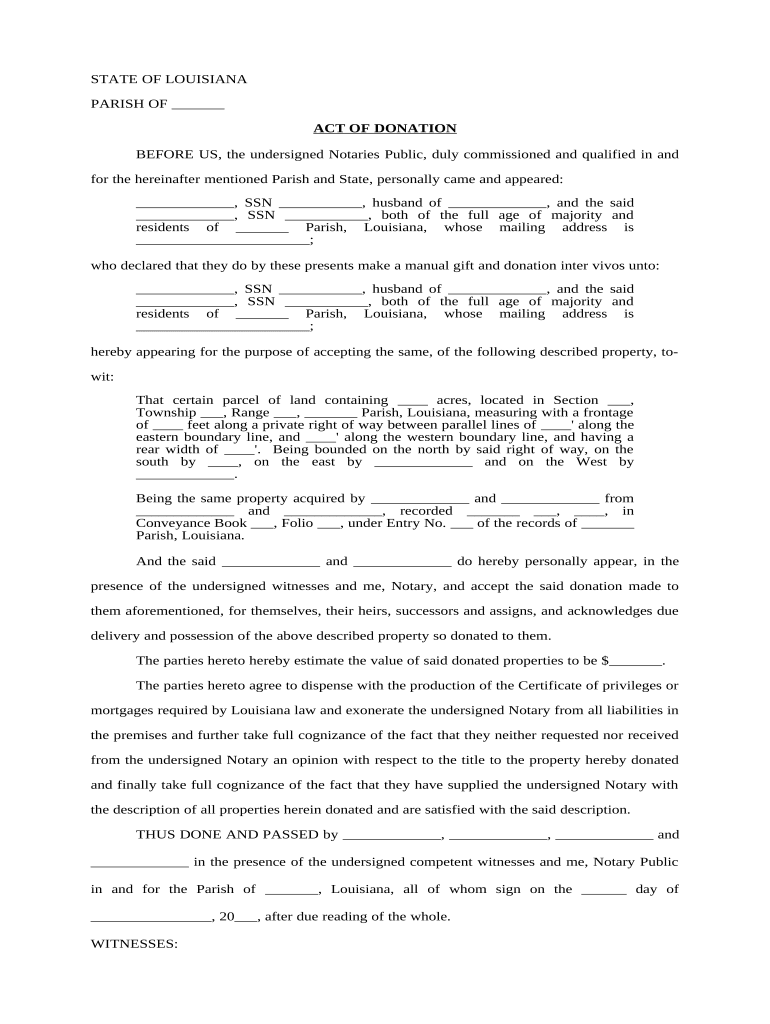
An Act of Donation Real Estate documents donor intent, creates a public record, and helps deliver marketable title to the donee when properly executed and recorded under state rules.

Typical users include private donors, nonprofit donees, real estate attorneys, and title professionals involved in gift conveyances.
Full legal names and current addresses for donor and donee. For entities include formation details and authorized signer information to confirm authority to convey.
Complete metes-and-bounds description or recorded lot and block citation taken from existing deed or survey; accuracy is required for county acceptance.
Explicit language declaring the transfer as a gift without monetary consideration, for example 'grants and conveys as a donation' or 'for love and affection.'
Donor signature, printed name, and date; notary acknowledgement that complies with state wording and includes notary seal and commission expiration.
Disclosure of known mortgages, liens, or easements where required, or an express statement regarding existing encumbrances when warranted by title review.
Designated space for county recorder stamps, recording number, and date. A clear recording block facilitates proper indexing and public notice.
| Field | Configuration |
|---|---|
| Document Routing Order for Signers | Sequential signing: donor then donee then notary. |
| Signer Authentication Method (Email/SMS) | Email link plus optional SMS code for identity. |
| Template Field Validation and Locking | Require property APN and legal description fields. |
| Storage Format and Retention Settings | Save signed PDF/A in cloud storage with audit trail. |
Prepare platform settings to accept PDFs, manage signatures, and retain audit logs for legal validity.
| signNow | DocuSign | Adobe Sign | PandaDoc | HelloSign | |
|---|---|---|---|---|---|
| Starting Price | $8/user/mo | $15/user/mo | $14/user/mo | $19/user/mo | $15/user/mo |
| Free Trial | 7-day free trial, no credit card | Verify with vendor | Verify with vendor | Verify with vendor | Verify with vendor |
| Bulk Send | Yes — available on Business Premium | Verify with vendor | Verify with vendor | Verify with vendor | Verify with vendor |
| Audit Trail | Yes | Yes | Yes | Yes | Yes |
| HIPAA Compliant | Yes | Yes | Yes | No | No |
| Envelope Cap | No cap | 100 envelopes/user/year | Verify with vendor | Verify with vendor | Verify with vendor |
Record the deed immediately to establish priority and public notice.
Sign and notarize in the notary's presence on the same executed instrument.
File Form 709 if required by IRS rules; consult a tax advisor for thresholds and deadlines.
Order title search and insurance before or immediately after recording to identify defects.
Confirm county-specific formatting and indexing rules prior to submission to avoid rejection.
Prepare deed language and collect legal descriptions; obtain preliminary title data.
Donor signs and notary attaches acknowledgement; witnesses sign if required.
File deed with county recorder and pay applicable fees for indexing.
Provide stamped recorded copy to donee, title insurer, and retain originals securely.