Heading
Date, recipient (assessor or tax collector), and subject line stating 'Letter Regarding Ad Valorem Tax Exemption'.
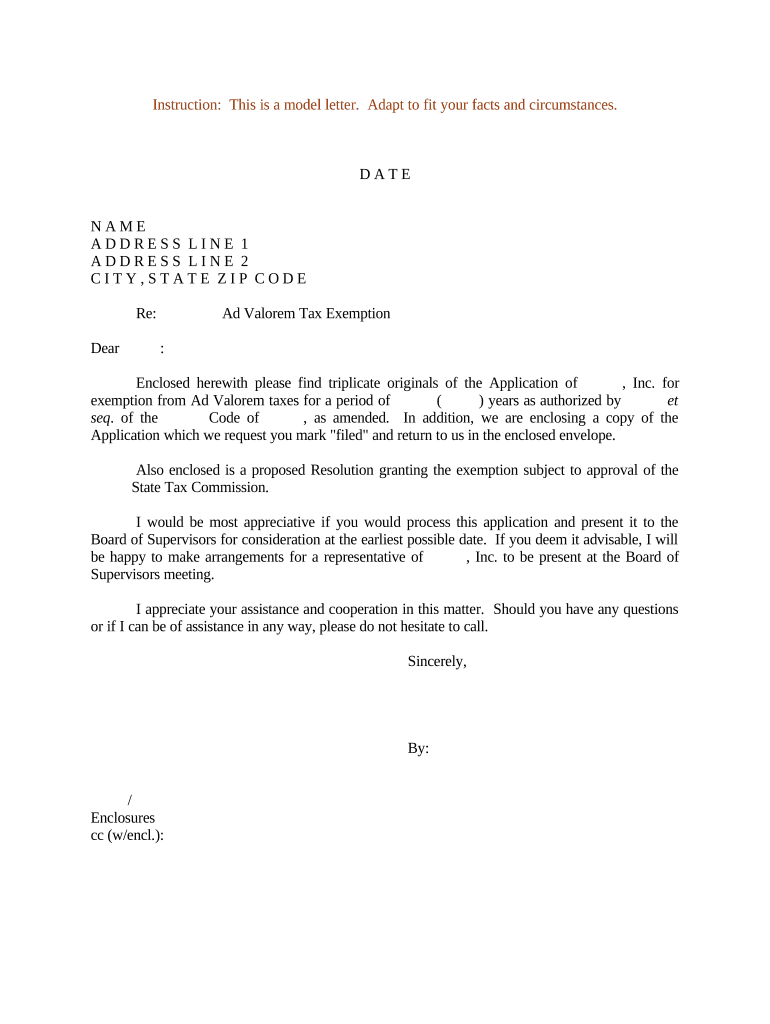
A well-prepared letter clarifies eligibility, preserves procedural rights, and reduces processing delays—helping avoid incorrect assessments and potential penalties. It creates a written trail the assessor uses to evaluate eligibility for ad valorem relief.

The letter is most often prepared by property owners, tax professionals, nonprofit administrators, or government attorneys to claim statutory exemptions.
Accurate identification of the filer and clear authority to act reduce the chance of rejection and preserve appeal windows.
Date, recipient (assessor or tax collector), and subject line stating 'Letter Regarding Ad Valorem Tax Exemption'.
Taxpayer legal name, mailing address, contact details, and representative information if applicable.
Assessor parcel number, physical address, and full legal description of the parcel or improvement.
Statute citation or ordinance and concise explanation how the property meets statutory criteria.
Attach deeds, exemption certificates, organizational charters, proof of occupancy, or other evidentiary items.
Printed name, title, signature, date, and statement of authority to act for the taxpayer or entity.
Record copy of deed showing ownership, conveyance history, and any restrictive covenants relevant to tax status.
For nonprofits, attach articles of incorporation, IRS determination letter, and bylaws demonstrating qualifying status.
Lease agreements, occupancy records, or use affidavits showing how the property is used in relation to the exemption.
Previous tax bills or exemption certificates that show prior treatment and help determine retroactive relief.
| File Format | PDF | Use flattened PDF/A for stable archival |
|---|---|
| File Naming | ParcelID_LastName_Exemption.pdf | Use assessor-specified naming if provided |
| Attachments | Combine evidence into one multi-page PDF | Include a cover index page |
| Metadata | Embed parcel number in document properties | Aids automated processing |
| Access Controls | Apply password if required by recipient | Provide password separately if requested |
Check the assessor’s portal for electronic acceptance rules before submitting to avoid rejections.
When submitting electronically, retain the signed file and the signing audit trail to prove delivery and execution.
Often tied to tax year or calendar date; check county rules for specific deadline
Appeals commonly must be filed within 30–60 days after assessment notice
Some counties allow retroactive relief if filed within a specific period
Certain exemptions require annual renewal or recertification
Processing time can affect billing cycles and refund timing
Assessor receives and logs the exemption letter and attachments.
Staff verify documents, parcel data, and statutory eligibility.
Assessor may request clarification or additional evidence within a set timeframe.
Office issues approval, partial approval, or denial; notice includes appeal instructions.
A county assessor receives a nonprofit’s letter requesting charitable exemption, including IRS 501(c) letter and deed
An individual owner submits a homestead exemption letter with proof of residency and ID
| signNow | DocuSign | Adobe Sign | PandaDoc | HelloSign | |
|---|---|---|---|---|---|
| Starting Price | $8/user/mo | $15/user/mo | $14/user/mo | $19/user/mo | $15/user/mo |
| Free Trial | 7-day free trial | Varies by plan | Varies by plan | Varies by plan | Varies by plan |
| Bulk Send | Yes | Yes | Yes | Yes | No |
| Audit Trail | Yes | Yes | Yes | Yes | Yes |
| HIPAA Compliant | Yes | Yes | Yes | No | No |
| Envelope Cap | No cap | 100 envelopes/user/year | Varies | Varies | Varies |