Establishing secure connection…Loading editor…Preparing document…

Affidavit Adverse Possession

This template is fully customizable. Edit the text, fill out the fields, and send it for signature. Give it a try!
Affidavit Adverse Possession

What an Affidavit of Adverse Possession Is and When it Applies

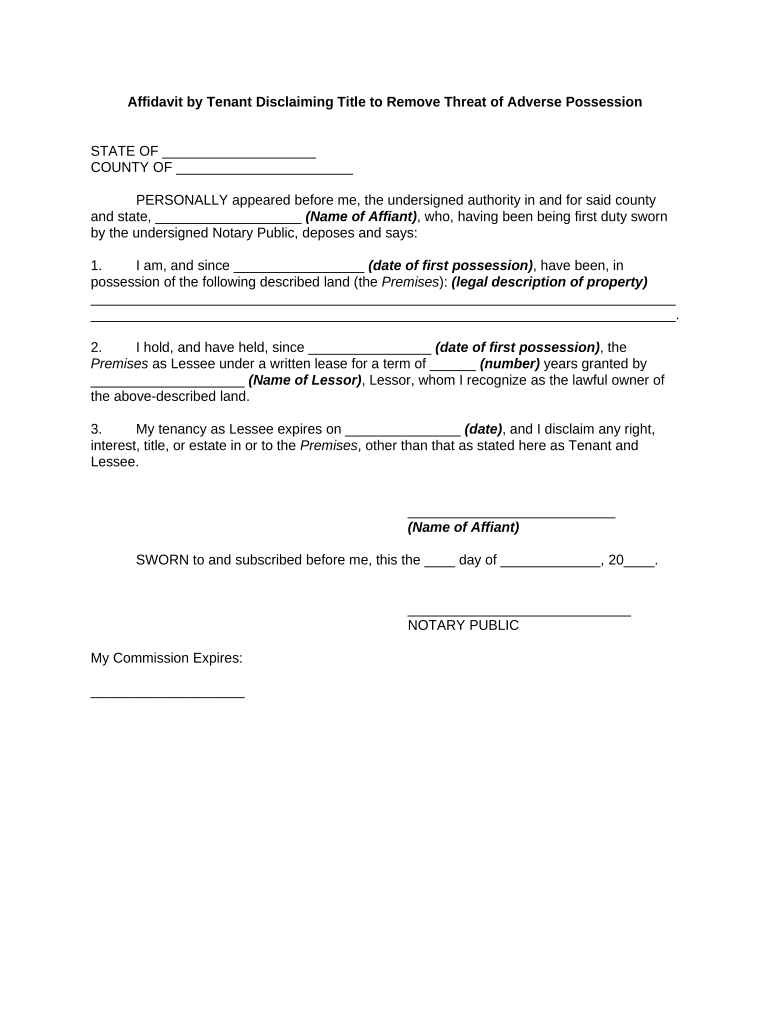
An Affidavit of Adverse Possession is a sworn written statement used by a claimant to describe continuous, open, notorious, exclusive, and hostile possession of land to support a title claim. It summarizes facts such as the property description, the period of possession, acts demonstrating control, and any attempts to give notice. Many jurisdictions allow recording the affidavit with the county recorder to provide constructive notice to third parties; statutory elements and required supporting documentation vary by state. This document often accompanies survey maps, tax records, and proof of improvements.

Why an Affidavit of Adverse Possession Matters

The affidavit organizes evidence needed for a statutory adverse possession claim, creates a public record of the claimant’s assertion, and can alert title companies and neighbors. Filing a clear affidavit reduces ambiguity in title searches and supports negotiations or quiet-title litigation when necessary.

Why an Affidavit of Adverse Possession Matters

Common Users and Stakeholders

The affidavit is used by claimants and professionals involved in property title issues.

  • Property owners or possessors asserting adverse possession claims for boundary or unused land
  • Title companies and closing attorneys reviewing risks before issuing insurance or transferring title
  • Surveyors and land-use professionals supplying legal descriptions, maps, and evidence

Who Typically Prepares and Signs This Affidavit

Affiant

The individual or entity claiming adverse possession. The affiant must be able to attest to continuous exclusive possession and provide supporting documentation, and will sign the affidavit under oath before a notary public or other authorized official.

Title Officer

A title professional or attorney who reviews the affidavit and supporting exhibits, confirms chain-of-title impacts, and advises on filing, recording, or quiet-title actions to resolve potential defects.

Essential Information to Include

Affiant Name: Full legal name on ID
Property Description: Legal description or parcel ID
Possession Period: Start and end years
Acts of Possession: Physical control details
Supporting Documents: Surveys, receipts, tax records
Notary Block: Notary acknowledgement required

Step-by-Step: Completing the Affidavit

Follow these sequential steps to prepare a complete and recordable affidavit of adverse possession.

  • 01
    Gather Evidence: Collect surveys, tax records, photos, and witness affidavits
  • 02
    Draft Narrative: Describe continuous, open, exclusive, notorious possession
  • 03
    Attach Exhibits: Include maps, tax rolls, receipts, and any supporting documents
  • 04
    Sign & Notarize: Sign before an authorized notary and complete acknowledgement

Where the Affidavit Goes and What Happens Next

After notarization, the affidavit is typically recorded and circulated to interested parties; routing varies by county.

  • Local Notary: Affiant executes the affidavit before a notary public
  • County Recorder: Submit for recording with the county recorder's office
  • Title Search: Title companies add the affidavit to the chain-of-title search
  • Notice to Parties: Notify neighbors and lenders as appropriate

Digital Signing and Recording Considerations

Electronic preparation and e-signing can streamline gathering signatures and exhibits, but verify local rules before relying solely on electronic processes.

  • Document Formats: PDF, PDF/A, DOCX supported
  • Identity Proofing: Multi-factor or credential analysis required
  • Audit Trail: Time-stamped signing history retained

Saving and Exporting the Final Affidavit

Preserve signed affidavits in multiple formats to satisfy recorder and title company requirements while keeping a secure audit trail.

Signed PDF

Export a tamper-evident PDF with embedded audit trail and notary acknowledgement so counties and title companies can verify authenticity.

PDF/A Archive

Save a PDF/A version for long-term archival to ensure future accessibility and to meet record retention policies.

Editable DOCX

Keep an editable DOCX master copy for future amendments or attorney revisions before re-notarization and re-recording.

Audit Report

Export and store the signing audit report showing timestamps, IP addresses, and identity verification steps for evidentiary records.

Key Parts of a Professional Affidavit of Adverse Possession

A robust affidavit includes a clear narrative, documented exhibits, precise legal description, and appropriate formalities to support title examination and recording.

Caption

Case caption or heading identifying the document as an Affidavit of Adverse Possession, the affiant’s name, and the property location to help index the record.
Statement of Possession

A chronological narrative describing how the affiant possessed the property: dates, activities (maintenance, improvements), exclusions of others, and any visible acts of control.

Legal Description

The complete legal description or assessor parcel number is included verbatim to ensure the recorder files the affidavit against the correct parcel.

Supporting Exhibits

Numbered exhibits such as surveys, photos, tax receipts, permits, and witness affidavits are attached and cross-referenced in the affidavit narrative.

Oath and Notary

A jurat or acknowledgement signed before an authorized official with the notary’s seal and signature, meeting the state’s notarial form and retention rules.

Signature Block

Affiant signature, printed name, date, and contact information; attorney or preparer identification where required for follow-up or validation.

Timelines and Processing Expectations

Understand the statutory and administrative timing that affects adverse possession claims and recording effects.

Statute of Limitations:

Varies by state, commonly 5–30 years for adverse possession claims

Recording Processing:

County recording typically completes in 1–10 business days, depending on e-recording availability

Notarization Timing:

Notarize at signing; some counties require original ink-signed notarized documents

Title Search Impact:

Title companies update records after recording; analysis timing varies by vendor

Challenge Window:

Third parties may file disputes or quiet-title actions within statutory periods

Key Milestones in Filing and Recording

Follow these sequential milestones to complete and record the affidavit successfully.

01

Prepare Affidavit

Assemble narrative, exhibits, and legal description before signing

02

Notarize Document

Execute the affidavit before a notary and obtain required acknowledgements

03

Record With County

Submit original or e-recorded affidavit to the county recorder for indexing

04

Monitor Title

Confirm recording appears in title searches and notify interested parties

Common Preparation Errors to Avoid

  • Using vague possession descriptions without dates or corroborating exhibits reduces credibility and may lead to rejection by title officers.
  • Failing to match the affiant name to supporting IDs or tax records can trigger identity verification delays or recording rejections.
  • Submitting incomplete legal descriptions or incorrect parcel numbers causes mis-indexing or rejection at the recorder’s office.
  • Relying solely on unsigned or unauthenticated exhibits (photos without dated receipts or metadata) weakens the affidavit’s evidentiary value.

Risks and Consequences of Inaccurate or Improper Affidavits

Title Defect: Insurance denial or title cloud
Recording Rejection: County refusal to index
Perjury Exposure: Criminal penalties for false statements
Boundary Litigation: Costly quiet-title disputes
Tax Liability: Back taxes or reassessments possible
Delay Costs: Extended resolution timeline

How an Affidavit Differs from Similar Documents

Compare the affidavit to deeds, quiet-title complaints, and easement documents to choose the correct tool for your objective.

Document Type Affidavit Deed Quiet-Title Suit
Purpose record factual claim transfer title adjudicate title
Formality sworn statement conveyance instrument court filing
Requires Notary
Creates Title no (supports claim) court may decree

eSignature and Platform Pricing Options for Preparing and Signing the Affidavit

Platform pricing and capabilities vary; signNow appears first for comparison and the table highlights starting prices, trial availability, bulk send, audit trail, HIPAA compliance, and envelope caps.

signNow DocuSign Adobe Sign PandaDoc HelloSign
Starting Price $8/user/mo $15/user/mo $14/user/mo $19/user/mo $15/user/mo
Free Trial 7-day free trial Varied Varied Varied Varied
Bulk Send Yes Yes Yes Yes Yes
Audit Trail Yes Yes Yes Yes Yes
HIPAA Compliant Yes Yes Yes No No

Practical Scenarios Where an Affidavit Is Used

These examples illustrate typical fact patterns that lead to filing an affidavit of adverse possession.

Rural Boundary Claim

A neighbor maintained and farmed a strip of unused land openly for over 20 years, using it for fences and access

  • Evidence included dated photos and tax records
  • The affidavit documented the continuous acts of possession and attached the survey and receipts to support a later quiet-title action if needed.

Urban Vacant Lot

A claimant landscaped and paid property taxes on an adjacent vacant lot continuously for many years, excluding others

  • Possession was visible and notorious
  • The recorded affidavit and assessor records created constructive notice to potential buyers and informed title insurer risk assessment.

Frequently Asked Questions about Affidavits of Adverse Possession

Answers to common practical and legal questions about drafting, notarizing, and recording an affidavit of adverse possession.


Need help? Contact support

be ready to get more
Join over 28 million airSlate SignNow users