Caption
Document title, jurisdiction, and case or account reference placed at the top to identify purpose and recipient.
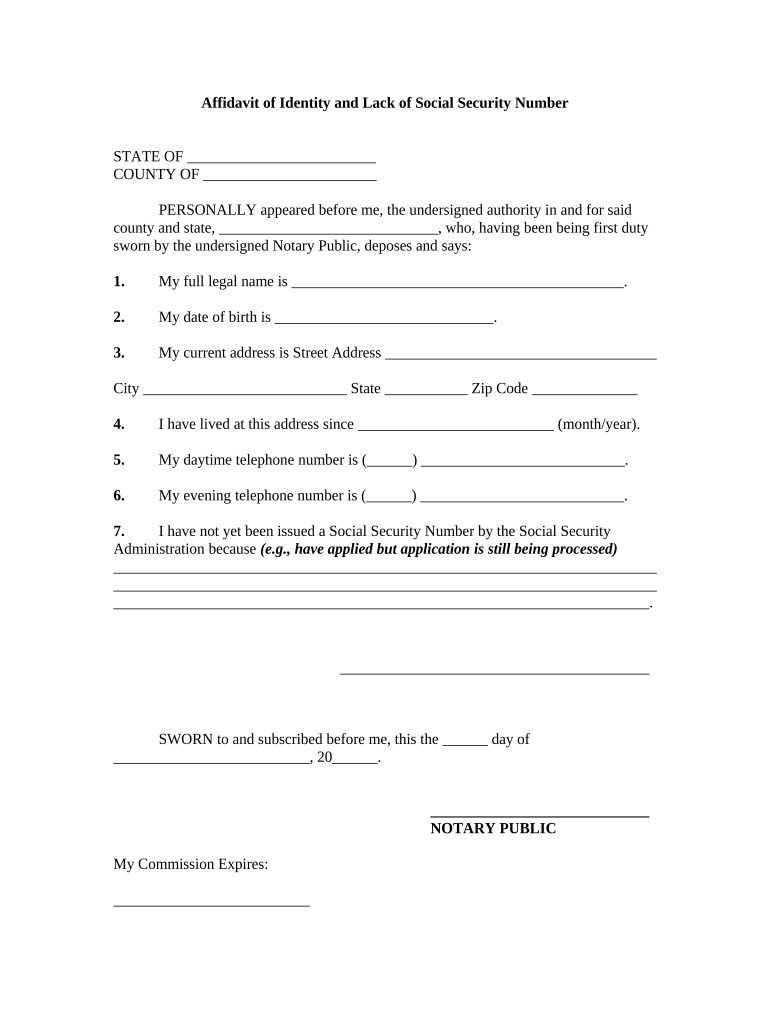
A clear, complete affidavit resolves name discrepancies, enables corrections to legal or financial records, and reduces delays in transactions. It provides a sworn record that recipients can rely on to update titles, accounts, or government files while documenting the affiant's intent and identity under applicable laws such as ESIGN and state notary rules.

Typical users prepare or request Affidavits of Identity when documentation gaps prevent routine processing or record correction.
Recipients rely on a notarized affidavit plus supporting ID to accept the sworn statement and proceed with corrections or filings.
The individual asserting identity facts. They provide full legal name, aliases, date of birth, and attach government ID. They sign the affidavit under penalty of perjury and should appear before a notary or follow permitted RON procedures when allowed.
A corporate officer or legal representative signing on behalf of an entity. They must state authority, identify themselves, and include documentation proving capacity, such as a board resolution or power of attorney, when required by the recipient.
A property manager needed to correct a deed name to match a seller's ID
A clinic corrected patient records when names differed between files
Document title, jurisdiction, and case or account reference placed at the top to identify purpose and recipient.
Full legal name, aliases, date and place of birth, current address, and relationship to the named person stated clearly for verifiability.
A concise narrative that explains the identity discrepancy, lists supporting documents, and states why the affidavit is necessary.
Numbered attachments such as government ID photocopies, prior records, or legal documents referenced in the statement.
Affiant signature, printed name, date, and contact information; indicate signer capacity if signing for an entity.
Notary or notarial wording showing oath/affirmation, date, venue, and notary signature and seal to authenticate the statement.
W-9 or account updates: supply affidavit when the payer or institution requests identity proof.
Obtain notarial acknowledgment or RON as required prior to submission.
Use remote notarization only where the recipient accepts RON evidence.
Recipient review commonly takes 1–10 business days depending on volume.
Attach affidavit to the underlying filing to maintain a single evidentiary package.
Prepare the narrative and confirm supporting documents before execution.
Complete notarization or permitted RON and collect certificate of completion.
Send to the requesting institution with attachments and cover note.
Recipient reviews and amends records or notifies of outstanding issues.
Choose a platform that supports required file types, notarization methods, and signer authentication for your jurisdiction.
Ensure the chosen workflow captures audit trails, stores attachments securely, and meets applicable compliance such as ESIGN, UETA, and HIPAA where required.
| Field | Configuration |
|---|---|
| Document Template | Use a reusable affidavit template |
| Signer Order | Affiant then notary sequence |
| Authentication Level | Email + SMS or KBA for high assurance |
| Retention Setting | Enable audit trail and long-term storage |
| Criteria | Affidavit of Identity | Sworn Declaration |
|---|---|---|
| Notarization Required | commonly yes | sometimes |
| Typical Use | correct records | general sworn statement |
| Attachment Needs | id copies required | often optional |
| Legal Weight | high probative value | moderate probative value |
| signNow | DocuSign | Adobe Sign | PandaDoc | HelloSign | |
|---|---|---|---|---|---|
| Starting Price | $8/user/mo | $15/user/mo | $14/user/mo | $19/user/mo | $15/user/mo |
| Free Trial | 7-day free trial | Trial available | Trial available | Trial available | Trial available |
| Bulk Send | Yes | Yes | Yes | Yes | No |
| Audit Trail | Yes | Yes | Yes | Yes | Yes |
| HIPAA Compliant | Yes | Yes | Yes | No | No |