Establishing secure connection…Loading editor…Preparing document…

Affidavit of Descent

This template is fully customizable. Edit the text, fill out the fields, and send it for signature. Give it a try!
Affidavit of Descent

What an Affidavit of Descent Is and when it applies

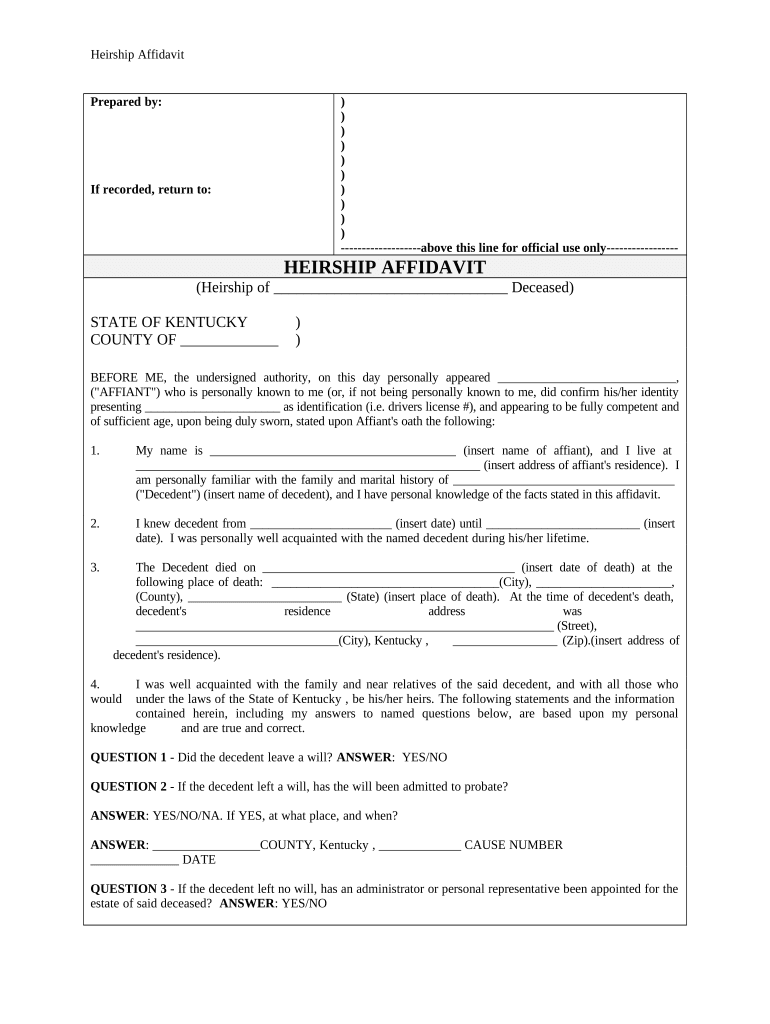
An Affidavit of Descent is a sworn written statement used to document how property of a deceased person passes to heirs when a probate administration is not necessary or a simplified transfer is allowed. It identifies the decedent, lists heirs and their relationships, describes the property at issue, and explains the legal basis for transfer to establish chain of title for recorders, banks, or other custodians.

Why an Affidavit of Descent matters for transfers

This affidavit reduces administrative friction when a small or uncontested estate requires transfer of real or tangible property, creates a documented chain of title for recorders and title companies, and may avoid full probate in jurisdictions that allow summary procedures for small estates.

Why an Affidavit of Descent matters for transfers

Who typically prepares and accepts this affidavit

The Affidavit of Descent is commonly prepared by heirs or their counsel and reviewed by recorders, title companies, and financial institutions.

  • Heirs and personal representatives who need to claim property without full probate.
  • Probate attorneys and paralegals preparing sworn descent statements and supporting affidavits.
  • Title companies or county recorders verifying chain of title for transfers or closings.

Courts, banks, and third parties rely on accurate affidavits to clear title; incomplete or inconsistent submissions are often returned or disputed.

Who signs and explains their role

Heir Claimant

An heir or successor signs as the affiant to swear under oath to their relationship and facts of descent; they must supply identification, copies of the decedent’s death certificate, and any supporting family records to prove entitlement.

Probate Attorney

An attorney prepares or reviews the affidavit to ensure statutory requirements are met, assembles supporting documents for recording, advises on whether affidavit use is appropriate versus formal probate, and represents the affiant if objections arise.

Essential fields every affidavit should include

Decedent Name: Full legal name
Date of Death: MM/DD/YYYY
Heirs Named: Names and relationships
Property Description: Legal description or asset details
Jurisdiction: County and state
Affiant Contact: Name, address, phone

Consequences of inaccurate or fraudulent affidavits

Perjury Exposure: Criminal penalties and fines
Title Defect: Clouded or invalid title
Third-Party Claims: Challenges by unknown heirs
Recording Rejection: Return or refusal to record
Delay Costs: Longer closing timelines
Tax Consequences: Unexpected estate or transfer taxes

Common errors to avoid when preparing the affidavit

  • Using informal names or initials instead of full legal names can cause rejection or later disputes over identity.
  • Failing to attach a certified death certificate, probate orders, or clear property descriptions commonly leads to recorder refusal.
  • Omitting notarization, incorrect notary acknowledgment wording, or absent witness statements where required invalidates the filing.
  • Listing heirs without documentation of relationship or omitting liens and encumbrances increases risk of third-party claims.

Real-world uses and practical outcomes

Two short examples show how an affidavit of descent resolves transfers without full probate and when it may be inappropriate.

Small Estate Transfer

A decedent left a single bank account under the state small-estate threshold and no will.

  • The sole heir filed an affidavit with the bank.
  • The bank released funds after verifying identity and supporting documents, avoiding an estate administration and saving several weeks of court time.

Real Property Claim

Heirs used an affidavit to transfer a parcel where title was uncontested and no probate was opened.

  • County recorder required notarization and proof of death.
  • After recording, the title search cleared and the heirs completed a sale, but a missing heir later required supplemental proceedings.

Step-by-step: completing an Affidavit of Descent

Follow these sequential steps to prepare and submit a valid affidavit of descent; requirements vary by state and county recorder so confirm local rules before recording.

  • 01
    Gather Documents: Collect death certificate and ID.
  • 02
    Identify Heirs: List names and relationships.
  • 03
    Draft Affidavit: Complete statutory language accurately.
  • 04
    Notarize & Record: Sign before a notary, then file.

Where to submit the affidavit after notarization

After notarization, choose the appropriate recipient based on the asset type — real property, bank accounts, or personal property each have different custodians.

  • County Recorder: Record deeds and property transfers.
  • Probate Court: File when court confirmation is required.
  • Title Company: Provide for closings and title updates.
  • Financial Institution: Submit for account or asset release.

Core elements to include in a professional affidavit

A well-constructed affidavit of descent reduces objections and recorder questions; include clear, statutory language and attach supporting records for quick acceptance.

Affiant Statement

A sworn declaration by the affiant describing his or her knowledge, relationship to the decedent, and the facts supporting succession under state law, written in precise, unambiguous terms.
Heir List

A complete list of heirs with full legal names, birthdates if helpful, relationship to decedent, and shares or specific interests being claimed to avoid future disputes.

Property Description

Full legal description for real property or clear identifying details for personal property (serial numbers, account numbers) so the recorder or custodian can match records accurately.

Legal Basis

Citation of the controlling state statute or small-estate provision relied upon for transfer, plus any probate filings or court orders that support the affidavit’s authority.

Attachments

Certified death certificate, prior deed or title documents, family records, and any prior probate paperwork that corroborate the affiant’s statements and establish chain of title.

Notary Block

A proper notary acknowledgment or jurat formatted per state requirements, plus witness signature lines if the local law or deed form requires witnesses in addition to notarization.

Supporting documents and file types to use

Use standard formats and include commonly requested attachments so recorders and third parties can accept and process your affidavit without delay.

PDF Signed Copy

Provide a high-resolution PDF version suitable for recording and long-term retention; ensure the PDF includes notarization blocks and embedded signatures or visible notary stamps as required.

Editable DOCX

Keep an editable Word DOCX for attorney review and revisions before finalizing; do not submit drafts to recorders or custodians.

Certified Death Certificate

Attach a copy of the certified death certificate or certified extract to prove the decedent’s death; many institutions will not accept uncertified photocopies.

Title & Deed Copies

Include prior deed or title documents that show the decedent’s ownership interest and any recorded encumbrances to avoid surprises during title searches.

Customizing and completing the affidavit online

Configure an online document workflow to collect signatures, attach evidence, and export record-ready files for recording or delivery to institutions.

Field Configuration
Signing Order Set affiant first, then witnesses or attorneys as needed
Authentication Use email plus SMS or ID verification for stronger identity proof
Conditional Fields Show witness lines only if state rules require them
Export Settings Produce flattened PDF for recorders, retain editable DOCX for counsel

Digital submission, integrations, and file compatibility

Choose a platform that supports common formats, integrates with record-keeping systems, and meets notarization or authentication needs.

  • File Formats: PDF, DOCX, and searchable PDF supported
  • Integrations: Salesforce, Microsoft 365, NetSuite, Google Workspace
  • Notary Options: In-person notary or RON where permitted

Confirm the recorder’s electronic filing requirements before e-submitting; some counties accept only flattened, notarized PDFs and may require extra metadata.

Expected processing times and practical deadlines

Processing times vary by county and institution; plan for recording, bank, and title company lead times when scheduling transfers.

Immediate Filing Recommended:

Record promptly to reduce disputes; delays can allow competing claims.

Recorder Processing:

Typical county recording takes 2–8 weeks depending on backlog.

Title Company Review:

Expect 1–3 weeks for title search and clearance.

Probate Consideration:

If probate opens, affidavit may be deferred until court action completes.

Tax Reporting:

Allow time for estate tax or reporting obligations where applicable.

eSignature vendor comparison for handling affidavits

Comparison of core pricing and capabilities relevant to affidavit workflows; signNow appears first as a widely used option for eSigning and workflow automation.

signNow DocuSign Adobe Sign PandaDoc HelloSign
Starting Price $8/user/mo $15/user/mo $14/user/mo $19/user/mo $15/user/mo
Free Trial Yes, 7-day trial Varies by plan Varies by plan Varies by plan Varies by plan
Bulk Send Yes Yes Yes Yes No
Audit Trail Yes Yes Yes Yes Yes
HIPAA Compliant Yes Yes Yes No No

Frequently asked questions about Affidavits of Descent

Answers to common questions about validity, witnesses, notarization, and electronic signing for Affidavits of Descent.


Need help? Contact support

be ready to get more
Join over 28 million airSlate SignNow users