Establishing secure connection…Loading editor…Preparing document…

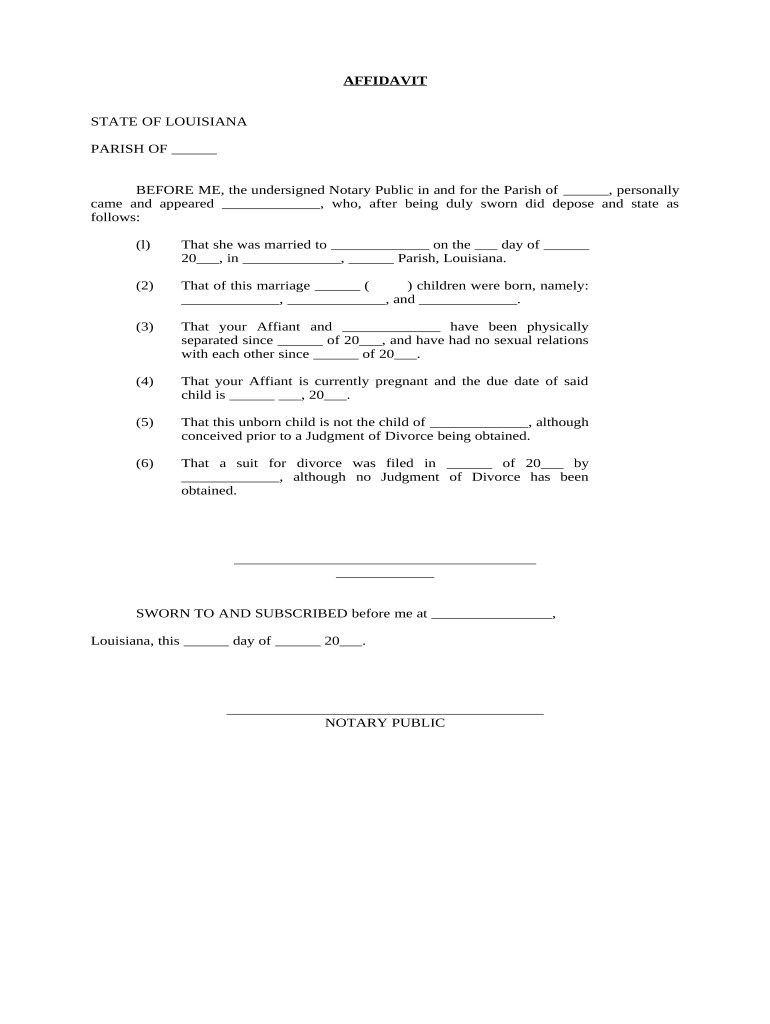
Affidavit of Paternity

This template is fully customizable. Edit the text, fill out the fields, and send it for signature. Give it a try!
Affidavit of Paternity

What an Affidavit of Paternity Is

An Affidavit of Paternity is a signed legal statement used to establish that a man is the biological parent of a child when the parents are unmarried or when paternity is otherwise not listed on a birth record. The form records identifying information for the child and parents, documents parental intent or knowledge, and may be used to request the addition of a father’s name to a birth certificate, establish custody or support obligations, or create a legal basis for benefits and inheritance rights.

Why this document matters

The affidavit creates an administrative record of parentage that can simplify birth-certificate corrections, access to benefits, and future child-support or custody proceedings while avoiding immediate court action in many jurisdictions.

Why this document matters

Who typically completes an Affidavit of Paternity

Common users include parents, hospital staff, county vital records offices, and attorneys involved in family law or benefits administration.

  • Unmarried mother or father completing parentage documentation for a newborn or existing child
  • County or state vital records clerks processing birth certificate amendments and establishing a parent record
  • Family law attorneys preparing documentation for custody, support claims, or administrative filings

Use depends on state procedures; some states permit administrative filing while others require court orders or additional verification steps.

Core elements included in a professional affidavit

A complete affidavit combines factual declarations, identity data, a notarized signature block, and fields for official use so it can be accepted by state agencies and courts.

Child details

Full legal name, date and place of birth, and any hospital or birth record identifiers required for matching with vital records.
Parent identities

Full legal names, dates of birth, addresses, and government ID references for both mother and alleged father to confirm identity.

Statement of paternity

A clear, signed declaration by the individual attesting to biological parentage and intent to be recognized as the legal parent.

Notary block

Space for a notarial acknowledgment, including notary name, commission information, signature, and date to authenticate the signer.

Administrative fields

Agency use fields for file numbers, clerk initials, or actions taken, which help state offices track processing and amendments.

Optional testing note

A field to record whether genetic testing was performed and the testing provider if results are attached or referenced.

Step-by-step: filling out and executing the affidavit

Follow these sequential steps to complete, authenticate, and file an Affidavit of Paternity reliably.

  • 01
    Gather documents: Collect IDs, birth record, and any prior paternity documents.
  • 02
    Complete form: Enter all names, dates, and addresses as instructed in the fillable fields guide.
  • 03
    Sign before notary: Sign in the presence of a notary or follow state RON procedures where allowed.
  • 04
    Submit to agency: File with the state vital records office or county registrar per local instructions.

Setting up a digital workflow for online completion

Configure a clear e-filing workflow to collect information, verify identity, and apply notarization if permitted by the state.

Field Configuration
Identity verification Require government ID upload or MFA for remote signers
Notarization step Enable RON session where state law allows
Document storage Save signed PDF and audit trail in secure storage
Delivery Route copies to parents and vital records agency

Digital signing and submission considerations

Confirm that the chosen e-signature platform supports required authentication, audit trails, and any needed notary integrations before beginning a remote workflow.

  • Authentication: Email, SMS, KBA, or stronger options
  • Audit trail: Time-stamped logs and IP records
  • RON support: Audio-video session and recording

Ensure the platform can produce an exportable signed PDF and evidence file acceptable to the state vital records office and to any court that may review the affidavit.

Where to send the completed affidavit

After execution and notarization (if required), route the affidavit to the correct agency and retain copies for all parties.

  • Local registrar: County vital records office for birth-certificate amendments
  • State vital records: State Department of Health or equivalent central office
  • Family court: When a court order or judicial review is required
  • Personal records: Provide certified copies to both parents and retain originals

Timing and processing expectations

Filing timelines vary by state; processing may take days to several weeks depending on agency volume and whether supplemental verification is required.

Immediate filing window:

File as soon as information is accurate to expedite certificate updates

Agency processing time:

Often 5–30 business days depending on state workload

Genetic testing delays:

Test results can add 2–6 weeks to completion

Court-required actions:

If court review needed, scheduling extends timeline significantly

Record update confirmation:

Request written confirmation of birth-certificate amendment

Key milestones in the affidavit process

A typical lifecycle includes completion, authentication, submission, and record update stages that proceed sequentially.

01

Form Completion

All fields completed and reviewed for accuracy

02

Authentication

Notary or approved e-notarization performed

03

Submission

Document delivered to county or state vital records office

04

Certificate Update

State processes amendment and issues updated birth certificate

Common mistakes to avoid

  • Entering inconsistent names or dates that do not match government ID or hospital records, which triggers identity verification and delays.
  • Using initials or nicknames instead of full legal names, causing rejection when the agency cannot match records.
  • Skipping notarization in jurisdictions that require it, which can render the affidavit unusable for official amendment.
  • Failing to retain the signed original and a certified copy, leaving parents without evidence if later dispute arises.

Legal risks and consequences of errors

Invalid filing: May be rejected
Delay in benefits: Access to benefits may be delayed
Support obligations: Creates potential child support liability
Probate impact: Affects inheritance rights
Perjury exposure: False statements may trigger charges
Court disputes: May lead to litigation and additional costs

Essential identification and supporting items

Child DOB: MM/DD/YYYY
Child name: Full legal
Parent IDs: Driver's license or passport
Proof of birth: Hospital record or birth certificate
Notary details: Notary name and commission
Test results: Genetic test report if used

Common eSignature platform pricing and capability snapshot

This comparison highlights starting prices and select capabilities relevant to signing and notarizing an Affidavit of Paternity; signNow is listed first per platform convention.

signNow DocuSign Adobe Sign PandaDoc HelloSign
Starting Price $8/user/mo $15/user/mo $14/user/mo $19/user/mo $15/user/mo
Free Trial 7-day free trial Varies by plan Varies by plan Varies by plan Varies by plan
Bulk Send Yes Yes Yes Yes No
Audit Trail Yes Yes Yes Yes Yes
HIPAA Compliant Yes Yes Yes No No
Envelope Cap No cap 100 envelopes/user/year Varies by plan Varies by plan Varies by plan

Frequently asked questions about Affidavits of Paternity

Answers to common questions on validity, notarization, edits, and how e-signatures are treated under U.S. law.


Need help? Contact support

be ready to get more
Join over 28 million airSlate SignNow users