Establishing secure connection…Loading editor…Preparing document…

Agistment Agreement

This template is fully customizable. Edit the text, fill out the fields, and send it for signature. Give it a try!
Agistment Agreement

What an Agistment Agreement Is

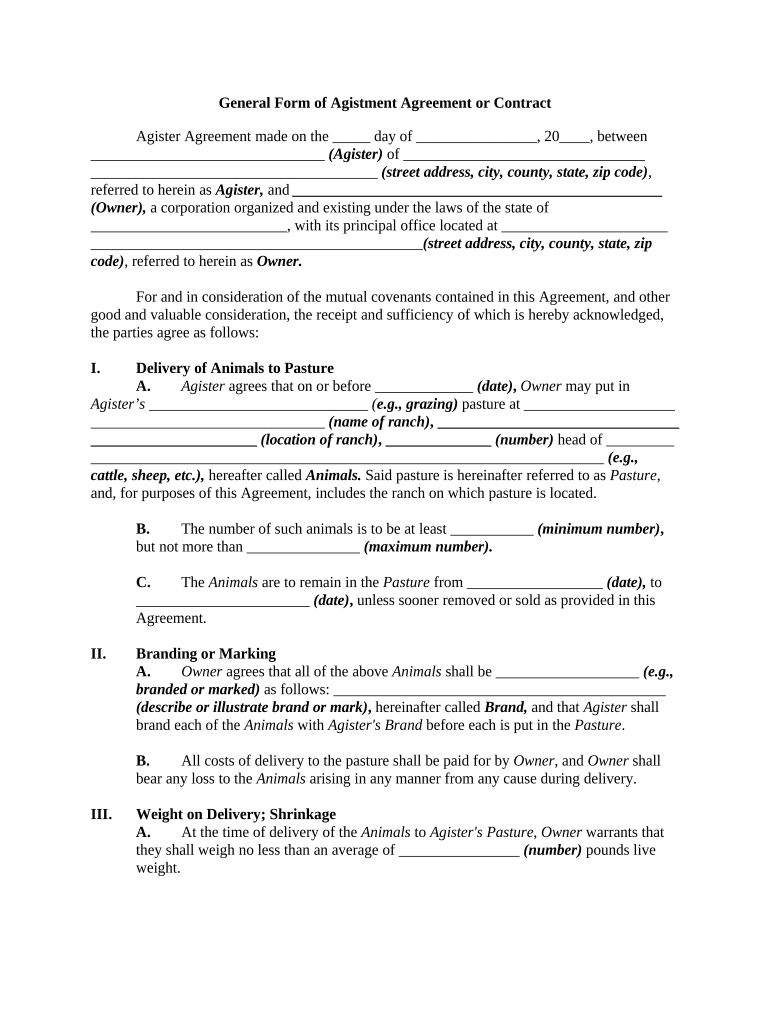
An Agistment Agreement is a contract where one party (the agister) agrees to care for and feed livestock or horses owned by another party (the owner) in exchange for payment or services. The agreement defines boarding, grazing, feeding, veterinary care, access rights, duration, payment schedules, insurance obligations, and allocation of liability. It can cover short-term boarding, seasonal grazing, or long-term stabling. A clear, written Agistment Agreement reduces disputes by documenting responsibilities, removal procedures, and remedies under applicable state property and bailment laws.

Why a Written Agistment Agreement Matters

Use an Agistment Agreement to define care standards, payment terms, and risk allocation between owner and agister. It helps prevent disputes over animal welfare, property access, and termination, and provides clear remedies under applicable state law.

Why a Written Agistment Agreement Matters

Who Typically Completes an Agistment Agreement

Typical parties who complete an Agistment Agreement include livestock owners, boarding facility operators, and private agisters.

  • Livestock owners — clarify liability, boarding fees, and removal rights before and after agistment.
  • Agisters/boarders — document care standards, feed responsibilities, and emergency veterinary procedures.
  • Farms and facilities — use to set insurance, access hours, and subcontracting permissions.

Step-by-Step: Completing an Agistment Agreement

Complete the Agistment Agreement in order: identify parties, describe services, set payment, address liability, and obtain signatures.

  • 01
    Identify Parties: Enter full legal names and contact details
  • 02
    Describe Services: Specify boarding, grazing, feed, and medical care scope
  • 03
    Payment Terms: State fees, schedule, late penalties, and accepted payment methods
  • 04
    Signatures: All parties sign and date; include witness or notary if required

Security and Compliance Considerations

Encryption: TLS 1.2/1.3 in transit; AES-256 at rest
Certifications: SOC 2 Type II, ISO 27001, PCI DSS
HIPAA: BAA available for protected health information
ESIGN/UETA: Compliant with federal and state e-signature laws
Audit Trail: Timestamped logs, IP, actions retained
Access Controls: SSO, role-based permissions, two-factor options

Key Risks and Potential Penalties

Liability for Injury: Owner may face negligence liability
Unpaid Fees: Agister can retain animals until paid
Improper Removal: May trigger trespass or conversion claims
Tax Reporting: Income reporting obligations apply
I-9/Employment: If employees involved, follow I-9 rules
Notary/Witness Errors: Improper notarization can void enforcement

Common Preparation Errors to Avoid

  • Vague service descriptions that omit animal counts, feeding schedules, or veterinary responsibilities lead to disputes and differing expectations about care standards.
  • Failing to specify payment timing, late fees, or acceptable methods creates collection difficulties and may leave agisters uncompensated for services rendered.
  • Not addressing removal procedures or emergency medical authorization causes delays in urgent care and legal uncertainty when animals must be moved.
  • Using informal emails instead of a signed agreement risks enforceability problems under ESIGN and state contract law when parties dispute terms.

Two Practical Agistment Agreement Examples

These two examples illustrate typical Agistment Agreement uses and contract clauses that prevent disputes in boarding and seasonal grazing contexts.

Boarding Stable

A boarding stable drafted an Agistment Agreement to formalize rates, boarding rules, and veterinarian access permissions for clients.

  • Included emergency care authorization and fee allocation.
  • The contract reduced disputes by defining turnaround times for removal, establishing insurance requirements, and giving the stable a lien remedy for unpaid fees, which improved collections and clarified responsibilities during seasonal influxes.

Seasonal Grazing

A rancher agisted cattle on leased pasture for summer grazing and used the agreement to specify stocking rates and biosecurity measures.

  • Required 30 days' removal notice.
  • By documenting responsibilities for feed supplementation and disease monitoring, both parties avoided confusion during drought, and animal welfare decisions were made according to the written protocol, reducing legal exposure.

How the Agreement Execution Workflow Typically Works

Typical workflow for executing an Agistment Agreement, from draft to signed copy and retained records.

  • Draft: Prepare terms and service description
  • Review: Parties review clauses, insurance, and fees
  • Sign: Execute signatures, witness, or notary as law requires
  • Store: Retain executed copy per retention policy

Setting Up an Online Signing Workflow

Configure online workflows to collect signatures, attach veterinary records, and notify parties about renewals and payments.

Field Configuration
Signature Type Email link; SMS code optional
Authentication Email + access code or KBA
Notifications Automated reminders and expiry alerts
Document Attachments Veterinary records and insurance certificates

Platform and Format Requirements for eSigning

Use secure eSignature platforms that support enforceability, audit trails, and optional notarization; select integrations that match your recordkeeping systems.

  • Formats: PDF, DOCX, and printable formats
  • Integrations: Salesforce, NetSuite, Google Workspace, Box
  • Authentication: Email link, SMS code, or ID proofing

Key Timing and Deadline Considerations

Key timing considerations for Agistment Agreements include effective dates, notice periods, and seasonal deadlines for removal.

Effective Date:

Start date in MM/DD/YYYY format controls obligations

Notice Period:

Notice required for termination, often 7–30 days depending on clause

Payment Due:

Due on specified date; late fees apply per agreement

Emergency Removal:

Immediate action clauses for animal welfare as specified

Renewal:

Automatic or mutual renewal terms and corresponding deadlines

Milestones: From Drafting to Post-Termination

Track these milestones from initial drafting through post-termination obligations so parties know timing and responsibilities.

01

Drafting

Define scope, fees, and care responsibilities with owner and agister

02

Execution

Obtain signatures, witnesses, or notarization as required by state law

03

Performance

Agister provides daily care and documents feed and medical events

04

Post-Termination

Settle accounts, return animals, and retain records per retention policy

Comparing an Agistment Agreement with a Grazing Lease

Key differences between an Agistment Agreement and a Grazing Lease—use this table to choose the right document for your arrangement.

Criteria Agistment Agreement Grazing Lease
Duration short-term long-term
Control of Animals owner retains title possession transferred
Payment Basis fee for care rent for pasture
Liability care-based tenant liability

eSignature Pricing Comparison for Executing Agistment Agreements

Pricing snapshot for common eSignature platforms suitable for executing Agistment Agreements; signNow appears first for vendor comparison.

signNow DocuSign Adobe Sign PandaDoc HelloSign
Starting Price $8/user/mo $15/user/mo $14/user/mo $19/user/mo $15/user/mo
Free Trial 7-day trial Varies Varies Varies Varies
Bulk Send Yes Yes Yes Yes No
Audit Trail Yes Yes Yes Yes Yes
HIPAA Compliant Yes Yes Yes No No
Envelope Cap No envelope cap 100 envelopes/user/year Varies Varies Varies

Frequently Asked Questions About Agistment Agreements

Answers to common questions about drafting, signing, and enforcing Agistment Agreements, including eSignature and notarization concerns.


Need help? Contact support

be ready to get more
Join over 28 million airSlate SignNow users