Establishing secure connection…Loading editor…Preparing document…

Agistment Agreement

This template is fully customizable. Edit the text, fill out the fields, and send it for signature. Give it a try!
Agistment Agreement

What an Agistment Agreement Covers

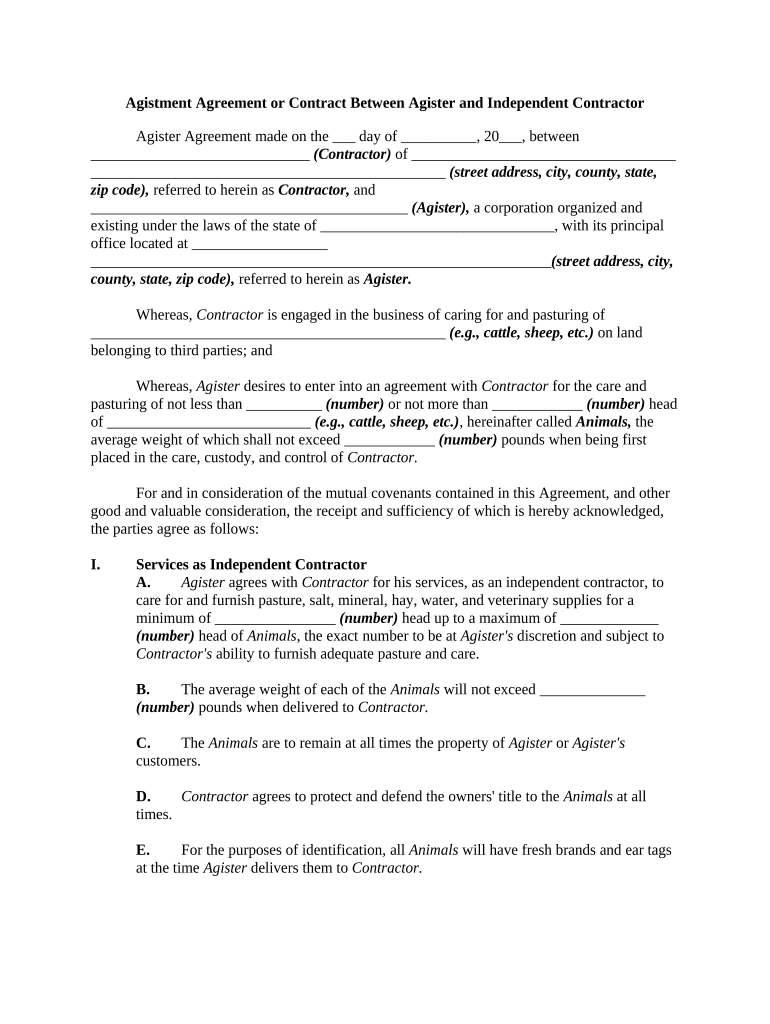
An Agistment Agreement is a written contract between a landowner or property manager and a party who boards, grazes, or cares for livestock on that land for a fee or other consideration. It defines the property used, the animals covered, duration, payment, care responsibilities, feeding, veterinary access, and removal procedures. The agreement allocates risk and liability, sets insurance and indemnity expectations, and may include termination, notice and dispute-resolution clauses to reduce misunderstandings between the agister and the livestock owner.

Why a Written Agistment Agreement Matters

A clear written agreement protects property owners and animal owners by documenting responsibilities, financial terms, and procedures for illness, injury or market changes. It reduces disputes about care standards and establishes legal recourse if animals are lost or property damaged. A contract also supports insurance claims and lender or regulatory inquiries by showing agreed duties and timelines.

Why a Written Agistment Agreement Matters

Who Commonly Uses Agistment Agreements

Typical users include landowners who lease pasture, livestock owners seeking temporary boarding, and service operators providing care and management.

  • Landowners offering pasture or facilities for hire; they need to limit liability and define access rights.
  • Livestock owners (individuals, breeders, small farms) who need proof of care terms and removal procedures.
  • Agistment operators or stable managers who require payment terms, care standards, and indemnity provisions.

A written contract clarifies expectations for all parties and supports insurance, tax and legal recordkeeping.

Primary Signers and Their Roles

Owner

The landowner or property manager who permits grazing or boarding. Typically responsible for providing safe facilities, maintaining pasture standards per the agreement, and complying with local land-use or zoning rules. The owner documents permitted uses and any access restrictions in the agreement.

Agister

The person or business caring for animals on the property. The agister accepts obligations for daily care, feeding, and arranging veterinary treatment if authorized. The agister often handles routine maintenance and must follow notice and removal procedures set out in the contract.

Essential Information to Include

Parties: Full legal names
Property: Physical address
Animals: Species and count
Fees: Amount and due date
Term: Start and end dates
Insurance: Required coverage

Key Risks and Legal Consequences

Liability Exposure: Third-party injury claims
Loss of Animals: Financial responsibility
Contract Breach: Damages or injunctions
Regulatory Penalties: Animal health violations
Insurance Gaps: Denied claims for lack of cover
Tax Issues: Mischaracterized income

Common Preparation Mistakes to Avoid

  • Vague care standards that fail to define feeding schedules, turnout, or veterinary authorization lead to disputes and inconsistent animal welfare.
  • Not specifying termination notice periods or removal logistics, which can create conflict when either party seeks to end the arrangement.
  • Failing to require insurance and proof of coverage exposes the landowner to liability and may leave owners uncompensated after incidents.
  • Mismatch between names on IDs, insurance certificates, and the contract can hinder enforcement and create tax or payment complications.

How to Complete an Agistment Agreement

Follow these steps to create a clear, enforceable contract that protects both the property owner and the animal owner.

  • 01
    Identify Parties: Enter full legal names and contact details for all parties.
  • 02
    Describe Property: Specify the parcel, access points, and permitted areas.
  • 03
    Detail Care Terms: State feeding, turnout, veterinary authority, and recordkeeping.
  • 04
    Set Payments: List fees, billing schedule, and late payment remedies.

Where to Send or File the Completed Agreement

After signing, route copies to each party and retain official records with property management or farm office.

  • Owner Copy: Provide signed original to landowner for records.
  • Operator Copy: Agister retains signed copy accessible on-site.
  • Veterinary Copy: Give vet authorization copy if medical care is delegated.
  • Digital Archive: Store PDF in secure document management system.

Core Clauses Every Professional Agreement Should Have

Include these sections to set expectations, limit liability, and provide clear operational rules for boarding, grazing, and animal care.

Scope of Use

Define permitted activities, pasture boundaries, stocking density, and any prohibited practices such as unattended breeding or off-site grazing.
Care Standards

Specify feeding, watering, bedding, stabling, parasite control, hoof care, and who authorizes routine and emergency veterinary care.

Payment Terms

State fees, deposit, invoicing frequency, accepted payment methods, late fees, and whether boarding includes feed or additional charges apply.

Insurance & Indemnity

Require liability insurance, name additional insured if appropriate, and include indemnity for negligence or willful misconduct.

Duration & Termination

Set effective date, renewal terms, notice periods for termination, and procedures for removing animals upon notice.

Dispute Resolution

Designate governing law and a mechanism for resolving disputes—mediation, arbitration, or court—and specify venue.

Digital Workflow Settings for Online Completion

Configure a digital workflow that automates routing, signature capture, and record retention for the agreement.

Field Configuration
Signature Order Set role-based signing sequence: owner then agister.
Authentication Use email plus SMS code or stronger KBA for identity.
Attachments Require insurance proof and animal IDs as uploads.
Retention Policy Set automatic PDF archiving and audit trail retention.

Sharing, Signing, and Format Requirements

Use tools that support PDF and DOCX, audit trails, and integration with your document repository for reliable recordkeeping.

  • File Formats: PDF and Word DOCX are standard for contracts.
  • Integrations: Connect to Salesforce, NetSuite, Google Workspace, or Box.
  • Authentication: Support email links, SMS codes, and optional KBA.

Ensure the platform you choose provides tamper-evident signed PDFs and an exportable audit trail for compliance and insurance purposes.

Typical Timing and Notice Requirements

Plan clear dates for payment, term start, veterinary authorizations, and removal notices to avoid disputes.

Effective Date:

Enter as MM/DD/YYYY; start of obligations.

Payment Due:

Specify frequency (monthly/quarterly) and grace period.

Termination Notice:

Commonly 30 days but may vary by agreement.

Vet Authorization:

Specify emergency spending cap and contact process.

Insurance Renewal:

Require proof before policy expiration each year.

Key Contract Milestones

Track the contract lifecycle from negotiation through closure with clear milestone events and owner/operator responsibilities.

01

Negotiation

Agree terms, animal lists, and insurance before move-in.

02

Move-In

Confirm animal inspection and initial payment on arrival.

03

Ongoing Care

Document routine records and veterinary treatments during the term.

04

Move-Out

Follow removal procedures and final reconciliation of fees.

How an Agistment Agreement Differs from Similar Contracts

Compare common contract types so you can choose terms that match intent and legal status.

Agreement Type Agistment Agreement Grazing Lease
Possession Transfer temporary board only longer-term possession possible
Payment Basis per head or per service typically per acre or flat rent
Care Obligations owner and agister share duties often owner bears more duties
Removal Rights prompt removal on notice may include set term for removal

Pricing and Vendor Comparison for eSignature Tools

Compare baseline pricing and common enterprise features when selecting an eSignature provider to execute and store Agistment Agreements electronically.

signNow DocuSign Adobe Sign PandaDoc HelloSign
Starting Price $8/user/mo $15/user/mo $14/user/mo $19/user/mo $15/user/mo
Free Trial 7-day free trial, no credit card Varies by plan Varies by plan Varies by plan Varies by plan
Bulk Send Yes Yes Yes Yes No
Audit Trail Yes Yes Yes Yes Yes
HIPAA Compliant Yes Yes Yes No No
Envelope Cap No cap 100 envelopes/user/year Varies by plan Varies by plan Varies by plan

Practical Examples of Agreement Use

Two concise scenarios show typical allocations of duties, payments, and removal procedures used in practice.

Pasture Boarding Scenario

A small herd owner needs summer grazing near home

  • Agister charges per head monthly
  • The agreement lists animal IDs, sets veterinary spend limit, requires proof of insurance, and specifies 30-day removal notice to avoid disputes and protect both parties.

Emergency Care Scenario

A property owner allows transient boarding during flood recovery

  • Agister agrees emergency care procedures
  • The contract requires immediate vet notification, cost caps with owner approval, and a clear indemnity clause covering property damage and transport costs.

Practical Tips for a Clear, Enforceable Agreement

Adopt these practices to reduce ambiguity, speed execution, and strengthen enforceability.

Standardize Templates
Use a consistent template with completed exhibits for property maps and animal lists to avoid ad hoc variations that create disputes.
Require Proofs
Collect insurance certificates, identification, and veterinary authorizations before animals arrive; verify renewals annually.
Specify Costs
Detail all fees, what is included, and escalation clauses for feed or emergency care to prevent billing conflicts.
Preserve Records
Keep signed PDFs with audit trails and a versioned change log to support claims and comply with retention rules.

Frequently Asked Questions About Agistment Agreements

Answers to common execution, enforceability, and recordkeeping questions when creating or managing an Agistment Agreement.


Need help? Contact support

be ready to get more
Join over 28 million airSlate SignNow users