Establishing secure connection…Loading editor…Preparing document…

Prepayment Agreement

This template is fully customizable. Edit the text, fill out the fields, and send it for signature. Give it a try!
Prepayment Agreement

What a Prepayment Agreement Is and when it's used

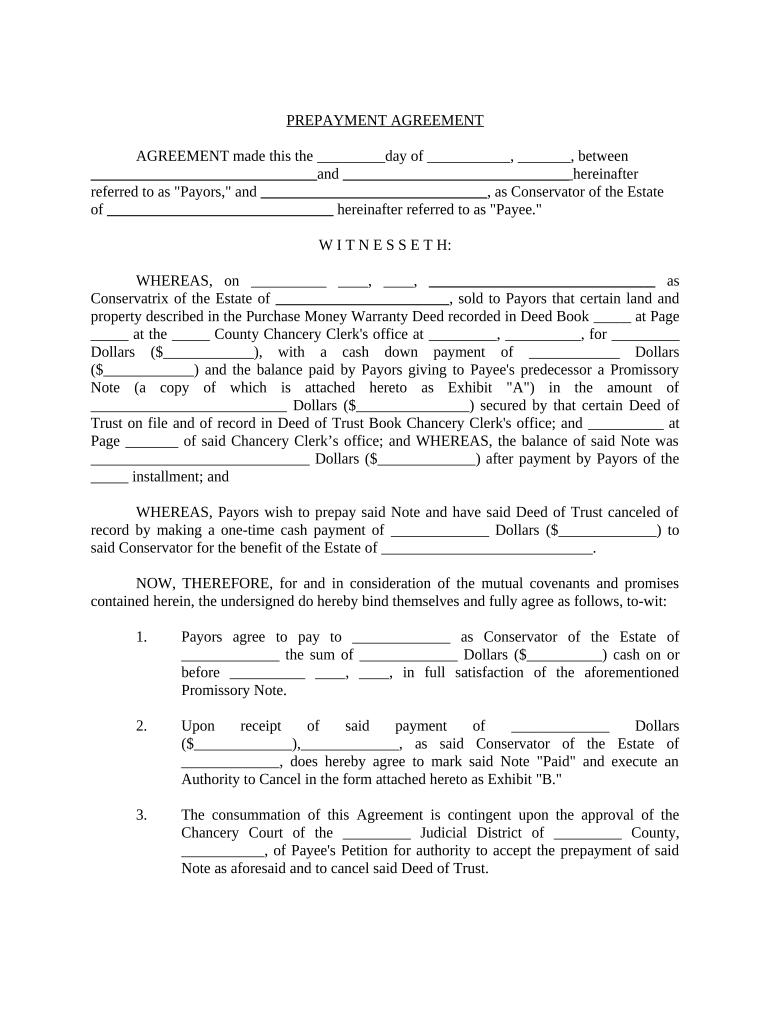
A Prepayment Agreement is a contractual document that records an advance payment from a payer to a payee for future goods, services, or deliverables. It sets the prepaid amount, payment schedule, conditions for application of funds, refund or credit rules, and default remedies. Organizations use prepayment agreements across real estate, construction, professional services, and finance to secure cash flow and allocate performance risk. When executed electronically, the agreement should meet ESIGN and UETA requirements for intent, consent, attribution, and record retention; many U.S. teams use eSignature tools such as signNow to collect legally binding signatures and preserve an audit trail.

Why a clear Prepayment Agreement matters

A precise Prepayment Agreement reduces disputes, clarifies refund and delivery conditions, and protects both parties’ expectations. It also documents the timing of obligations, supports accounting and tax treatment of prepaid funds, and provides evidence of consent under ESIGN (15 U.S.C. ch. 96) or state UETA frameworks.

Why a clear Prepayment Agreement matters

Who typically signs or prepares a Prepayment Agreement

Common users range from small businesses to institutional buyers; roles differ by industry and transaction complexity.

  • Real estate developers and brokers who collect deposits or prepaid rents.
  • Service providers and vendors securing advance payment for future work.
  • Lenders, escrow agents, and finance teams handling advance fee arrangements.

Core elements to include in a professional Prepayment Agreement

A comprehensive agreement reduces ambiguity and supports enforceability by listing monetary terms, timing, remedies, and administrative details in clear sections.

Parties

Full legal names and entity types for payer and payee, including registered business names and contact details for notices; avoid nicknames or informal names.
Prepayment Amount

Exact dollar amount, currency, calculation method (flat fee or percentage), and whether the amount is refundable, nonrefundable, or held in escrow.

Payment Schedule

Date or milestone when prepayment is due, accepted payment methods, and whether partial prepayments are permitted.

Use of Funds

Specify how prepayments will be applied to invoices, milestones, or retainers and describe any restrictions or earmarking of funds.

Refund Terms

Conditions and timelines for refunds or crediting, processing fees, and any deductions for work performed or costs incurred.

Default Remedies

Consequences for nonpayment or breach, interest on unpaid balances, right to suspend services, and dispute resolution procedures.

Step-by-step: completing a Prepayment Agreement

Use this short sequence when preparing, reviewing, and signing a prepayment agreement to reduce execution errors and delays.

  • 01
    Prepare draft: List parties, amount, dates, and refund rules.
  • 02
    Verify identity: Confirm signer authority and matching legal names.
  • 03
    Collect payment: Obtain payment or payment authorization per method chosen.
  • 04
    Execute record: Obtain signatures and retain executed copy with audit trail.

Typical routing and processing for signed agreements

A consistent routing workflow speeds execution and ensures each party receives a complete, timestamped copy with supporting evidence of consent.

  • Upload document: Sender uploads final agreement for signing.
  • Place fields: Add signature, date, and payment authorization fields.
  • Send to signers: Email or link delivered to each signer in order.
  • Capture evidence: Platform records timestamps, IP, and actions.

Recommended digital workflow settings for prepayment agreements

Configure these settings to reduce friction and preserve legal evidence when collecting electronic signatures and payments.

Field Configuration
Authentication Email link with optional SMS code or KBA for higher assurance
Conditional Fields Show refund fields only if refund option selected
Payment Collection Enable integrated payment field or require external transfer confirmation
Audit Trail Retain timestamps, IP addresses, and signer actions automatically

Technical considerations for eSigning and storing prepayment agreements

Verify compliance needs such as a HIPAA BAA or 21 CFR Part 11 controls for regulated workflows and ensure secure storage with AES-256 and TLS in transit.

  • Integrations: Salesforce, NetSuite, Microsoft 365, Google Workspace
  • File formats: PDF and DOCX accepted; output preserves signed PDF/A
  • Authentication: Email, SMS code, SSO, or KBA available

Key dates to include and monitor in a Prepayment Agreement

Clearly stated dates prevent disputes and affect refund rights, performance timing, and accounting recognition.

Effective Date:

Date the agreement takes effect and controls obligations.

Payment Due Date:

Exact date or milestone when prepayment must be received.

Delivery or Service Window:

Period within which goods or services must be delivered.

Refund Request Period:

Timeframe for requesting refunds or credits.

Notice Period:

Days required for termination or cancellation notices.

Milestones from agreement to performance

Track these sequential milestones to ensure payment is applied and services or goods are scheduled promptly.

01

Agreement Finalized

Parties sign and effective date is set.

02

Payment Received

Funds confirmed and recorded against the agreement.

03

Work Commences

Performance or delivery starts per schedule.

04

Settlement or Close

Final reconciliation, refunds, or credits processed.

Common preparation errors to avoid

  • Vague refund language that fails to define events triggering refunds and calculation methods, causing later disputes and litigation risk.
  • Mismatched party names between contract and payment account, which can prevent enforcement or trigger banking holds.
  • Missing payment instructions or ambiguous methods that delay receipt and may be treated as nonpayment under the agreement.
  • Failure to document consent or retention of the signed record properly, weakening enforceability under ESIGN or state law.

Potential legal and financial risks

Breach Damages: Monetary damages or specific performance
Forfeiture Risk: Loss of prepaid funds if contract terms permit
Accounting Impact: Incorrect revenue recognition or liability misclassification
Tax Withholding: Backup withholding triggered by missing TINs
Contract Voidance: Unenforceable terms due to ambiguity
Regulatory Exposure: HIPAA or consumer law violations in regulated contexts

How a Prepayment Agreement differs from a deposit or escrow agreement

Compare core attributes to select the right instrument for your transaction and to set correct expectations for funds handling.

Document Type Prepayment Agreement Deposit Agreement
Refundability contract-defined often escrow-controlled
Accounting Treatment liability or deferred revenue trust liability
Use Case advance payment for services security for performance
Third-party Custody usually no frequently yes

Sample eSignature vendor pricing and feature overview for executing agreements

Basic pricing and feature availability vary by vendor and plan; signNow is listed first for comparison across common eSignature capabilities used when executing Prepayment Agreements.

signNow DocuSign Adobe Sign PandaDoc HelloSign
Starting Price $8/user/mo $15/user/mo $14/user/mo $19/user/mo $15/user/mo
Free Trial Yes, 7-day Yes Yes Yes Yes
Bulk Send Yes (Business Premium+) Yes Yes Yes No
Audit Trail Yes Yes Yes Yes Yes
HIPAA Compliant Yes Yes Yes No No
Envelope Cap No cap 100 env/user/yr Varies Varies Varies

Real-world examples of Prepayment Agreement use

These case summaries show how different organizations use prepayment agreements to manage cash flow and reduce execution friction.

Martin Properties

Tim Martin, Founder, used electronic Prepayment Agreements to collect tenant move-in deposits efficiently

  • Mobile-first signing and cloud storage simplified processing
  • As a result, Martin Properties reduced turnaround time for deposits, maintained consistent records, and improved tenant onboarding while preserving compliance controls.

Fertility Centers of Illinois

John Butler, Founder, standardized prepayment terms for patient services and streamlined consent handling

  • Template-based execution with audit trails ensured consistency
  • The approach simplified billing, reduced administrative follow-up, and improved traceability of prepaid services.

Who can sign on behalf of an organization

Authorized Officer

A corporate officer or manager with delegated signing authority should sign contracts. Confirm authority via corporate resolution or signature policy to avoid challenges to enforceability.

Contract Manager

Project or contract managers often execute standardized prepayment agreements under delegated authority; ensure written delegation and that payment account details are verified to process funds.

Frequently asked questions about Prepayment Agreements

Answers to common execution and enforceability questions when drafting or signing a Prepayment Agreement.


Need help? Contact support

be ready to get more
Join over 28 million airSlate SignNow users