Establishing secure connection…Loading editor…Preparing document…

Alabama Foreclosure Deed

This template is fully customizable. Edit the text, fill out the fields, and send it for signature. Give it a try!
Alabama Foreclosure Deed

What an Alabama Foreclosure Deed Is and when it applies

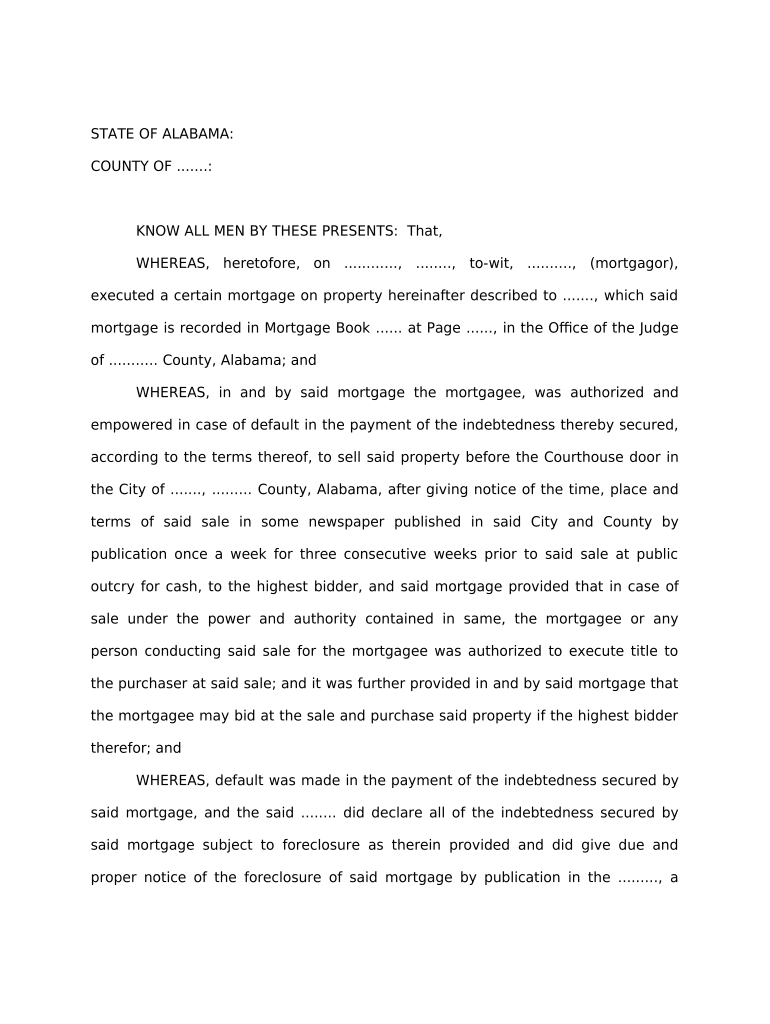
An Alabama Foreclosure Deed is the written conveyance executed after a trustee's sale or other foreclosure sale that transfers title from the foreclosed owner to the purchaser or trustee. The deed records the post-sale ownership change and typically contains the legal property description, recital of sale authority, consideration, and a notarized acknowledgement. Accurate drafting and prompt recording are important to preserve marketable title and to reflect lien priority; defects or missing elements can create title clouds or impede future conveyancing and financing.

Why a properly prepared Alabama Foreclosure Deed matters

A correct foreclosure deed documents the sale, preserves chain of title, and reduces the risk of post-sale challenges. It ensures county records reflect current ownership and helps purchasers obtain title insurance and clear title for resale or financing.

Why a properly prepared Alabama Foreclosure Deed matters

Who typically prepares, signs, and records these deeds

Common participants include trustees, lenders, title companies, and purchasers involved in foreclosures and post-sale closings.

  • Trustees and counsel who administer the foreclosure sale and prepare the post-sale deed.
  • Purchasers or investors who acquire title at the trustee's sale and need a recorded instrument.
  • Title companies and closing agents who review, insure, and index the recorded deed for future conveyancing.

Coordination among these parties—accurate drafting, notarization, recording, and distribution—reduces title problems and speeds post-sale transactions.

Core elements to include in an Alabama Foreclosure Deed

A professional deed contains a clear sale recital, precise legal description, identification of the trustee or grantor, purchaser/grantee name, consideration statement, and an appropriate notary acknowledgement reflecting state and county.

Sale Recital

Describe the foreclosure event, citation to the empowering instrument, and date of the trustee's sale in clear terms for recordkeeping.
Legal Description

Include the complete metes-and-bounds or recorded lot-and-block description exactly as it appears in prior instruments to avoid recording rejection.

Grantor Identity

List the trustee or foreclosing party using the exact legal name and capacity (e.g., 'as Trustee under Deed of Trust dated...').

Grantee Details

Provide the purchaser’s full legal name and, if an entity, its formation type and state to preserve clarity in title records.

Consideration

State the sale consideration or a concise recital (for example, the purchase price at trustee's sale) to assist title examiners.

Notary Acknowledgement

Attach a complete, state-compliant notary acknowledgement showing county, state, date, and signer's identity for recorder acceptance.

Step-by-step: prepare, execute, and record the deed

Follow these sequential steps to prepare, execute, and record an Alabama Foreclosure Deed correctly and confirm public indexing.

  • 01
    Prepare Deed: Draft deed with accurate legal description and sale recital.
  • 02
    Sign & Notarize: Trustee or authorized party signs; obtain required notary acknowledgement.
  • 03
    Record Deed: File with the county probate or land records office and pay recording fees.
  • 04
    Distribute Copies: Provide recorded copies to purchaser, title company, and retain originals.

Where the deed goes and who receives copies

Overview of where to file, who receives copies, and how the recorded Alabama Foreclosure Deed becomes part of the public land records.

  • Drafting: Prepare the deed document with sale recital and full legal description.
  • Execution: Trustee signs and obtains notarization; witness requirements follow state rules.
  • Recording: Submit to the county probate or land records office for indexing and public notice.
  • Distribution: Provide recorded copy to the purchaser and retain copies for title chain.

Digital preparation, eSigning, and integration considerations

Electronic preparation and eSigning require a compliant eSignature platform, editable source documents, and printer-ready PDF output.

  • File Formats: PDF and Word DOCX supported
  • Integrations: Salesforce, NetSuite, Google Workspace, Box, Procore
  • Authentication: Email, SMS code, or advanced identity verification

Recommended online workflow settings for deed execution

Typical online workflow settings when preparing and sending an Alabama Foreclosure Deed for signature, notarization, and recordation.

Field Configuration
Signer Role Trustee, purchaser, or title agent
Authentication Email link, SMS code, or knowledge-based verification
Notary Mode In-person or Remote Online Notary where permitted
Recording Prep Include recorder instructions and cover sheet

Security and compliance items to track when handling deeds

Encryption: AES-256 at rest; TLS 1.2/1.3 in transit
Audit Trail: Detailed timestamp, IP, and action log
HIPAA BAA: BAA available for covered healthcare workflows
ESIGN / UETA: Electronic signatures valid under federal and state law
Notarization: Acknowledgement required by recording offices
RON Support: Remote notarization allowed where state law permits

Consequences of incorrect or improperly executed deeds

Recording Rejection: Invalid form or missing fee
Title Cloud: Ambiguous description creates cloud on title
Tax Consequences: Unreported transfers may trigger tax issues
Statutory Noncompliance: Failure to follow sale procedures invalidates deed
Fraud Allegations: Incorrect grantor identity invites fraud claims
Insurance Denial: Title insurers may refuse coverage

Common mistakes to avoid when preparing a foreclosure deed

  • Using an incomplete or incorrect legal description leads to rejection or ambiguous title, often necessitating corrective instruments and additional fees.
  • Failing to identify the trustee’s authority or reference the empowering instrument can expose the deed to challenge by prior lienholders.
  • Omitting a proper notary acknowledgement, county designation, or recording fee causes clerks to refuse recording until corrected.
  • Sending unsigned or improperly signed copies to title insurers delays underwriting and can block closings or secondary financing.

Real-world scenarios showing typical uses for a foreclosure deed

These concise examples illustrate how different parties use an Alabama Foreclosure Deed after a trustee's sale.

Investor Purchase

A private investor buys property at a trustee's sale

  • The trustee executes a deed naming the investor as grantee
  • The recorded deed allows the investor to clear title, obtain insurance endorsements, and market the property for resale after satisfying redemption or municipal obligations.

Lender Conveyance

A lender acquires title at foreclosure to protect its security interest

  • Trustee's deed documents the transfer and consideration
  • The lender records the deed, updates loan records, and coordinates with title counsel to remove subordinate liens and prepare for disposition.

Typical signatories and their responsibilities

Foreclosure Trustee

A trustee (often an attorney or bank agent) executes the deed in the trustee capacity, confirms authority under the deed of trust, and ensures proper notarization and reference to the sale date for recording and title chain continuity.

Purchasing Party

The purchaser or grantee accepts title conveyed by the deed, supplies required identifying information for the grantee block, furnishes funds if applicable, and provides a recorded copy to title insurers or subsequent buyers.

Time-sensitive actions and common timing expectations

Key timing points influence when the deed takes effect and how soon it should be recorded to protect purchasers and lien priorities.

Trustee's Sale Date:

Occurs per notice schedule; marks transfer of possession in many jurisdictions

Deed Execution:

Execute deed contemporaneous with sale or per trustee procedures

Recording Timing:

Record deed promptly after execution to protect purchaser interests

Redemption Period:

Any statutory redemption window runs per state law and affects transfer finality

Title Insurance:

Order and deliver deed copy to insurer to begin underwriting promptly

Sequential milestones from notice to recorded deed

A typical sequence from default to recorded deed includes notice, sale, deed execution, and recording milestones.

01

Notice of Default

Lender records or publishes required notice of sale per statute.

02

Trustee's Sale

Public sale occurs and purchaser is identified at auction.

03

Trustee's Deed Executed

Trustee executes deed conveying title to purchaser or nominee.

04

Deed Recorded

File deed with county recorder to finalize public transfer.

Practical tips for accurate and efficient deed completion

Follow these best practices to reduce rejections, streamline title transfer, and support insurer requirements.

Verify Legal Description
Confirm the exact legal description against the recorded mortgage or prior deed; mismatches are a leading cause of recording rejections and title exceptions, often requiring corrective instruments and additional recording fees.
Confirm Trustee Authority
Reference the deed of trust, appointment language, and sale authorization to prove trustee authority; include instrument citations to help title examiners and avoid challenges.
Use Clear Consideration Language
State the sale amount or a precise recital of consideration; tidy consideration language assists tax compliance, reporting, and title insurance underwriting without revealing confidential bid details.
Bundle Recorder Requirements
Attach any required cover sheet, transfer tax form, or recording instructions and include the correct fee to minimize clerical rejection and expedite indexing.

How to correct or amend a recorded foreclosure deed

If an error appears in a recorded deed, follow a corrective workflow to preserve title clarity and minimize disputes.

01

Identify Error:

Pinpoint the exact mistake and affected clause.
02

Prepare Corrective:

Draft a corrective or reformation deed referencing the original instrument.
03

Execute Corrective:

Have authorized signer execute and notarize the correction.
04

Record Corrective:

Record the corrective instrument with cross-reference to original.
05

Notify Parties:

Send recorded copies to title insurer and stakeholders.
06

Update Files:

Retain both original and corrective instruments for audit.

Comparing signNow and common eSignature vendors for deed workflows

Price and capability vary across eSignature vendors; the table below highlights starting price, trial, bulk send, audit trail, HIPAA compliance, and envelope caps.

signNow DocuSign Adobe Sign PandaDoc HelloSign
Starting Price $8/user/mo $15/user/mo $14/user/mo $19/user/mo $15/user/mo
Free Trial 7-day trial Varies Varies Varies Varies
Bulk Send Yes Yes Yes Yes No
Audit Trail Yes Yes Yes Yes Yes
HIPAA Compliant Yes Yes Yes No No
Envelope Cap No cap 100 envelopes/user/year Varies Varies Varies

FAQs and troubleshooting for Alabama Foreclosure Deeds

Answers to common questions on e-signing, notarization, errors, and recording related to Alabama Foreclosure Deeds.


Need help? Contact support

be ready to get more
Join over 28 million airSlate SignNow users